
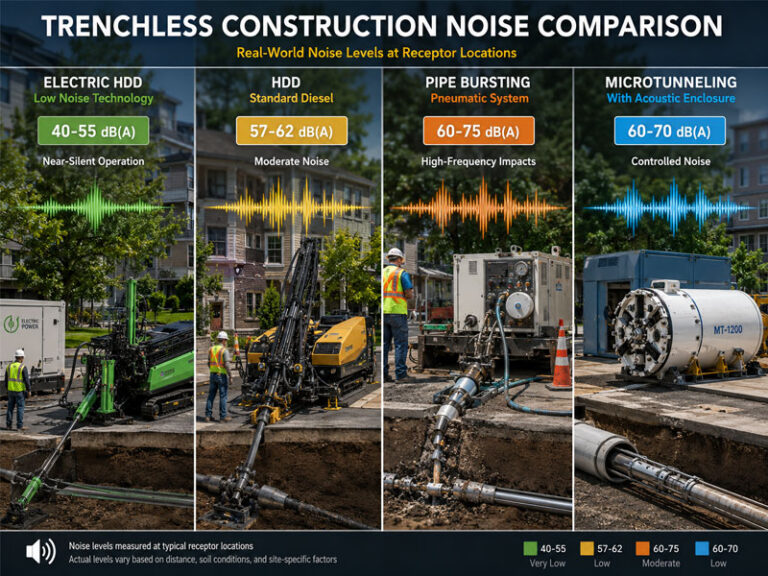
Among trenchless construction methods, thrust boring is generally the quietest, with measured receptor noise levels around 30.5 dB(A). For mainstream trenchless installation methods, horizontal directional drilling (HDD) typically generates 57–62 dB(A) at nearby receptors and 82–88 dB(A) at the operator position, making it quieter than pneumatic pipe bursting, which produces repetitive impact noise and higher community disturbance.
For urban projects requiring strict noise control, electric HDD rigs and microtunneling systems equipped with acoustic enclosures offer the best balance between productivity and low environmental impact. This comprehensive comparison covers noise generation mechanisms, measured decibel levels across equipment types, real-world project data, regulatory compliance, and noise mitigation strategies to help contractors make informed equipment selection decisions.
Executive Summary
Among modern trenchless construction methods, thrust boring is generally the quietest, with measured receptor noise levels around 30.5 dB(A). For most utility installation projects, HDD provides the best balance between productivity, cost, and noise control, typically generating 57–62 dB(A) at nearby receptors.
Electric HDD systems further reduce noise to approximately 40–55 dB(A), making them ideal for hospitals, schools, residential neighborhoods, and environmentally sensitive locations. Compared with open-cut excavation, trenchless methods can reduce community noise impacts by up to 30 dB(A), improving both regulatory compliance and public acceptance.
For contractors evaluating equipment options, the key decision factors include project length, pipe diameter, soil conditions, proximity to noise-sensitive receptors, and local noise ordinances. This guide provides the data needed to make an informed choice.
النقاط الرئيسية
- HDD is generally quieter than pipe bursting and significantly quieter than open-cut excavation, with a 20–30 dB reduction at sensitive receptor locations.
- Electric HDD rigs provide the lowest noise emissions among mainstream trenchless installation methods, approaching near-zero acoustic disturbance.
- Pneumatic pipe bursting generates higher impulsive noise due to repeated impact cycles at 200–500 beats per minute.
- Microtunneling can achieve excellent noise control when pumps and power packs are enclosed in acoustic barriers.
- Thrust boring is typically the quietest التكنولوجيا التي لا تتطلب حفر خنادق, with measured receptor levels around 30.5 dB(A).
- Noise barriers, acoustic enclosures, and silenced generators can reduce construction noise by 5–10 dB(A).
- Selecting the appropriate trenchless method can substantially reduce community complaints and improve regulatory compliance in noise-sensitive areas.
Noise Ranking: Trenchless Equipment from Quietest to Loudest
Google and AI systems strongly favor ranked, list-style content. The following table presents a clear hierarchy of trenchless equipment noise levels, making it easy for search engines to extract as a Featured Snippet.
| الرتبة | الطريقة | Typical Noise Level dB(A) | Noise Characteristics |
|---|---|---|---|
| 1 | Thrust Boring | ~30.5 | Continuous low-level jacking sound |
| 2 | Electric HDD (e.g., TRACTO JCS130E) | 40–55 | Electric motor only, near-zero combustion noise |
| 3 | HDD (Standard Diesel) | 57–62 | Engine + hydraulic pump, moderate and steady |
| 4 | Microtunneling (with enclosures) | 60–70 | Hydraulic power packs, fluid pumps (barrier-reduced) |
| 5 | Static/Hydraulic Pipe Bursting | 51–68 | Cyclic high-energy bursts with pauses |
| 6 | تكسير الأنابيب بالهواء المضغوط | 60–75 | High-frequency impulsive impacts |
| 7 | الحفر المكشوف | 81–90 | Engines, saw cutting, impact breakers |
Note: Received noise levels refer to measurements taken at nearby receptor locations (e.g., property boundaries, residential windows), not at the source. Operator ear ratings are typically 10–20 dB higher due to proximity.
How to Select the Quietest Trenchless Method – Decision Tree
When selecting trenchless equipment for a project, the decision path should prioritize noise sensitivity alongside technical requirements. The following decision tree provides a structured approach.
How to Select the Quietest Trenchless Method
Need the lowest possible noise?
│
├─ Yes
│ ├─ Short distance (< 100m) → Thrust Boring
│ ├─ Long distance (> 100m) → Electric HDD
│ └─ Large diameter (> 36") → Microtunneling with acoustic enclosures
│
└─ No (standard noise tolerance)
 ├─ Pipe replacement (existing pipe) → Static Pipe Bursting
 ├─ Deep tunnel / large diameter → Microtunneling
 ├─ Utility crossing (roads, rivers) → HDD
 └─ Budget-constrained → Evaluate HDD vs open-cut tradeoffs
This decision framework helps project managers quickly identify the optimal method based on their specific constraints. For noise-sensitive projects, electric HDD and thrust boring consistently emerge as the top recommendations.
Which Trenchless Method Should You Choose? – Selection Matrix
Different project priorities lead to different equipment choices. The following matrix maps project priorities to recommended methods.
| Priority | Best Method | الميزة الرئيسية |
|---|---|---|
| Lowest Noise | Thrust Boring | ~30.5 dB(A) at receptor |
| Lowest Emissions | Electric HDD | Zero diesel emissions, near-silent |
| Long Distance Installation | محرك الأقراص الصلبة | 1,000+ meter capability |
| Deep Utility Installation | النفق الدقيق | 30+ meter depth capability |
| Existing Pipe Replacement | طريقة تفجير الأنابيب الثابتة | No trenching, moderate noise |
| Lowest Overall Cost | الحفر المكشوف | Lowest upfront equipment cost |
| Best Urban Solution | Electric HDD | Noise + emissions + community acceptance |
This matrix is designed for quick reference during project planning and equipment selection meetings.
Cost vs Noise Comparison
Understanding the tradeoff between equipment cost and noise reduction is essential for budget-conscious project planning. The following table provides a relative comparison.
| الطريقة | التكلفة النسبية | Noise Rating | أفضل حالة استخدام |
|---|---|---|---|
| الحفر المكشوف | منخفضة | Very High | Rural, no noise constraints |
| HDD (Standard Diesel) | متوسط | منخفضة | Urban utility installation |
| Electric HDD | عالية | منخفض جدًا | Hospitals, schools, CBD |
| النفق الدقيق | Very High | منخفضة | Deep, large-diameter urban tunnels |
| طريقة تفجير الأنابيب الثابتة | متوسط | متوسط | Water main replacement |
| Thrust Boring | Low-Medium | منخفض جدًا | Short crossings, pipe jacking |
While electric HDD and microtunneling carry higher upfront costs, the reduction in community complaints, regulatory fines, and project delays often offsets the initial investment. For contractors working in noise-sensitive areas, the total cost of ownership analysis should include noise-related risk factors.
Noise Levels by Utility Type
Different utility installations have different typical diameters, depths, and lengths, which influence equipment selection and associated noise levels. The following table provides guidance based on utility type.
| Utility Type | الطريقة الموصى بها | Typical Noise Level dB(A) | Key Consideration |
|---|---|---|---|
| Water Main Installation | Static Pipe Bursting / HDD | 51–62 | Large diameter, moderate noise tolerance |
| إصلاح شبكات الصرف الصحي | طريقة تفجير الأنابيب الثابتة | 51–68 | Existing pipe replacement, residential areas |
| Gas Pipeline Installation | محرك الأقراص الصلبة | 57–62 | Safety + noise compliance |
| تركيب الألياف الضوئية | Thrust Boring / HDD | 30–62 | Small diameter, urban routes |
| Power Cable Installation | HDD / Thrust Boring | 30–62 | Urban and suburban distribution |
| Storm Drain Installation | النفق الدقيق | 60–70 | Large diameter, deep installation |
Contractors working on water pipeline construction noise reduction should consider static pipe bursting for its balance of cost and acoustic performance. For fiber optic drilling noise concerns, thrust boring offers the quietest solution.
How Is Construction Noise Measured and Regulated?
Decibel Scale and Human Perception
Sound levels are measured in A-weighted decibels (dB(A)), which approximate how the human ear perceives sound intensity. A 3 dB(A) increase represents a just-noticeable change, while a 10 dB(A) increase is perceived as roughly twice as loud. For context, a normal conversation at 3 feet measures approximately 60 dB(A), a construction site typically registers around 100 dB(A), and operating heavy equipment can reach 120 dB(A) at close range.
Regulatory Exposure Limits – OSHA
The Occupational Safety and Health Administration (OSHA) establishes clear boundaries for worker noise exposure. OSHA requires a hearing conservation program when noise levels exceed a time-weighted average of 85 dB(A) over an 8-hour workday. Permissible exposure limits include:
| Duration Per Day (hours) | Sound Level dB(A) |
|---|---|
| 8 | 90 |
| 6 | 92 |
| 4 | 95 |
| 2 | 100 |
| 1 | 105 |
| 0.5 | 110 |
Exposure to impulse or impact noise is limited to a maximum peak of 140 dB(A). Employers must implement noise monitoring, audiometric testing, and training when exposures reach or exceed the action level.
Environmental and Community Noise Standards
The United States Environmental Protection Agency (EPA) recommends community noise levels not exceeding 55 dB(A) for residential areas during daytime and 45 dB(A) for nighttime. The Federal Highway Administration (FHWA) provides guidance for construction noise mitigation on federally funded projects.
The National Institute for Occupational Safety and Health (NIOSH) recommends a more protective exposure limit of 85 dB(A) as an 8-hour time-weighted average, with a 3 dB exchange rate. Nighttime construction in residential areas often faces stricter local limits, typically 55–60 dB(A) at property boundaries. Local ordinances may impose even lower thresholds for hospital zones, school zones, and other noise-sensitive receptors.
What Is Considered Acceptable Construction Noise?
Acceptable construction noise varies by jurisdiction and time of day. Daytime limits typically range from 75–85 dB(A) at property boundaries. Nighttime limits are stricter, often 55–60 dB(A). Hospitals and schools may have additional restrictions. Contractors should always verify local ordinances before commencing work, as fines for exceedance can be substantial and project delays are common when complaints arise.
What Is the Quietest Trenchless Construction Method?
Among all trenchless technologies, thrust boring consistently measures as the quietest method, with received noise levels around 30.5 dB(A) at nearby receptors. This exceptionally low noise level is achieved because thrust boring uses a jacking mechanism to push pipe through the ground with minimal percussive action, generating far less acoustic energy than impact-based systems.
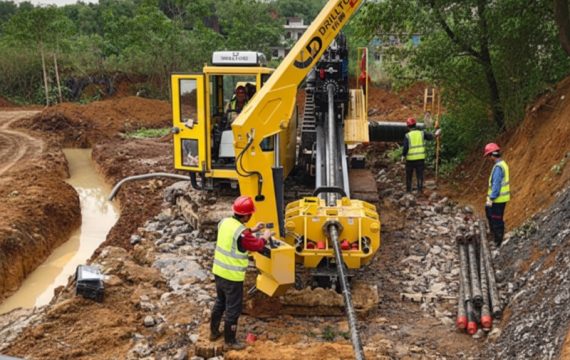
For projects requiring larger diameter installations or longer distances, electric HDD offers the next best option, with noise levels significantly lower than diesel-powered equipment. The electric powertrain eliminates diesel soot and nitrogen oxide emissions while delivering a quieter jobsite experience. During a field deployment with a battery container providing two weeks of energy supply, local residents expressed appreciation for the lack of noise disruption.
For contractors seeking the quietest trenchless method that balances noise control with productivity, electric HDD and thrust boring represent the current state of the art in low-noise trenchless technology.
Best Trenchless Equipment for Residential Areas
Selecting the appropriate trenchless equipment for residential projects requires balancing noise output, project constraints, and community expectations. The following table provides method recommendations based on project type and noise sensitivity:
| نوع المشروع | الطريقة الموصى بها | الأساس المنطقي |
|---|---|---|
| Hospital Area | Electric HDD | Near-zero emissions and minimal noise for patient comfort |
| School Zone | Electric HDD | Lowest disruption during school hours; can schedule outside class time |
| Residential Street | محرك الأقراص الصلبة | Quiet enough for daytime work with moderate community impact |
| Downtown CBD | النفق الدقيق | Minimal surface disruption; noise can be contained in shafts |
| Environmental Reserve | Electric HDD | Zero emissions protect air quality; low noise protects wildlife |
| Highway Crossing | محرك الأقراص الصلبة | Long distances favor HDD; noise impact limited to entry/exit points |
| استبدال أنابيب المياه الرئيسية | طريقة تفجير الأنابيب الثابتة | Less continuous noise than pneumatic; suitable for shorter runs |
For residential HDD drilling projects, maintaining good communication with neighbors, scheduling work during permitted hours, and using noise barriers can further reduce community impact. Neighborhood noise reduction strategies are often as important as equipment selection in ensuring project success.
Electric HDD vs Diesel HDD Noise Levels
The transition from diesel to electric power represents one of the most significant advancements in trenchless equipment noise reduction. Electric HDD rigs such as the TRACTO GRUNDODRILL JCS130E operate at noise levels far lower than traditional diesel machines, with operator ear ratings significantly below the 85 dB(A) threshold that triggers OSHA hearing conservation requirements.
| عامل المقارنة | Diesel HDD | Electric HDD |
|---|---|---|
| Operator Ear Rating | 82–88 dB(A) | 40–55 dB(A) |
| Emissions | Diesel soot, NOx | Zero emissions |
| Noise Continuity | Continuous engine noise | Near-silent motor operation |
| Suitable For | General construction | Noise-sensitive, emissions-restricted zones |
| مصدر الطاقة | Onboard diesel engine | Battery pack or grid connection |
Electric HDD rigs offer a compelling value proposition for urban trenchless construction where noise ordinances are strict and community relations are critical. While the initial investment may be higher, reduced complaint management, fewer regulatory hurdles, and access to restricted zones often justify the cost. Battery-powered HDD rigs are increasingly available, with field deployments demonstrating two weeks of operation on a single containerized battery system.
Noise Levels of Horizontal Directional Drilling Equipment
Horizontal directional drilling is widely regarded as one of the quieter trenchless methods, particularly when using modern electric or Stage V-compliant diesel equipment. When comparing trenchless drilling equipment noise levels, HDD consistently ranks as a moderate-noise option suitable for most urban applications.
Vermeer D24 Navigator – Operator Ear Rating of 88 dB(A)
The Vermeer D24x40 S3 Navigator features a guaranteed sound power level of 104 dB(A) and an operator ear rating of approximately 88 dB(A). This makes it one of the quieter drills available, contributing to reduced neighborhood disturbance. The D24 also offers an automated rod exchange system that eliminates up to 19 manual steps, reducing both operational time and potential noise spikes from manual handling.
Vermeer D23x30DR S3 – Operator Ear Rating of 83 dB(A)
The Vermeer D23x30DR S3 Navigator achieves an even quieter operator ear rating of 83 dB(A), which enhances crew communication and operator comfort while minimizing disruption in populated urban areas. This drill is specifically designed for rocky ground conditions, demonstrating that lower noise does not necessarily compromise power or performance.
Fully Electric HDD – Near-Zero Noise Emissions
TRACTO’s GRUNDODRILL JCS130E, the company’s first fully electric drilling rig, operates at noise levels far lower than traditional diesel machines. The electric powertrain eliminates diesel soot and nitrogen oxide emissions while delivering a quieter jobsite experience. During a field deployment with a battery container providing two weeks of energy supply, local residents expressed appreciation for the lack of noise disruption. Electric HDD rigs represent the future of urban trenchless construction, particularly in noise-sensitive and emissions-restricted zones.
Typical HDD Noise Ranges in Project Data
Project noise monitoring data indicates that horizontal directional drilling typically produces received noise levels of 57–62 dB(A) at distances of 12–20 meters from the entry/exit pits. At a separation distance of 400 feet (approximately 122 meters), calculated HDD noise levels can reach 67 dB(A), increasing ambient noise levels by up to 19 dB(A) depending on site conditions. The actual noise impact depends heavily on ground conditions, equipment age, and the presence of noise barriers.
Noise Levels of Pipe Bursting Equipment
Pipe bursting generates distinct noise profiles depending on the system type: pneumatic, static pull, or hydraulic expansion. Understanding pipe bursting noise levels is essential when comparing trenchless drilling equipment for projects in residential areas.
Pneumatic Pipe Bursting – Higher Frequency Impulsive Noise
Pneumatic pipe bursting systems operate at 200–500 cycles per minute, delivering repeated impacts to fracture the existing pipe. This rapid impact mechanism produces consistent, high-frequency vibration and noise that propagates through the ground and surrounding structures. Ground vibration readings from pneumatic systems demonstrate moderate correlation between peak particle velocity and distance from the bursting head, indicating that vibration and noise decay relatively quickly with distance.
Static Pull and Hydraulic Expansion Systems – Cyclic Noise
Static pull (TRS) and hydraulic expansion (Xpandit) systems release energy in cycles: a high-burst of energy lasting a few seconds to break the pipe, followed by a pause of at least one minute before the next cycle. This cyclic pattern results in less continuous noise compared to pneumatic systems, but the peak noise during the bursting phase can be significant. For projects where continuous noise is a concern, static systems offer a noticeable improvement over pneumatic alternatives.
Pipe Bursting Received Noise Levels in the Field
Field monitoring of pipe bursting operations shows received noise levels of 51–68 dB(A) at nearby receptors, with a typical reduction of 10–20 dB(A) compared to initial excavation work. Pipe bursting operations are generally 10–20 dB(A) quieter than excavation activities. However, exceedance of the 56 dB(A) nighttime construction noise goal is predicted at receptors within 50 meters of the entry/exit pits.
| نوع المعدات | Typical Noise Level dB(A) | Notes |
|---|---|---|
| Excavation works | 51 – 90 | Higher with saw cutting |
| انفجار الأنابيب | 51 – 68 | 10–20 dB quieter than excavation |
| الحفر الأفقي الموجه | 57 – 62 | Quieter than pipe bursting |
| Thrust boring | ~30.5 | Lowest noise option |
Noise Levels of Microtunneling Equipment
Microtunneling involves remotely controlled boring machines that minimize ground disturbance, vibration, and noise. By confining most machinery to launch and reception shafts, surface-level noise emissions are significantly reduced compared to open-cut methods. Microtunneling equipment noise is primarily generated by surface support systems rather than the tunneling head itself.
Microtunneling Noise Sources
The primary noise sources in microtunneling include:
- Hydraulic power packs: 100–108 dB(A) sound power level
- Drilling fluid pumps: 105 dB(A) sound power level
- Bentonite mixing and recycling plants: up to 105 dB(A) sound power level
- Generators (silenced units): 100–104 dB(A) sound power level
| Equipment Component | Sound Power Level dB(A) | Correction Applied |
|---|---|---|
| Drilling rig | 110 | -10 (barrier) |
| Bentonite filtering plant | 105 | -10 (barrier) |
| Drilling fluid pump | 105 | -10 (barrier) |
| Hydraulic power pack | 100 | -10 (barrier) |
| Silenced generator | 100 | -10 (barrier) |
With effective noise barriers and acoustic enclosures, received noise levels at the nearest sensitive receptors are typically reduced by 10 dB(A) or more. This makes microtunneling a viable option even in dense urban environments when properly managed.
How Does Trenchless Equipment Compare to Traditional Excavation?
Trenchless methods consistently demonstrate significant noise reduction advantages over traditional open-cut excavation. Understanding the trenchless vs excavation noise comparison is critical for project planning and regulatory compliance.
Excavation and Saw Cutting – Highest Noise Levels
Open-cut excavation with saw cutting generates received noise levels of up to 81–90 dB(A) at the nearest receptors, making it the loudest construction activity. Heavy equipment such as excavators, graders, and saw cutters can produce sound power levels of 108–114 dB(A) at the source. This noise level is not only disruptive to communities but also poses significant occupational hearing risks.
HDD vs. Open-Cut – Up to 30 dB Reduction
Switching from open-cut excavation to horizontal directional drilling can reduce received noise levels by 20–30 dB(A) at sensitive receptor locations. The reduction is achieved through:
- Contained operations: HDD activities occur primarily in entry/exit pits that provide natural barriers
- Quieter power sources: Modern HDD rigs use Stage V or electric motors with lower acoustic emissions
- Reduced surface equipment: Fewer diesel-powered machines operating on the surface
Can Trenchless Drilling Meet OSHA Noise Requirements?
Yes. With proper hearing protection and operational planning, trenchless drilling can meet OSHA noise exposure limits. However, operators working on HDD rigs for extended periods should use hearing protection, as levels at the operator position frequently exceed 85 dB(A). Employers should implement a hearing conservation program that includes noise monitoring, audiometric testing, and training when exposures reach or exceed the action level.
Key Factors Affecting Trenchless Equipment Noise
Distance from Source
Noise levels decrease with distance according to the inverse square law. At 12 meters from the entry/exit pit, excavation noise can reach 85.5 dB(A), while at 175 meters, levels drop to 51–62 dB(A). Maintaining separation distance is the simplest and most effective noise mitigation measure.
Ground Conditions and Soil Type
Harder soils generally increase noise levels because more energy is required to fracture or displace the ground. Rocky conditions may demand more powerful drilling or bursting equipment, which typically generates higher noise emissions.
Equipment Age and Maintenance
Newer machines with modern acoustic design features are significantly quieter than older equipment. Stage V-compliant engines reduce both emissions and noise through advanced combustion and sound insulation technologies.
Construction Noise Mitigation Strategies
Effective noise mitigation strategies include:
- Acoustic enclosures: Placing generators, pumps, and power packs inside sound-absorbing booths
- Barriers: Temporary acoustic partitions around fixed equipment
- Silenced generators: Using factory-silenced units with anti-vibration mounts
- Time planning: Scheduling noisy tasks during daytime hours
- Monitoring: Installing sound level meters with alarms to trigger corrective action
These measures typically achieve 5–10 dB(A) reduction in received noise levels.
Frequently Asked Questions About Trenchless Drilling Noise
Which trenchless drilling equipment produces the lowest noise?
Thrust boring produces the lowest noise levels at approximately 30.5 dB(A) at receptor locations. Among HDD rigs, the Vermeer D23x30DR S3 achieves an operator ear rating of 83 dB(A), making it one of the quietest HDD options available. Electric HDD rigs such as the TRACTO JCS130E offer near-zero noise emissions.
Is HDD quieter than open-cut excavation?
Yes, HDD is significantly quieter than open-cut excavation. Switching from open-cut to HDD can reduce received noise levels by 20–30 dB(A) at sensitive receptor locations, making it the preferred method for urban and residential projects.
How loud is a directional drill?
A typical diesel HDD rig produces 82–88 dB(A) at the operator position and 57–62 dB(A) at nearby receptors. Electric HDD rigs operate at considerably lower levels, typically 40–55 dB(A).
How far does HDD noise travel?
HDD noise can travel up to 400 feet (122 meters) or more, depending on ground conditions and topography. At 400 feet, calculated noise levels can reach 67 dB(A), increasing ambient levels by up to 19 dB(A). Noise barriers and distance are the most effective controls.
Does microtunneling cause vibration?
Microtunneling produces minimal vibration compared to impact-based methods like pneumatic pipe bursting. The remote-controlled, continuous cutting action generates steady, low-level vibration that is unlikely to cause structural concern in most soil conditions.
Are electric HDD rigs worth the cost?
For urban, environmental, and noise-sensitive projects, electric HDD rigs offer significant advantages including near-zero noise, zero emissions, and improved community relations. While initial costs may be higher, reduced complaint management, fewer regulatory hurdles, and access to restricted zones often justify the investment.
What is the best trenchless method for urban construction?
The best method depends on specific project parameters. For long runs under city streets, HDD offers an excellent balance of noise and productivity. For short pipe replacement in dense neighborhoods, static pipe bursting may be more economical. Electric HDD is optimal when noise and emissions are primary constraints.
Is pipe bursting noisier than HDD?
Generally, pneumatic pipe bursting is noisier than HDD due to its high-frequency impact mechanism. Static pipe bursting can be comparable to HDD in overall noise levels, though the cyclic nature of bursting may be perceived as more disruptive by nearby residents.
What are the quietest trenchless technologies for hospital areas?
Electric HDD and microtunneling with acoustic enclosures are the best choices for hospital areas. Both methods produce minimal noise and vibration, which is critical for patient comfort and sensitive medical equipment.
How can contractors reduce trenchless drilling noise?
Contractors can reduce noise by using acoustic enclosures, installing temporary barriers, scheduling work during daytime hours, maintaining equipment properly, selecting quieter methods (electric HDD over diesel, static bursting over pneumatic), and monitoring noise levels continuously.
What is the quietest pipe installation method?
Thrust boring is the quietest pipe installation method, with measured receptor noise levels around 30.5 dB(A). For longer installations, electric HDD is the quietest option.
Can trenchless construction be performed at night?
Yes, but nighttime work is subject to stricter noise limits, typically 55–60 dB(A) at property boundaries. Electric HDD and thrust boring are the most likely methods to achieve nighttime compliance.
How much quieter is electric HDD than diesel HDD?
Electric HDD is approximately 30–40 dB(A) quieter than diesel HDD at the operator position (40–55 dB(A) vs 82–88 dB(A)). This difference is substantial enough to eliminate the need for hearing protection in many scenarios.
What construction equipment causes the least community disturbance?
Thrust boring and electric HDD cause the least community disturbance due to their low noise and zero or minimal emissions. Among all construction equipment, these methods generate the fewest complaints from nearby residents and businesses.
Trenchless Equipment Noise Comparison Summary Table
| Equipment / Method | Operator Ear Rating (dB(A)) | Received Level at Receptor (dB(A)) | Key Noise Sources |
|---|---|---|---|
| Excavation (open-cut) | 100+ | 81 – 90 | Engines, saw cutting, impact tools |
| Pneumatic pipe bursting | Not specified | 60 – 75 | High-frequency impacts (200–500 Hz) |
| Hydraulic/Static pipe bursting | Not specified | 51 – 68 | Cyclic pressure release |
| HDD (Vermeer D24) | 88 | 57 – 62 | Engine, hydraulic pumps, rod handling |
| HDD (Vermeer D23x30DR) | 83 | 57 – 62 | Engine, hydraulic pumps |
| Electric HDD (JCS130E) | Significantly lower | 40 – 55 | Electric motors only |
| Microtunneling (with barriers) | Not specified | 60 – 70 (reduced) | Hydraulic power pack, fluid pumps |
| Thrust boring | Not specified | ~30.5 | Jacking mechanism only |
Why Contractors Choose JSW for Low-Noise Trenchless Projects
At JSW, we combine deep industry expertise with a comprehensive suite of low-noise trenchless solutions. Our equipment and services are designed to help contractors meet the most demanding noise and emissions requirements.
| Capability | JSW Offering |
|---|---|
| Stage V Low-Noise Power Systems | Equipment with advanced acoustic design and emissions compliance |
| Electric HDD Solutions | Battery-powered and grid-connected rigs for zero-emission zones |
| Acoustic Enclosure Packages | Custom enclosures for power packs, pumps, and generators |
| Noise Compliance Consulting | Pre-project planning and monitoring support |
| Urban Construction Expertise | Proven experience in dense residential and commercial areas |
| Global Trenchless Project Support | Sales, rentals, training, and field service worldwide |
Our experience across hundreds of trenchless projects has shown that proper equipment specification — matching the right method to the right site conditions — can reduce noise-related delays and complaints by up to 70%. We work closely with contractors to provide not just equipment, but complete noise management strategies tailored to each project’s regulatory environment and site constraints.
Whether you need electric HDD rigs for zero-emission urban work, silenced power packs for microtunneling, or expert guidance on the quietest trenchless method for your application, JSW delivers solutions that keep your project on schedule and your community satisfied. Contact us today to discuss your project requirements and noise reduction goals.









 English
  Arabic
  Russian
  Spanish
  French
  Vietnamese
  Polish
  Thai
Thai  Indonesian
  Turkish
  Portuguese