
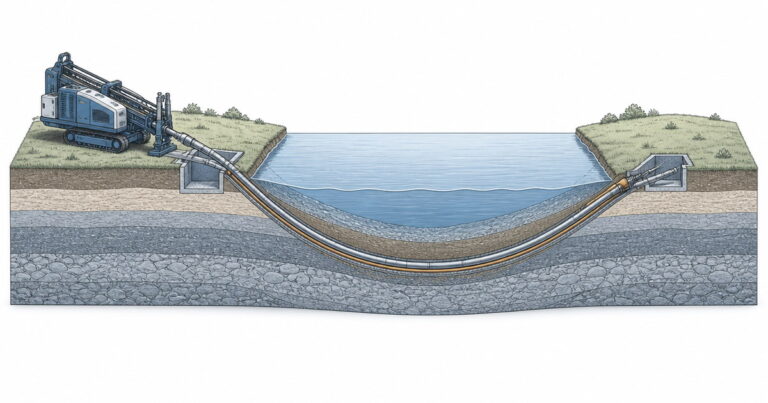
Horizontal directional drilling terms are the shared vocabulary of an HDD crossing: the bore-path geometry (pilot hole, entry angle, bend radius, depth of cover), the downhole tools and steering systems, the drilling fluid, the installation loads and the final records. This guide defines 20 of them in the order a crossing happens, gives each the unit it is measured in plus a typical value, and ends with a table you can scan before a bid meeting.
Every term here changes a number, a test or a risk allocation. Read in sequence, they answer one question each: entry angle is typically 8° to 18°, cover 0.9-1.5 m (3-5 ft), and the reamed hole about 1.2-1.5 times the pipe outside diameter. On crossings we have supported, those three numbers decide most arguments.
Where a value is project-specific this HDD glossary says so, and names such as the NASTT HDD Good Practices Guidelines, ASTM F1962 and ASCE Manual of Practice 108 appear in prose. Still choosing between methods? Our overview of trenchless technologies places HDD alongside microtunneling and boring.
Bore Path and Geometry Terms
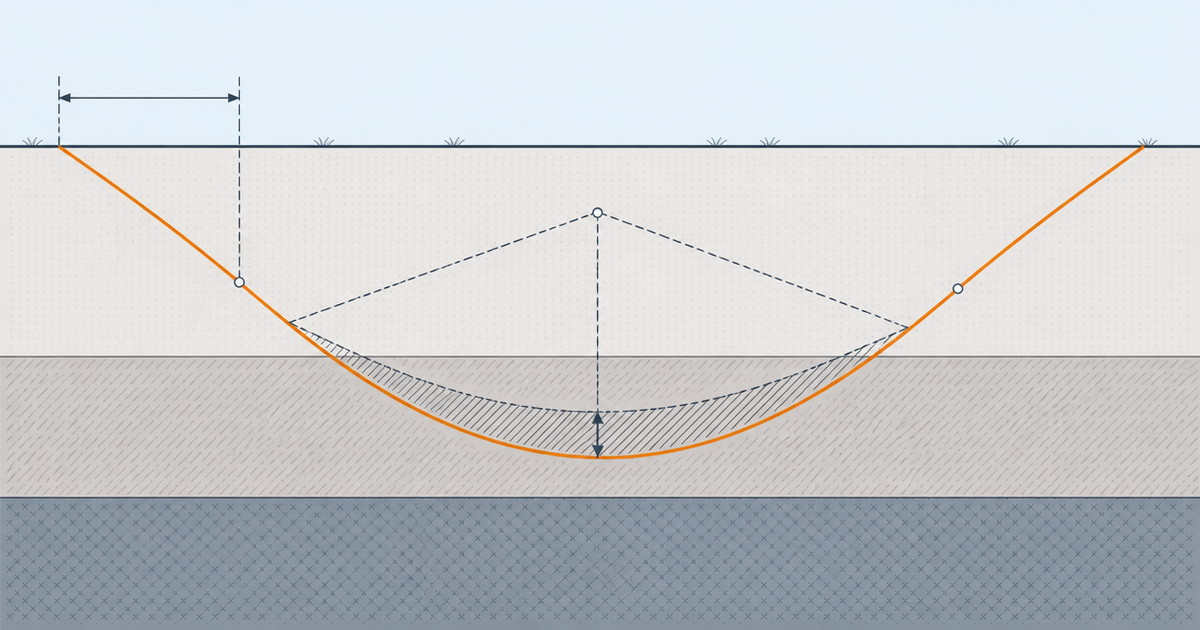
These five horizontal directional drilling terms describe the crossing’s shape and together decide whether a pipe can be installed between the entry and exit points.
Pilot Hole
The pilot hole is the first, smallest-diameter bore, drilled from entry to exit while the head is steered on line and grade, often at about 100 to 250 mm (4 to 10 in.). It matters because pilot errors are hard to fix later and can push a crossing outside its right-of-way.
Entry Angle
The entry angle is the angle the drill string makes with the horizontal where it enters the ground, typically about 8° to 18° from horizontal in published good practice. Shallower entries suit long crossings and steeper ones suit short crossings. The entry angle sets how fast the bore reaches design depth and how likely fluid is to return near the rig.
Exit Angle
The exit angle is the angle at which the drill head breaks through the ground on the exit side, usually matched to the entry angle so the bore profile stays symmetrical. A poor exit angle can leave the pipe entry too steep for the product pipe’s bend radius or force a larger exit pit.
Bend Radius
Bend radius is the smallest radius the bore, and the product pipe inside it, can follow without exceeding allowable bending stress. For a bore path the common rule of thumb is about 100 ft of radius per inch of pipe diameter, roughly 1,000-1,200 times the outside diameter, so a 300 mm pipe is designed on a radius of the order of 300 m to 360 m. Bend radius decides how deep and how long a crossing must be.
Depth of Cover
Depth of cover is the vertical distance between the top of the installed pipe and the ground or design riverbed surface. Published crossing requirements commonly sit at 0.9 to 1.5 m (3 to 5 ft), with a depth-of-cover-to-diameter ratio near 1.5, but the governing figure is always project-specific. Cover protects the pipe from loads, scour and future excavation.
Downhole Tools and Steering Terms
Steering is what separates HDD from a straight bore. These five terms cover the drill string, the tools that turn the bit, and the three guidance systems that show where the head is.
Drill String
The drill string is the connected length of drill pipe, and where used a downhole motor, that carries rotation and thrust from the rig to the drill head or reamer. It matters because string size and weight set the rig class and limit how tight and how long a crossing can be.
Mud Motor
A mud motor is a downhole tool that converts the hydraulic energy of the drilling fluid into rotation at the bit, so the bit turns without the whole string rotating. It is used mainly in rock and on long bores where full-string rotation would demand too much torque. It changes steering and rig selection.
Walkover Locator
A walkover locator is a surface tracking system in which a sonde in the drill head is read by a handheld receiver above ground to give depth, position and heading. It is standard for shallow and medium bores and practical to roughly 9 to 12 m of cover.
Wireline Guidance
Wireline guidance runs a cable inside the drill string to carry sensor data to the surface, giving continuous steering information without anyone walking the alignment. It suits deeper and longer crossings than walkover.
Gyro Steering
Gyro steering uses a gyroscope in the downhole tool to measure heading independently of the earth’s magnetic field, so it works inside steel casing or near magnetic interference. It is usually the costliest guidance method and is reserved for deep, long or noisy crossings.
| الطريقة | How It Works | Practical Limit | Best Used When |
|---|---|---|---|
| Walkover locator | Sonde read by a surface receiver | About 9-12 m of cover | Shallow bores on an accessible line |
| Wireline guidance | Cable in the string sends data up | Deeper and longer than walkover | Deep or long crossings, limited access |
| Gyro steering | Gyroscope heading, no magnetic field | Not limited by magnetism; higher cost | Steel casing, interference, very deep bores |
Drilling Fluid Terms
Drilling fluid does four jobs at once. These three horizontal directional drilling terms cover what the fluid is made of and what happens to it at the surface.
Drilling Fluid
Drilling fluid, usually called mud, is the water-based mixture pumped down the drill string and returned up the annulus, the gap between the string or pipe and the bore wall. It cools and lubricates the bit, carries cuttings, and stabilises the bore. Viscosity, density and flow rate are often the difference between a clean bore and a frac-out.
Bentonite
Bentonite is a clay, mainly sodium montmorillonite, used as the base of most HDD fluids because it swells in water to build viscosity and form a thin filter cake on the bore wall. Its concentration is adjusted to the ground. The filter cake limits fluid loss into permeable ground and reduces inadvertent-return risk.
Mud Recycling
Mud recycling removes cuttings and sand from returning drilling fluid so it can be re-used instead of discharged, using shakers, desanders, desilters and sometimes centrifuges. Many sites run it as a closed loop that avoids surface spills. Recycling cuts water and bentonite use, reduces disposal volume and is often required by permits. NASTT’s HDD Good Practices Guidelines treat solids control as part of the fluid plan.
Installation and Load Terms
Once the pilot hole exists, the bore is enlarged and the pipe is installed. These four horizontal directional drilling terms cover the reaming tools and the loads that decide the rig class.
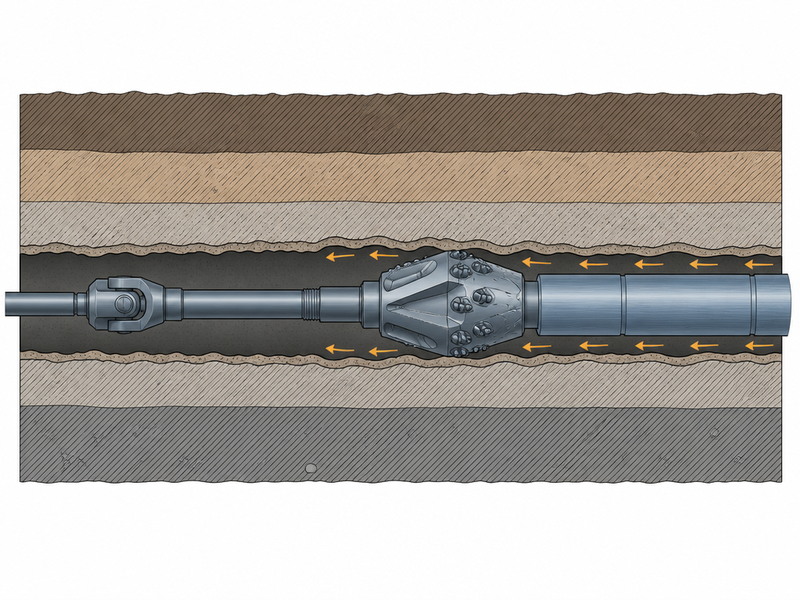
Reaming and Prereaming
Reaming enlarges the pilot hole, usually in several passes, until it reaches about 1.2 to 1.5× the product pipe outside diameter. NASTT guidance recommends the smaller of 1.5× the pipe diameter or 300 mm (12 in.) larger, and prereaming means enlarging before pullback rather than during the pull.
Hole Opener and Reamer
A hole opener or reamer is the cutting tool pulled through the pilot hole to enlarge it; common types include fly-cutters, fluted-body and barrel reamers, and rock reamers such as roller-cone or PDC tools. Several sizes are run in sequence. We have seen reamer selection govern penetration rate, hole quality and the risk of collapse.
الانسحاب
Pullback is the final stage, in which the product pipe is attached behind a reamer or a swivel and pulled through the fluid-filled bore in one continuous operation. The pipe is usually welded or fused into one string and supported on rollers, work our خدمات تركيب خطوط الأنابيب teams handle. Pullback puts the highest loads on the pipe, coating and welds.
Pullback Force
Pullback force is the tension needed to move the pipe string through the bore, quoted in kilonewtons (kN) or tons and measured as the force the rig sustains at breakover and through the pull. It is estimated from pipe weight, friction, curvature and fluid drag, then factored.
Site, Records and Risk Terms
The last three terms cover the surface works, the main environmental risk and the record that outlives the project.
Entry and Exit Pits
Entry and exit pits are the excavations at each end of the crossing where the rig is set up and the pipe is staged or received. They are sized to the entry angle, the pipe and the rig’s anchoring needs, and are usually smaller than a microtunneling launch shaft. Pit location and size drive permitting, footprint and restoration.
Frac-out (Inadvertent Return)
Frac-out, also called inadvertent return, is the uncontrolled escape of drilling fluid to the surface or into a watercourse when downhole pressure exceeds the strength of the confining ground. It is most likely in shallow, permeable or fractured ground and is a key risk on river crossings, which is why pipeline repair services and contingency crews are planned ahead. It triggers spill response and is managed by a monitoring and inadvertent-return plan of the kind FERC requires on regulated crossings.
As-built Drawing
An as-built drawing records the actual installed alignment and profile, the real entry and exit angles, depths, bend radii and pipe position, as opposed to the design path. It is compiled from guidance and survey data and confirmed after pullback. It becomes the permanent record for future clearance and integrity work, feeding later pipeline inspection.
All 20 Horizontal Directional Drilling Terms at a Glance
This is the quick-reference version of the horizontal directional drilling terms in this HDD glossary, with the unit or typical value and the decision each term drives.
| Term | Typical Unit or Value | Why It Matters |
|---|---|---|
| Pilot hole | Often 100-250 mm (4-10 in.) | Sets later alignment; hard to correct |
| Entry angle | About 8°-18° from horizontal | Sets how fast the bore reaches depth |
| Exit angle | Usually matched to entry angle | Decides pipe entry and pit size |
| Bend radius | About 1,000–1,200 × pipe OD | Converts angles into crossing length |
| Depth of cover | Commonly 0.9-1.5 m (3-5 ft) | Protects the pipe from loads and scour |
| Drill string | By rig class; project-specific | Carries torque and thrust; limits geometry |
| Mud motor | Mainly rock and long bores | Avoids rotating the whole string |
| Walkover locator | To about 9-12 m of cover | Low-cost steering for shallow bores |
| Wireline guidance | Deeper than walkover | Steers where the line cannot be walked |
| Gyro steering | Deep or magnetic-intense bores | Holds line despite interference |
| Drilling fluid | Set per ground | Stabilises the bore; drives frac-out risk |
| Bentonite | Adjusted to the soil | Builds viscosity; limits fluid loss |
| Mud recycling | Shakers, desanders, desilters | Cuts water use and disposal volume |
| Reaming and prereaming | 1.2-1.5× product pipe OD | Clearance controls friction |
| Hole opener and reamer | Fly-cutter, fluted, barrel, rock | Governs rate and hole quality |
| الانسحاب | Single continuous operation | Highest loads on pipe and coating |
| Pullback force | kN or tons; project-specific | Decides rig class and pipe tension limit |
| Entry and exit pits | Sized to angle, pipe, rig | Drive permitting and restoration |
| Frac-out (inadvertent return) | Risk in shallow permeable ground | Triggers spill response and monitoring |
| As-built drawing | Actual vs design profile | Permanent record for clearance |
How These Terms Connect: Bend Radius, Entry Angle and Depth of Cover
Three of the horizontal directional drilling terms above are locked together by geometry: bend radius, entry angle and depth of cover. An entry angle of 12° is only usable if the product pipe can curve to horizontal within the bend radius it allows. With a tight radius and a steep entry, the bore must reach full depth almost immediately, which may exceed the pipe’s allowable bend.
Depth of cover adds the third constraint: a deeper crossing needs a longer transition to descend and climb back out, so it is also longer at the same bend radius.
The Three Terms That Most Often Cause Disputes on a Bid
Which horizontal directional drilling term should a bid document define first?
In our bid reviews, three horizontal directional drilling terms account for most disagreement between owner, engineer and contractor.
1. Reamed-hole diameter (bore-to-pipe clearance)
Owners sometimes specify an exact reamed diameter, while contractors price the minimum clearance the ground will stand. Because published guidance is a range of roughly 1.2 to 1.5× the pipe outside diameter or 300 mm (12 in.) larger, a bid can turn on which end is assumed. State the acceptance basis, not just a number.
2. Depth of cover
Design cover, minimum cover at a point and cover measured to the riverbed all read differently in a specification. We have seen a crossing compliant with design cover still disputed because the contract did not say where cover is measured and which surface governs.
3. Pullback force and allowable pipe tension
Pullback force is estimated, not known, until the pull happens, so a bid can hinge on the assumed friction factor and design factor. If the contract does not name the allowable pipe tension and the factor of safety, a contractor either prices open risk or accepts risk it should not. Stating both, in kN or tons, aligns the estimate and the acceptance test.
Scope of Application: When These Terms Govern a Bid
These terms govern a bid wherever scope, tolerance or documentation is being priced.
- Read in full when the crossing carries a bore plan, records and an as-built survey.
- Read in part for a short duct placement, where only geotechnical, bend radius and clearance terms bite.
- Always check reamed-hole diameter, depth of cover and pullback force.
How This Changes by Project Role
I am starting on an HDD site next week – which terms come first?
Learn reamed-hole diameter, bend radius and depth of cover first: they are the three numbers that turn a request into a feasible crossing.
Which terms must a bid or scope of work define in writing?
Define reamed-hole diameter, depth of cover and pullback force in writing, because those are the terms that most often become disputes.
What should I check when reviewing an as-built submission?
Check that the as-built shows the installed profile, the real entry and exit angles and the depths, not just the design intent redrawn.
Frequently Asked Questions About HDD Terminology
Read with our HDD crossing services page, this HDD terminology guide covers the horizontal directional drilling terms that decide a crossing.
What is the most important HDD term for a beginner to learn first?
Bend radius is usually the first term to master. It sets the tightest curve the product pipe and the drill string can follow, and therefore how deep and how long a crossing has to be to change direction safely.
What unit is pullback force measured in on an HDD rig?
Pullback force is quoted in kilonewtons (kN) or in tons, depending on the region. It is the tension the rig must sustain to move the pipe string through the bore, estimated from pipe weight, friction, curvature and fluid drag, so the governing value is always project-specific.
How deep can walkover locating work before you need wireline or gyro?
Walkover locating is practical to roughly 9 to 12 m of cover. Beyond that, or where the alignment cannot be walked over, the crossing normally switches to wireline guidance, and magnetically noisy or very deep bores may use gyro steering.
What is the difference between reaming and prereaming?
Reaming enlarges the pilot hole, usually in several passes, until the bore reaches about 1.2 to 1.5 times the product pipe outside diameter. Prereaming means enlarging the hole before pullback, as opposed to reaming during the pull, and it is the more common approach on large crossings.
What does frac-out mean in HDD and why does it matter?
Frac-out, also called inadvertent return, is the uncontrolled escape of drilling fluid to the surface or into a watercourse. It happens when downhole fluid pressure exceeds the strength of the confining ground, and it is most likely in shallow, permeable or fractured soils, so crossings are usually governed by a monitoring and inadvertent-return plan.
What should an as-built drawing show after pullback?
An as-built drawing should show the actual installed alignment and profile: real entry and exit angles, depths of cover, bend radii and the position of the pipe, compared with the design path.
النقاط الرئيسية
- Use this HDD glossary as a checklist: the terms here cover one crossing, from pilot hole to as-built drawing.
- Bend radius, entry angle and depth of cover are locked together: fix two and the third, plus the crossing length, are determined.
- Reamed-hole clearance is typically 1.2-1.5× the product pipe outside diameter, and it is a common bid dispute when the acceptance basis is not stated.
- Walkover locating is practical to about 9-12 m; deeper or obstructed crossings move to wireline guidance and sometimes gyro steering.
- Pullback force, in kN or tons, is estimated and project-specific, so the allowable pipe tension and design factor belong in the contract.
- Frac-out is the risk term to watch: it drives the drilling-fluid plan, the monitoring program and the environmental permits.
How JSW Supports HDD Projects
JSW is a pipeline engineering and construction company that executes trenchless crossings with its own crews and equipment. Our scope covers HDD crossing services, pipeline installation services, pipeline inspection and pipeline repair services, from feasibility and bore-path design through pullback and as-built handover.
Because we plan and execute with one team, the bend-radius check, reamed-hole basis and pullback-force estimate come from the engineers who run the bore. That is how these horizontal directional drilling terms become a pricing basis both sides can stand behind, not just HDD terminology.
- Integrated delivery: feasibility, design, drilling and as-built from one team.
- Auditable process data: pilot-hole survey, guidance logs, fluid records and pull-force data.
- Risk-explicit pricing: bids state the cover definition, reamed-hole basis and allowable pull tension.
- Safety and compliance: inadvertent-return and monitoring plans to project permits.
Planning a crossing and unsure which terms the bid must fix? Send your alignment, pipe size and ground data for a free technical review. Our engineers respond with a scoped recommendation and budget range.





































 English
  Arabic
  Russian
  Spanish
  French
  Vietnamese
  Polish
  Thai
Thai  Indonesian
  Turkish
  Portuguese