
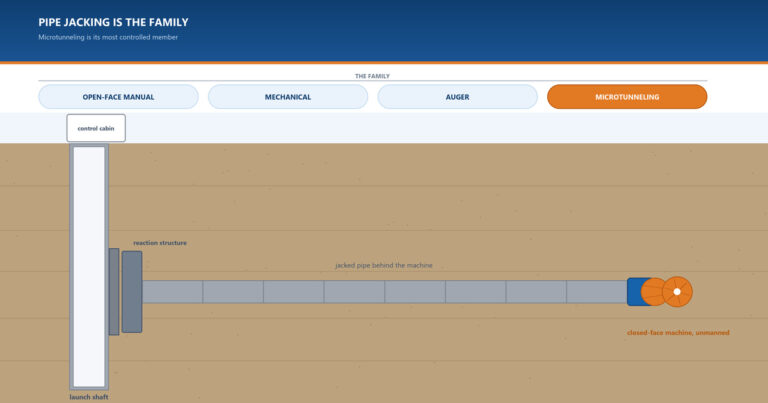
Short answer: microtunneling is not a different method from pipe jacking – it is the unmanned, guided form of it. Pipe jacking is the family, and microtunneling is the member that adds a guidance system and continuous face support to the same jacked-pipe idea.
This page settles the relationship between the two terms, sets out the criteria that separate them, and shows where the accuracy, jacking-force and specification rules diverge.
The wording in a specification decides the equipment, crew, price and safety plan that come back in a bid.
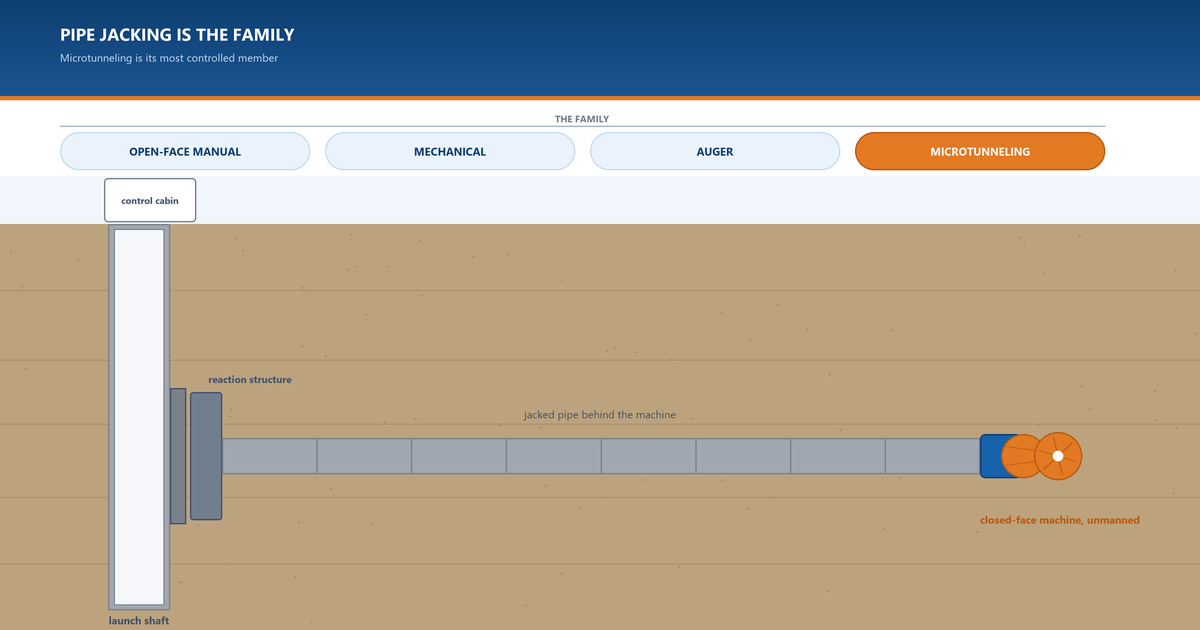
Is Microtunneling the Same as Pipe Jacking?
No. Pipe jacking is the broad family: pipe is pushed through the ground behind an excavation face, and the jacking force is carried by the pipe string itself. Microtunneling is one member of that family.
In any microtunneling vs pipe jacking discussion, the useful shorthand is that microtunneling is pipe jacking with three additions: the machine is operated from the shaft, it is guided to a specified deviation limit, and it supports the face continuously. Remove any of the three and the work falls back to traditional jacking.
The framing matters, because a specification that mixes the two terms leaves bidders to guess which obligation applies.
Bottom line: pipe jacking describes how the pipe is installed; microtunneling describes how the machine is controlled while it is installed.
Pipe Jacking Is the Family, Not a Sibling
It helps to picture pipe jacking as a family with several members. The common element is a jacking pipe pushed from a launch shaft, with the reaction taken at the shaft. What changes between members is how the face is excavated and who or what controls it.
- Open-face manual jacking: a crew excavates at the face and removes spoil by hand or by a small skip.
- Mechanical jacking: a roadheader or excavator arm works at the face, still with people in the pipe at larger diameters.
- Auger jacking: a rotating auger inside a casing removes spoil, so no worker needs to reach the face.
- حفر الأنفاق الصغيرة: a closed-face machine that operates unmanned, with guidance and continuous face support, pushing a jacking pipe behind it.
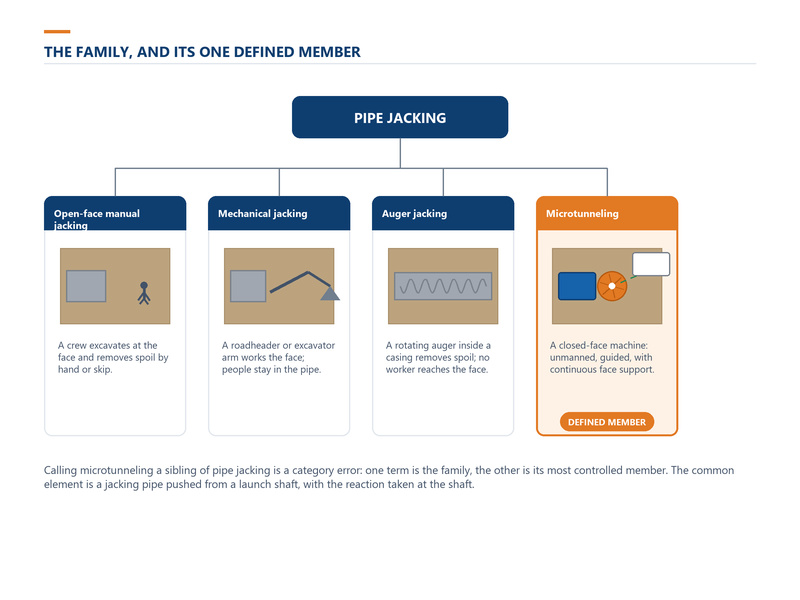
Seen this way, calling microtunneling a sibling of pipe jacking is a category error: a machine does not compete with a method.
Bottom line: the microtunneling vs pipe jacking question is answered by taxonomy, not by performance: one term is the family, the other is its most controlled member.
Which Three Criteria Must Be Met Together?
This section is the reference definition for the term in this batch. The recognised definition comes from ASCE/CI 36-15, Standard Construction Guidelines for Microtunneling: it sets three criteria that must all be satisfied, and it is what a specification should point to.
| المعيار | What it requires | Evidence in a bid |
|---|---|---|
| Remote control | The machine is operated from the shaft, with no crew at the face | Machine type, control cabin, no-entry method statement |
| Guided tolerance | A steering system holds the alignment to the specified figure | Laser or gyroscopic system, figure stated in millimetres |
| Continuous face support | Ground at the face is supported throughout the drive | Slurry or earth pressure balance system, separation plant |
All three conditions must hold at once, or the drive is priced as traditional jacking.
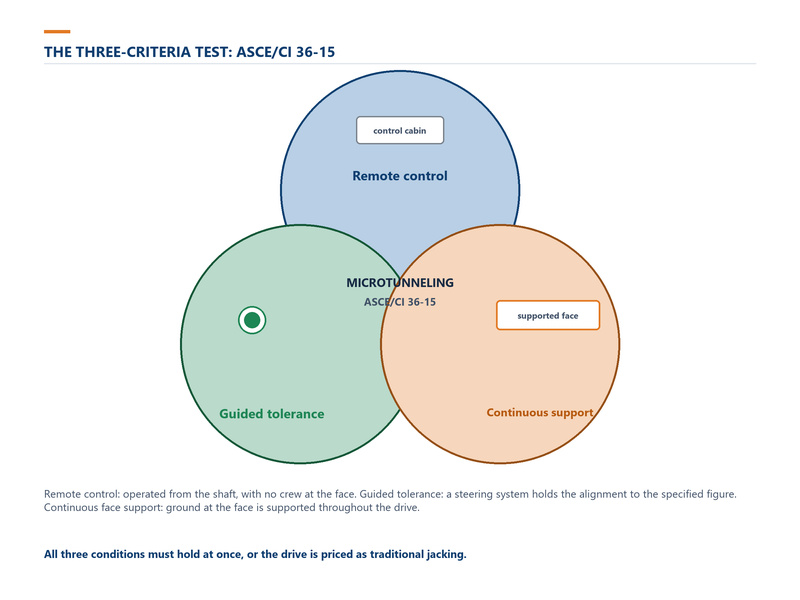
The criteria are cumulative, and removing the crew from the pipe is more than a convenience: it removes the principal safety exposure of traditional jacking and lets the alignment be trusted over a long drive. Where any one criterion is absent, the drive is specified and priced as traditional jacking.
Bottom line: if a bid cannot evidence all three criteria, it is being priced as pipe jacking, whatever the tender document calls it.
Traditional Pipe Jacking Still Exists: Manual and Mechanical Jacking
It is easy to forget that most pipe jacking in the world is not microtunneling. Manual and mechanical jacking remain common, particularly for larger diameters, shorter drives and dry, stable ground where a person can work safely at the face.
Where a crew enters the pipe, the sequence is defined: confirm the ground will stand unsupported, ventilate and monitor the atmosphere, then work the face under supervision. The pipe and jacks are shared with microtunneling; the control system is not.
- Applicability: stable clay or dry ground, above the water table, with no settlement-sensitive assets overhead.
- Boundary conditions: running or water-bearing ground, tight settlement limits, and any drive where entry is unsafe.
- What to state explicitly: the guided accuracy of an unmanned machine, and the safety record that comes from removing hand mining from the drive.
Traditional jacking is not obsolete, but it is a different contract risk that the specification has to name.
Tolerances and Guidance: Where the Rules Diverge
The accuracy a method can hold is the clearest technical divider between the two. Tolerance bands depend on the machine and the drive, and the figures for guided microtunneling units are set out in our microtunneling vs HDD comparison.
Manual and mechanical pipe jacking typically hold ±50-100 mm, because corrections come after the face has already moved. That gap is a design input, not a detail: a gravity sewer or a rail crossing may not be buildable to the looser figure.
Where the required tolerance is tighter than hand mining can hold, the drive must be priced as microtunneling.
| الطريقة | Typical accuracy | Why the figure holds |
|---|---|---|
| النفق الدقيق | Tightest of the jacked methods | Continuous laser or gyroscopic guidance |
| Manual or mechanical pipe jacking | ±50-100 mm | Corrections applied after the face advances |
| Directional drilling | About ±100 mm | Surface-tracked bore on a curve |
Read as a set, these rows answer the key question: microtunneling vs pipe jacking is decided by the machine and the ground, not by the pipe.
What Actually Limits How Far a Jacked Drive Can Go?
Jacking force is what actually limits a drive, and the family rules differ here too. Every metre of pipe adds friction, and the jacks must overcome it while the pipe string carries the load in compression.
Four elements control the force: the compressive capacity of the jacking pipe, the joints between sections, the thrust wall that reacts the load at the launch shaft, and the lubrication that reduces friction along the pipe skin.
Lubrication, usually a bentonite or polymer slurry injected at the pipe skin, is the least costly way to extend a drive.
Where it is not enough, an intermediate jacking station is inserted: a set of jacks partway along the string that pushes the leading section from within.
| العنصر | الدور | What this element guarantees |
|---|---|---|
| Pipe compressive capacity | Carries the jacking load | Prevents crushing or cracking of the pipe |
| Pipe joints | Transmit force between sections | Prevents joint damage and misalignment |
| Thrust wall | Reacts the load in the ground | Prevents wall movement or failure |
| Lubrication | Reduces skin friction | Keeps force and drive length within range |
| Intermediate jacking station | Splits the load along the string | Prevents an overloaded pipe on a long drive |
Force, not distance, is what limits a jacked drive.
The jacking envelope is the practical rule: specifications commonly require allowance for an intermediate jacking station roughly every 100 m, drives in the 600-900 mm class typically reach 160-200 m, and a jacked line can exceed 1 km once such stations and skin friction control are used. Exact figures depend on pipe diameter and machine configuration, so the specification should state the allowance it expects.
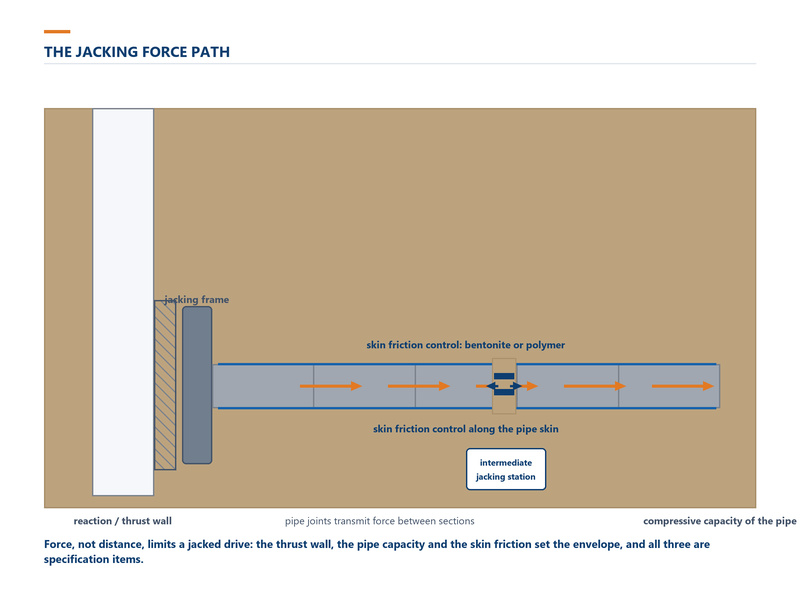
The thrust wall, the pipe capacity and the skin friction decide how far a drive can go, and all three are specification items, not contractor preferences.
Cost and Risk: Why the Family Resemblance Is Misleading
Because the two terms share pipes, joints and jacks, they are often assumed to cost the same. They do not. The difference in any microtunneling vs pipe jacking tender is the machine, the control system, the crew and the safety plan.
- Plant: a guided, closed-face machine with a slurry or earth pressure balance system costs more to mobilise than an open-face jacking rig.
- Crew: an unmanned machine removes people from the pipe, which changes the labour profile and the rescue arrangements.
- Support: continuous face support adds a separation plant and fluid handling that open-face jacking does not need.
- Risk transfer: the tighter the settlement and safety limits, the more the client is buying control, not metres.
The premium a client pays for microtunneling buys control of the risk: a bounded alignment, a face nobody has to enter, and a method statement the designer can defend.
A like-for-like price needs the specification to name the method, because the risk being priced is different.
Why the Wording Matters in a Specification
This is the practical core of the microtunneling vs pipe jacking distinction. The words in the specification decide which method a contractor prices, and therefore which machine, crew, programme and safety plan arrive on site.
- “Microtunneling” obliges the bidder to provide unmanned operation, a guided alignment and continuous face support, and it prices the crew accordingly.
- “Pipe jacking” alone can be priced with hand mining, no guidance system and an open face, which is a different risk and a different number.
- A clause that names only remote control is ambiguous unless the required tolerance and the face-support requirement are also stated.
- Intermediate jacking station allowances should be listed as bid items so they are not treated as extras.
- Lubrication and the settlement limits should be named, because both drive the method statement.
Send us the draft clause and we will mark it against these five points before it goes to tender.
On projects we have executed, the most common cause of a non-comparable bid set is a specification that uses both terms without defining either. The fix is one sentence that cites ASCE/CI 36-15 and states the required figure.
Bottom line: write the definition into the specification, and the bids become comparable; leave it out, and the cheapest bid wins on a method the design did not intend.
Microtunneling vs Pipe Jacking: How Do the Two Sets of Rules Compare?
The table below condenses the rules into the items a specification or method statement normally has to address.
| المعيار | النفق الدقيق | Traditional pipe jacking |
|---|---|---|
| Relationship | A subset of pipe jacking | The parent family |
| Face control | No crew at the face; operated from the shaft | Work at the face by hand or machine |
| Guidance | Laser or gyroscopic, continuous | Limited; corrected after the fact |
| Tolerance | Tighter than traditional jacking | ±50-100 mm |
| Face support | Continuous (slurry or earth pressure balance) | Open face; ground must stand |
| Jacking pipe | Same pipe family, higher load capacity | Compressive capacity sets the drive length |
| Hand mining | No entry at the face | Used for stable, dry, entry-safe drives |
| Remote control | Standard, operated from the shaft | Crew supervised at the face |
| Typical diameter | See microtunneling vs HDD | About 150-2,400 mm |
Read across the rows, the two columns share pipe and jacks but not obligations.
Writing a trenchless specification? Send the clause and the alignment data for a free method review, and our engineers will confirm the definition, the alignment figure and the jacking-force allowances.
الأسئلة الشائعة
Is microtunneling the same as pipe jacking?
No. Microtunneling is a subset of pipe jacking. Pipe jacking is the family – pushing pipe through the ground behind an excavation face – and microtunneling is the member that adds unmanned operation, a guidance system and continuous face support, as defined by ASCE/CI 36-15.
What makes pipe jacking count as microtunneling?
Three criteria, taken together: the machine is operated from the shaft with no crew at the face, its guidance system holds the specified figure, and the face is supported continuously. Pipe jacking that meets all three is microtunneling; jacking that relies on workers at the face is not.
Can pipe jacking be done with a crew at the face?
Yes, but only under the older rules. The sequence is fixed: prove the ground will stand unsupported, ventilate and monitor the atmosphere, then advance the face with the crew supervised. That suits larger, shorter, dry drives; where settlement limits are tight, control moves off the face to remote control in the shaft.
On a 1,200 mm sewer drive at 8 m depth under a live road, how accurate is manual or mechanical pipe jacking?
Manual and mechanical pipe jacking typically hold about ±50-100 mm, against ±10-25 mm for microtunneling. The gap comes from the guidance system: microtunneling steers continuously against a laser or gyroscopic reference, while traditional jacking corrects after the fact.
We need a 900 mm gravity sewer drive of 250 m under a live road – in microtunneling vs pipe jacking, how far can one drive go before an extra jacking station is needed?
Pipe jacking drives can exceed 1 km with additional jacking stations and skin friction control, although a single unassisted drive is far shorter. Machines in the 600-900 mm class are typically limited to 160-200 m per drive, and specifications commonly require allowance for one roughly every 100 m.
Our jacked drive runs 250 m at 8 m depth – what role does the thrust wall play?
The thrust wall transfers the jacking force into the ground behind the launch shaft. Its capacity, together with the compressive strength of the pipe, sets how hard the jacks can push, and it is one of the elements a specification should define.
Our specification says “pipe jacking” but requires ±25 mm and a supported face – should microtunneling vs pipe jacking be priced as one method or two?
The wording decides which method a contractor prices: a specification that names microtunneling obliges the bidder to provide unmanned operation, a guided alignment and continuous face support, driving the machine, crew and safety plan; pipe jacking alone can be priced with traditional jacking. The two bids are not comparable.
Is pipe jacking cheaper than microtunneling?
Like for like, microtunneling costs more: the pipe and jacks are shared, but the guided machine, control system and face-support plant are not.
How Do You Get the Specification Right?
If you are writing the specification, the definition clause is the sentence to get right; if you are bidding, the alignment figure, the intermediate jacking station allowance and the lubrication plan are the lines that decide your number; if you are the owner, the safety plan is where the risk you bought shows up.
Closing the microtunneling vs pipe jacking gap starts with three documents: the alignment and depth, the geotechnical investigation, and the accuracy the design actually needs.
A good starting sentence is short: name the method, cite the standard, and state the alignment figure. Everything the bidder needs to price – machine class, guidance, face support and crew – follows from those three things.
We quote the specification wording alongside the price, because the wording is what determines which crew and which machine turn up.
For jacked drives, see our microtunneling construction services and the wider microtunneling services that deliver the drive. For the wider family, see what are trenchless technologies, and for the cost and accuracy side of traditional jacking, see microtunneling vs jack and bore: cost and accuracy.
Two further comparisons are useful when the specification is still open: microtunneling vs HDD: the key differences and microtunnel vs. HDD vs. direct pipe. Both assume the definition set out on this page.
Final Verdict: What Does the Definition Change?
Microtunneling and pipe jacking are not alternatives: pipe jacking is the family, and microtunneling is the member defined by three criteria under ASCE/CI 36-15.
That definition is what changes the rules: the accuracy a contractor must hold, the load the pipe must carry, the safety plan that keeps people out of the pipe, and the sentence that decides which of the two is being bought.
Where the two terms are used loosely, fix the wording first; everything else – alignment figure, shaft reaction, extra jacking station and method statement – follows from it.
Get a second opinion at no cost. Send over the draft specification, and our engineers will mark where the wording changes the bid.
Related: pilot tube vs slurry microtunneling and microtunneling vs jack and bore.
Sources
Figures in this guide follow these published industry standards and guidance documents:
- ASCE/CI 36-15, Standard Construction Guidelines for Microtunneling; supports the three-criteria test and the tolerance table.
- Akkerman equipment guidance on jacking force, thrust capacity and intermediate jacking stations.
- Herrenknecht technical notes on microtunneling machines and pipe jacking systems.
- NASTT Good Practices Guidelines (Microtunneling and Pipe Jacking).





































 English
  Arabic
  Russian
  Spanish
  French
  Vietnamese
  Polish
  Thai
Thai  Indonesian
  Turkish
  Portuguese