
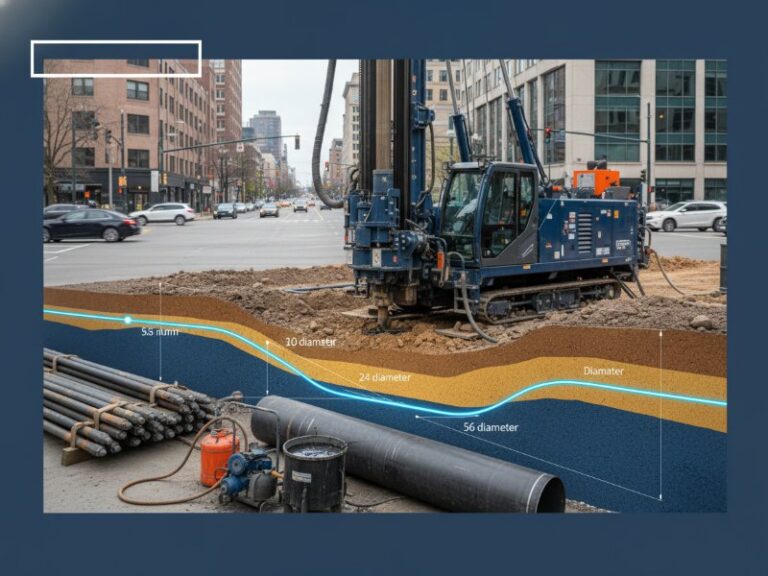
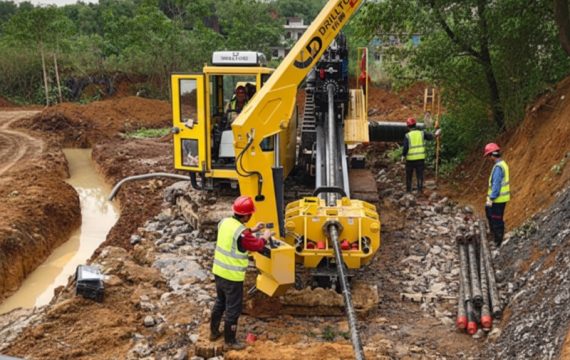
Le coût du forage HDD pour les projets de canalisations varie généralement entre $10 et $30 par pied linéaire pour le forage de base, tandis que le coût total d’installation se situe souvent entre $20 et $75 par pied linéaire, en fonction du sol, du diamètre de la canalisation, de la longueur du forage et des conditions du site. Les traversées urbaines, les formations rocheuses et les forages profonds peuvent faire grimper les coûts, en particulier lorsque la remise en état, l'obtention des autorisations et l'élimination des déchets sont prises en compte.
Aperçu rapide des coûts
Débit de forage de base par type de sol
| État du sol | Coût de base par pied linéaire | Débit de production type |
|---|---|---|
| Argile meuble ou sable | $8–$12 | 200 à 250 pieds par jour |
| Argile compacte ou sable dense | $12–$18 | 150 à 200 pieds par jour |
| Sol mixte ou gravier | $18–$30 | 120 à 180 pieds par jour |
| Roche érodée | $25–$40 | 100 à 150 pieds par jour |
| Roche dure, comme le granit ou le basalte | $40–$75 | 80 à 120 pieds par jour |
Les conditions du sol constituent l'un des principaux facteurs de coût, car les formations plus dures ralentissent la production, accélèrent l'usure des outils et augmentent le risque d'arrêts de production.
Multiplicateur de diamètre en fonction du diamètre du tuyau
| Diamètre du tuyau | Multiplicateur de diamètre | Passes d'alésage types |
|---|---|---|
| 2 à 4 pouces | 0,7x | 1–2 |
| 6 à 8 pouces | 1,0x | 2–3 |
| 10 à 12 pouces | 1,5x | 3–4 |
| 16 à 20 pouces | 2,2x | 4–5 |
| 24 à 30 pouces | 3,0x | 5–6 |
| 30 à 48 pouces | 4,0x–5,0x | 6–8 |
Les diamètres plus importants nécessitent davantage d'alésage, davantage de fluide de forage et une force de traction plus importante, ce qui augmente à la fois le temps et les coûts.ndl.
Pourquoi les coûts varient-ils ?
Les conditions du sol et le diamètre des canalisations expliquent généralement la majeure partie des variations de prix dans les travaux de forage horizontal dirigé (HDD). Un projet réalisé dans un sol meuble avec une canalisation de petit diamètre peut être mené à bien rapidement à l'aide d'un outillage standard, tandis qu'une canalisation de grand diamètre traversant la roche peut nécessiter un équipement spécialisé, des vitesses d'avancement plus lentes et des changements d'outils plus fréquents.
La longueur du forage est également un facteur important, car les coûts de mobilisation sont répartis sur la distance totale ; ainsi, les forages courts présentent souvent un coût au pied plus élevé que les projets de longueur moyenne. En revanche, les forages plus longs peuvent s'avérer plus économiques au pied si les conditions du site restent stables et si la géométrie du forage est optimale.
Coûts cachés à prendre en compte dans le budget
Le forage de base ne représente qu'une partie du coût total du projet. Un budget complet pour un forage horizontal dirigé (HDD) doit également inclure la mobilisation, les fluides, la localisation des réseaux, l'ingénierie, l'obtention des autorisations, la remise en état et les imprévus.
- Mobilisation et démobilisation : $2 000 – $15 000.
- Fluides de forage et élimination : $3–$8 par pied linéaire.
- Fouilles et localisation des réseaux : $500–$2 500 par jour.
- Ingénierie et conception : $2 000 – $15 000.
- Autorisation : $1 000 – $10 000.
- Matériau des tuyaux : varie considérablement en fonction du diamètre et des caractéristiques techniques.
- Remise en état du site : $500–$5 000.
- Réserve : 15%–25% au total.
La gestion des fluides de forage et les conditions de sol imprévues constituent des sources particulièrement courantes de dépassements de budget ; il est donc préférable de les considérer comme des postes budgétaires essentiels plutôt que comme des options facultatives.
Comment estimer le coût
Utilisez cette formule simple pour obtenir une première estimation :
Longueur × Tarif de base × Coefficient de diamètre = Coût de forage de base
Par exemple, un forage de 1 500 pieds par le biais de terrain hétérogène avec Tuyau de 16 pouces peut être estimée comme suit :
- Tarif de base : $20/pied
- Longueur : 1 500 pieds
- Multiplicateur de diamètre : 2,2x
Cela donne une estimation de base des coûts de forage de $66,000 avant d'ajouter les frais de mobilisation, les fluides, les autorisations, la remise en état, le matériel de canalisation et les imprévus.
Pour établir votre budget, c'est le meilleur moyen d'éviter de sous-estimer le coût total de l'installation. Les entrepreneurs proposent généralement des devis fixes plus précis après avoir examiné un rapport géotechnique et évalué les conditions du chantier.
HDD ou tranchée à ciel ouvert ?
Le forage horizontal dirigé (HDD) présente souvent un rythme de forage plus élevé que l'excavation à ciel ouvert, mais son coût total d'installation peut s'avérer inférieur si l'on tient compte de la remise en état de la surface, de la gestion de la circulation et des mesures d'atténuation des impacts environnementaux. C'est pourquoi le forage horizontal dirigé (HDD) est souvent privilégié pour les traversées routières, les traversées de zones humides, les corridors urbains et d'autres sites sensibles.
| Élément de coût | Tranchée à ciel ouvert par 1 000 pieds | HDD par 1 000 pieds |
|---|---|---|
| Excavation ou forage dirigé | $8 000 – $15 000 | $12 000 – $25 000 |
| Étaiement des tranchées et sécurité | $3 000 – $8 000 | $0 |
| Enlèvement et remplacement du revêtement routier | $15 000 – $40 000 | $0–$5 000 |
| Régulation du trafic et fermetures de voies | $5 000 – $20 000 | $1 000 – $3 000 |
| Aménagement paysager et restauration | $4 000 – $12 000 | $500–$2 000 |
| Mesures d'atténuation des impacts environnementaux | $2 000 – $10 000 | $500–$2 000 |
| Coût total d'installation | $37 000 – $105 000 | $14 000 – $37 000 |
La pose en tranchée ouverte peut encore s'avérer plus économique pour des tronçons très courts situés en pleine campagne ou sur des terrains non aménagés, en l'absence de chaussée, de circulation ou d'exigences de remise en état. Dans les zones urbanisées, la forage horizontal dirigé (HDD) offre généralement un meilleur rapport coût total.
Quand le disque dur est la meilleure solution
Le HDD est particulièrement efficace pour :
- Passages à niveau et passages sur autoroute.
- Traversées de cours d'eau et de zones humides.
- Zones urbaines développées.
- Sites écologiquement sensibles.
- Passages à niveau.
- Projets répondant à des normes de restauration élevées.
C'est dans ces situations que la pose sans tranchée permet souvent de réaliser les économies les plus importantes et de limiter au maximum les perturbations.
Questions à poser aux entrepreneurs
Pour comparer correctement les devis, demandez à chaque entrepreneur de détailler les éléments suivants :
- Débit de forage de base par classe de sol.
- Frais de mobilisation et de démobilisation.
- Coût du fluide et méthode d'élimination.
- Nombre de passes d'alésage incluses.
- Coût de la spéléologie par site.
- Assumer ses responsabilités.
- Responsabilité en matière de restauration.
- Estimation de la production quotidienne.
- Taux de surcoût en cas de terrain plus difficile que prévu.
- Assurance et couverture des passages à niveau.
La transparence des éléments de l'offre facilite grandement la comparaison des offres à périmètre égal.
FAQ
Quel est le coût moyen au pied d'un gazoduc en HDD ?
Pour les conduites de distribution de gaz de 4 à 6 pouces, les débits de forage de base se situent souvent autour de De $12 à $25 par pied, le coût total d'installation étant généralement plus élevé une fois pris en compte les travaux de pose des canalisations, les permis et la remise en état.
Combien coûte un forage directionnel pour une conduite d'eau principale ?
Pour les conduites d'eau principales de 8 à 12 pouces, les tarifs de base varient souvent entre De $15 à $30 par pied, alors que le coût total d'installation peut atteindre De $35 à $70 par pied en fonction de la restauration des sols et du site.
Le câblage en tranchée fermée est-il moins coûteux que le câblage en tranchée ouverte sur de longues distances ?
C'est souvent le cas dans les zones urbanisées, car les économies réalisées grâce à la réduction des travaux de remise en état et de gestion du trafic peuvent compenser le surcoût lié au forage.
Quel est le principal coût caché des projets liés aux disques durs ?
L'élimination des fluides de forage et la présence de roches imprévues constituent deux des risques budgétaires les plus courants, et tous deux peuvent augmenter considérablement le coût du projet.
Puis-je obtenir un devis à prix fixe pour un projet lié aux disques durs ?
En général, ce n'est qu'après qu'un entrepreneur a examiné un rapport géotechnique et les conditions du chantier. En l'absence de données sur le sol, les offres ne sont souvent que des estimations assorties de clauses de révision.










 English
  Arabic
  Russian
  Spanish
  French
  Vietnamese
  Polish
  Thai
Thai  Indonesian
  Turkish
  Portuguese