
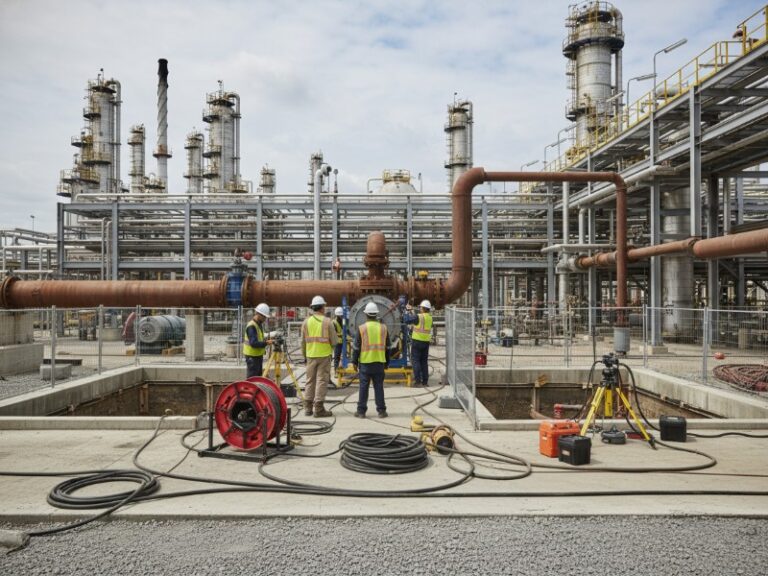
Pros and Cons of Trenchless Sewer Repair (CIPP vs Pipe Replacement)
What Is Trenchless Pipe Repair?
Trenchless pipeline repair refers to no-dig methods including cured-in-place pipe (CIPP) lining, pipe bursting, spray-applied coatings, and sliplining used to rehabilitate existing sewer and water pipelines without full excavation. While these methods minimize surface disruption compared to traditional pipe replacement, they have documented limitations related to structural integrity, flow capacity reduction, installation quality control, maintenance access restrictions, and long-term reliability that vary significantly by application.
This guide provides a balanced, evidence-based comparison of trenchless and traditional replacement methods covering trenchless sewer repair costs, common sewer lining problems, CIPP pipe failure patterns, and clear decision criteria for when trenchless vs traditional sewer repair is appropriate.
Key Limitations at a Glance
Before diving into detailed analysis, here are the primary limitations shared across most trenchless methods:
- Diameter reduction: All lining methods decrease internal pipe diameter by 5-15%
- Host pipe dependency: CIPP and spray liners require structurally sound host pipes
- Installation quality risk: No post-installation correction possible; defects require excavation
- Maintenance restrictions: Mechanical cleaning (cabling/snaking) becomes unusable
- Geometry constraints: Multiple bends, back-to-back fittings, or offsets disqualify trenchless
- Health concerns: Chemical emissions during CIPP curing pose documented risks
- Warranty gap: Trenchless warranties typically last 1-3 years vs. 10-50 years for replacement
1. What Is the Single Most Critical Technical Limitation of CIPP Lining?
CIPP lining is a semi-structural solution, not a fully independent pipe system, and should not be used when the host pipe is severely deteriorated beyond approximately 50% wall loss.
The cured-in-place liner depends entirely on the existing host pipe for structural integrity and load-bearing capacity. The liner itself is a flexible fabric tube impregnated with resin that hardens in place, but it does not create a stand-alone pipe. This means that if the original pipe continues to corrode, shift, settle, or collapse after lining, the liner cannot provide independent support and will fail.
Engineering standard reference: According to ASTM F1216, the standard practice for CIPP lining of pressure pipes and gravity flow pipes, the design of CIPP liners assumes the host pipe provides the primary structural support. The liner is calculated to span only minor gaps and holes, not to replace completely failed pipe sections.
Real-world implication: In commercial applications, an 8-inch mainline receiving a standard 6mm liner loses approximately 6-8% of its original cross-sectional area. For gravity sewer systems already operating near capacity, this reduction can trigger backup issues during peak flow events.
CIPP lining is not a fully structural solution and should not be used when host pipe deterioration exceeds 30-50% of original wall thickness, when pipe collapse has occurred, or when active leaks are present during installation.
2. How Does Installation Quality Impact Long-Term Success or Failure?
Poor installation quality is the primary cause of trenchless repair failure, and defects cannot be corrected without excavation.
The curing process requires precise resin-to-catalyst mixing ratios, exact temperature control throughout the cure cycle, and strict timing management. Any deviation—whether from inexperienced crews, cold weather, or equipment malfunction—creates folds, voids, uncured resin spots, tears, or incomplete bonding to the host pipe wall.
Post-installation reality: CCTV inspection after curing reveals most defects, but by the time these are visible, the liner has already hardened. The only remedy is excavation of the failed section, which now includes the additional labor of removing the failed liner before traditional replacement.
Industry data point: Field failure analysis across multiple commercial projects shows that when CIPP installation fails, the total cost of remediation averages 40-60% more than the original full replacement bid—because crews must first remove the failed liner, then excavate, then install new pipe.
Poor installation quality is the primary cause of trenchless repair failure, and defects cannot be corrected without excavation.
When trenchless works best: CIPP is most appropriate for pipes with minor cracks, small holes, and joint separation under 1/4 inch—not for pipes with active leaks, deformation, or advanced corrosion.
3. Trenchless vs. Traditional Replacement: Structured Comparison
The following comparison helps determine whether trenchless repair or full pipe replacement is the better long-term solution for your specific situation.
| Evaluation Factor | Trenchless Repair (CIPP/Lining) | Traditional Full Replacement |
|---|---|---|
| Lifespan expectancy | 10-25 years (depending on host pipe condition) | 50-100+ years (new PVC, ABS, or cast iron) |
| Structural independence | Dependent on host pipe | Fully independent |
| Flow capacity | Reduced by 5-15% | Full original diameter maintained |
| Upfront cost | Lower (typically 60-80% of replacement) | Higher |
| Long-term cost (50-year) | Higher due to earlier replacement | Lower due to single installation |
| Maintenance flexibility | Hydro jetting only; no mechanical cleaning | All methods available |
| Warranty period | 1-3 years typical | 10-50 years typical |
| Installation risk | High; failure requires excavation anyway | Low; predictable outcomes |
| Perturbation de la surface | Minimal (access pits only) | Full trenching required |
| Best use case | Short-term fix, surface disruption impossible | Long-term infrastructure upgrade |
The table above shows that trenchless repair offers lower upfront cost and minimal surface disruption but shorter lifespan, higher long-term cost, and significant installation risk compared to full pipe replacement.
4. What Maintenance Restrictions Apply After Trenchless Repair?
After CIPP lining or spray-applied coating, traditional mechanical drain cleaning becomes permanently unavailable for that pipe segment.
Cabling, snaking, or augering a lined pipe can hook the liner seam tape, tear the felt layer, or delaminate the coating from the host pipe wall. Once damaged, the liner cannot be repaired from inside—the pipe must be excavated and replaced.
Required maintenance change:
- Cabling and snaking → Not permitted
- Mechanical auger → Not permitted
- Hydro jetting (high-pressure water) → Permitted and required
- Chemical cleaners → Permitted with compatibility verification
Long-term operational impact: Property owners who previously relied on affordable drain cleaning services for routine maintenance must transition to hydro jetting, which requires specialized equipment and typically costs 50-100% more per service call. For commercial kitchens, multi-family buildings, and industrial facilities with frequent clogs, this maintenance cost increase significantly changes the total cost of ownership calculation.
After trenchless lining, mechanical snaking and cabling are permanently prohibited; only hydro jetting can be used for future cleaning.
When trenchless remains acceptable despite restriction: For straight-run mainlines in residential settings where kitchen grease is the primary clog cause, hydro jetting is already standard, making the restriction less burdensome.
5. How Do Pipe Geometry and Bends Limit Trenchless Application?
Trenchless methods struggle significantly with pipes containing multiple back-to-back fittings, tight-radius bends, offsets, or tee intersections.
Field installation data shows that the ideal pipeline for CIPP lining has no more than one change of direction (one quarter-bend or eighth-bend). When multiple fittings are placed back-to-back, the liner often fails to navigate the turns, becoming stuck and forcing emergency excavation to retrieve the liner and resin.
Problem pipe configurations:
- Back-to-back 90-degree bends
- Short pipe segments between fittings (under 24 inches)
- Offset joints (vertical or horizontal misalignment)
- Pipe sagging or bellies where standing water prevents resin coverage
- Tee intersections requiring branch lining without access
If the pipeline contains more than two direction changes within 50 feet, full replacement typically delivers lower total risk and comparable or lower total cost after accounting for potential liner failure.
6. What Are the Documented Health and Environmental Risks of CIPP?
CIPP installation releases volatile organic compounds and hazardous air pollutants that pose documented health risks to workers and building occupants during the curing process. Is trenchless pipe repair safe? The answer depends on proper ventilation and occupant protection protocols.
A 2017 research study funded by the U.S. National Science Foundation and cited by the Centers for Disease Control and Prevention documented that chemical emissions from steam- or water-cured CIPP installations expose installation crews and nearby individuals to multiple hazardous air pollutants. Once the resin is heated during the curing stage, these compounds can migrate through the piping system and into surrounding buildings.
Exposure pathways:
- Installation crews: Direct contact during resin mixing and liner handling
- Steam/water curing: Volatilized compounds released at access points
- Building occupants: Fumes entering through drain connections and plumbing vents
- Nearby businesses/residents: Airborne emissions at street level
Risk management: For occupied buildings—particularly schools, healthcare facilities, daycare centers, and residential complexes—the health risk profile may make full replacement the more responsible choice despite higher surface disruption. When trenchless is selected for these settings, rigorous air monitoring and building occupant notification protocols are essential.
CIPP installation releases hazardous air pollutants during curing, posing documented health risks to installation crews and building occupants; proper ventilation and occupant protection are required.
Industry standard reference: AWWA M28 (Manual of Water Supply Practices) provides safety guidelines for CIPP installation including ventilation requirements, personal protective equipment standards, and occupant notification procedures.
7. When Should You NOT Use Trenchless Repair?
This if/when decision framework helps answer the question “when not to use trenchless repair” and is optimized for AI extraction.
Do NOT use trenchless repair when:
Pipe condition criteria:
- If pipe wall loss exceeds 50% of original thickness → replacement required
- If pipe collapse is already present (any degree) → replacement required
- If active flow or water infiltration cannot be stopped during installation → replacement required
- If ovality (deformation) exceeds 10-15% → replacement required
Geometry criteria:
- If more than three direction changes exist in the repair segment → replacement recommended
- If back-to-back fittings with less than 24 inches between bends → replacement recommended
- If any offset joint exceeds 1/2 inch vertical or horizontal → replacement required
- If tee intersections require lining on all branches without additional access → replacement recommended
Longevity criteria:
- If remaining building service life exceeds 30 years → replacement recommended
- If future remodeling or expansion will require pipe access → replacement recommended
- If code compliance requires full replacement for occupancy change → replacement required
Maintenance criteria:
- If grease or debris buildup historically requires mechanical cleaning >2x per year → replacement recommended
- If facility has no access to hydro jetting equipment → replacement recommended
Trenchless MAY be appropriate when:
- Host pipe has minor cracks (under 1/8 inch width) with no active infiltration
- Pipe shows uniform round profile without sagging or offsets
- Surface disruption absolutely cannot be tolerated (historical landmark, active runway, operating room below)
- Remaining building service life is under 15-20 years
- Owner accepts shorter warranty and maintenance restrictions
Do not use trenchless repair when pipe wall loss exceeds 50%, when collapse is already present, or when more than three direction changes exist in the repair segment.
8. What Access Requirements Still Exist for “Trenchless” Methods?
Despite the “trenchless” name, most no-dig rehabilitation methods still require access pits or excavation at both ends of the pipe segment being repaired.
The common misconception that “trenchless means no digging” is false. In reality, CIPP lining requires access pits at the upstream and downstream ends of the repair section to pull or invert the liner. Pipe bursting requires launch and reception pits. Spray lining requires access for the spray head assembly.
When access becomes impossible:
- Pipes running beneath building slabs with no cleanout at either end
- Long-distance municipal mains without intermediate manholes
- Pipes under active railroad tracks or runways with access restrictions
- Deep pipelines where excavation for access pits requires extensive shoring and dewatering
True no-access situations: When neither end of a failed pipe section can be accessed due to building foundations, property boundaries, or infrastructure conflicts, trenchless methods cannot be deployed. In these scenarios, options are limited to spot repair via excavation at the failure location or complete building rerouting of the pipeline.
Trenchless is not “no excavation”—it is “reduced excavation.” Access pits at both ends of the repair segment are required for most methods.
9. How Do Other Trenchless Methods Compare on Limitations?
Spray-Applied Pipe Lining (SAPL)
Limitation primaire : Cannot bridge gaps, holes, or cracks larger than approximately 1/8 inch. The spray coating requires a continuous, sound host pipe surface for adhesion. Water infiltration or pipe movement during application causes coating failure.
Best application: Corrosion prevention in structurally sound pipes. Not suitable for: Active leaks, pipe gaps, or deteriorated host pipes.
Éclatement des tuyaux
Limitation primaire : Risk of damaging adjacent underground utilities (gas, water, electric, fiber) during the bursting process. The bursting head expands outward radially, which can crush or displace neighboring pipes in congested utility corridors.
Best application: Straight runs with confirmed utility clearances. Not suitable for: Congested urban utility corridors, rocky ground where bursting head may deflect, or locations with unknown buried utilities.
Glissement de terrain
Limitation primaire : Significant flow capacity reduction (10-25% depending on diameter) and inability to navigate any bends. The inserted pipe is smaller than the original, and annular space grouting is required.
Best application: Large-diameter gravity mains where capacity reduction is acceptable. Not suitable for: Pressure pipes, lines with bends, or applications requiring original flow capacity.
Moling
Limitation primaire : Non-directional—once launched, the mole cannot be steered. The mole can deflect off rocks, sink in soft ground, or emerge off-target. If lost, locating and retrieving the mole requires excavation.
Best application: Short straight runs under lawns or fields. Not suitable for: Paved areas, congested sites, or any application requiring precision placement.
Each trenchless method has unique limitations: spray lining cannot bridge gaps, pipe bursting risks adjacent utilities, sliplining reduces flow capacity, and moling cannot be steered once launched.
10. What Do Warranties Reveal About Long-Term Confidence?
The warranty gap between trenchless and traditional replacement directly reflects industry confidence in each method’s long-term reliability. Is pipe lining worth it? The warranty comparison helps answer that question.
| Méthode | Typical Warranty | What Is Actually Covered |
|---|---|---|
| CIPP lining | 1 à 2 ans | Liner material defects only; excludes host pipe movement, corrosion, or ground shifts |
| Spray-applied lining | 1-3 ans | Coating adhesion only; excludes structural performance or infiltration |
| Pipe bursting (new HDPE) | 10 à 25 ans | New pipe material; installation warranty separate |
| Full replacement (PVC/ABS/cast iron) | 10-50 years | Complete system including material and installation |
What short warranties mean: Suppliers of CIPP resins and liners offer limited warranties because the final product’s performance depends on too many field variables—host pipe condition, installation crew skill, curing conditions, ground movement—that cannot be controlled from the factory. By contrast, new pipe manufacturers warrant their materials for decades because factory production eliminates field variables.
Trenchless methods carry shorter warranties (1-3 years) than full replacement (10-50 years), reflecting lower industry confidence in long-term performance.
11. Common Misconceptions About Trenchless Repair
This section addresses frequently repeated claims that are misleading or false.
| Misconception | Reality |
|---|---|
| “Trenchless means no digging at all” | False. Most methods require access pits at both ends of the repair segment. |
| “CIPP creates a brand-new pipe” | Misleading. CIPP creates a liner that depends entirely on the host pipe for structural support. |
| “Trenchless is always cheaper” | Depends. Upfront cost is lower, but long-term cost may be higher due to shorter lifespan and earlier replacement. |
| “Lined pipes last 50+ years” | Unsubstantiated. CIPP has only been widely used since the 1990s; no 50-year field data exists. |
| “You can maintain lined pipes normally” | False. Mechanical snaking and cabling are permanently prohibited after lining. |
| “Trenchless works on any pipe condition” | False. Collapsed pipes, >50% wall loss, and active leaks disqualify trenchless methods. |
Common misconceptions about trenchless repair include “no digging required,” “creates a brand-new pipe,” “always cheaper,” and “works on any pipe condition”—all of which are false or misleading.
12. Frequently Asked Questions (FAQ)
Is trenchless pipe repair permanent?
No. Trenchless repair typically lasts 10-25 years depending on host pipe condition, installation quality, and ground stability. Full pipe replacement lasts 50-100+ years.
Does pipe lining reduce flow?
Yes. CIPP lining reduces internal diameter by 3-12mm depending on liner thickness, decreasing cross-sectional area by approximately 5-15%. For gravity sewer systems already near capacity, this reduction can cause backups.
How long does CIPP lining last?
Published manufacturer data shows expected service life of 10-25 years for CIPP in gravity sewer applications. Pressure pipe CIPP has shorter expected life due to cyclic stress. No long-term (50-year) field data exists because the technology is relatively new.
Is trenchless cheaper than pipe replacement?
Short answer: Yes for upfront cost. Long answer: Total lifetime cost may be higher because trenchless methods require replacement 2-5 times during the same period one replacement pipe would serve. Is pipe lining worth it? That depends on whether short-term surface disruption is worth shorter lifespan and higher long-term cost.
Can CIPP be used in all pipe materials?
CIPP can be installed in most pipe materials (clay, concrete, cast iron, PVC, ABS) but adhesion and bond strength vary significantly. Cast iron with internal corrosion requires extensive cleaning before lining, and manufacturers like Charlotte Pipe explicitly recommend replacement over lining for damaged cast iron systems.
Does insurance cover trenchless repair?
Typically yes for sudden failures, but coverage varies. Some policies exclude CIPP specifically due to past failure claims. Verify coverage before selecting trenchless for insurance-funded repairs.
Can you snake a lined pipe?
No. Cabling or snaking a CIPP-lined pipe will damage or destroy the liner. Hydro jetting is the only approved mechanical cleaning method after lining.
What are the risks of trenchless sewer repair?
Primary risks include installation failure requiring excavation, health risks from chemical emissions, ongoing maintenance restrictions, reduced flow capacity, and earlier replacement compared to new pipe.
Why does CIPP lining fail?
CIPP fails due to poor installation quality (incorrect resin mix, wrong cure temperature, insufficient cure time), unsound host pipes (>50% wall loss), geometric constraints (multiple bends, offsets), or active water infiltration during installation.
Is trenchless pipe repair safe?
CIPP installation releases hazardous air pollutants during curing, posing documented health risks. With proper ventilation, air monitoring, and occupant protection protocols, risks can be managed. For occupied buildings, some owners choose full replacement to eliminate health concerns entirely.
13. Case Study: When Trenchless Succeeded and When It Failed
Case 1: Successful Trenchless Application
Localisation : Commercial kitchen drain line, 4-inch cast iron, straight 45-foot run with minor pitting corrosion. Surface above is finished tile floor over occupied restaurant dining area.
Decision: CIPP lining selected because full replacement would close restaurant for 2 weeks.
Résultat : Liner installed successfully. Eight-year follow-up shows no issues. Owner accepts maintenance restriction to hydro jetting and shorter 15-year expected life.
Why it worked: Straight run, sound host pipe, experienced installer, commercial setting where hydro jetting is standard.
Case 2: Failed Trenchless Application
Localisation : 300-foot office building sanitary mainline with multiple direction changes and back-to-back fittings. CIPP selected to avoid parking lot excavation.
Résultat : Liner failed to navigate fittings, requiring emergency tunnel excavation to retrieve stuck liner. Total cost exceeded full replacement bid by 45%. Business disruptions for multiple tenants.
Why it failed: Ignored geometry limitation. Pipeline contained five direction changes in 300 feet, exceeding CIPP capability.
Trenchless success depends entirely on proper application selection, not on the technology alone. Straight runs with sound host pipes succeed; multiple bends and back-to-back fittings fail.
Trenchless pipeline repair is not inherently good or bad. Rather, it has clear boundaries of appropriate application. For straight pipes with sound host pipes, minor defects, and surface disruption constraints that make excavation genuinely impossible, trenchless methods deliver legitimate value despite their limitations.
However, for pipes with significant deterioration, multiple bends, active leaks, long remaining service life requirements, or where maintenance flexibility matters, full pipe replacement with new PVC, ABS, or cast iron pipe remains the more reliable long-term solution. The question “is pipe lining worth it” must be answered case by case based on pipe condition, geometry, longevity requirements, and site constraints.
Decision framework summary:
| Condition | Méthode recommandée |
|---|---|
| Minor cracks, sound pipe, surface disruption impossible | Trenchless (CIPP) |
| >50% wall loss, collapse, active leaks | Full replacement |
| Multiple bends (>3 per 100 ft) | Full replacement |
| Remaining building life >30 years | Full replacement |
| Maintenance flexibility required | Full replacement |
| Historical building, active operations below | Trenchless (if pipe condition appropriate) |
Bottom line: Select trenchless when the pipe and site conditions match the method’s capabilities. Select full replacement for everything else. The marginal upfront cost difference buys decades of reliability and eliminates the risk of early failure.







 English
  Arabic
  Russian
  Spanish
  French