
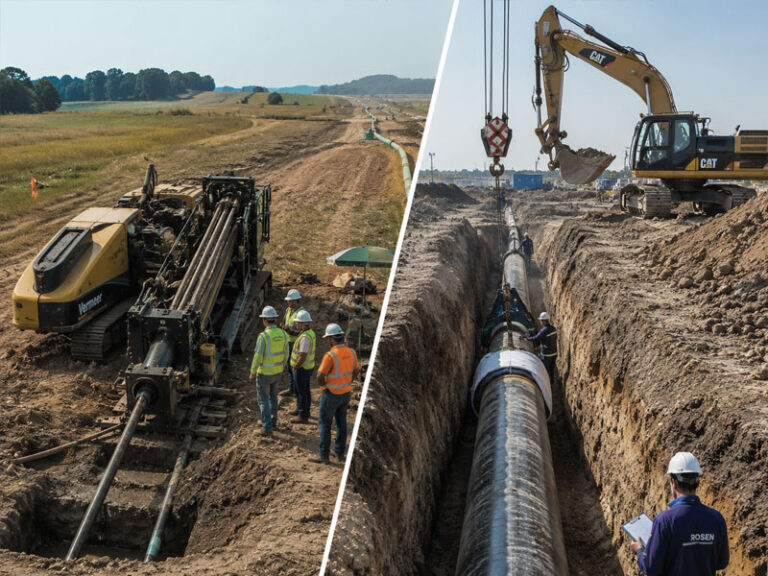
Trenchless technology offers lower environmental impact, reduced traffic disruption, shorter project durations, improved worker safety, and lower life-cycle costs compared with traditional open-cut excavation. While open-cut excavation may be cheaper for shallow installations in undeveloped areas, trenchless methods are generally preferred for urban infrastructure rehabilitation, utility crossings, environmentally sensitive zones, and deep pipeline installations.
Quick Comparison
| Question | Winner |
|---|---|
| Lower Environmental Impact | Sans tranchée |
| Lower Traffic Disruption | Sans tranchée |
| Faster Construction | Sans tranchée |
| Lower Initial Cost | À ciel ouvert |
| Lower Life-Cycle Cost | Sans tranchée |
| Best for Urban Areas | Sans tranchée |
| Best for Deep Installations | Sans tranchée |
| Best for Collapsed Pipes | À ciel ouvert |
1. What Is Trenchless Technology?
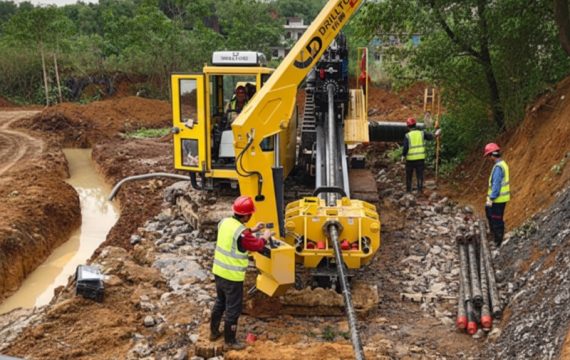
Trenchless technology is a group of underground construction methods used to install, replace, or rehabilitate pipelines and utilities with minimal surface excavation. Common trenchless methods include Horizontal Directional Drilling (HDD), Cured-in-Place Pipe (CIPP) lining, pipe bursting, microtunneling, and pipe jacking. These techniques utilize specialized equipment to work from small entry pits or the ground surface, significantly reducing the need for extensive trenching. The global trenchless equipment market was valued at approximately US$4.98 billion in 2025 and is projected to reach US$7.30 billion by 2032, reflecting the technology’s growing adoption as the primary standard for urban infrastructure renewal. For a deeper dive into specific trenchless pipeline installation methods, explore our detailed guides.
2. What Is Open-Cut Excavation?
Open-cut excavation is a traditional construction method that requires digging a trench from the ground surface to install, repair, or replace underground infrastructure. Also known as cut-and-cover or trenching, this approach involves excavation, pipe installation, backfilling, and surface restoration. While straightforward and familiar to most contractors, it requires extensive shoring, dewatering, and pavement restoration. It is often more cost-effective than trenchless methods in areas without pavement or for shallow installations, but its limitations become pronounced in congested urban settings, at greater depths, and in environmentally sensitive locations.
3. Trenchless vs Open-Cut at a Glance
The following table provides a high-level comparison of the two methods across key decision-making factors:
| Facteur | Technique sans tranchée | Open-Cut Excavation |
|---|---|---|
| Perturbation de la surface | Minimal | Haut |
| Traffic Impact | Faible | Haut |
| Impact environnemental | Low (59-80% less CO₂) | Haut |
| Coût initial | Moderate to High | Low to Moderate |
| Life-Cycle Cost | Lower (30-50% savings) | Plus élevé |
| Construction Speed | Faster (20-60% quicker) | Slower |
| Risque pour la sécurité | Lower | Plus élevé |
| Urban Suitability | Excellent | Limited |
| Deep Installations | Cost-effective | Expensive |
| Utility Congestion | Better | Difficult |
4. Advantages and Disadvantages of Trenchless Technology
Understanding the pros and cons of trenchless methods is essential for informed decision-making. The table below summarizes the key advantages and disadvantages:
| Advantages | Disadvantages |
|---|---|
| Minimal surface excavation | Higher upfront equipment costs |
| Faster construction schedules | Specialized equipment required |
| Lower carbon emissions (59-80% reduction) | Skilled operators and trained crews needed |
| Reduced traffic and business disruption | Not suitable for completely collapsed pipes |
| Lower life-cycle costs (30-50% savings) | Limited effectiveness in heavily obstructed pipes |
| Enhanced worker and public safety | Groundwater management can be challenging |
| Extended pipeline lifespan (30-50+ years) | Access limitations in some site conditions |
5. How Much Does Trenchless Technology Cost?
Cost is a primary consideration for any infrastructure project. While trenchless methods typically have higher upfront costs than open-cut excavation, the life-cycle savings are substantial. The following table provides typical cost ranges for common trenchless methods:
| Méthode | Typical Cost Range (USD per linear foot) |
|---|---|
| Forage directionnel horizontal (HDD) | $10 – $50 |
| Éclatement des tuyaux | $30 – $80 |
| Cured-in-Place Pipe (CIPP) Lining | $50 – $250 |
| Microtunneling | $300 – $1,500 |
Remarque : Actual costs vary significantly based on pipe diameter, installation depth, soil conditions, groundwater levels, project location, surface restoration requirements, and site accessibility. For a detailed trenchless pipeline installation cost analysis, consult our comprehensive pipe bursting cost per foot and HDD installation process guides.
6. What Is the Environmental Impact Comparison?
6.1 Carbon Footprint Reduction
Trenchless methods consistently demonstrate superior environmental performance, particularly regarding carbon emissions. A comparative study of sewer network restoration in Brno, Czech Republic, found that trenchless technology achieved a 59.2% reduction in CO2 emissions compared to excavation technology. The carbon footprint of the trenchless variant was measured at 9.91 tons CO2 equivalent, versus 24.29 tons CO2 equivalent for the open-cut method.
More dramatic results have been documented in large-scale projects. A 25-mile pipeline replacement project in Texas using trenchless methods resulted in only 887 metric tons of CO2 emissions, compared to a calculated 5,379 metric tons from conventional methods—representing an over 80% reduction. In New Mexico, emissions from open-cut excavation were estimated to be 77% higher than those from pipe bursting.
6.2 Reduced Material Displacement and Spoil Generation
The environmental advantages extend beyond carbon emissions. The CIPP method reduces excavated material by up to 95% compared to open-cut methods—a difference of 60 m³ versus 1,200 m³ for a typical project. This substantial reduction in spoils minimizes transportation needs, disposal costs, and associated environmental hazards.
The use of trenchless technologies also reduces water consumption and spoil generation, while bio-based drilling fluids and renewable energy-powered equipment further enhance sustainability outcomes. This aligns with the United Nations Sustainable Development Goals and supports national carbon reduction targets in countries like New Zealand, where thousands of kilometers of aging infrastructure require renewal.
7. What Is the Cost Comparison?
7.1 Initial Costs vs. Life-Cycle Costs
A comprehensive life-cycle cost analysis (LCCA) reveals significant long-term savings. For sewerage rehabilitation in Tanga, Tanzania, the CIPP method offered 48.2% cost savings over traditional open-cut methods over a 50-year lifespan. The net present value (NPV) for CIPP was TZS 4.67 billion compared to TZS 9.01 billion for open-cut excavation.
These savings are driven by:
- Reduced maintenance costs: TZS 110 million/year for CIPP versus TZS 275 million/year for open-cut
- Less frequent rehabilitation: Every 25 years versus every 10 years
- Lower indirect costs: TZS 600 million versus TZS 2,100 million
7.2 How Much Can Trenchless Technology Save?
The cost advantage varies by project type. The table below illustrates typical savings across different applications:
| Type de projet | Typical Life-Cycle Cost Savings |
|---|---|
| Sewer Rehabilitation | 30% – 50% |
| Water Main Replacement | 20% – 40% |
| Gas Pipeline Rehabilitation | 15% – 35% |
| Urban Utility Installation | 25% – 60% |
7.3 Factors Influencing Cost
The cost advantage of trenchless methods becomes more pronounced at greater depths. While open-cut costs increase significantly with depth due to shoring, dewatering, and larger equipment requirements, trenchless costs remain relatively stable. In areas with pavement or surface improvements, trenchless methods eliminate costly restoration that represents a substantial portion of open-cut project budgets.
For gas pipeline rehabilitation, CIPP lining can reduce overall engineering costs by 20% by minimizing excavation, demolition compensation, and the risk of damaging surrounding pipelines. The CIPP flipped lining method also offers a trenchless construction timeline reduction of up to 60% compared to open-cut alternatives.
8. How Much Faster Is Trenchless Construction?
Project timelines are a critical consideration for infrastructure owners. Trenchless methods consistently outperform open-cut excavation in terms of construction speed:
| Trenchless Method | Typical Time Reduction vs. Open-Cut |
|---|---|
| Revêtement CIPP | 50% – 70% |
| Éclatement des tuyaux | 30% – 60% |
| Forage directionnel horizontal (HDD) | 20% – 50% |
9. What Are the Social and Operational Benefits?
9.1 Minimized Traffic Disruption
In urban areas, the social costs of open-cut excavation can be substantial. Trenchless methods mitigate traffic disruptions by up to 78% and reduce business losses by 70%. The City of Clearwater’s Island Estates community water main replacement project demonstrates these benefits: more than 6,000 linear feet of water mains were replaced using pipe bursting, with traffic flowing “almost completely uninterrupted through the tight neighborhood roads that would have come to a near standstill had the roads been cleaved and split apart by an open-cut operation.”
9.2 Reduced Community Impact
Trenchless construction minimizes noise pollution, dust generation, and disruption to green spaces. In the Clearwater project, residents were placed on a temporary water bypass system ensuring minimal service interruption. Each service transfer typically took only a few minutes, and “few even noticed the transition due to the extremely short duration each service transfer took.”
Weston Haggen, lead design engineer for the Island Estates project, noted that “residents have been happier, overall, with the reduced physical scope of the project compared to the larger areas needed for open-cut.”
9.3 Enhanced Safety
Open-cut excavation presents significant safety hazards, with cave-ins posing the most serious danger to workers. Additional risks include falls, falling loads, exposure to hazardous atmospheres, and accidents involving mobile equipment. Trenchless methods reduce worker exposure to these hazards by eliminating or minimizing the need for personnel to work in deep excavations. The controlled environment also reduces risks to the public from open trenches and construction zones.
10. Major Types of Trenchless Technology and Their Applications
Understanding which trenchless method to use for a specific project is crucial. Each technique has unique strengths and is suited for particular applications:
- Horizontal Directional Drilling (HDD): Best for utility crossings, river crossings, and long-distance pipelines. HDD is ideal for installing new pipelines under obstacles without disturbing the surface. For detailed HDD installation process information, refer to our complete guide.
- Éclatement de canalisation : Best for water main and sewer replacement. This method breaks the existing pipe while simultaneously pulling a new one into place.
- Cured-in-Place Pipe (CIPP) Lining: Best for sewer and stormwater rehabilitation. CIPP creates a new pipe within the existing one, perfect for structural rehabilitation without excavation. Learn more about CIPP pipe rehabilitation.
- Microtunneling: Best for large-diameter urban pipelines. This remote-controlled technique provides high accuracy for gravity sewers and other sensitive installations.
For a comprehensive overview of these and other techniques, visit our pipeline construction services page.
11. Where Is Trenchless Technology Used?
Trenchless technology has applications across multiple industries and infrastructure sectors:
- Systèmes d'égouts municipaux – Rehabilitation and replacement of aging sewer networks
- Water Main Rehabilitation – Upgrading potable water distribution systems
- Oil and Gas Pipelines – Installation and maintenance of energy transport infrastructure
- Utility Conduits – Installing electrical and telecommunication conduits
- Telecommunications and Fiber Optics – Laying fiber optic cables with minimal disruption
- Offshore Wind Infrastructure – Landfall construction for subsea power cables
For information on trenchless equipment manufacturers and industry solutions, explore our partner network.
12. Best Trenchless Method by Application
Selecting the right method for your specific project type ensures optimal results. The following table provides clear recommendations:
| Application | Méthode recommandée |
|---|---|
| Sewer Rehabilitation | Revêtement CIPP |
| Water Main Replacement | Éclatement des tuyaux |
| Utility Crossings | Forage directionnel horizontal (HDD) |
| Fiber Optic Installation | Forage directionnel horizontal (HDD) |
| Large Gravity Sewers | Microtunneling |
| Offshore Landfalls | Direct Pipe |
13. When Should You Choose Trenchless Technology?
When Is Trenchless Technology Better Than Open-Cut Excavation?
Trenchless technology is generally the better choice when projects involve urban streets, highways, railways, rivers, environmentally sensitive areas, deep utility installations, or locations where minimizing traffic disruption and surface restoration costs is important. Open-cut excavation is usually preferred for collapsed pipes and shallow installations in undeveloped areas.
The following decision matrix provides clear guidance on method selection based on project conditions:
| Scénario | Méthode recommandée |
|---|---|
| Urban streets and congested areas | Sans tranchée |
| Highway and railway crossings | Sans tranchée |
| Traversées de rivières et de voies navigables | Sans tranchée |
| Deep utility installations | Sans tranchée |
| Environmentally sensitive areas | Sans tranchée |
| Completely collapsed pipes | À ciel ouvert |
| Shallow installations in undeveloped areas | À ciel ouvert |
| Short runs in greenfield rural projects | À ciel ouvert |
14. Real-World Trenchless Technology Case Studies
Concrete data from completed projects provides the strongest evidence for the advantages of trenchless technology.
Case Study Summary
| Project | Method Used | Key Benefit Achieved |
|---|---|---|
| Texas Pipeline Replacement (25 miles) | Trenchless Replacement | Over 80% lower CO₂ emissions |
| Clearwater Water Main Replacement (6,000+ ft) | Éclatement des tuyaux | Traffic maintained; minimal resident disruption |
| Broward County Water Main Upgrade | Trenchless Replacement | EPA-approved; protected sensitive environmental area |
Texas Pipeline Replacement Project
- Scope: 25-mile pipeline replacement
- Résultat : Achieved over 80% lower carbon emissions compared to open-cut alternatives
- Additional Benefit: Significantly reduced land disturbance and surface restoration requirements
Clearwater Water Main Replacement
- Scope: Over 6,000 feet of water main replacement in a residential neighborhood
- Résultat : Traffic flow maintained with minimal resident disruption
- Point à retenir : Residents experienced only minutes of service interruption during service transfers
Broward County Water Main Upgrade
- Scope: Asbestos cement water main replacement in a sensitive equestrian trail area
- Résultat : EPA-approved trenchless replacement that protected the environmentally sensitive location
- Significance: Traditional open-cut methods were rejected entirely due to the high potential for environmental disturbance
15. What Are the Limitations of Trenchless Technology?
While trenchless technology offers numerous advantages, it is not universally applicable:
Higher upfront costs: In areas without pavement or for shallow installations, open-cut methods may be more cost-effective initially.
Specialized expertise requirements: A survey in Tanzania found that 70% of contractors were untrained in trenchless methods, representing a significant barrier to adoption. The lack of formal guidelines and difficulty estimating future expenses also prevents many municipalities from adopting these technologies.
Not suitable for collapsed pipes: Open-cut remains the only viable option for repairing pipes that have completely collapsed or lost their slope.
Root obstruction challenges: Heavily obstructed pipes may require extraction methods not compatible with some trenchless rehabilitation approaches.
Groundwater management: In some projects, unexpected groundwater levels can complicate operations. During a Direct Pipe installation in Virginia, the water table was approximately seven feet higher than anticipated, requiring changes to dewatering methods and construction of an on-site water treatment plant to address PFAS contamination.
16. How to Select the Appropriate Method
The selection between trenchless and open-cut methods should consider multiple parameters:
| Consideration | Sans tranchée | À ciel ouvert |
|---|---|---|
| Profondeur | Cost stable at depth | Cost increases significantly with depth |
| Urban setting | Preferred | Disruptive to traffic and businesses |
| Environmental sensitivity | Excellent for sensitive areas | High environmental impact |
| Pipeline condition | Good for structurally sound pipes | Required for collapsed pipes |
| Initial cost | Higher for shallow installations | Lower for shallow installations |
| Life-cycle cost | Lower over time | Higher over time |
| Project timeline | Generally shorter | Generally longer |
| Safety risk | Lower | Plus élevé |
The Life-Cycle Cost Analysis (LCCA) framework provides a structured approach to evaluate alternatives, incorporating three primary cost components: construction cost, environmental cost, and social cost. This framework integrates parameters such as pipe dimensions, material properties, emissions, energy use, traffic control, noise, and community impacts.
17. Frequently Asked Questions (FAQ)
Is trenchless technology cheaper than open-cut excavation?
While upfront costs can be higher, trenchless methods typically offer 30-50% lower life-cycle costs due to reduced restoration and maintenance expenses. The savings become more significant in urban areas and at greater depths.
What are the main disadvantages of trenchless technology?
The primary disadvantages include higher initial equipment costs, the need for specialized expertise and training, and limitations when dealing with fully collapsed pipes. Additionally, some methods may not be suitable for heavily obstructed pipes.
Is trenchless technology environmentally friendly?
Yes. Studies consistently show that trenchless methods can reduce carbon emissions by 59% to 80% compared with traditional open-cut excavation. They also reduce material waste by up to 95% and minimize disturbance to ecosystems.
How long does trenchless pipe rehabilitation last?
Most trenchless rehabilitation systems, such as CIPP, provide a service life of 30 to 50+ years, significantly extending the lifespan of existing infrastructure. Some systems can last up to 100 years depending on material quality and installation conditions.
What is the lifespan of a trenchless pipeline?
Trenchless pipelines typically last 30 to 100 years, depending on the material used, installation quality, and operating conditions. CIPP liners often provide 50+ years of service life.
Does trenchless technology require excavation?
Trenchless methods require minimal excavation compared to open-cut. Most techniques only need small entry and exit pits, typically 4 to 8 feet wide, rather than a continuous trench spanning the entire pipeline length.
Can trenchless methods increase pipe diameter?
Yes. Pipe bursting can increase pipe diameter by one or two sizes (e.g., 6-inch to 8-inch or 8-inch to 10-inch), making it an excellent choice for capacity upgrades.
Is HDD more expensive than excavation?
HDD typically has higher upfront costs than open-cut for shallow installations. However, for deep installations, urban areas, or crossings requiring minimal disruption, HDD is often more cost-effective overall.
What is the most common trenchless rehabilitation method?
Cured-in-Place Pipe (CIPP) lining is the most widely used trenchless rehabilitation method globally, accounting for approximately 50-60% of all trenchless rehabilitation projects.
When should I choose open-cut excavation over trenchless?
Open-cut remains the preferred method for shallow installations in undeveloped areas, or when a pipe has completely collapsed and must be entirely removed. It may also be more cost-effective for short runs of small-diameter pipe where social and environmental costs are minimal.
Which trenchless method is best for sewer rehabilitation?
Cured-in-Place Pipe (CIPP) lining is the most widely used trenchless rehabilitation method for sewer systems. It is suitable for a wide range of pipe diameters and conditions and creates a seamless, jointless new pipe within the existing one.
Is trenchless construction faster than traditional methods?
Yes. Depending on the specific method, trenchless construction can be 20% to 70% faster than open-cut excavation. CIPP lining and pipe bursting typically offer the most significant time savings.
What is the best trenchless method for water main replacement?
Pipe bursting is often the most cost-effective and efficient method for replacing water mains, as it breaks the old pipe while simultaneously installing a new one of the same or larger diameter.
Is trenchless technology worth the cost?
For most urban, deep, or environmentally sensitive projects, yes. The combination of lower life-cycle costs, reduced social disruption, and environmental benefits typically outweighs the higher initial investment.
Can trenchless technology be used under roads?
Yes. Trenchless methods are specifically designed for installations under roads, highways, and other infrastructure without disrupting surface traffic. For trenchless drilling under roads, refer to our specialized guides.
What pipe materials can be rehabilitated using trenchless methods?
Trenchless rehabilitation works on various materials including clay, cast iron, ductile iron, steel, PVC, and asbestos cement pipes.
Which trenchless method is the most environmentally friendly?
CIPP lining generally has the lowest environmental impact due to minimal excavation and reduced material displacement. All trenchless methods are significantly more environmentally friendly than open-cut excavation.
How deep can trenchless drilling go?
Horizontal Directional Drilling (HDD) can reach depths exceeding 100 feet, depending on equipment and soil conditions. Microtunneling can achieve similar depths with high accuracy.
Is trenchless technology suitable for residential projects?
Yes. Trenchless methods are increasingly used for residential sewer and water line replacements, particularly in neighborhoods with mature landscaping, driveways, and other hardscape features that property owners want to preserve.
18. Decision Guide
Choose Trenchless Technology if:
✓ The project is in an urban area with congested streets
✓ Traffic disruption must be minimized or avoided
✓ Environmental protection and carbon reduction are priorities
✓ Pipelines are deep underground
✓ Long-term life-cycle costs and maintenance matter most
✓ The site has sensitive ecosystems or protected areas
✓ Existing pavement or landscaping must be preserved
Choose Open-Cut Excavation if:
✓ The pipe is completely collapsed and cannot be rehabilitated
✓ The project site is undeveloped with no pavement
✓ Installation depth is shallow (under 6 feet)
✓ Initial capital budget is the primary concern
✓ The pipe run is short and in a rural area
✓ Full access to the pipe is required for inspection or complex repairs
19. Executive Summary
Trenchless technology is generally the preferred solution for urban infrastructure projects because it minimizes excavation, reduces environmental impact, lowers life-cycle costs, and shortens construction schedules. Open-cut excavation remains appropriate for collapsed pipes, shallow installations, and undeveloped areas where restoration costs are minimal. For the majority of municipal and industrial pipeline projects, trenchless methods deliver superior outcomes across environmental, economic, and social dimensions. The trenchless construction benefits are well-documented and continue to drive global adoption.
20. Key Takeaways
For a quick summary of the primary advantages discussed in this guide:
- Carbon Footprint: Trenchless can reduce CO₂ emissions by 59%–80%.
- Material Waste: Excavated material can be reduced by up to 95%.
- Économies de coûts : Life-cycle costs may be 30%–50% lower than open-cut.
- Social Impact: Traffic disruption can be reduced by up to 78%.
- Project Speed: Construction timelines can be shortened by 20%–70%.
- Core Methods: CIPP, HDD, pipe bursting, and microtunneling are the most widely used trenchless methods.
Trenchless technology offers substantial advantages over traditional open-cut excavation across environmental, economic, social, and safety dimensions. The quantifiable benefits include carbon emissions reduction of 59-80%, material displacement reduction of up to 95%, life-cycle cost savings of 30-50%, traffic disruption reduction of up to 78%, and pipeline lifespan extension of 30-50+ years.
While not universally applicable—open-cut remains necessary for collapsed pipes and may be more cost-effective for shallow installations in unpaved areas—the trend toward trenchless adoption is clear. The technology is evolving with AI-enabled mapping and robotic systems, making it increasingly efficient and accessible. As urban populations grow and infrastructure ages, trenchless methods will play an essential role in sustainable infrastructure development. For professional assistance with your next project, explore our full range of pipeline rehabilitation services and maintenance solutions.
Sources and References
This guide references standards, research, and data from leading industry bodies and publications:
- North American Society for Trenchless Technology (NASTT)
- International Society for Trenchless Technology (ISTT)
- American Society of Civil Engineers (ASCE)
- U.S. Environmental Protection Agency (EPA)
- American Water Works Association (AWWA)
- Trenchless Technology Magazine
- Water Research Foundation





 English
  Arabic
  Russian
  Spanish
  French
  Vietnamese
  Polish
  Thai
Thai  Indonesian
  Turkish
  Portuguese