
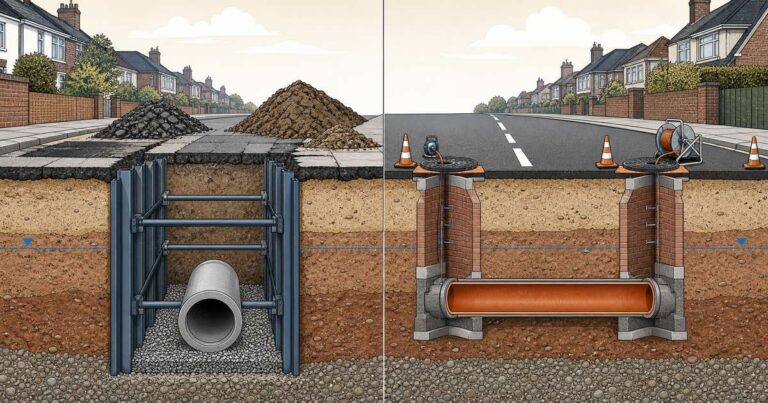
Short answer: In a CIPP vs open cut comparison, CIPP usually delivers the lower whole-life cost on deep, congested or heavily trafficked streets. Open cut keeps the lower direct bid on shallow, straight runs in open ground, where trench and reinstatement costs stay low.
In a CIPP vs open cut decision, both methods reach one goal: a serviceable pipe. Cured-in-place pipe (CIPP) lining cures a resin-saturated tube against the host wall; open-cut replacement removes the pavement and lays a new pipe in the trench.
This guide compares the two on the criteria that decide most rehabilitation budgets: what each method bills for, the disruption it imposes on traffic and frontage, and its life-cycle carbon.
Is CIPP Always Cheaper Than Open-Cut Replacement?
No. The ranking turns on four conditions, and open cut keeps the lower bid where none of them holds.
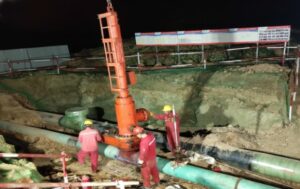
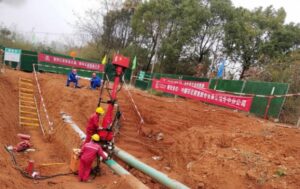
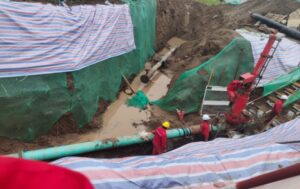
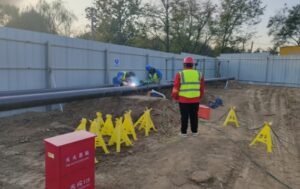
Open-cut replacement bills excavation, support, water control, bedding and surface reinstatement along the whole length. CIPP reaches the pipe through existing manholes, so the road structure stays intact. All four tilt the total toward CIPP:
- Depth. Deeper cover puts more earth pressure on the support and raises the water table to control.
- Traffic. Under a live carriageway, holding the corridor open for months costs more than the lining premium.
- Surface value. Frontage, utilities and a busy route raise the price of every metre of open cut excavation.
- Ground. Running sand, wet ground or contamination add disposal that CIPP mostly avoids.
En résumé : CIPP wins the whole-life total once depth, traffic or surface value is high; open-cut replacement keeps the lower direct bid on simple, shallow runs.
Direct Cost: What Does Each Method Actually Bill For?
Direct cost is what a contractor prices line by line. Open-cut replacement carries a full-length bill: excavate, support and dewater the trench, lay the pipe, backfill, then reinstate the surface along every metre.
CIPP front-loads its cost onto survey, cleaning, a liner whose thickness is set to ASTM F1216, and its cure.
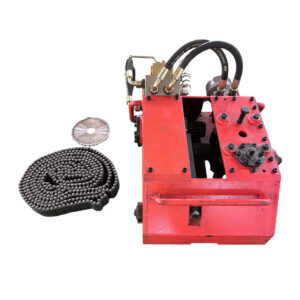
Open-cut cost tracks the length of trench; CIPP cost is largely fixed per section, so its unit rate falls as the run between manholes lengthens. Preparation is a priced step: protruding service connections are cut back with pipe cutting machines.
| Cost line | Remplacement à ciel ouvert | Revêtement CIPP |
|---|---|---|
| Surface works | Full-length break-out and rebuild | Manhole access only |
| Ground support | Support along the open length | None along the run |
| Water control | Pumping for the life of the trench | Flow diverted at the manholes |
| Pipe element | New pipe, bedding and joints | Resin-impregnated liner and cure |
| Spoil | Hauled off and replaced | Minimal arisings |
| Road restoration | Whole length, highway standard | Working areas only |
| Indicative unit cost | Higher as depth and traffic rise | About one-half to one-third of open cut at DN300 |
One published comparison puts CIPP renewal of a DN300 drainage line at about one-half to one-third of the open-cut rate per metre, a 2.79-fold difference on that study’s cost basis. Treat the ratio as indicative for that diameter and boundary.
For the wider side-by-side, see the overview at trenchless technology vs open cut excavation.
Where Does the Cost Crossover Sit?
In a CIPP vs open cut comparison, there is no single depth at which CIPP becomes cheaper. The crossover is a combination of cover depth, water table, traffic and surface value.
| Condition on the run | Open-cut cost driver | Method favoured |
|---|---|---|
| Shallow cover, dry ground | Minimal support or pumping | Open cut, lower bid |
| Deep cover, high water table | Support, pumping and spoil, full length | CIPP |
| Live carriageway or trading frontage | Diversion, traffic management, lost trade | CIPP |
| Highway-standard surface | Full-length reinstatement | CIPP |
| Bore must grow for capacity | New larger pipe | Open cut |
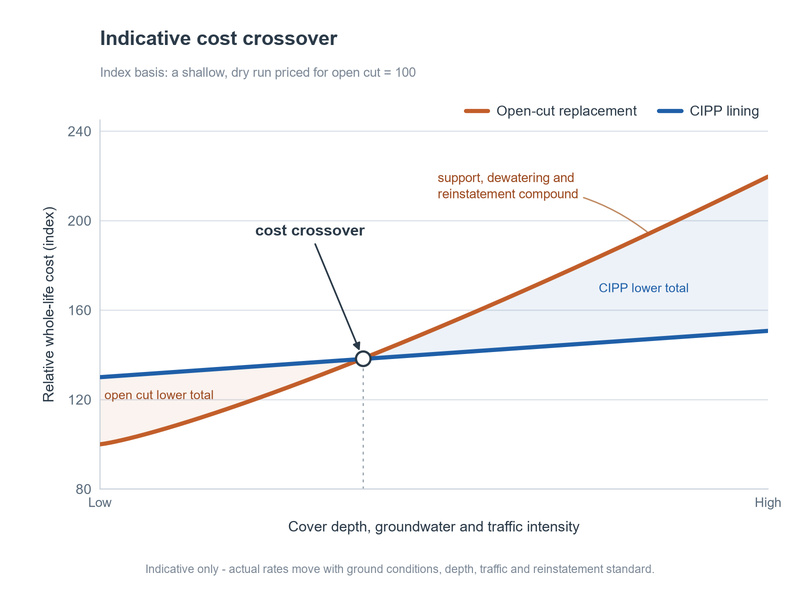
En résumé : treat the crossover as a set of conditions rather than a depth – CIPP becomes the lower total once open cut excavation support, dewatering, traffic and reinstatement outweigh the lining premium.
On renewals we have priced, support and dewatering decide more than the lining premium does.
How Much Disruption Does Each Method Cause?
Disruption is where the two methods differ most visibly, and where much of the cost of open-cut replacement hides. An open cut excavation holds the full alignment throughout: the trench is dug, the pipe laid, the ground backfilled and the surface restored section by section.
CIPP works manhole to manhole, so the carriageway between access points stays open while the liner cures. Traffic disruption collapses from a months-long, corridor-wide occupation to short local activity:
- Traffic diversion. A full-length closure forces queuing, diversions and a lower speed limit.
- Noise and dust. Excavation, haulage and compaction expose residents for the whole open period.
- Road restoration. Freshly reinstated pavement rarely matches the surface, and restoring a long trench shortens the carriageway’s life.

What Do Life-Cycle Comparisons Show on Carbon?
Carbon is now a scoring criterion on many public renewals, and the published life-cycle studies point one way. Trenchless renewal reports about 59%-80% lower carbon emissions than open cut. The saving comes from removing excavation, haulage and reinstatement, which carry most of the embodied carbon.
The 59%-80% band reflects different system boundaries. A study of small sewers put the monetised environmental cost of the trenchless option about 25% lower, while supplier-published figures for single products reach 87%.
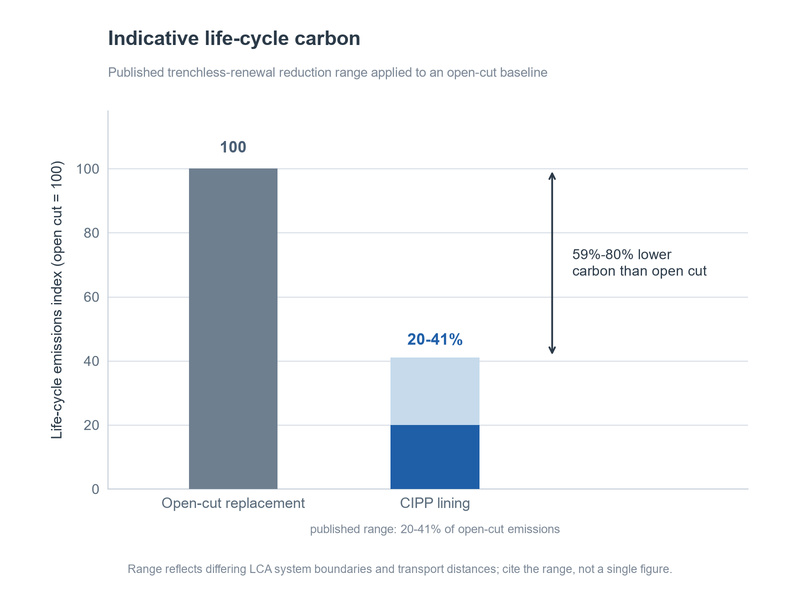
En résumé : published life-cycle studies generally show CIPP cutting carbon emissions well below open cut, but the exact figure depends on the study boundary, so cite the range and not a single number.
Which Social Costs Do Owners Underestimate?
Beyond the direct bill and the visible disruption sits a layer of social cost that rarely enters the tender but reaches the final account. These costs fall on a city or a utility, growing with the length and duration of an open cut excavation.
- Lost tax revenue. Closed frontages trade less, so the authority collects less during construction.
- Public safety exposure. A long, deep excavation kept open for months lengthens the period of risk.
- Pavement life. Repeated reinstatement shortens the carriageway’s life and brings forward resurfacing.
Lost trade, safety exposure and pavement life form the social cost that makes a cheap open-cut bid expensive in whole-life terms, and a study that omits them is not comparing like with like.
Programme: Who Finishes First, and Why?
The two methods carry schedule risk in different places. Open-cut replacement advances linearly: each length is excavated, piped and reinstated before the next opens, so the programme tracks the slowest section.
CIPP runs section by section between manholes. A section is lined and cured in hours to a few days, and once the resin cures the pipe returns to service, so surface occupation is measured in short blocks.
| Programme factor | Remplacement à ciel ouvert | Revêtement CIPP |
|---|---|---|
| Work sequence | Linear, one section at a time | Manhole to manhole |
| Surface occupation | Whole alignment, full duration | Access points only |
| Weather sensitivity | High: the trench floods | Low: work is inside the pipe |
| Time per unit | Days per section plus restoration | Hours to a few days per section |
| Traffic disruption | Months of closure and diversion | Brief local traffic management |
En résumé : open-cut replacement is faster only on short, simple, unconstrained runs; on long, deep or busy corridors the manhole-to-manhole model returns the pipe to service sooner.
When Is Open-Cut Replacement Still the Right Answer?
CIPP renews a pipe that is still sound enough to carry a liner. When the asset itself is obsolete, open cut is the honest recommendation, not a fallback.
- Capacity increase. A larger bore needs a new pipe, so open cut.
- Shallow and unobstructed. A shallow, straight run in open ground keeps the bid lower.
- Severe structural loss. A collapsed pipe leaves a liner nothing sound to support it.
- Road already open. If the street is being rebuilt, reinstatement is already covered.
How Does CIPP vs Open-Cut Compare Side by Side?
| Critère | Remplacement à ciel ouvert | Revêtement CIPP |
|---|---|---|
| Whole-life cost | Lower on shallow, dry runs | Lower on deep, wet or busy streets |
| Cost basis | Per metre of trench | Per lined section |
| Surface impact | Full alignment closed for months | Manhole access only |
| Traffic disruption | Diversions, long term | Brief local management |
| Road restoration | Whole length, highway standard | Working areas only |
| Émissions de carbone | High: excavation and haulage | Lower: published range 59%-80% less |
| Diamètre | Can be enlarged | Set by the existing bore |
| Programme | Linear, weather-sensitive | Section by section, in service fast |
| Typical fit | Shallow, sound ground needing upsizing | Deep, busy, structurally adequate pipe |
Which Five Decision Rules Settle a CIPP vs Open-Cut Choice?
Apply these in order; the first rule that gives a clear answer usually settles the method.
- Read the depth and the water. If the trench needs support beyond a box and continuous pumping, price the open-cut side up.
- Value the surface. On a live road or a shop frontage, put a number on the traffic disruption before comparing cost.
- Check the pipe, not just the bore. If it holds a sound shape and enough wall to carry a liner, CIPP is open; if it has collapsed, open cut wins.
- Ask whether the diameter must grow. Any capacity increase takes the decision to open cut.
- Compare whole-life, not the bid. Add pavement reinstatement, social cost and the shorter pavement life before the two numbers meet.
In a CIPP vs open cut study, price both options on one alignment and write down the assumption that would flip them.
Not sure which side of the crossover your project sits on? Send your alignment, diameter and geotechnical data to the JSW engineering team for a free method review, and we will tell you which method the numbers support.
Questions fréquemment posées
Is CIPP always cheaper than open-cut replacement?
No. CIPP removes the excavation and reinstatement that scale with the open length, so it usually wins on whole-life cost. Shallow, dry, uncongested runs are the exception.
Where is the cost crossover between CIPP and open-cut replacement?
Price both options on the same alignment: the crossover is where open-cut support, dewatering, traffic management and reinstatement exceed the per-section lining premium.
How much does CIPP reduce carbon emissions compared with open cut?
Published life-cycle studies commonly report about 59%-80% lower carbon emissions for trenchless renewal. The wide spread reflects different system boundaries, transport distances and reinstatement assumptions.
Does CIPP cause less traffic disruption than an open trench?
Usually. CIPP works through existing manholes, so a corridor-wide occupation becomes brief activity at the access points. The traffic plan still has to cover the curing window and the flow bypass.
Why does road restoration cost more with open cut?
Open cut breaks the pavement and sub-base along the entire open length and reinstates all of it, often to a highway specification. CIPP leaves the road structure intact and restores only the manhole working areas.
When should you still choose open-cut replacement?
Choose open cut when the asset fails on capacity or condition – a main that must carry more flow, a collapsed run, a street already being rebuilt – or when the run is shallow, straight and uncongested.
What social cost does open-cut replacement add?
The social cost owners often omit includes lost trade and tax revenue along closed frontages, longer public exposure to a deep excavation, and a shorter service life for the reinstated surface.
How Do You Get a Defensible Cost and Carbon Comparison?
A reliable CIPP vs open cut comparison needs five inputs: the CCTV survey and pipe condition, the diameter and depth, the geotechnical and groundwater data, the traffic and frontage constraints, and the acceptable duration of surface occupation.
Owners scoring bids should weight reinstatement cost as well as the headline rate; designers should confirm the liner thickness against the host pipe; contractors should price the number of lined sections. The renewal scope itself sits with réhabilitation de canalisations sans tranchée, and the surrounding asset works with solutions de rénovation des canalisations.
For the method family this decision sits inside, start from how trenchless pipe rehabilitation works. The wider comparison of lining options sits in trenchless rehabilitation methods: CIPP vs pipe bursting vs slip lining.
On carbon and permitting, the boundary logic is set out in environmental impact assessment for trenchless construction.
Final Verdict: Which Method Fits Your Project?
In a CIPP vs open cut decision, neither method ranks first in the abstract: the ranking follows depth, ground and surface.
Choose open cut where the pipe is shallow, the route is uncongested and the line needs a larger diameter.
Choose CIPP where the pipe is sound, the cover is deep, the ground is wet, or the street must keep working – road restoration and lost trade on a long open trench are costs the owner keeps paying.
Where the maths is close, the deciding inputs are the CCTV survey, the geotechnical report and a bidder-priced alternative.
Our crews have lined pipes in live carriageways where an open trench was not an option. The pattern holds: the open-cut bid looks cheaper until restoration, lost trade and carbon are priced in.
As a pipeline engineering company, JSW delivers CIPP renewal, and we recommend open cut without hesitation when the asset, not the bore, needs replacing.
Get a second opinion at no cost. Our engineering team will price CIPP and open-cut replacement on your alignment and tell you which one we would build.
Sources
Each axis of this comparison rests on published material: the cost and programme questions on issuing-body guidance, the carbon range on published life-cycle studies, and the condition assessment on NASSCO PACP practice.
- ASTM, the issuing body for cured-in-place pipe and pipeline rehabilitation standards – supports the direct-cost and renewal sections.
- NASTT, trenchless good-practice guidance – supports the disruption and programme sections.
- NASSCO, PACP condition-assessment practice – supports the survey and decision-rule sections.
- WRc, sewer rehabilitation and life-cycle guidance – supports the carbon-comparison section.










 English
 Arabic
 Russian
 Spanish
 French
 Vietnamese
 Polish
 Thai
 Indonesian
 Turkish
 Portuguese