
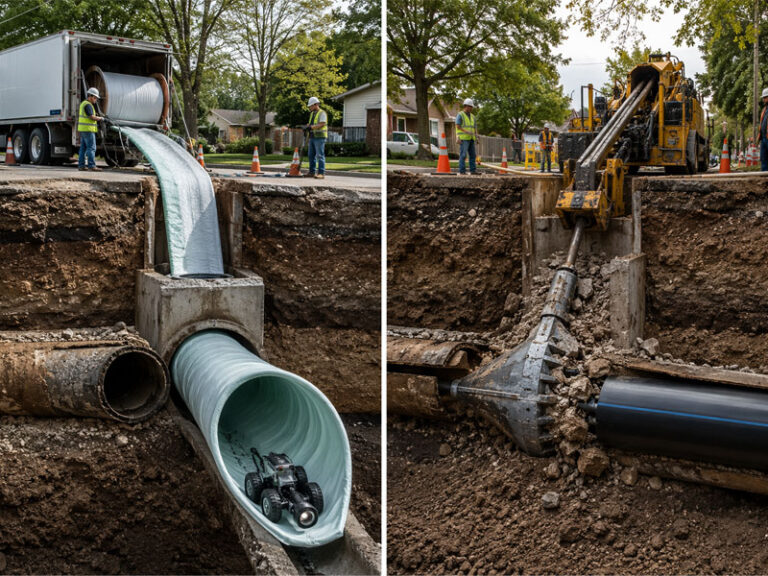
CIPP (Cured-in-Place Pipe) is a trenchless rehabilitation method that repairs an existing pipe by installing a resin liner inside the damaged pipeline. Pipe bursting is a trenchless replacement method that breaks the old pipe and simultaneously installs a new HDPE pipe. The key difference is that CIPP creates a new pipe inside the old one, while pipe bursting removes the old pipe and replaces it with a completely new pipeline.
CIPP vs Pipe Bursting at a Glance
| Méthode | Meilleur pour |
|---|---|
| CIPP | ✓ Structurally stable pipes with minor cracks or leaks ✓ Corrosion inside a sound pipe ✓ Locations with limited excavation access ✓ Lower-cost rehabilitation projects |
| Éclatement des tuyaux | ✓ Collapsed or severely damaged pipes ✓ Complete pipe replacement needs ✓ Diameter upgrade requirements ✓ Long-term infrastructure renewal |
CIPP vs Pipe Bursting: Comparison Summary
| Fonctionnalité | Tuyau durci sur place (CIPP) | Éclatement des tuyaux |
|---|---|---|
| Method Type | Pipe rehabilitation (pipe-in-pipe) | Pipe replacement (old pipe fractured) |
| Removes Old Pipe | Non | Oui |
| New Pipe Installed | No (installs a resin liner) | Yes (installs new HDPE/fusible PVC pipe) |
| Typical Material | Epoxy, polyester, or vinyl ester resin liner | High-density polyethylene (HDPE) or fusible PVC |
| Variation du diamètre | Reduces diameter by ~1/4 inch | Same size or upsizes by one standard diameter |
| Meilleure application | Minor cracks, leaks, corrosion in structurally intact pipes | Collapsed pipes, severe damage, or capacity upgrades |
| Durée de vie prévue | 50+ years (dependent on host pipe) | 50 – 100 years (independent of old pipe) |
| Access Required | One access point (cleanout or small pit) | Two pits (launching and receiving) |
| Typical Cost | $80 – $250 per linear foot | $100 – $300 per linear foot |
Note on Costs: Actual project costs vary significantly depending on pipe diameter, depth, access conditions, soil type, restoration requirements, and local labor rates. The figures above represent typical ranges for residential and light commercial applications in North America.
1. What Is CIPP Pipe Lining?
CIPP, also known as CIPP pipe lining, is a rehabilitation technique that creates a seamless structural liner inside the existing pipeline without removing the original pipe. The process requires minimal excavation—typically just one access pit—and is considered one of the few truly trenchless methods available.
1.1 The CIPP Installation Process
The installation follows a sequence of steps:
- Cleaning and Inspection: The existing pipe is cleaned using high-pressure water jetting and inspected with a CCTV camera to assess the condition and identify blockages or offsets.
- Liner Preparation: A flexible felt or fiberglass tube is saturated with a thermosetting resin (typically polyester, vinyl ester, or epoxy).
- Liner Insertion: The resin-soaked liner is inserted into the host pipe either by inversion (using water or air pressure to turn the liner inside out) or by winching it into place.
- Curing: The liner is inflated and cured using hot water, steam, or UV light to harden the resin and form a structurally sound pipe within the old one.
- Service Reinstatement: Once cured, robotic cutters are used to reopen service connections.
1.2 Advantages of CIPP
- Minimal Excavation: Requires only one access pit, making it ideal for high-traffic urban areas.
- Cost-Effective for Rehabilitation: Lower upfront cost compared to full replacement.
- Versatile: Can be installed in pipes of various materials, including clay, cast iron, PVC, and concrete.
1.3 Limitations of CIPP
- Réduction du diamètre: Reduces internal diameter, which may affect hydraulic capacity.
- Host Pipe Dependency: Long-term success relies on the structural stability of the host pipe.
- Not for Collapsed Pipes: CIPP cannot be installed if the pipe has collapsed or has severe joint displacement.
2. What Is Pipe Bursting?
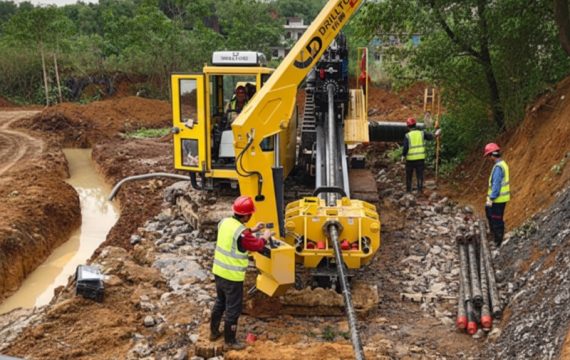
Pipe bursting is one of the most widely used trenchless pipe replacement methods because it allows contractors to replace underground pipelines without full excavation. This method demolishes the existing pipe while simultaneously installing a new one. It is a “semi-trenchless” method because it requires launching and receiving pits, but it disturbs far less surface area than open-cut excavation.
2.1 The Pipe Bursting Process
- Access Pit Preparation: Small excavation pits are dug at both ends of the pipe section.
- Cable and Bursting Head: A cable is fed through the existing pipe, and a conical bursting head (slightly larger than the existing pipe) is attached.
- Fracturing: The bursting head is pulled through, using hydraulic or pneumatic force to break the old pipe outward into the surrounding soil.
- Simultaneous Installation: As the old pipe fragments, a new HDPE pipe is pulled in directly behind the bursting head.
- Service Reconnection: The new pipe is connected to service laterals, and the pits are backfilled.
2.2 Advantages of Pipe Bursting
- Full Replacement: Installs a brand-new pipe, eliminating issues like corrosion or root intrusion.
- Capacity Upsizing: Can increase the pipe diameter by one standard size.
- Longest Lifespan: HDPE pipes have a lifespan of 50 to 100 years, independent of the old pipe.
2.3 Limitations of Pipe Bursting
- Higher Upfront Cost: Equipment and labor are more expensive than CIPP.
- Requires Two Access Points: Access to both ends of the pipe is mandatory.
- Ground Movement: The percussive action can cause ground heave or settlement in some soil types.
3. CIPP vs Pipe Bursting: Cost Comparison
Cost is often the deciding factor in method selection. However, looking only at the price per foot can be misleading. A complete economic analysis considers the project scope and long-term value.
3.1 Typical Cost Ranges
Data from 2024-2026 field studies shows a consistent cost advantage for CIPP on a per-foot basis:
- CIPP: Lower upfront cost, typically $80 to $250 per linear foot for residential and light commercial lines. For larger diameters, the cost can range from $25 to $65 per linear foot for 8-inch lines.
- Éclatement des tuyaux: Higher material and equipment costs, typically $100 to $300 per linear foot for residential and light commercial lines. For 8-inch lines, costs range from $40 to $80 per foot.
3.2 Long-Term Economic Analysis
While CIPP has a lower upfront cost, the total cost of ownership may favor pipe bursting:
- Less Frequent Intervention: Pipe bursting provides a brand-new pipe with a lifespan of up to 100 years. CIPP may fail prematurely if the host pipe continues to deteriorate.
- Municipal Project Data: In one large municipal comparison, replacing both water and sewer lines jointly using pipe bursting for water and CIPP for sewer cost approximately €1,700 per meter, while separate open-cut replacements were comparable. These projects demonstrate that trenchless methods save significant road restoration costs over open-cut.
4. CIPP vs Pipe Bursting: Lifespan Comparison
- CIPP Lifespan: Offers a 50+ year lifespan, but this is highly dependent on the condition of the host pipe. If the host pipe settles or shifts, the liner can be compromised.
- Pipe Bursting Lifespan: Provides a 50 to 100-year lifespan because it installs a completely new HDPE pipe. This lifespan is independent of the old pipe, making it a more permanent solution.
5. CIPP vs Pipe Bursting vs Traditional Open-Cut Excavation
Many project owners also consider traditional open-cut excavation as a third option. This comparison helps contextualize the trenchless methods against conventional construction.
| Méthode | Travaux d'excavation requis | Typical Cost | Durée de vie | Meilleur cas d'utilisation |
|---|---|---|---|---|
| CIPP | Minimal (one access pit) | $80 – $250/ft | Plus de 50 ans | Rehabilitation of sound pipes |
| Éclatement des tuyaux | Limited (two pits) | $100 – $300/ft | 50 – 100 years | Replacement and upsizing |
| Open-Cut Excavation | Full trenching | $75 – $200/ft + restoration | 75+ years | New construction or complete reconstruction |
Open-cut remains the most expensive when restoration costs (pavement, landscaping, traffic control) are factored in, often exceeding trenchless methods by 30–50% in urban settings.
6. CIPP vs Pipe Bursting Selection Guide
Selecting the right method depends on a systematic evaluation of your pipeline’s condition and project goals. Use this decision table to guide your choice:
| Project Condition | Méthode recommandée |
|---|---|
| Minor cracks or leaks in a structurally sound pipe | CIPP |
| Corrosion inside a structurally stable pipe | CIPP |
| Limited excavation access (one pit available) | CIPP |
| Lowest upfront cost is the primary concern | CIPP |
| Collapsed or severely damaged pipeline | Éclatement des tuyaux |
| Need to increase pipe diameter | Éclatement des tuyaux |
| Existing pipe is at the end of its useful life | Éclatement des tuyaux |
| Need a completely new, independent pipe system | Éclatement des tuyaux |
In summary:
- Choose CIPP if: Your pipe is structurally stable, you have limited access (one pit), and your primary goal is cost-effective rehabilitation.
- Choose Pipe Bursting if: Your pipe is collapsed, you need to upsize, or you seek a permanent, long-term replacement.
7. Frequently Asked Questions (FAQ) About CIPP and Pipe Bursting
Q1. Is pipe bursting better than CIPP?
Not necessarily. Pipe bursting is better for collapsed pipes or when upsizing is needed. CIPP is better for structurally sound pipes where minimal disruption and lower cost are priorities. The “better” method depends entirely on the pipe’s condition and project objectives.
Q2. Can CIPP increase pipe capacity?
No. CIPP reduces the internal diameter by approximately 1/4 inch. If you need to increase capacity, pipe bursting is the only trenchless method that can upsize the pipe.
Q3. Does pipe bursting damage surrounding utilities?
When executed properly, pipe bursting minimizes disturbance to surrounding utilities. However, a thorough utility locate and ground-penetrating radar survey are essential before any project to mitigate risks.
Q4. How long does CIPP installation take?
For a typical residential lateral, CIPP can be installed and cured within 4 to 8 hours. Larger municipal projects may take 1 to 3 days, depending on pipe length and curing method.
Q5. How long does pipe bursting take?
Pipe bursting usually takes 1 to 2 days for a residential line, including pit excavation, bursting, and backfilling. Larger projects may take longer.
Q6. What pipe materials can be burst?
Pipe bursting is most effective on brittle materials like cast iron, clay, and concrete. It can also be used on ductile iron with specialized equipment, but it is less effective on PVC due to its flexibility.
Q7. Is CIPP suitable for water mains?
Yes, CIPP is used for water mains, but only with potable-grade epoxy liners that are NSF-61 certified. This ensures the liner does not leach chemicals into the drinking water.
Q8. Which method is cheaper, CIPP or pipe bursting?
Generally, CIPP is cheaper on a per-foot basis for rehabilitation. Pipe bursting is more expensive due to higher material and equipment costs. However, pipe bursting provides a permanent replacement, which may offer better long-term value.
Q9. Can CIPP repair collapsed pipes?
No. CIPP requires a passage through the pipe to insert the liner. If the pipe has collapsed, pipe bursting is the appropriate solution.
Q10. Which method lasts longer?
Pipe bursting typically lasts longer (50-100 years) because it installs a completely new HDPE pipe. CIPP offers a 50+ year lifespan, but this depends on the stability of the host pipe.
8. Technical References and Industry Standards
This article references industry standards and guidelines to ensure technical accuracy. These standards are widely recognized in the trenchless industry and are used by engineers and municipal agencies for project specifications:
- ASTM F1216: Standard Practice for Rehabilitation of Existing Pipelines and Conduits by the Inversion and Curing of a Resin-Impregnated Tube (CIPP).
- ASTM F1743: Standard Practice for Rehabilitation of Existing Pipelines and Conduits by Pulled-in-Place Installation of Cured-in-Place Pipe (CIPP).
- ASTM F2019: Standard Practice for Rehabilitation of Existing Pipelines and Conduits by Pulled-in-Place Installation of Glass Reinforced Plastic (GRP) CIPP.
- ASTM F2657: Standard Practice for Pressure Pipeline Renewal by Pipe Bursting.
- NASSCO: The National Association of Sewer Service Companies provides PACP/MACP/LACP assessment standards and certification for trenchless rehabilitation practices.
About the Author: JSW Engineering Team
JSW is a leading provider of pipeline infrastructure solutions, specializing in trenchless technologies for pipeline rehabilitation, maintenance, and new construction. Our engineering team brings decades of combined field experience, having delivered high-integrity solutions for municipal water, wastewater, and industrial pipeline systems across North America.
Trenchless Pipeline Assessment
Not sure whether CIPP or pipe bursting is right for your project?
Our engineers can evaluate:
- ✓ Existing pipe condition and failure type
- ✓ Diameter requirements and capacity needs
- ✓ Soil conditions and geotechnical factors
- ✓ Installation access limitations
- ✓ Long-term lifecycle cost analysis
Get a professional trenchless rehabilitation recommendation tailored to your specific project.









 English
  Arabic
  Russian
  Spanish
  French
  Vietnamese
  Polish
  Thai
Thai  Indonesian
  Turkish
  Portuguese