
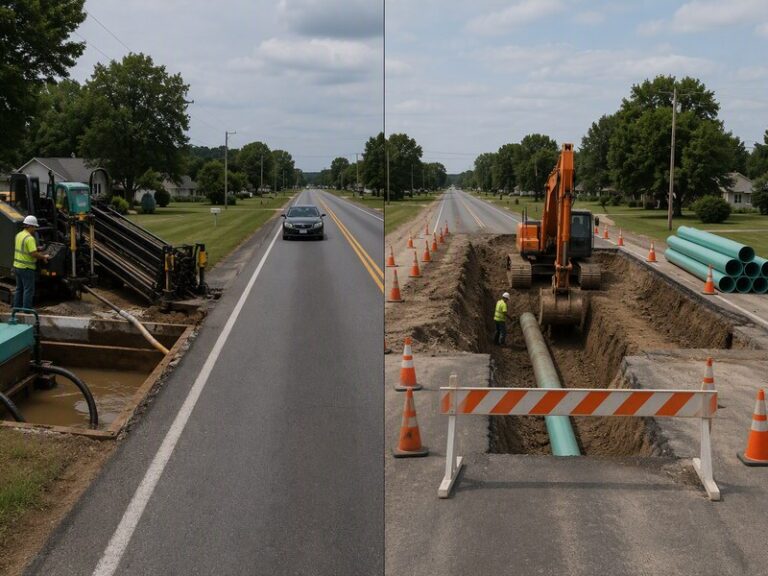
Directional drilling vs trenching is a total-cost decision, not a unit-price decision: horizontal directional drilling (HDD) usually wins wherever the route crosses pavement, landscaping, waterways, rail or live utilities, and open-cut trenching wins in open ground where restoration is cheap.
The per-foot rate only describes the machine working; the finished price is decided by what happens to the surface above the pipe, and that is where most budget comparisons go wrong.
This guide explains what each directional drilling vs trenching quote actually covers, why surface restoration can multiply an open-cut price by two to five times on paved routes, the 2026 cost ranges published for both methods, and the project types where boring wins on total installed cost and the types where it does not. It closes with a priced example of a 300-foot road crossing and a bid-comparison checklist you can reuse.
Points clés à retenir
- The per-foot gap between directional drilling vs trenching is rarely the deciding number; restoration, traffic control and schedule risk routinely outweigh it.
- Boring wins where the surface is expensive: roads, driveways, waterways, wetlands, rail corridors and congested urban alignments.
- Trenching wins in open fields, short shallow runs and rock or cobble ground where drill tooling struggles.
- A contractor that runs both methods can quote the same scope both ways, which is the only honest way to compare them.
Bore vs. Trench: Two Ways to Install a Pipe, Two Different Cost Shapes
HDD is a steerable trenchless method. A drilling rig launches a pilot bore from a small entry pit, guides it along a curved underground path, reams the hole to the required diameter, and pulls the product pipe back through in one continuous operation.
The surface between the pits is never opened, which is why horizontal directional drilling services are specified for roads, yards, riverbanks and other surfaces that must stay intact. Directional boring is the same operation under a different name, used widely for telecom, gas, water and electric utility work.
Open-cut trenching is the conventional method most people picture when they think of laying pipe. Crews excavate a continuous trench along the full route, lay bedding and pipe, backfill in compacted lifts, and restore the surface. It is simple, well understood and, in the right setting, genuinely hard to beat on price.
Because the two methods disturb completely different amounts of surface, they carry different cost structures. Trenching spreads cost along the whole length: excavation, shoring, backfill, compaction and restoration for every foot. Boring concentrates cost at two points: mobilization and machine time, plus drilling fluid handling and pit restoration.
Directional Drilling vs Trenching: The Per-Foot Numbers Everyone Asks For
For horizontal directional drilling, cost guides published in 2026 put the rate at roughly $10 to $30 per linear foot on average for typical utility work, with wider planning ranges of $12 to $60+ per foot for residential and light-commercial bores as diameter, depth, soil and congestion climb. Conventional trenching commonly runs $8 to $40+ per linear foot in similar conditions. The bore method sits above ordinary trenching on unit price almost everywhere, and that single fact drives most of the confusion in this comparison.
Unit rates leave out the items that decide the job: mobilization of $250 to $800+ per move for typical small rigs (climbing toward $1,000-$2,500 for road-crossing setups), minimum callouts of $500 to $1,500+ on small jobs, entry and exit pit restoration, drilling fluid mixing and disposal, compaction testing and surface restoration of any kind. Two quotes that both claim $20 per foot can produce very different invoices.
| Méthode | Typical 2026 range (per linear foot) | What the range includes | What it excludes |
|---|---|---|---|
| Directional boring (HDD) | $10-$30 average; $12-$60+ full planning range | Pilot bore, reaming, pullback, drilling fluid on site, crew and rig | Mobilization, pits and restoration, fluid disposal, tie-ins, contingency for rock |
| Open cut | $8-$40+ | Excavation, pipe laying, backfill | Saw-cutting, pavement and base removal and replacement, compaction testing, traffic control, landscaping restoration, dewatering |
What moves the number inside those ranges:
- Bore length: a short crossing carries the full mobilization share; longer bores spread it over more feet.
- Pipe diameter and depth: bigger reamers and deeper cover mean more passes, more drilling fluid and more machine time.
- Ground conditions: uniform clay and sand drill fast; cobble, running sand and rock raise the rate sharply.
- Congestion: every unmarked utility adds potholing, re-route design or hand excavation.
- Region and season: local labor rates, permit fees and winter conditions shift both methods together.
Why the Trench Price Triples: The Restoration Multiplier
The most common comparison error is stopping at excavation. On any paved or landscaped route, open-cut trenching triggers a chain of items that never appears in the per-foot number: saw-cutting, pavement and base removal, spoil disposal, backfill and compaction testing, base course replacement, final paving or concrete, striping, and replanting of lawns, beds and irrigation lines.
The numbers are large. A national repair-cost index for 2026 prices full asphalt replacement at $8 to $12 per square foot and concrete driveway replacement, demolition included, at $14 to $22 per square foot.
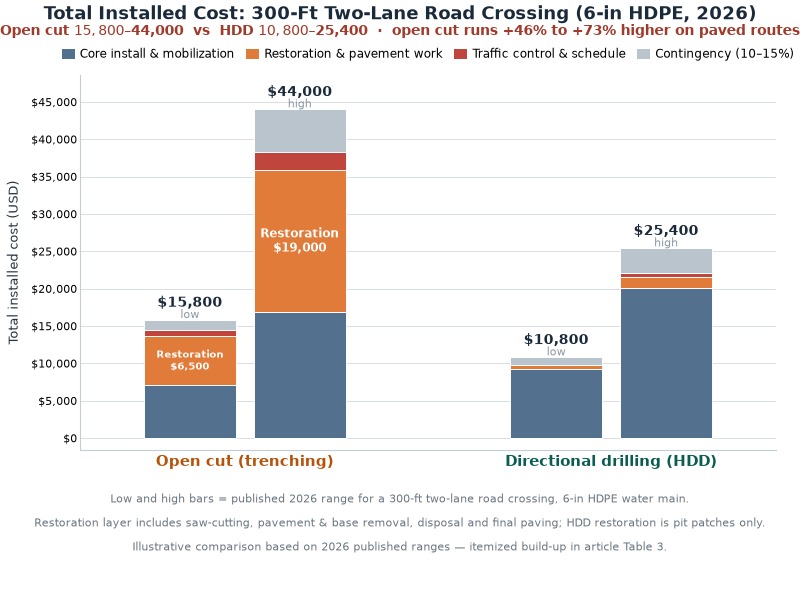
A 300-foot crossing of a two-lane road disturbs thousands of square feet of surface; contractor case data from 2025 and 2026 shows pavement restoration alone adding $5,000 to $20,000+ to open-cut road crossings. Add landscaping, base repair and compaction testing and total restoration pushes the finished cost of a paved-route trench to two to five times its direct installation cost.
Traffic control is the second silent line: lane closures, flagging, detour signing, restricted work hours and, on busy roads, police details or night-shift premiums. Businesses along the route lose access for the duration, and municipalities lose the road itself. The schedule stretches as well, because paving and concrete restoration are weather-dependent and often wait weeks behind the installation crew.
Utility strikes are the third silent line. The Common Ground Alliance estimates that damage to buried utilities costs the U.S. economy about $83.2 billion per year, and excavation is the leading cause. Open-cut work exposes the full route to the bucket, while OSHA requires a protective system for any trench deeper than 5 feet, adding shoring or sloping cost that unit rates rarely state.
When Directional Drilling Actually Saves Money
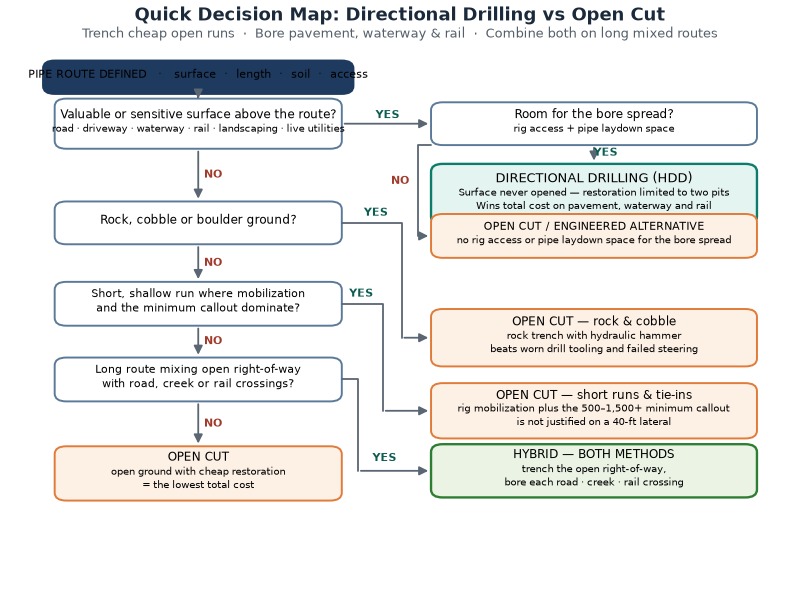
The pattern across every scenario below is consistent: directional drilling vs trenching stops being a debate about machine rates and becomes a debate about the cost of the surface above the pipe. The more valuable, sensitive or busy the surface, the more the bore pays for itself.
University research on urban installations supports the pattern: a peer-reviewed comparison found open-cut construction roughly 15 to 30 percent more expensive than horizontal directional drilling across typical urban crossing mixes, once restoration and social costs are counted — a gap that runs wider, 46 to 73 percent, on full-width pavement crossings like the priced example below.
| Scénario | The open-cut cost trap | Why the bore wins on total cost |
|---|---|---|
| Roads and highways | Lane closures, phased traffic control, full-width pavement restoration, permit conditions | Crossing typically complete in one to two days; driving surface untouched, no pavement settlement joints |
| Driveways, sidewalks, landscaping | Saw-cutting, repaving, replanting mature trees and beds | Disturbance limited to two small pits; property access preserved |
| Rivers, streams, lakes | Dewatering, flow diversion, dredge or fill permits, turbidity controls | Bore passes beneath the bed; the watercourse is never opened |
| Wetlands and protected habitat | Disturbance permits often denied or heavily conditioned | Regulator-preferred; often the only method the permit allows |
| Rail corridors | Track shutdown windows, flagging, strict restoration specifications | Under-track bore scheduled around rail traffic; no track removal |
| Congested urban corridors | Business downtime, multiple live utility crossings, restoration of premium surfaces | Steered around existing lines after potholing; disruption measured in days |
| Long or deep routes | Restoration cost accumulates with every foot; settlement joints appear over time | Surface cost is fixed regardless of length; depth is no obstacle |
Our bid reviews on municipal water and gas programs match this pattern: whenever a route crossed pavement or a watercourse, the boring price beat the open-cut total even when the bore unit rate was higher. The saving usually came from the items neither crew digs for: restoration, traffic control and schedule.
When Open Trenching Is the Honest Cheaper Choice
Open-cut trenching is not the fallback option; in four situations it is the genuinely cheaper and more reliable choice:
- Open, undeveloped ground: fields, farmland and new subdivisions with no surface improvements; experienced crews can exceed 1,000 feet per day in simple soil.
- Short, shallow runs: a 40-foot service lateral or a tie-in does not justify rig mobilization, and small jobs collide with the $500 to $1,500+ minimum callout.
- Rock and cobble: drill tooling wears and steers poorly in boulder ground, where a rock trench with a hydraulic hammer is often faster and cheaper.
- Precision gravity work: short sewer runs requiring exact line and grade can be installed and inspected in an open trench more reliably than by bore.
Independent costing supports the nuance. An environmental value engineering assessment of a simple open-ground crossing found HDD totals roughly 10 to 15 percent higher than open cut in that specific case — the premium that remains on longer runs once mobilization spreads, with no surface value to protect, no restoration bill and no schedule pressure. That is exactly what field experience predicts, and honest method selection means naming those cases out loud instead of selling boring on every job.
The strongest projects usually combine both methods. A subdivision water main, for example, may be trenched through the open right-of-way and bored under the two roads and the creek it crosses. That hybrid approach is how the most cost-effective utility programs are actually built.
Worked Example: A 300-Foot Road Crossing, Priced Both Ways
To make the HDD vs open cut comparison concrete, we priced a 300-foot, 6-inch HDPE water main crossing beneath a suburban two-lane road with paved shoulders at 4 to 6 feet of cover, using published 2026 ranges. The estimate is illustrative and for planning only: your region, soil and permit fees will move the lines, but the shape of the directional drilling vs trenching comparison will not.
| Cost item | Open cut | Directional boring (HDD) |
|---|---|---|
| Mobilization and setup | $800-$1,800 | $1,000-$2,500 |
| Locates, potholing, permits | $600-$1,800 | $600-$1,800 |
| Pilot bore, reaming, pullback (300 ft) | Sans objet | $5,400-$10,500 |
| Excavation, shoring, dewatering | $2,500-$6,000 | Sans objet |
| Bedding, pipe and fittings | $2,000-$4,500 | $2,000-$4,500 |
| Saw-cutting, pavement and base removal, disposal | $1,500-$4,000 | Sans objet |
| Backfill, compaction and testing | $1,200-$2,800 | $300-$800 (pits only) |
| Traffic control and flagging | $800-$2,400 | $0-$500 |
| Surface restoration (paving, shoulders) | $5,000-$15,000 | $500-$1,500 (pit patches) |
| Contingency, 10-15 percent | $1,400-$5,700 | $1,000-$3,300 |
| Total installed cost, illustrative | $15,800-$44,000 | $10,800-$25,400 |
The comparison flips where the surface is cheap. The same 300 feet through an open field trenches for roughly $6,000 to $12,000 all-in, because the restoration and traffic lines collapse and the bore price barely changes, which is why directional drilling cost per foot alone never answers the question. The bore premium is widest on short runs like this one; on longer open-ground mains, mobilization spreads across more feet and the premium narrows toward the low teens, in line with the value-engineering figures discussed above.
A single 60-foot driveway crossing can also favor trenching once mobilization and the minimum callout are counted, which is why the directional drilling vs trenching answer is site-specific and why both methods belong in the same conversation.
On larger-diameter steel pipelines the arithmetic of HDD vs open cut is identical but the numbers are bigger: full-width pavement demolition and weeks of staged closures against a crossing completed in a few working days, with the pipe string fabricated and welded on the entry spread.
How to Compare Bore and Trench Bids Without Getting Fooled
Every line above points to one discipline: when you compare directional drilling vs trenching, price both methods on the same scope sheet. When depth, diameter, length, restoration standard, mobilization and tie-ins match, the cheaper method usually reveals itself.
- Hand both contractors the same alignment, depth, diameter and length.
- Define the restoration standard explicitly: full-lane mill and overlay, trench-width patch, or grass and seed.
- Ask what is excluded: mobilization, traffic control, dewatering, compaction testing, drilling fluid disposal.
- Require itemized pricing, not a single per-foot number.
- Agree how unknowns are priced: rock, cobble, unmarked utilities and re-routes as unit prices or allowances, not surprises.
- Confirm 811 locates and potholing are in the scope for every utility crossing.
- Check the schedule assumptions: lane-closure windows, restoration lead times, weather exposure.
- Ask for reference crossings in similar soil, depth and surface conditions, and inspect one if possible.
A contractor that operates both directional drilling and open-cut crews can quote the same job both ways from real production data rather than catalogue theory. That neutrality is worth more than any discount on a favorite method.
Want to see this comparison on your own alignment? Take the checklist above to your route data before you ask for bids — and when you want an engineering team to run the same side-by-side review for you, how to send your project details is described at the end of this guide.
Directional Drilling vs Trenching FAQ
Is directional drilling cheaper than trenching?
It depends on the surface, not the method. Over open ground with cheap restoration, trenching is usually cheaper. Across pavement, waterways, rail or landscaped areas, HDD vs open cut usually favors the bore on total installed cost, because boring removes the restoration, traffic control and schedule lines that dominate an open-cut invoice. The only reliable test is pricing the same directional drilling vs trenching scope both ways.
How much does directional drilling cost per foot?
2026 cost guides put directional drilling cost per foot at roughly $10 to $30 on average for utility work, with planning ranges of $12 to $60+ as diameter, depth and ground conditions climb. Conventional trenching commonly runs $8 to $40+ per linear foot. Mobilization of $250 to $800+ and minimum callouts of $500 to $1,500+ apply to small jobs, so short crossings always cost more per foot than long ones.
When should you avoid directional drilling?
Avoid boring in open, easily restored ground where short runs make mobilization dominant; in rock, cobble or boulder ground where tooling wears and steering fails; where there is no laydown space for pipe string assembly; and for short gravity sewer runs that demand exact line and grade. In those cases open-cut trenching is faster, cheaper and more reliable.
What is the difference between directional boring and trenching?
Directional boring (HDD) installs pipe through a steered underground bore from a small entry pit to a small exit pit, leaving the surface between them untouched. Trenching excavates a continuous open trench along the full route, lays the pipe, then backfills and restores the surface. Boring costs more per foot and less in total where the surface is valuable; trenching is the reverse.
Does directional drilling damage roads, yards or existing utilities?
Surface damage is limited to the entry and exit pits, typically a few hundred square feet, because the bore path itself never opens the surface. Utility risk is managed before the bore starts: 811 locates plus potholing expose every crossing, and the drill path is designed above or below existing lines. The main residual risk, inadvertent drilling-fluid returns (frac-outs) in weak ground, is controlled with a fluid plan and monitored during drilling.
How much does it cost to bore under a road?
Boring a 6-inch water main under a two-lane road runs roughly $10,800 to $25,400 total installed cost for a 300-foot crossing in 2026 pricing. Open cut on the same scope prices out around $15,800 to $44,000 once pavement restoration, traffic control and contingency are counted. Shorter crossings cost more per foot because mobilization dominates.
How long does directional drilling take compared with open cut?
A bore under a two-lane road typically completes in one to two working days, and the road surface never closes. Open cut on the same crossing runs longer, because pavement restoration is weather-dependent and often trails the install crew by weeks.
How JSW Helps You Price Bore vs. Trench Honestly
JSW is a pipeline engineering and construction company that operates both trenchless and conventional crews, so we can quote the same scope both ways. Our work spans pipeline construction services, trenchless pipeline repair technology and pipeline maintenance services.
Crossing projects are supported by pipeline automatic welding technology et pipeline cold bending for string fabrication on long pullbacks, pipeline hot tapping and plugging services for live tie-ins that avoid shutdowns, and pipeline cutting machines and related tooling used to prepare pipe on site. Horizontal directional drilling remains the method we run most often, but our engineering team also plans open-cut programs and hybrid routes when the surface and soil make them the lower-cost answer.
What distinguishes our support is engineering-first method selection:
- Method-neutral pricing: the same scope sheet priced by both our bore and open-cut teams, from real production records rather than assumptions.
- Full-chain execution: bore planning, pipe string welding and cold bending, pullback, tie-ins, testing and restoration under one contract.
- Transparent line items: itemized restoration, drilling fluid handling, contingency and change-order rates agreed before work starts.
- Field-verified records: daily drilling logs, compaction tests and as-builts that stand up to audit.
If you are weighing directional drilling vs trenching for an upcoming line, send us the alignment, pipe diameter, geotechnical data and surface conditions, and our engineering team will return a scoped, itemized comparison of both methods within five working days, with a recommendation even when it is not the method we bid first.
Not sure whether boring or trenching is cheaper for your site?
Send us the route and pipe details and get both methods priced on one scope sheet, with restoration and traffic control itemized. Free engineering review within five working days. Reach us via our contact form.





































 English
  Arabic
  Russian
  Spanish
  French
  Vietnamese
  Polish
  Thai
Thai  Indonesian
  Turkish
  Portuguese