
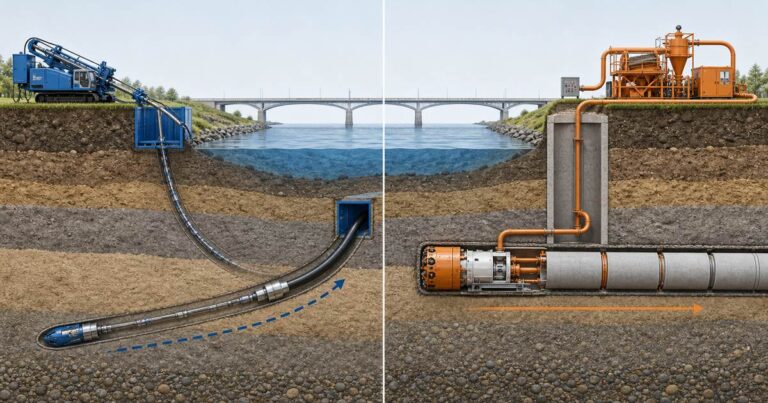
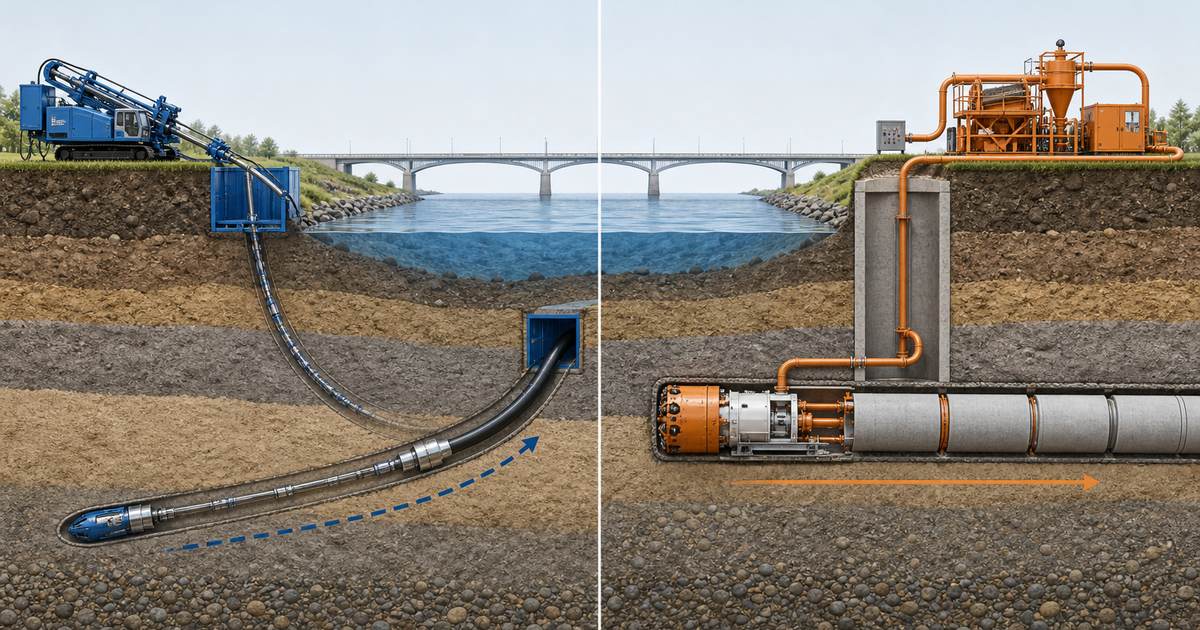
Short answer: in the HDD vs microtunneling comparison, HDD wins for long, curved, cost-efficient pressure crossings, while microtunneling wins when laser-guided line-and-grade accuracy is required for gravity sewers, large diameters, or unstable ground.
This guide explains how each trenchless method works, compares accuracy, cost, soil compatibility, diameter and length limits, and ends with a 7-factor decision checklist you can hand to your engineer or contractor before they prepare a quote.
What Is Horizontal Directional Drilling (HDD) and How Does It Work?
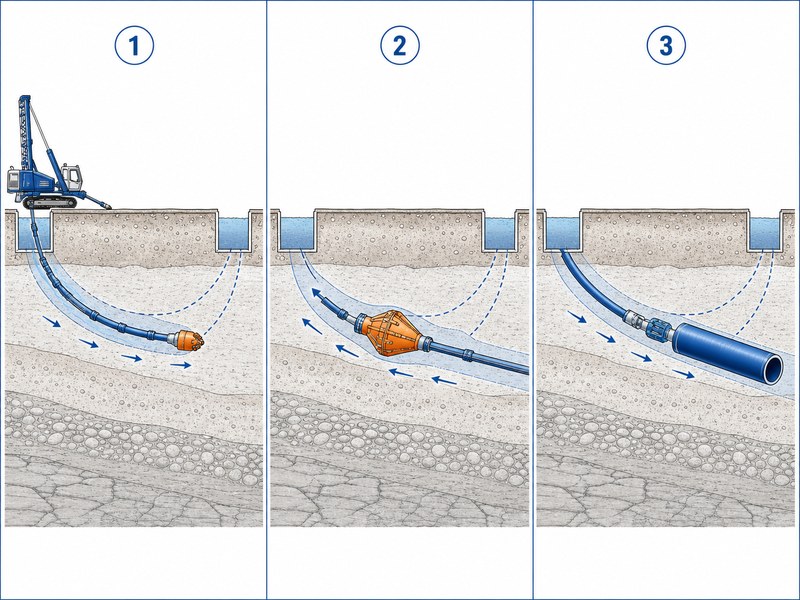
Horizontal directional drilling (HDD) is a steerable, surface-launched trenchless pipe installation method. The HDD drilling rig stays on the surface, and the bore follows a controlled arc from an entry pit to an exit pit, so no launch shaft or reception shaft is excavated.
HDD is executed in three stages:
- Pilot bore. A steerable drill head bores a pilot hole, typically 50-125 mm (2-5 in.) in diameter, along the planned path. An electronic locating system tracks the drill head, and a bentonite-based drilling fluid lubricates the bore, stabilizes the hole, and carries cuttings to the surface.
- Reaming. A reamer is pulled back through the pilot hole, usually in several passes, until the bore diameter is roughly 50 percent larger than the product pipe.
- Pullback. The product pipe, typically HDPE, steel, or PVC, is attached to the drill string and pulled through the finished borehole in a single continuous operation.
Across the industry, HDD is one of the most widely applied trenchless technologies for pressure utility crossings. Typical single bores range from 50 to 1,200 mm (2-48 in.) in diameter, exceed 1,800 m in length, and reach depths of 15 m or more, per ASTM F1962, the standard practice for HDD design.
Because the bore follows a curve, the pipe must be able to flex. That is why HDD suits pressure pipelines such as water mains, gas lines, force mains, cables, and conduits.
What Is Microtunneling and How Does It Work?
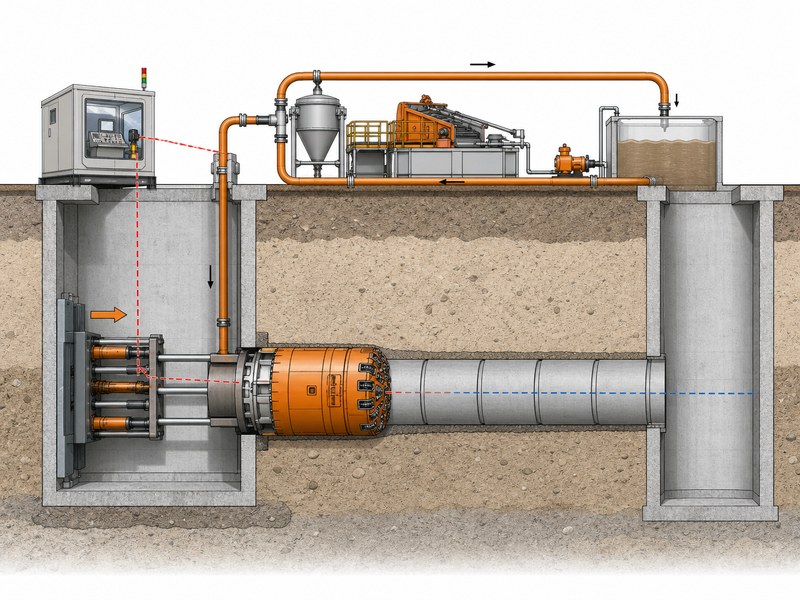
Microtunneling, spelled microtunnelling in some regions, is a pit-launched, remotely controlled trenchless technology. A microtunnel boring machine (MTBM) excavates the ground while the product pipe is jacked into place behind it, so excavation and pipe installation happen as one continuous, pipe-jacking-based operation.
The MTBM is lowered into a launch shaft and steered by laser and gyroscopic guidance systems monitored by an operator on the surface. A closed-loop slurry system keeps the excavation face under continuous pressure, which supports loose or water-bearing soils and prevents the bore from collapsing.
A slurry separation plant on the surface removes the cuttings. As the MTBM advances, hydraulic jacks push each new pipe section forward from a thrust wall at the back of the launch shaft.
Microtunneling holds line and grade to about ±10 mm and installs pipes from roughly 300 to 3,000 mm (12-120 in.) in diameter. Typical single drives run 100-300 m without intermediate jacking stations and extend beyond 1,500 m with jacking stations, per NASTT good practices guidelines. Rock cutterheads allow boring through soft clays, silts, sands, high water tables, and hard rock.
HDD vs Microtunneling: Key Differences at a Glance
| Paramètres | HDD | Microtunneling |
|---|---|---|
| Launch setup | Entry and exit pits only; rig on the surface | Launch and reception shafts with thrust wall |
| Guidance | Electronic locating system (walkover or wireline) | Laser and gyroscopic guidance, remote control |
| Typical accuracy | ±100 mm | ±10 mm |
| Diamètre du tuyau | 50-1,200 mm (2-48 in.) | 300-3,000 mm (12-120 in.) |
| Drive length | Up to 1,800 m or more in one bore | 100-300 m typical; 1,500 m+ with jacking stations |
| Alignment profile | Curved arc | Straight or gently curved line and grade |
| Best soils | Clay, silt, sand, soft to medium rock | Soft and unstable soils, high water table, rock |
| Typical applications | Pressure lines, cables, conduits, long crossings | Gravity sewers, storm drains, large-diameter crossings |
| Surface footprint | Minimal; two small pits | Larger; shafts plus slurry separation plant |
| Relative cost | Lower mobilization and crew cost | Higher equipment, crew, and setup cost |
HDD vs Microtunneling Key Specs at a Glance
- Accuracy: ±100 mm (HDD) vs ±10 mm (microtunneling)
- Pipe diameter: 50-1,200 mm vs 300-3,000 mm
- Drive length: up to 1,800 m vs 100-300 m (1,500 m+ with jacking stations)
- Cost: lower bid for HDD; lower lifecycle cost for microtunneling on sewers
Ranges per ASTM F1962, ASCE Manual of Practice 108, and NASTT guidance.
How Much Accuracy Do You Actually Need?
Accuracy is usually the fastest way to shortlist a method, because the two technologies are roughly an order of magnitude apart: HDD typically holds ±100 mm, while microtunneling holds ±10 mm on line and grade. Tolerances per ASCE Manual of Practice 108 and NASTT guidance.
For a pressure pipe, a deviation of 100 mm over a 500 m crossing rarely matters. For a gravity sewer installed at a 1% grade, the same deviation is the difference between a line that flows and a line that pools, because a sewer must hold a constant, precise slope. That is why gravity sewers are the classic microtunneling application: the curved HDD bore cannot hold a continuous grade.
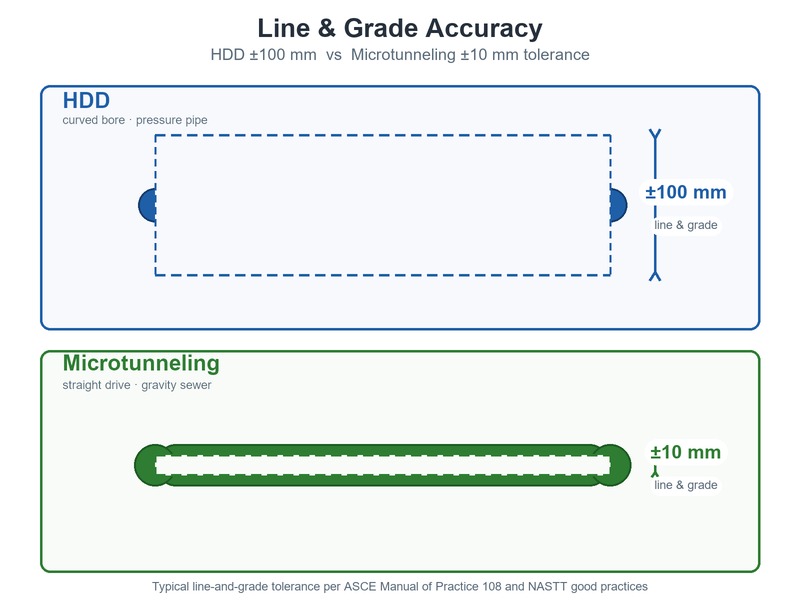
En résumé : the HDD vs microtunneling accuracy gap decides the method: gravity sewers need ±10 mm, pressure lines tolerate ±100 mm.
HDD vs Microtunneling Cost: Which Is Cheaper for Your Project?
HDD is generally the cheaper method at the bid stage. It requires a smaller crew, simpler equipment, and no slurry separation plant, and mobilization is faster. Microtunneling carries higher upfront costs: the MTBM, the launch and reception shafts, the jacking frame, the slurry circuit, and a larger operating crew.
Total cost is driven by six variables: pipe diameter, drive length, ground conditions, shaft depth and dewatering, surface restoration, and permitting. In stable, consistent ground, HDD vs microtunneling cost can differ by several times for the same nominal crossing.
In soft, water-bearing soil, where HDD would need extensive fluid management, the gap narrows.
The lifecycle side matters too. An HDD bore follows curves, and each bend in an HDD pipeline is a potential weak point that can raise maintenance costs over the life of the asset. A microtunneling installation sits on a straight, precise alignment, which is one reason operators report lower long-term maintenance on microtunneled sewer lines. See our pipeline maintenance services and our guide on trenchless pipe rehabilitation for lifecycle planning.
En résumé : HDD wins on bid price; microtunneling wins on long-term maintenance for sewers.
Which Method Handles Your Ground Conditions Better?
Ground conditions can eliminate a method before cost is even discussed.
- HDD performs best in clay, silt, sand, and soft to medium rock, where drilling fluid keeps the bore stable and carries cuttings out. Loose gravel, cobbles, boulders, and very high water tables are the problem zones: cohesionless soils can collapse into the bore, and pressurized drilling fluid can escape to the surface as an inadvertent return.
- Microtunneling excels in the conditions HDD struggles with: soft, unstable, or water-bearing ground, because slurry pressure continuously supports the excavation face. Rock is handled with rock cutterheads. The difficult cases for microtunneling are boulder fields and mixed ground, where the cutterhead must cope with rapidly changing material.
A geotechnical report is not optional when comparing any two trenchless methods. At minimum, you need soil classifications, groundwater levels, and a boulder or cobble assessment across the full alignment before choosing between the two methods.
En résumé : unstable or water-bearing ground favors microtunneling; stable clay and soft rock favor HDD.
A 7-Factor Decision Framework for HDD and Microtunneling
When we evaluate a project at JSW, we score it against the same seven factors, in this order:
- Pipe diameter. Above about 1,200 mm, HDD stops being practical; microtunneling takes over.
- Drive length. Very long single drives favor HDD; segmented drives with jacking stations favor microtunneling.
- Alignment tolerance. Gravity flow means microtunneling; pressure flow means either method works.
- Ground conditions. Unstable, water-bearing soils favor microtunneling; stable clays and soft rock favor HDD.
- Crossings and obstacles. Both methods cross roads, rivers, and railways; HDD handles longer, curvier alignments.
- Surface and shaft constraints. If shafts are impossible or prohibitively expensive, HDD is the practical choice.
- Budget and lifecycle cost. Lowest bid favors HDD; lowest 50-year cost often favors microtunneling for sewers.
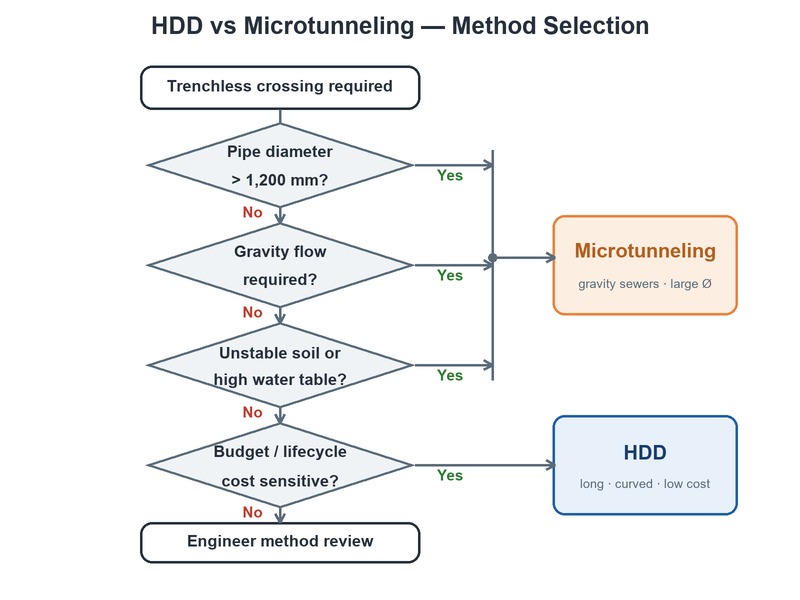
Choose HDD if…
Your project is a pressure pipeline, a cable or conduit run, a crossing under a river, road, or wetland, or a job where surface disturbance must be minimal and shafts are not feasible.
Choose microtunneling if…
You are installing a gravity sewer or storm drain, the pipe diameter is large, the alignment sits under a highway, railway, or sensitive structure, or the ground is soft, sandy, or below a high water table.
Not sure which method fits your site? Send your alignment data and geotechnical report for a free method review, and our engineers will tell you which method to bid.
When to Choose HDD
HDD is the workhorse for long, curved, cost-sensitive installations:
- Water mains, gas lines, and force mains where the pipe can flex
- Electrical cables and telecommunication conduits
- Crossings beneath rivers, streams, highways, airports, and environmentally sensitive wetlands
- Deep installations where the rig can steer around existing utilities
- Projects where open shafts are impractical or too expensive
For a closer look at the technology, read our guide on horizontal directional drilling services and how we plan the pilot bore, reaming, and pullback sequence.
When to Choose Microtunneling
Microtunneling is the precision instrument of trenchless pipe installation:
- Gravity sewers and storm drains that must hold exact grade
- Large-diameter lines from 300 mm up to 3,000 mm
- Crossings beneath highways, railways, and runways where settlement must be controlled
- Deep alignments in soft or water-bearing ground
- Urban sites near sensitive structures where low vibration and high accuracy are mandatory
The microtunnel boring machine operates remotely, so crews never enter the bore during the drive. For long, large-diameter crossings, direct pipe technology, a hybrid that combines an HDD rig with a closed-face microtunneling machine, is worth evaluating as a third option. See our microtunneling construction services page for the equipment and shaft configurations we use on gravity sewer projects.
Frequently Asked Questions About HDD and Microtunneling
What are the limitations of microtunneling?
Microtunneling requires launch and reception shafts, which add cost and surface footprint. The microtunnel boring machine and its slurry circuit are expensive to mobilize, the separation plant produces spoil that must be disposed of, and boulders or mixed ground can slow or stop a drive. Typical single drives run 100-300 m; jacking stations extend them beyond 1,500 m.
What does HDD mean in pipeline?
In pipeline construction, HDD stands for horizontal directional drilling: a steerable, surface-launched trenchless technology that drills a pilot bore, reams it to size, and pulls the product pipe through, without digging an open trench.
Is pipe jacking the same as HDD?
No. Pipe jacking pushes pipe sections into the ground from a launch shaft using hydraulic jacks, typically with a shield or boring machine ahead of the pipe. HDD drills a hole from the surface and pulls the pipe back through it. Microtunneling is a remote-controlled form of pipe jacking; HDD is a drilling and pullback process. For the cutting and fabrication side of either method, see our pipe cutting machines.
How much does microtunneling cost?
There is no universal rate, because cost scales with diameter, drive length, ground conditions, shaft depth, and disposal requirements. What is consistent is the relationship: microtunneling generally costs more than HDD for the same crossing, and the premium is largest on short, simple drives. Ask contractors to price both trenchless methods on your actual alignment before comparing.
Can HDD install a gravity sewer?
Generally no. The HDD bore follows a curved arc, so it cannot maintain the constant, precise grade a gravity sewer needs. Gravity lines are almost always a microtunneling or pipe jacking application.
Is microtunneling more accurate than HDD?
Yes. Microtunneling typically holds line and grade to ±10 mm, while HDD typically holds ±100 mm. This accuracy gap is the deciding factor for gravity sewers and for crossings near sensitive structures.
Which is more expensive, HDD or microtunneling?
For a given crossing, microtunneling is usually the more expensive method to bid, because it needs a microtunnel boring machine, launch and reception shafts, a jacking frame, and a slurry separation plant. The premium is largest on short, simple drives.
What is the maximum depth of HDD?
Typical HDD installations reach depths of 15 m or more, and deeper crossings are possible with large rigs and careful drilling fluid management. Depth is rarely the limiting factor; bore length and ground conditions usually constrain the design first.
How to Get an Accurate HDD vs Microtunneling Cost Estimate
A reliable comparison starts with complete project data: geotechnical investigation results, utility locates, crossing length and depth, pipe material and diameter, allowable surface disruption, and restoration or permitting requirements.
Then ask each contractor for two things: a line item quote for their recommended method, and an alternative quote for the other method on the same alignment. Contractors who can price both methods honestly are the ones worth shortlisting, because the correct trenchless pipe installation method depends on your site, not on the equipment they happen to own.
JSW provides the full chain of trenchless pipeline services: HDD and microtunneling construction, pipe fabrication with automatic pipeline welding technology, hot tapping, and pipeline maintenance.
Because we execute rather than resell, our estimates are based on our own crews, equipment, and completed crossings, and we recommend a method even when it is not the one we bid first. With 200+ completed crossings, our engineers compare both methods against real site data.
Contact our engineering team with your alignment data for a method comparison and budget estimate.
Final Verdict: HDD vs Microtunneling, Which Is Better for Your Project?
Neither trenchless technology is better in the abstract. Choose HDD for pressure pipelines, long and curved crossings, and cost-sensitive projects with stable ground. Choose microtunneling for gravity sewers, large diameters, unstable or water-bearing soil, and any alignment where ±10 mm accuracy protects the investment.
The fastest way to resolve the HDD vs microtunneling question on your own project is to score your site against the seven factors above, confirm the result with a geotechnical report, and have contractors price both methods.
Get a second opinion at no cost. JSW engineers review alignment data and ground conditions and recommend the method that fits, even when it is not the service we bid first. See our pipeline construction services for the full delivery chain.
Sources
The accuracy, diameter, and drive-length ranges in this guide follow these published industry standards:
- ASTM F1962, Standard Guide for Use of Maxi-Horizontal Directional Drilling for Placement of Polyethylene Pipe or Conduit Under Obstacles, Including River Crossings.
- ASCE Manual of Practice 108, Pipeline Design for Installation by Horizontal Directional Drilling.
- NASTT HDD Good Practices Guidelines.
- NASTT Microtunneling Good Practices Guidelines.





































 English
  Arabic
  Russian
  Spanish
  French
  Vietnamese
  Polish
  Thai
Thai  Indonesian
  Turkish
  Portuguese