
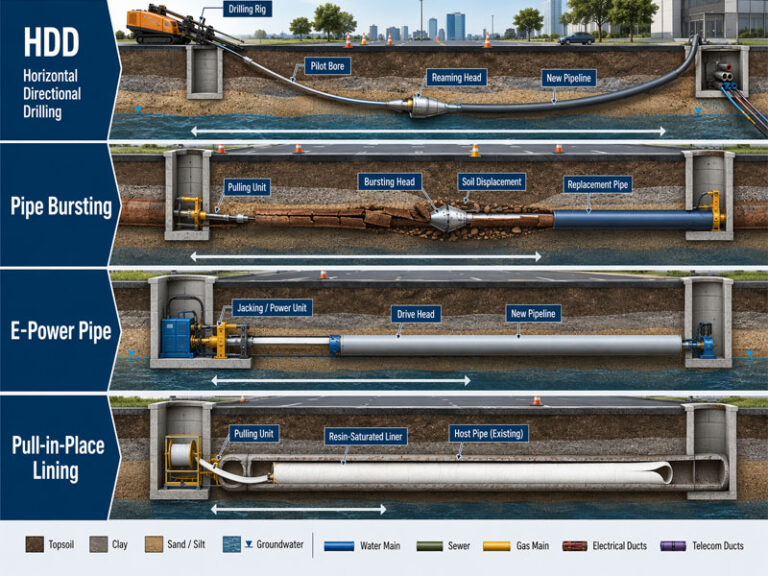
The maximum distance a pipe can be pulled using trenchless methods ranges from approximately 50 meters to more than 3,000 meters, depending on the installation technology, pipe characteristics, ground conditions, and equipment limitations. For new pipeline construction, Horizontal Directional Drilling (HDD) typically achieves 200–800 meters per pull. For pipeline rehabilitation, specialized pull-in-place lining systems can exceed 3,000 meters in a single insertion.
Maximum Pull Distance Comparison Table
| Trenchless Method | Maximum Pull Distance (Typical) | Maximum Pull Distance (Record/Specialized) |
|---|---|---|
| Forage directionnel horizontal (HDD) | 200 – 800 m | Up to 1,000+ m |
| Éclatement des tuyaux | 50 – 200 m | 174 m (570 ft) for 32-inch pipe |
| E-Power Pipe Method | Jusqu'à 2 000 m | 2,000 m (single launch pit) |
| Pull-in-Place Lining | 1,000 – 2,000 m | Up to 3,000 m (World record) |
In practice, HDD remains the most common choice for long-distance new pipe installations, while pull-in-place lining systems achieve the longest continuous pulls because they are installed inside existing pipelines, experiencing significantly less friction.
What Is Pipe Pulling Distance in Trenchless Construction?
Pipe pulling distance refers to the maximum continuous length of pipe that can be installed or pulled underground during a single trenchless operation without exceeding allowable pulling force, pipe stress limits, or equipment capacity.
Unlike open-cut installation, trenchless pipe pulling is fundamentally limited by mechanical resistance rather than excavation length. This distinction makes understanding pull force calculations and geological factors essential for successful project design.
1. How Far Can HDD Drill and Pull Pipe Underground?
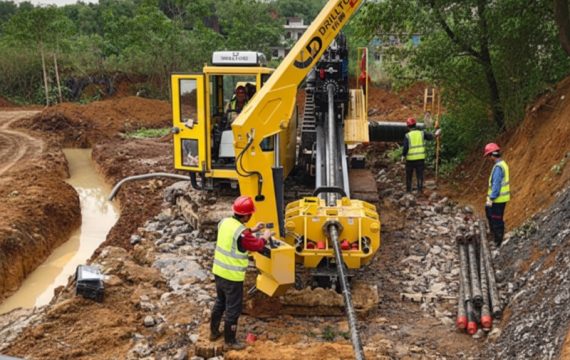
Horizontal Directional Drilling (HDD) is the most common method for installing new pipelines under rivers, highways, and sensitive environmental areas.
Horizontal directional drilling distance depends on drilling rig capacity, pipe diameter, drilling fluid performance, bore radius, and geological conditions. In most utility projects, HDD pullback length is measured by hundreds of meters, while specialized crossings may exceed one kilometer.
- Typical Range: Standard utility crossings for pipes ranging from 90mm to 630mm in diameter typically achieve pullbacks of 200 to 800 meters (656 to 2,625 feet) .
- Record Achievements: A documented project successfully installed 36-inch (914mm) ductile iron pipe with a pullback of 1,640 feet (500 meters) , with calculations indicating that pull forces remained far below allowable limits.
- Long-Distance Potential: For steel pipes in favorable conditions, a single crossing can extend up to 800 meters.
Learn more about the horizontal directional drilling process.
2. How Far Can Pipe Bursting Pull a Pipe?
Pipe bursting is a trenchless rehabilitation method that fractures an existing pipe while simultaneously pulling a new one into place. The force required to break the host pipe significantly limits its range.
- Distance Limits: A notable North American project for 32-inch diameter pipe achieved a pull of 570 feet (174 meters) , which was cited as a record for that pipe size. The project faced significant challenges, including a high water table that created unstable “liquid sand” conditions, showcasing how geology impacts maximum distance.
Compare pipe bursting vs HDD for your next rehabilitation project.
3. How Long Can Pull-in-Place Lining Systems Be?
For pipeline rehabilitation rather than new construction, pull-in-place lining systems offer the greatest trenchless pipe installation distance.
- Maximum Distance: These systems are designed for long-distance insertion. The NORDITUBE IH-LINER system has demonstrated maximum insertion lengths of up to 3,000 meters (9,840 feet) in a single pull .
- Case in Point: In a world record project completed in 2019, a DN 800 (800mm diameter) three-layer liner was installed over 1.2 kilometers (3,937 feet) in just five days .
4. What Factors Limit Pipe Pulling Distance?
Understanding the variables that constrain pull length is essential for accurate project planning and risk management.
- Pull Force and Pipe Stress: The primary limiting factor. Engineers use validated formulas that consider pipe diameter, soil conditions, and bore path geometry to predict pull forces.
- Friction and Soil Conditions: The coefficient of friction between the pipe coating and soil, groundwater conditions, and soil type (sand, clay, rock) are all critical.
- Pipe Diameter and Material: Larger and heavier pipes require exponentially greater pull forces, naturally limiting their maximum distance.
5. What Determines the Maximum Pipe Pull Distance?
| Facteur | Impact on Pull Distance |
|---|---|
| Diamètre du tube | Larger pipes require higher pulling force, reducing maximum length. |
| Matériau des tuyaux | HDPE allows flexibility; rigid ductile iron/steel pipes require special systems. |
| Soil Conditions | High-friction soils (e.g., clay) reduce achievable distance; sand offers less resistance. |
| Bore Geometry | More curves and sharp angles increase pulling resistance and stress. |
| Equipment Capacity | Larger, more powerful drilling rigs enable longer and larger-diameter pulls. |
| Drilling Fluid Performance | Proper fluid management reduces friction and stabilizes the borehole. |
6. Longest Trenchless Pipe Pulls and Real-World Project Examples
Real-world projects demonstrate the practical limits of trenchless technology and serve as benchmarks for future installations.
| Technologie | Maximum Achieved Distance | Application Context |
|---|---|---|
| HDD | 500 m+ (1,640 ft) | 36-inch ductile iron water main |
| Pull-in-Place Lining | 3,000 m (9,840 ft) | DN 800 pipeline rehabilitation |
| E-Power Pipe | Jusqu'à 2 000 m | Cable protection and gas lines |
| Éclatement des tuyaux | 174 m (570 ft) | 32-inch diameter replacement |
7. How Does Pull Distance Affect Trenchless Installation Cost?
Does Longer Trenchless Pipe Pull Distance Reduce Cost?
In many projects, longer pulls reduce the cost per installed meter because fewer access pits and less surface restoration are required. However, extremely long pulls may require larger HDD rigs, additional engineering analysis, and higher risk management costs.
- Économies de coûts : Minimizes excavation, shoring, traffic control, and environmental mitigation costs.
- Cost Drivers: Larger equipment, higher engineering costs, and increased risk of stuck pipe or borehole collapse.
See our complete trenchless pipe installation cost guide for detailed pricing analysis.
8. How to Choose the Right Trenchless Method for Your Project
Selecting the optimal method requires balancing distance capabilities against project-specific constraints.
| Type de projet | Recommended Trenchless Method | Typical Pull Distance |
|---|---|---|
| Fiber Optic Cable Installation | HDD | 200 – 1,000 m |
| Gas Pipeline Crossing | HDD | 500 – 1,000+ m |
| Water Transmission Main | HDD | 500 – 1,500 m |
| Sewer Rehabilitation / Relining | Pull-in-Place Lining | 1,000 – 3,000 m |
| Replacing Damaged Small-Diameter Sewer | Éclatement des tuyaux | 50 – 200 m |
| Urban Utility Protection | E-Power Pipe | Jusqu'à 2 000 m |
9. Frequently Asked Questions (FAQ)
Q: How far can horizontal directional drilling go?
A: HDD typically reaches 200 to 800 meters per pull. Large projects with favorable geology can exceed 1,000 meters.
Q: What is the longest HDD pull ever completed?
A: Verified installations for 36-inch diameter pipe have completed pullbacks of 1,640 feet (500 meters) . Engineering analysis suggests much longer pulls are possible.
Q: How far can HDPE pipe be pulled underground?
A: For standard HDD installations, HDPE pipe (90mm to 630mm diameter) is commonly pulled up to 200 meters . With specialized equipment and lower friction, this distance can be extended significantly.
Q: What limits HDD pullback length?
A: The primary limit is the tensile stress on the pipe. Other factors include available pull force, coefficient of friction, and bore path geometry.
Q: Can trenchless pipes be installed over 1 mile?
A: Yes. A one-mile (1.6 km) installation is achievable through multiple shorter HDD pulls or by using a single specialized pull-in-place lining system.
Q: What is the longest underground pipe pull?
A: The longest underground pipe pulls depend on the trenchless technology used. Specialized pull-in-place lining systems have demonstrated single-pull distances approaching 3 kilometers, while conventional HDD projects typically operate within several hundred meters.
Q: Which trenchless method achieves the longest distance?
A: Pull-in-place lining systems achieve the longest single-pull distances, exceeding 3,000 meters. For new installations, HDD is the most common long-distance method.
Q: Does longer pipe pulling reduce installation cost?
A: Yes. Longer pulls reduce the number of access pits and surface restoration work, lowering the overall cost per meter. However, extremely long pulls may require larger, more expensive equipment and increased engineering analysis.
For new pipeline construction, HDD is the most widely used long-distance trenchless installation method, typically achieving 200–800 meters per pull. For rehabilitation projects, pull-in-place lining systems can achieve the greatest single-pull distances, exceeding 3 kilometers in specialized applications. The final selection should be based on a comprehensive evaluation of pipe diameter, material, soil conditions, and project budget.
The maximum distance a pipe can be pulled using trenchless methods ranges from 200 meters for standard HDD to over 3,000 meters for specialized lining systems. The right choice for your project hinges on pipe material, soil conditions, and application requirements. Understanding these limits—and their economic impact—is essential for designing a successful, cost-effective, and low-risk trenchless project.
Need Help Selecting the Right Trenchless Installation Method?
Our engineering team can evaluate your project requirements, including pipe diameter, installation distance, soil conditions, and pulling force calculations, to recommend the most suitable trenchless solution. With decades of field experience in complex utility crossings, we provide data-driven insights to support successful project delivery.







 English
  Arabic
  Russian
  Spanish
  French
  Vietnamese
  Polish
  Thai
Thai  Indonesian
  Turkish
  Portuguese