
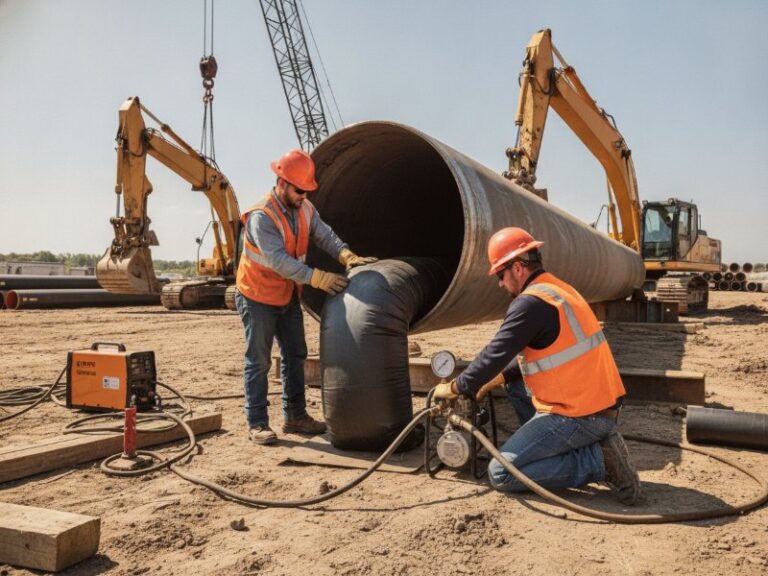
Mechanical pipe plugs seal pipes using mechanical compression from a tightened bolt or wing nut, while inflatable pipe plugs (also called pneumatic pipe plugs) seal by expanding with air or fluid pressure. Mechanical plugs are best for long-term, low-pressure use in clean, round pipes, whereas inflatable plugs are ideal for irregular pipes, fast installation, and high-pressure applications up to 120+ psi.
Quick Comparison: Mechanical vs Inflatable vs Pneumatic Pipe Plugs
| Fonctionnalité | Bouchon mécanique | Inflatable (Pneumatic) Plug |
|---|---|---|
| Sealing principle | Mechanical compression | Pneumatic/hydraulic expansion |
| Pression maximale | ~65 psi | 120+ psi (Kevlar reinforced) |
| Access requirement | Full pipe diameter access | Small opening (1/4 pipe diameter) |
| Pipe condition needed | Round, clean, smooth | Any condition (conforms to irregularities) |
| Best application | Long-term isolation | Fast deployment, high pressure |
Key Definitions
A mechanical pipe plug is a rigid sealing device that uses a threaded bolt or wing nut to compress elastomer rings outward against pipe walls.
A pneumatic pipe plug is a type of inflatable pipe plug that seals by expanding with compressed air inside the pipe.
Back pressure refers to the force exerted against the pipe plug from the upstream side during operation.
Pipe ovality describes how much a pipe deviates from a perfect circular shape, expressed as a percentage.
What Is a Mechanical Pipe Plug and How Does It Work?
A mechanical pipe plug is a rigid sealing device that uses a mechanical expansion mechanism—typically a threaded bolt, wing nut, or butterfly assembly—to compress sealing elements against the pipe interior.
How Mechanical Plugs Create a Seal
When you tighten the central bolt or wing nut on a mechanical plug, it forces two metal plates closer together. This compression expands the surrounding rubber or elastomer ring radially outward, pressing it against the pipe wall to form a leak-tight seal. Mechanical plug sealing force is limited by bolt torque, but the plug remains sealed indefinitely through mechanical lock without requiring ongoing pressure monitoring.
Key Characteristics
| Spécifications | Mechanical Pipe Plug Data |
|---|---|
| Sealing method | Mechanical compression (bolt/wing nut) |
| Plage de pression | Low to medium (typically under 65 psi) |
| Pipe size compatibility | Single size per plug |
| Installation time | 5-15 minutes (tool-dependent) |
| Deflation risk | None – mechanical lock |
| Material options | Natural rubber, Nitrile, Silicone, Viton |
Some mechanical plugs require only hand tightening, while high-pressure applications may need wrench-assisted adjustment. The plug stays sealed until manually loosened, making it ideal for long-term blocking where monitoring isn’t feasible.
Real-world usage note: According to JSW senior pipeline engineer with 18+ years of field experience across 30+ countries, mechanical plugs are most effective in clean, round pipes with consistent interior surfaces. Weld beads, corrosion deposits, or out-of-round pipe shapes prevent proper sealing.
What Is an Inflatable (Pneumatic) Pipe Plug and How Does It Work?
An inflatable pipe bag—also called a pneumatic pipe plug or bag stop—is a flexible sealing device made from reinforced elastomer materials that expands when filled with air, water, or gas to seal pipe interiors. A pneumatic pipe plug is another term for the same technology, commonly used in industrial and municipal applications where access is limited or pipe conditions are unknown.
The Inflation Sealing Mechanism
Insert the deflated bag into the pipe through an access point—sometimes as small as one-quarter of the pipe’s diameter—then inflate it using a pump or compressed air source. The bag expands to conform precisely to the pipe’s interior shape, including irregularities like weld seams, corrosion pits, and slight ovality. Inflatable plug sealing force increases with internal pressure, creating an exponentially tighter seal as back pressure rises.
Material Construction and Pressure Capabilities
| Spécifications | Inflatable (Pneumatic) Bag Data |
|---|---|
| Sealing method | Pneumatic/hydraulic expansion |
| Plage de pression | Low to high (22-120+ psi operational) |
| Pipe size compatibility | Multi-size (one bag fits 3-5 diameters) |
| Installation time | 10-30 minutes (including inflation) |
| Deflation risk | Possible (requires pressure monitoring) |
| Reinforcement materials | Nylon cord, Kevlar, ballistic nylon |
Industrial-grade pneumatic pipe plugs use Kevlar reinforcement to withstand high back pressure and harsh conditions. A chemical facility in Germany successfully deployed a 56-inch Kevlar-reinforced bag stop that provided a guaranteed 100% positive seal.
Field performance data: A pipeline maintenance company performing approximately 50 bag stops annually reports zero inflatable bag failures when properly specified for the application.
Installation Speed: Mechanical vs Pneumatic Pipe Plugs
Mechanical plugs: Require insertion at full expanded diameter or assembly inside the pipe. Large-diameter mechanical plugs (over 24 inches) may need to be disassembled to pass through manways, then reassembled inside—a process taking hours.
Inflatable plugs: Insert deflated through small openings, then inflate. A 16-inch inflatable bag was inserted, inflated, and stabilized within 30 minutes during a Texas refinery project.
Verdict: Inflatable (pneumatic) pipe plugs install 3-5x faster for large-diameter pipes.
Pressure Ratings: Mechanical vs Inflatable Pipe Plugs
| Paramètres | Bouchon mécanique | Inflatable (Pneumatic) Plug |
|---|---|---|
| Standard max pressure | ~65 psi | 120+ psi |
| High-pressure capability | Limited by bolt strength | Kevlar-reinforced available |
| Temperature range | -20°F to 250°F (material dependent) | Similar range |
| Back pressure resistance | Modéré | High (exponential sealing surface) |
For applications exceeding 65 psi, inflatable pipe plugs with Kevlar reinforcement are preferred. Mechanical plug sealing force is limited by bolt torque, while inflatable plug sealing force increases with internal pressure—making pneumatic plugs the superior choice for high-pressure environments.
Pipe Condition and Shape Requirements
| État des tuyaux | Bouchon mécanique | Inflatable (Pneumatic) Plug |
|---|---|---|
| Round, clean pipe | Excellent seal | Excellent seal |
| Weld beads present | Poor seal | Conforms around beads |
| Corrosion deposits | Seal failure risk | Conforms to surface |
| Out-of-round pipe | Cannot seal | Adapts to shape |
| Pipe bends near tap point | Not recommended | Works effectively |
Mechanical plugs require concentric, geometrically circular pipe with minimal internal buildup. Inflatable plugs are “not biased to the concentricity, geometry, orientation, or internal condition of the pipe requiring isolation”—making them the superior choice for older infrastructure.
Cost Comparison: Mechanical vs Inflatable Pipe Plugs
| Cost Factor | Bouchon mécanique | Inflatable (Pneumatic) Plug |
|---|---|---|
| Per-unit purchase cost (small dia) | Lower ($50-200) | Moderate ($100-500) |
| Per-unit cost (large dia 24″+) | Very high ($2,000-10,000+) | Lower ($800-3,000) |
| Multiple pipe sizes | Need separate plug per size | One bag covers 3-5 sizes |
| Reusability | High (indefinite) | High (refurbishable) |
| Support equipment | Basic tools only | Air compressor/pump |
Total ownership analysis: For a contractor working with 6″, 8″, and 10″ pipes, mechanical plugs require three separate purchases (approx. $1,500 total). A single multi-size inflatable bag covering 6-10″ costs approximately $600-$800.
Case study: A refinery avoided $50,000+ in excavation and mechanical stop costs by using a $1,200 inflatable bag inserted through an existing 4-inch riser.
Application Suitability Matrix
| Application Scenario | Recommended Plug | Reasoning |
|---|---|---|
| Long-term isolation (months) | Mechanical | No pressure monitoring needed |
| Short-term maintenance (hours-days) | Inflatable | Faster install/removal |
| Corrosive/chemical service | Mechanical (compatible seals) | No inflation leak risk |
| Potable water | Either (NSF-certified) | Both available with certifications |
| High-pressure gas lines | Inflatable (Kevlar) | Higher pressure capability |
| Pipe with unknown interior | Inflatable | Conforms to irregularities |
| Limited access (small manhole) | Inflatable | Fits through small openings |
| Subsea/lowered environment | Mechanical (negatively buoyant) | Aluminum models available |
How to Choose the Right Pipe Plug (Step-by-Step)
Follow this step-by-step decision process to select between mechanical and inflatable (pneumatic) pipe plugs for your specific project:
Step 1: Determine pipe diameter
Measure the exact internal diameter of your pipe. Mechanical plugs require precise matching. Inflatable plugs work across a range (e.g., one bag covers 6-10 inches).
Step 2: Check pipe condition (clean or corroded)
Inspect interior surfaces for weld beads, corrosion deposits, or ovality. Clean, round pipes accept mechanical plugs. Any irregularities require inflatable plugs.
Step 3: Calculate back pressure
Determine the maximum pressure that will push against the plug during operation. For pressures under 65 psi, both options work. For 65-120+ psi, select Kevlar-reinforced inflatable plugs.
Step 4: Evaluate access point size
Measure your entry opening. If less than half the pipe diameter, only inflatable plugs can be inserted in deflated form.
Step 5: Decide isolation duration (temporary vs long-term)
For isolation exceeding 30 days without monitoring, choose mechanical plugs. For hours or days, inflatable plugs provide faster deployment.
Step 6: Check available equipment
Do you have an air compressor or pump on-site? If no inflation equipment is available, mechanical plugs are the practical choice.
Not sure which plug fits your pipeline? Get a free recommendation from JSW engineering—include your pipe diameter, media type, and operating pressure.
Best Pipe Plug by Industry
Oil and Gas Pipelines
Recommandation : Inflatable (pneumatic) pipe plugs with Kevlar reinforcement
Why: High pressure requirements (often exceeding 65 psi), limited access points, need for rapid deployment during emergency repairs. A pneumatic pipe plug can be inserted through small hot tap fittings.
Systèmes d'égouts municipaux
Recommandation : Inflatable pipe plugs
Why: Older pipes have weld beads, corrosion, and out-of-round conditions. Inflatable bags conform to irregular surfaces that mechanical plugs cannot seal. For sewer pipe plug vs inflatable test plug comparisons, inflatable wins on versatility.
Chemical Plants
Recommandation : Mechanical pipe plugs
Why: Chemical compatibility is paramount. Mechanical plugs use solid elastomer seals without inflation air that could leak corrosive materials. No pressurized inflation system to fail in hazardous environments.
Plumbing and Small-Diameter Pipes (Under 6 inches)
Recommandation : Mechanical pipe plugs
Why: Cost-effective for clean, round copper or PVC pipes. Simple installation without needing air compressors.
Water Treatment Facilities
Recommandation : Either type with NSF certification
Why: Potable water requires certified materials. Both mechanical and inflatable options available with proper certifications.
Power Generation (Cooling Lines)
Recommandation : Inflatable (pneumatic) pipe plugs
Why: Large diameters (24-72 inches) make mechanical plugs prohibitively expensive. Multi-size inflatable bags reduce inventory requirements.
Request a similar solution for your project – contact JSW with your industry and application details.
Common Mistakes When Choosing Pipe Plugs
Mistake #1: Using mechanical plugs in corroded or irregular pipes
Conséquence : The rigid sealing element cannot conform to surface irregularities, causing leakage.
Solution : Use an inflatable (pneumatic) pipe plug that conforms to any pipe interior condition.
Mistake #2: Underestimating back pressure requirements
Conséquence : The plug blows out under operational pressure, causing flooding or hazardous release.
Solution : Calculate maximum possible back pressure plus 25% safety factor. For any pressure over 65 psi, select Kevlar-reinforced inflatable plugs rated for 120+ psi.
Mistake #3: Ignoring pipe ovality
Conséquence : Mechanical plug cannot seal in non-round pipes.
Solution : Measure pipe roundness before selecting mechanical plugs. For oval pipes exceeding 3% deviation, choose inflatable plugs exclusively.
Mistake #4: Failing to monitor inflatable plug pressure during long-term isolation
Conséquence : Gradual pressure loss leads to seal failure without warning.
Solution : Check inflation pressure every 4 hours for multi-day jobs. Install pressure gauge with low-pressure alarm for unattended operations.
Mistake #5: Assuming one plug type works for all pipe plugging methods
Conséquence : Suboptimal performance, higher costs, or safety risks.
Solution : Evaluate each project individually against the step-by-step selection guide above.
Frequently Asked Questions About Pipe Plug Selection
Q: Which type of pipe plug is better for long-term applications?
A: Mechanical plugs are generally better for long-term isolation because they do not rely on maintained inflation pressure. Once installed and tightened, a mechanical plug remains sealed indefinitely without monitoring. Inflatable bags can be used for weeks-long projects but require pressure checks approximately every four hours to ensure inflation is maintained.
Q: Can inflatable pipe plugs fail?
A: Yes, inflatable pipe plugs can fail if improperly specified or maintained. Common failure modes include: over-inflation exceeding burst pressure, under-inflation causing seal loss, damage to the elastomer from sharp pipe edges, and valve leakage. Proper selection (including Kevlar reinforcement for high pressure) and regular pressure monitoring prevent the vast majority of failures. JSW pre-tests every bag to 1.5x rated pressure before shipment.
Q: What size pipe plug do I need?
A: For mechanical plugs, you need a plug exactly matching your pipe’s internal diameter (e.g., a 6-inch mechanical plug for 6-inch pipe). For inflatable plugs, select a bag whose specified diameter range includes your pipe size (e.g., a bag rated for 6-10 inch pipes works on any diameter within that range). Always verify the manufacturer’s size chart before purchasing.
Q: Can inflatable pipe plugs be reused?
A: Yes, inflatable plugs can be refurbished and reused. A major pipeline maintenance firm reports sending used bags back to manufacturers for refurbishing between projects. JSW offers inspection, testing, and recertification of used inflatable bags at approximately 40% of new purchase cost.
Q: What pressure rating do I need for my application?
A: Select based on your maximum anticipated back pressure plus a safety factor. For gravity flow sewer lines under 15 feet of head (6.5 psi), standard inflatable test balls suffice. For pressurized water mains at 80 psi, Kevlar-reinforced bags rated for 120+ psi are required. Mechanical plugs typically handle up to 65 psi.
Q: Are mechanical or inflatable pipe plugs more expensive?
A: It depends on diameter. For pipes under 6 inches, mechanical plugs are typically less expensive. For pipes over 12 inches, inflatable bags become significantly more cost-effective. A 24-inch mechanical plug may cost $3,000-$5,000, while a multi-size inflatable bag covering 20-28 inches costs approximately $1,500-$2,500.
Q: Which plug works best for bypass operations?
A: Both types offer bypass versions with a central tube allowing flow diversion. Inflatable bypass plugs are preferred for large diameters and irregular pipes. Mechanical bypass plugs are suitable for smaller, clean pipes where permanent or semi-permanent installation is needed.
Q: What is a pneumatic pipe plug?
A: A pneumatic pipe plug is another term for an inflatable pipe plug. Both refer to flexible elastomer devices that seal by expanding with compressed air. The terms are used interchangeably in industrial and municipal markets.
Download our complete Pipe Plug Sizing Chart with pressure rating calculations and material compatibility guides – request via website contact form.
Real-World Performance Case Study
A chemical production facility in Germany required temporary plugging of a 56-inch water-cooling line for scheduled modifications. Traditional mechanical line plugging would have required extensive equipment setup and extended downtime.
Solution deployed: A Kevlar-reinforced inflatable bag stop (pneumatic pipe plug) inserted through a smaller access point and inflated to seal the line.
Results documented:
- Installation completed faster than mechanical alternative
- Provided guaranteed 100% positive seal
- Allowed engineers to complete modifications within scheduled window
- Plant production unaffected during work
Senior project management stated the bag stop was “far simpler, quicker, less invasive and more cost-effective” than mechanical plugging.
Safety Considerations and Limitations
Mechanical plug limitations:
- Cannot be used as the sole protection for personnel downstream
- Requires precise sizing—incorrect size causes seal failure
- May loosen under vibration (requires periodic re-tightening)
Inflatable bag limitations:
- Requires continuous or monitored pressure source
- Can develop small leaks at connections
- Not recommended for highly corrosive materials without specialized coatings
Safety best practice: Industry standards recommend using two plugs in series for critical isolation where personnel protection is required.
Decision Framework Summary
Choose MECHANICAL pipe plug when:
- Isolation duration exceeds 30 days without monitoring capability
- Pipe diameter is under 8 inches and round/clean
- Operating pressure is under 65 psi
- No inflation equipment is available on-site
- Service involves highly corrosive chemicals
- Subsea installation requires negative buoyancy
Choose INFLATABLE (PNEUMATIC) pipe plug when:
- Multiple pipe sizes need coverage with one device
- Access is through small manholes or existing risers (4 inches or less)
- Pipe interior has weld beads, corrosion, or irregular shape
- Installation speed is critical (under 1 hour)
- Operating pressure exceeds 65 psi (use Kevlar-reinforced)
- Working near pipe bends or irregular geometries
- Transport and storage space is limited
About JSW: Pipeline Plug Solutions Engineered for Performance
JSW manufactures both mechanical pipe plugs and inflatable (pneumatic) bag stopping systems for the water, wastewater, oil, gas, and industrial pipeline markets. With over 500 pipeline isolation projects completed across 30+ countries, our engineering team brings 20+ years of field experience to every product design. JSW products comply with applicable ASTM and ISO standards.
What distinguishes JSW pipe plugs:
- Application-engineering approach: We analyze your pipe conditions, pressure requirements, and access limitations before recommending a solution. If a mechanical plug won’t seal due to weld beads, we specify an inflatable. If corrosive media rules out pneumatic seals, we recommend mechanical alternatives.
- Material traceability and certifications: All elastomers and reinforcement materials include full certification documentation.
- Refurbishment program: JSW inspects, tests, and recertifies used inflatable bags at approximately 40% of new purchase cost, extending service life across multiple projects.
- Pre-shipment testing: Every inflatable bag is pressure-tested to 1.5x rated pressure before leaving our facility, with test certificates provided to customers.
- Technical support: Certified application specialists answer selection questions and provide on-site installation guidance when needed. According to JSW senior pipeline engineer with 18+ years of field experience, proper selection prevents 90% of field failures.
Need a pipe plug selection recommendation? Contact JSW technical support with your pipe diameter, media type, operating pressure, and access constraints for a free application analysis.










 English
  Arabic
  Russian
  Spanish
  French
  Vietnamese
  Polish
  Thai
Thai  Indonesian
  Turkish
  Portuguese