
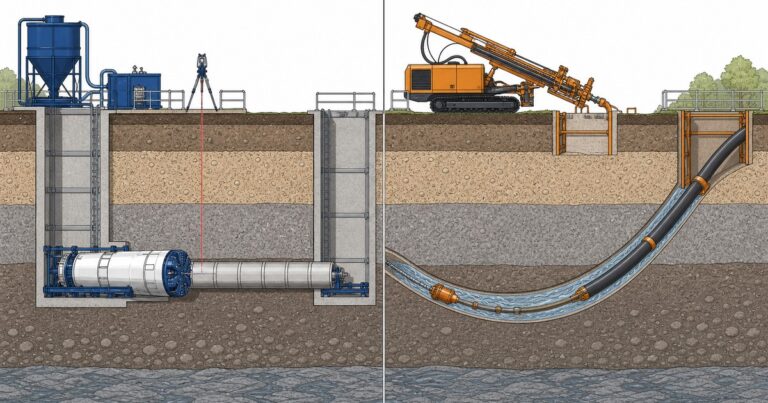
The key differences between microtunneling vs HDD come down to how the pipe is installed: microtunneling pushes a laser-guided pipe straight through the ground from a launch shaft with hydraulic jacks and a remotely controlled boring machine, while HDD pulls a flexible pipe through a curved bore drilled from the surface. Microtunneling holds line and grade to about ±25 mm (1 in.) and handles unstable, water-bearing ground; HDD is faster, cheaper and reaches far longer distances, but tolerates roughly an order of magnitude more deviation.
This guide explains the mechanics of both methods, then works through the eight differences that actually decide a project: installation principle, guidance and accuracy, diameter and drive length, ground and groundwater, shafts and site footprint, pipe materials, cost structure, and risk profile. It closes with a side-by-side comparison table, the line-and-grade test that eliminates one method on most projects, and answers to the questions engineers ask us most often about trenchless pipe installation.
How Microtunneling Works: Jacked Pipe, Laser Guidance and Face Support
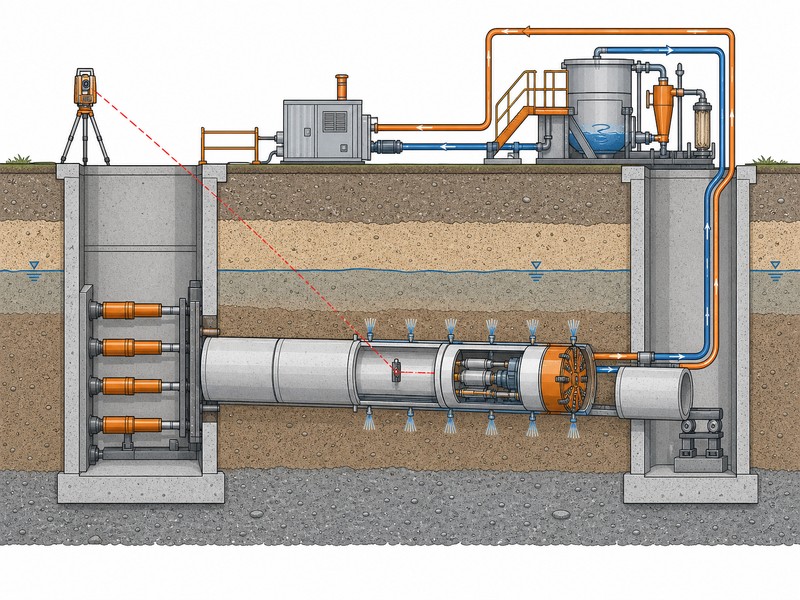
Microtunneling is a pit-launched method in which the pipe itself is the final support of the excavation. A microtunnel boring machine (MTBM) excavates the ground at the face, and hydraulic jacks in the launch shaft push the pipe string forward behind it. The machine is operated remotely from the surface, so no worker enters the pipe during the drive.
Four systems have to work together for a drive to succeed:
- The MTBM and its face support. A closed cutterhead excavates while slurry pressure or earth pressure balances the ground and groundwater at the face. This continuous face support is what allows the machine to advance through soft, saturated or loose soil without the bore collapsing.
- The guidance system. A laser target mounted in the lead pipe is read against a surface total station, giving the operator a live deviation from the design alignment. Curved alignments use gyroscopic guidance instead.
- The jacking frame and thrust wall. The frame transfers jacking force into the pipe string from a thrust wall at the back of the launch shaft. On longer drives, intermediate jacking stations are built into the pipe string to split the load and keep pipe wall stress within limits.
- The slurry circuit and separation plant. A closed-loop slurry system carries cuttings back to the surface, where a separation plant removes the solids for disposal. Bentonite lubrication grout is injected around the pipe exterior to hold jacking friction down, and a permanent cement-bentonite grout fills the annulus once the drive is complete.
Because the machine is remotely controlled and the pipe is pushed rather than pulled, microtunneling installs rigid jacking pipe in a straight or gently curved line at controlled grade. Manufacturer specifications for standard slurry machines list hydrostatic head ratings of about 3 bar, roughly 30 m of water head, which is why the method performs in ground where an open bore would simply not stand up.
How HDD Works: Pilot Bore, Reaming and Pullback
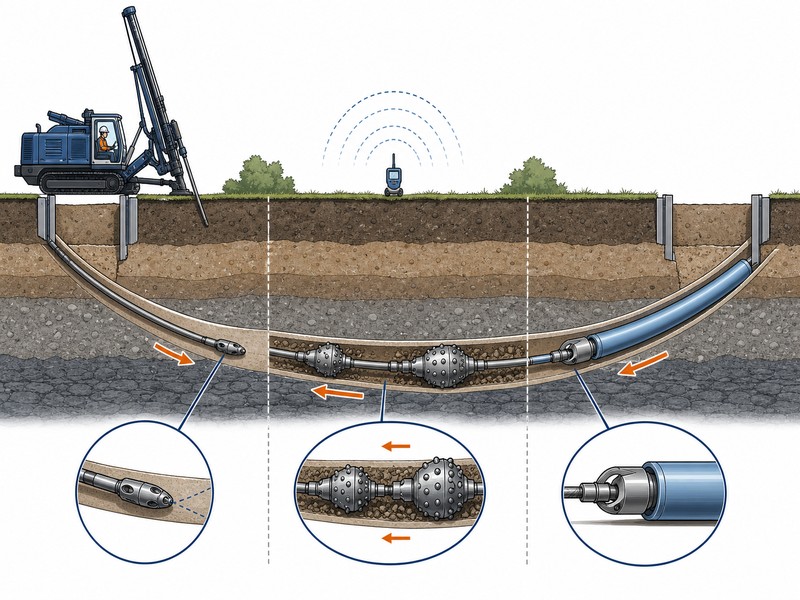
Horizontal directional drilling is a surface-launched method. The HDD rig stays above ground and drives a steerable bore along a controlled arc from an entry point to an exit point, so no launch shaft is excavated. The technology was adapted from oilfield drilling in the early 1970s; the first recorded river crossing covered 183 m (600 ft), and the method soon progressed to installing 1,070 mm (42 in.) pipe under 1,220 m (4,000 ft) crossings.
Every HDD installation follows the same three stages:
- Pilot bore. A steerable drill head advances along the design profile, tracked by a walkover locating system or, on deep and long bores, by wireline or gyroscopic guidance. Bentonite-based drilling fluid lubricates the bore, stabilises the hole and carries cuttings to the surface.
- Reaming. A reamer is pulled back through the pilot hole, usually in several passes, until the bore is roughly 50 percent larger in diameter than the product pipe.
- Pullback. The product pipe is attached to the drill string and pulled through the pre-drilled, fluid-filled bore in one continuous operation.
The consequence of that sequence matters more than any specification: the pipe is installed into a hole that already exists, so it must be flexible enough to follow a curve and strong enough to survive pullback tension. That is the mechanical reason HDD suits pressure pipelines, cables and conduits, and the reason it struggles with gravity-flow lines.
Microtunneling vs HDD: The Eight Key Differences
The differences below are ordered the way they tend to eliminate a method in practice, starting with the one that is hardest to design around.
1. Installation principle: the pipe is pushed, not pulled
Microtunneling advances the pipe as the excavation advances, so the pipe string carries jacking compression and provides support behind the machine. HDD completes the hole first and then pulls the pipe through it, so the pipe carries pullback tension instead. This single mechanical difference explains most of the others: it dictates the pipe material, the joint design, the accuracy that is achievable, and the size of the site works.
2. Guidance and accuracy: laser steering versus bore tracking
Microtunneling is steered continuously using a laser target in the lead pipe read against a surface total station, with gyroscopic guidance on curved alignments; corrections are made metre by metre. HDD tracks a steerable head with a walkover locator or wireline system and makes corrections between survey readings along a long arc.
The practical result is that microtunneling holds line and grade to about ±25 mm (1 in.), the tolerance commonly treated as the microtunneling industry standard, and well-controlled drives achieve ±10 to 15 mm. HDD tolerances are typically an order of magnitude looser and are normally specified as a percentage of the drive length rather than a fixed millimetre band. ASCE 36-15, the microtunneling design and construction guideline from the American Society of Civil Engineers, devotes its alignment and tolerance provisions to exactly this point.
3. Diameter and drive length: the two methods have opposite strengths
Microtunneling covers large diameters but shorter drives. Typical installed diameters run from about 300 mm to 3,000 mm (12-120 in.), and routine single drives run 100-300 m; intermediate jacking stations extend drives past 600 m by splitting the jacking load into sections.
HDD covers smaller diameters over much longer distances. Typical bores run from 50 mm to 1,200 mm (2-48 in.) and single bores reach 1,800 m and beyond, with depths of 15 m or more. Above roughly 1,200 mm, HDD stops being practical, because the pullback force and the volume of fluid and cuttings required rise faster than the equipment envelope.
4. Ground conditions and groundwater: closed face versus open bore
Microtunneling excavates behind a closed, pressurised face. Slurry machines balance groundwater and earth pressure at the cutterhead, and standard slurry machine lines are rated for hydrostatic heads of about 3 bar, roughly 30 m of water. Rock is handled with disc cutterheads. The difficult cases are boulder fields and rapidly changing mixed ground, where the cutterhead has to cope with material it was not configured for.
HDD relies on drilling fluid to hold an open bore. That works well in clay, silt, sand and soft to medium rock. It works badly in loose gravel and cobbles, where cohesionless material collapses into the bore, and in shallow, highly permeable ground, where pressurised fluid can escape to the surface as an inadvertent return.
In the United States, the Federal Energy Regulatory Commission publishes specific guidance requiring HDD monitoring, inadvertent return response and contingency plans, which tells you how routine that risk is on regulated crossings.
5. Shafts, surface footprint and site logistics
HDD needs an entry pit for the rig and a small exit pit, both shallow, and it leaves the surface largely undisturbed between them. Microtunneling needs a launch shaft and a reception shaft, and both are engineered structures rather than pits. A published municipal design example used a launch shaft roughly 12 m long, 6 m wide and 9 m deep, with a reception shaft of comparable depth.
Microtunneling also needs surface area for the slurry separation plant, spoil handling, pipe storage and a larger operating crew. In dense urban corridors, shaft availability and the size of the work site often decide the method before cost is even debated; where shafts are impossible or prohibitively expensive, HDD is usually the only practical route.
6. Pipe materials and joint design
Microtunneling requires jacking pipe engineered for compression: reinforced concrete pipe, polymer concrete, vitrified clay and steel casing, all with flush joints that transfer jacking force without snagging on the bore wall. HDD requires pipe that can flex along a curve and survive pullback tension: HDPE, welded steel, fusible PVC, and cable or conduit where the product is not a pressure line.
Getting this wrong is a project-level error rather than a detail. HDPE cannot be jacked, and rigid reinforced concrete pipe cannot be pulled through a curved HDD bore. Material availability, joint type and the local supply chain for jacking pipe routinely influence which method a design team can actually build.
7. Cost structure: what you are actually paying for
HDD is usually the lower bid for the same crossing. The crew is smaller, the equipment is simpler to mobilise, and there is no separation plant. Small-diameter utility boring is commonly quoted in the tens of dollars per linear foot in the United States, with a mobilisation minimum on small jobs.
Microtunneling carries a heavier cost structure: the microtunnel boring machine, two shafts, the jacking frame and thrust wall, the slurry circuit and separation plant, and a larger crew. The premium is largest on short, simple drives, where the fixed setup cost cannot be spread over distance.
Total cost in both cases is driven by the same six variables: pipe diameter, drive length, ground conditions, shaft depth and dewatering, surface restoration, and permitting. That is why comparing the two methods on indicative per-foot rates is unreliable, and why the comparison should be run on your actual alignment.
8. Risk profile: inadvertent returns versus jacking forces
The risks are not the same, so the mitigation and the contingency planning are not the same either. On HDD, the primary risks are inadvertent return of drilling fluid, bore collapse in cohesionless soil, excessive pullback force damaging the pipe, and settlement caused by fluid loss. Mitigation is fluid design, careful reaming, pressure monitoring and a documented response plan.
On microtunneling, the primary risks are jacking force exceeding the allowable pipe wall stress, loss of face pressure causing over-excavation or heave, boulders or mixed ground stalling the drive, and the consequences of a stalled machine that has to be recovered. Mitigation is geotechnical investigation, lubrication grouting discipline, intermediate jacking stations, and stopping criteria agreed before the drive starts.
Beneath both lists sits one shared principle: the geotechnical report is what converts these risks from surprises into priced line items. A comparison built on a soil classification, groundwater levels and a cobble or boulder assessment across the full alignment is worth more than the equipment brochures.
Microtunneling vs HDD at a Glance
| Paramètres | Microtunneling | HDD (horizontal directional drilling) |
|---|---|---|
| Launch setup | Launch shaft and reception shaft, with thrust wall | Entry and exit pits only; rig operates from the surface |
| Pipe installation | Pipe is jacked forward behind the MTBM | Pipe is pulled back through a pre-drilled bore |
| Guidance | Laser target with surface total station; gyro on curves | Walkover locating, wireline or gyroscopic tracking |
| Typical accuracy | ±25 mm (1 in.) standard; ±10-15 mm achievable | Order of magnitude looser; usually a percentage of drive length |
| Typical diameter | 300-3,000 mm (12-120 in.) | 50-1,200 mm (2-48 in.) |
| Typical drive length | 100-300 m routine; past 600 m with intermediate jacking stations | 1,800 m and beyond in a single bore |
| Alignment profile | Straight or gently curved line and grade | Curved arc between entry and exit |
| Face support | Closed, pressurised face; slurry rated to about 3 bar hydrostatic head | Open bore stabilised by drilling fluid |
| Best ground | Soft, loose, saturated or unstable soils; rock with disc cutters | Clay, silt, sand, soft to medium rock |
| Problem ground | Boulder fields and rapidly changing mixed ground | Loose gravel and cobbles; shallow permeable ground |
| Pipe materials | Jacking pipe: RCP, polymer concrete, vitrified clay, steel casing | Flexible or weldable: HDPE, steel, fusible PVC, conduit |
| Typical applications | Gravity sewers, storm drains, large-diameter crossings | Pressure mains, force mains, cables, long crossings |
| Surface footprint | Larger: two shafts, separation plant, spoil handling | Minimal: two small pits, rig on the surface |
| Relative bid cost | Higher; premium largest on short drives | Lower; mobilisation-minimum on small jobs |
Ranges follow published industry standards and guidelines for both methods, including ASCE 36-15, ASTM F1962 for maxi-HDD installation of polyethylene pipe, ASCE Manual of Practice 108 for pipeline design by HDD, and the NASTT good practices guidelines for HDD and for microtunneling. Treat the figures as typical envelopes: class ranges overlap, and the achievable limits on any given project depend on geology, drive length and machine configuration.
The Line-and-Grade Test: The Difference That Decides Most Projects
If you want a single question that resolves the microtunneling vs HDD comparison on most projects, ask whether the pipeline has to flow by gravity. A gravity line must hold a constant, precise fall from end to end; a pressure line only has to stay in the ground and stay intact.
The arithmetic behind that distinction is unforgiving. A 150 m gravity sewer drive laid at a 0.5 percent grade falls just 0.75 m from end to end. If the installation loses 100 mm of that fall, it has consumed more than 13 percent of the available gradient, and the line will pond instead of draining.
Microtunneling holds line and grade to about ±25 mm, which is why it and other guided pipe jacking methods dominate gravity sewer construction; an HDD bore follows a curved arc and cannot deliver that control.
That is also why the reverse is true for pressure pipelines. On a 500 m crossing of a water main, a deviation measured in hundreds of millimetres is absorbed by the pipe’s pressure capacity and has no operational consequence. Line and grade is therefore not a quality preference, it is a functional requirement that one method can meet and the other generally cannot. In practice, this is why the microtunneling vs HDD decision on a gravity line is usually settled before cost is discussed at all.

When Microtunneling Is the Right Choice
Microtunneling is the method to specify when alignment control, diameter or ground conditions outrank budget. It is usually the correct answer in these situations:
- Gravity sewers and storm drains that must hold a precise, constant grade over the full drive.
- Large-diameter lines from about 300 mm up to 3,000 mm, where pipe jacking is the only practical trenchless option.
- Soft, loose or saturated ground, and high water tables, because the closed slurry face supports the excavation continuously.
- Crossings under railways, runways and sensitive structures, where settlement must stay within tight structural tolerances.
- Deep alignments with long, straight runs in urban corridors, where the shaft site is available and the pipe is on or near the critical path.
The trade-offs to state honestly: two shafts, a larger work site, a higher bid, spoil that must be separated and disposed of, and a drive rate that is slower per metre than HDD. Among trenchless technology options it also carries the largest surface footprint, which is why shaft availability so often decides the method. For a comparison of how the finished line is maintained over its service life, see our pipeline maintenance services and our réhabilitation de canalisations sans tranchée capability.
When HDD Is the Right Choice
HDD is the method to specify when distance, speed and cost per metre matter more than tolerance. It is usually the correct answer in these situations:
- Pressure pipelines such as water mains, gas lines and force mains, where flow does not depend on gradient.
- Cables and conduits, including fibre, power and duct banks, where the product is flexible by nature.
- Long crossings, including single bores past 1,800 m, where setting a shaft every few hundred metres would dominate the budget.
- Constrained or environmentally sensitive surface sites, where a large shaft compound is not acceptable and the surface must be left intact.
- Projects on a tight programme, where mobilisation speed and a smaller crew determine when the crossing is complete.
The trade-offs here are equally clear: looser alignment control, a pipe that must tolerate both curvature and pullback tension, and drilling fluid management that becomes the main environmental control on the job. It remains the most widely deployed trenchless technology for long pressure crossings. For the full range of trenchless pipe installation methods and where HDD sits among them, our horizontal directional drilling services page covers the equipment and delivery sequence.
Deciding between microtunneling and HDD on a live project? Send your alignment data and geotechnical report, and our engineers will score both methods against your actual site conditions before recommending the one to bid.
The Hybrid Option: Direct Pipe
The microtunneling vs HDD question has a third answer that is worth raising on long, large-diameter crossings. Direct Pipe blends the two trenchless technologies: a surface-launched HDD-style rig drives a closed-face, face-supported machine and a single continuous pipe string, so the pipe is installed in one pass rather than drilled and pulled.
That combination removes the pullback tension and curvature limits of HDD while avoiding the jacking force build-up of a long microtunneling drive, and it is frequently specified under levees, rivers and railway embankments where both settlement and inadvertent returns are unacceptable. If your crossing is long, large and sensitive, it belongs in the comparison.
Questions fréquemment posées
These are the microtunneling vs HDD questions we field most often from engineers, owners and contractors during method selection.
What is the main difference between microtunneling and HDD?
Microtunneling pushes a laser-guided pipe straight through the ground from a launch shaft, using hydraulic jacks and a remotely controlled machine with a closed, pressurised face. HDD drills a curved bore from the surface with a steerable rig and pulls a flexible pipe back through it. Put simply: microtunneling pushes and holds tight line and grade; HDD pulls and covers long distances.
Can HDD be used to install a gravity sewer?
Generally no. A gravity sewer must hold a constant, precise slope over its whole length, and an HDD bore follows a curved arc that cannot deliver that control. Gravity sewers are installed by microtunneling or pipe jacking; HDD is used for pressure lines and conduits where flow is driven by pumps or pressure rather than fall.
Is microtunneling more accurate than HDD?
Yes. Microtunneling holds line and grade to about ±25 mm (1 in.) as the accepted industry standard, and well-controlled drives achieve ±10 to 15 mm. HDD tolerances are typically an order of magnitude looser and are usually written as a percentage of drive length rather than a fixed figure, which matters most on long bores.
Is microtunneling more expensive than HDD?
For the same crossing, microtunneling usually bids higher because it requires a microtunnel boring machine, launch and reception shafts, a jacking frame and a slurry separation plant. The premium is largest on short, simple drives. On long sewers in difficult ground or under deep cover, the gap narrows and can reverse once lifecycle maintenance is counted.
Is microtunneling the same as pipe jacking?
Microtunneling is a specialised form of pipe jacking, not a synonym for it. All microtunneling is pipe jacking, but not all pipe jacking is microtunneling. The defining features of microtunneling are a remotely operated machine, active face support and continuous guided steering, so no worker enters the pipe during the drive.
Which method is better for crossing under a river?
It depends on the pipe and the length. HDD is usually the lower-cost choice for long, single-span river crossings with pressure pipe or conduit. Microtunneling is preferred when the crossing is a gravity line, when the diameter is large, when the riverbed soils are loose or saturated, or when surface settlement and inadvertent returns must be avoided.
How long can a single microtunneling drive be compared with HDD?
Routine microtunneling drives run about 100-300 m, and intermediate jacking stations extend them past 600 m. HDD bores routinely reach 1,800 m and beyond in one continuous operation. Drive length is where HDD has its clearest advantage, because the rig stays on the surface and no separate jacking setup is needed.
Does HDD need entry and exit pits like a microtunneling shaft?
Yes, but far smaller. HDD needs an entry pit for the rig and an exit pit where the pipe is pulled in, typically shallow excavations sized to the pipe and the rig’s entry angle. Microtunneling needs a launch shaft and a reception shaft, which are deeper engineered structures, plus surface area for the separation plant, spoil handling and the jacking equipment.
Comparing Microtunneling and HDD on Your Own Alignment
Method selection is only as good as the site data behind it. Before you ask for pricing on either option, assemble the geotechnical investigation, utility locates, crossing length and depth, pipe material and diameter, allowable surface disruption, and restoration or permitting constraints. Those six inputs settle the microtunneling vs HDD question far more often than equipment preference does.
Then ask for both. A contractor who can price both methods on the same alignment and can explain why one is cheaper on your site is worth more than a contractor who only owns one type of machine.
JSW is a pipeline engineering and construction company that executes trenchless crossings with our own crews and equipment rather than reselling them. Our scope covers microtunneling construction services, HDD crossings, pipe fabrication with automatic pipeline welding, hot tapping and plugging for live lines, and the full services d'installation de pipelines chain that connects them.
Because we plan, engineer and execute the work ourselves, our microtunneling vs HDD comparisons reflect real site conditions rather than catalogue pricing, and we recommend the method that fits even when it is not the one we bid first.
Not sure whether your crossing should be microtunneled or drilled? Send your alignment data, geotechnical report and pipe specification for a free method review. Our engineers compare both methods on your actual alignment and return a technical recommendation with a budget range.
Standards and Guidelines Behind These Figures
The accuracy, diameter, drive-length and groundwater figures in this guide follow recognised industry standards and good practice guidelines rather than vendor claims:
- ASCE 36-15, Standard Design and Construction Guidelines for Microtunneling, published by the American Society of Civil Engineers
- NASTT Microtunneling Good Practices Guidelines and NASTT HDD Good Practices Guidelines, published by the North American Society for Trenchless Technology
- ASTM F1962, Standard Guide for Use of Maxi-Horizontal Directional Drilling for Placement of Polyethylene Pipe or Conduit Under Obstacles, Including River Crossings
- ASCE Manual of Practice 108, Pipeline Design for Installation by Horizontal Directional Drilling
- Federal Energy Regulatory Commission guidance on horizontal directional drill monitoring, inadvertent return response and contingency plans
- Federal Highway Administration utility guidance on trenchless installation methods, summarising the HDD Consortium good practices
Where published ranges differ between sources, this guide uses the conservative envelope rather than the optimistic one, so the microtunneling vs HDD figures above reflect what a project can defend in design review. Every crossing still has to be validated against its own geology, alignment and machine configuration.





































 English
  Arabic
  Russian
  Spanish
  French
  Vietnamese
  Polish
  Thai
Thai  Indonesian
  Turkish
  Portuguese