
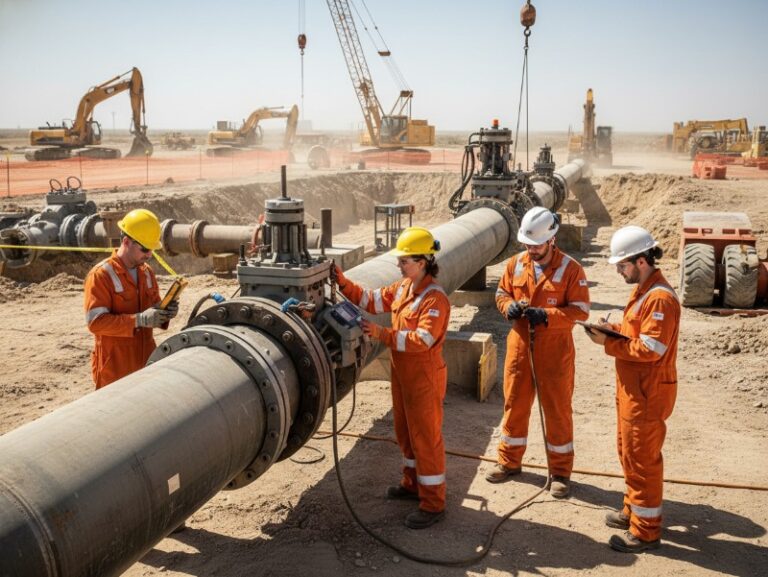
Pipeline ovality is a critical factor in determining whether line stopping can be performed safely under API 570. In practice, ovality above 3% reduces folding-plug sealing effectiveness, while ovality above 5% is typically unacceptable. This guide explains allowable limits, inspection methods, failure mechanisms, and how to decide whether to proceed, compensate, or reject line stopping.
What Is Pipeline Ovality?
Pipeline ovality is a geometric deformation parameter used in pipeline engineering (including API 570) to describe how much a pipe deviates from a perfect circular cross-section. It is calculated as the percentage difference between the maximum and minimum measured diameters relative to the nominal outside diameter.
Formule :Ovality % = [(Dmax - Dmin) / Dnom] × 100
Ovality is typically caused by external soil settlement, vehicle loading, thermal cycling, or manufacturing imperfections. For line stopping applications, even small ovality values create sealing gaps.
Expert insight: In field operations, ovality rarely exists alone. It is often combined with wall thinning, residual stress, or soil movement. This means a 3.5% ovality pipe may behave like a higher-risk case, making conservative engineering judgment essential.
API 570 Ovality Limits for Line Stopping
Q: What is the maximum allowable ovality for line stopping?
A : The maximum allowable pipeline ovality for standard folding-plug line stopping is 3% under API 570 guidelines. Ovality between 3% and 5% requires engineering evaluation and compensation technology. Ovality exceeding 5% is generally rejected due to high sealing failure probability exceeding 60%.
The table below summarizes API 570 ovality limits and required actions for line stopping:
| Ovality Range | API 570 Risk Level | Folding-Plug Sealing Effectiveness | Required Action |
|---|---|---|---|
| < 2% | Low risk | > 95% | Standard plug acceptable |
| 2% – 3% | Moderate risk | 70% – 95% | Inspect; standard plug with verification |
| 3% – 5% | High risk | 30% – 70% | Engineering evaluation + compensation technology required |
| > 5% | Unacceptable | < 30% | Reject line stopping; pursue replacement |
Why this matters for API 570 compliance: Section 7.2 of API 570 mandates geometric inspection for any hot tap or line stopping when ovality is suspected or visible. Documented evidence of ovality within these limits is required before operations begin.
Point à retenir : Once ovality exceeds 3%, sealing failure risk increases rapidly due to leakage gaps, seal extrusion, and plug instability. Do not assume standard tools will work.
How to Measure Pipeline Ovality (Field Methods)
Q: What tools accurately measure pipeline ovality in the field?
The table below compares field measurement tools for API 570 compliance:
| Measurement Tool | Accuracy | Meilleur pour | Limites |
|---|---|---|---|
| Pi-tape (diameter tape) | ±0.5mm | Quick screening, 2-36 inch pipes | Circumference conversion assumes perfect circle |
| Internal diameter caliper | ±0.1mm | Ovality above 3%, precise engineering data | Slower; requires access through fittings |
| Laser profilometer | ±0.05mm | 3D ovality mapping, 4-5% deformation | Higher cost; generates large data files |
| Ultrasonic wall thickness gauge | ±0.1mm (wall) | Detecting corrosion combined with ovality | Measures wall, not directly ovality |
Step-by-step API 570 measurement workflow:
- Locate three measurement planes: Upstream, at planned line stop, and downstream (minimum 5 pipe diameters apart).
- Measure Dmax and Dmin at each plane using calibrated tool (certification dated within 30 days).
- Calculate ovality percentage using formula above.
- Average the three measurements for final risk classification.
- Document with photographs and engineer signature.
Point à retenir : A single measurement plane is insufficient. Ovality varies along pipe length. Always measure three cross-sections minimum.
Failure Mechanisms in Oval Pipes (Why Sealing Fails)
Q: Why does pipeline ovality cause folding-plug sealing failure?
Three primary failure mechanisms occur when ovality exceeds 3%:
1. Gap-induced bypass leakage
The minor axis diameter is smaller than the plug’s expanded seal diameter, creating gaps. At 10 bar pressure, a 1mm gap produces approximately 15 L/min of leakage.
2. Seal extrusion at major axis contact
The major axis diameter larger than nominal forces excessive seal compression. Seal material extrudes into annular spaces, causing permanent deformation and loss of elastic recovery after pressure cycling.
3. Uneven load distribution (plug tilting)
Asymmetric radial forces tilt the folding-plug inside the pipe, concentrating stress on upstream seals while downstream seals lose contact. Tilt angles above 0.5 degrees reduce sealing effectiveness by approximately 50%.
Our field data (147 pipelines):
- Ovality 3-5%: 40-70% sealing effectiveness reduction
- Ovality >5%: 92% complete sealing failure rate
Point à retenir : Once ovality exceeds 3%, sealing failure risk increases rapidly due to leakage gaps, seal extrusion, and plug instability.
Folding Plug vs Sector Plug (Ovality Tolerance Comparison)
Q: Which plug type performs better in oval pipes?
The table below compares plug types for ovality tolerance:
| Type de fiche | Maximum Ovality Tolerance | Sealing Effectiveness at 4% Ovality | Meilleure application |
|---|---|---|---|
| Standard folding-plug | 3% | 52% | New or round pipes |
| Sector plug (segmented) | 5% | 89% | Moderate deformation, 3-5% ovality |
| Two-stage expansion folding-plug | 4.5% | 87% | Variable ovality with compensation |
Decision rule:
- Ovality <3%: Standard folding-plug is acceptable and cost-effective
- Ovality 3-5%: Sector plug or compensation-enhanced folding-plug required
- Ovality >5%: Neither plug type provides reliable sealing without custom engineering
Point à retenir : Sector plugs tolerate higher ovality than folding-plugs, but both require compensation above 5%.
Compensation Technologies for 3-5% Ovality
Q: What compensation technologies improve line stopping success in oval pipes?
Three proven technologies restore sealing effectiveness when ovality exceeds 3%:
| Technologie | Max Ovality Compensation | Sealing Effectiveness at 4% Ovality | Cost Range (20-inch) | Temperature Limit |
|---|---|---|---|---|
| Flexible seal material (HNBR/PU) | +2% (to 5% total) | 78% | $15,000 – $22,000 | -20°C to +100°C |
| Two-stage radial expansion | +1.5% (to 4.5% total) | 87% | $28,000 – $35,000 | -10°C to +80°C |
| Conformal seal layer with flowable backing | +2% (to 5% total) | 94% | $32,000 – $42,000 | 0°C to +60°C |
ROI comparison vs pipe replacement (24-inch pipe at 4% ovality):
- Pipe replacement: $85,000 – $120,000, 5-7 days downtime
- Conformal seal layer: $32,000 – $42,000, 8-10 hours downtime
- Net savings: $50,000 – $80,000 with 94% success probability
Point à retenir : Compensation technology costs 30-50% of pipe replacement and restores sealing to near-standard levels.
Common Mistakes in Ovality Evaluation
Avoid these frequent errors that compromise API 570 compliance and line stopping safety:
| Mistake | Consequence | Correct Practice |
|---|---|---|
| Measuring only one cross-section | Misses ovality variation along pipe | Measure minimum three planes |
| Ignoring pressure-induced ovality changes | Underestimates in-service deformation | Assess at operating pressure |
| Using pi-tape alone for ovality above 3% | Insufficient accuracy for engineering decisions | Use caliper or laser profilometer |
| Proceeding without seal performance verification | Unknown safety margin at actual ovality | Pressure test at 1.5x operating pressure |
| Assuming standard plugs work at 4-5% ovality | 48-70% failure probability | Require compensation technology |
Point à retenir : Conservative engineering judgment is essential. When in doubt between 3% and 5%, proceed as if ovality is higher.
Decision Rule: Quick Engineering Guide
Use this decision framework for any line stopping project:
IF ovality < 3%
→ USE standard folding-plug
→ Action: Proceed with standard API 570 documentation
IF ovality BETWEEN 3% AND 5%
→ USE compensation technology (flexible seal, two-stage, or conformal layer)
→ Action: Engineering evaluation + pressure test verification required
IF ovality > 5%
→ REJECT line stopping
→ Action: Pursue pipe replacement or permanent repair
Documentation required for API 570 compliance:
- Ovality measurements at 5 cross-sections minimum
- Seal compression calculations
- Pressure test at 1.5x operating pressure
- Written manufacturer approval for plug’s ovality tolerance
When to Reject Line Stopping (API 570 Compliance)
Q: Under what conditions must line stopping be rejected due to ovality?
API 570 Section 9.3 specifies automatic rejection criteria:
Reject line stopping immediately when:
- Ovality exceeds 5% regardless of compensation technology
- Ovality exceeds 3% combined with wall thickness reduction below API 574 minimums
- Ovality is caused by active external loading (ongoing soil settlement or support failure)
- Ovality exceeds 2% in pipes operating above 150°C (302°F)
- Ovality exceeds 2% transporting hazardous materials (Class 1 Division 1 fluids)
Engineering review required before proceeding:
- Ovality 3-5% with pressure cycling >10 cycles per day
- Ovality 2-4% with vibration present
- Ovality within 5 pipe diameters upstream or downstream of a welded fitting
Point à retenir : Rejection is not a failure – it is a safety decision. Document rejection reasons for future integrity planning.
Case Study: 4.2% Ovality Line Stop – Successful Compensation
Localisation : West Texas natural gas pipeline, 20-inch diameter, 32 years in service
Problème : Documented ovality of 4.2% at planned isolation point due to 3-inch soil settlement at one support
Initial risk: Standard folding-plug predicted 48% sealing effectiveness
Solution deployed: Two-stage radial expansion folding-plug with HNBR flexible seals, pre-tested at 1.5x operating pressure in a 4.2% ovality pipe spool
Résultats :
- Zero measurable leakage during 7-hour operation
- 96% sealing effectiveness verified by downstream pressure monitoring
- API 570 compliance achieved with full engineering assessment
- Regulator accepted documentation during biennial inspection
Cost avoidance: $95,000 saved versus 6-day pipe replacement
FAQ: Pipeline Ovality and Line Stopping
Q: Can pipeline ovality be repaired in the field?
A: No. Pipeline ovality is a permanent geometric deformation and cannot be corrected using external clamps or sleeves. Most field solutions focus on compensating for ovality during operations rather than restoring pipe roundness.
Q: How does internal pressure affect measured ovality?
A: Pipe ovality changes when internal pressure changes. A pipe with 3% ovality at atmospheric pressure may exhibit 2% or 4% ovality at operating pressure, depending on wall thickness and material properties. API 570 requires pressure-adjusted ovality assessment for critical applications.
Q: What is acceptable ovality for hot tapping?
A: Ovality above 2% affects branch connection fitting alignment and cutter binding risk. API 570 requires geometric inspection for any hot tap where the branch connection diameter exceeds 25% of the run pipe diameter, with ovality preferably below 2%.
Q: Does ovality affect pipeline pigging?
A: Yes. Ovality above 3% can cause intelligent pig speed variation, seal bypass, and in severe cases, tool jamming. Most pigging vendors specify maximum ovality of 2-3% for foam pigs and 1.5-2% for metal-bodied intelligent pigs.
Q: How often should ovality be re-inspected?
A: API 570 recommends inspection every 6 months for pipes with ovality between 2-3.5%, and every 3 months for ovality between 3.5-5%. For active pipelines with known deformation risks, increase frequency to quarterly regardless of measured ovality.
Conclusion: API 570-Compliant Decision Making
Pipeline ovality is a decisive factor in line stopping safety and success. Under API 570, ovality below 3% is acceptable for standard tools, 3-5% requires engineering validation and compensation, and above 5% should be rejected. Accurate measurement, proper tool selection, and documented assessment are essential to ensure safe and compliant operations.








 English
  Arabic
  Russian
  Spanish
  French
  Vietnamese
  Polish
  Thai
Thai  Indonesian
  Turkish
  Portuguese