
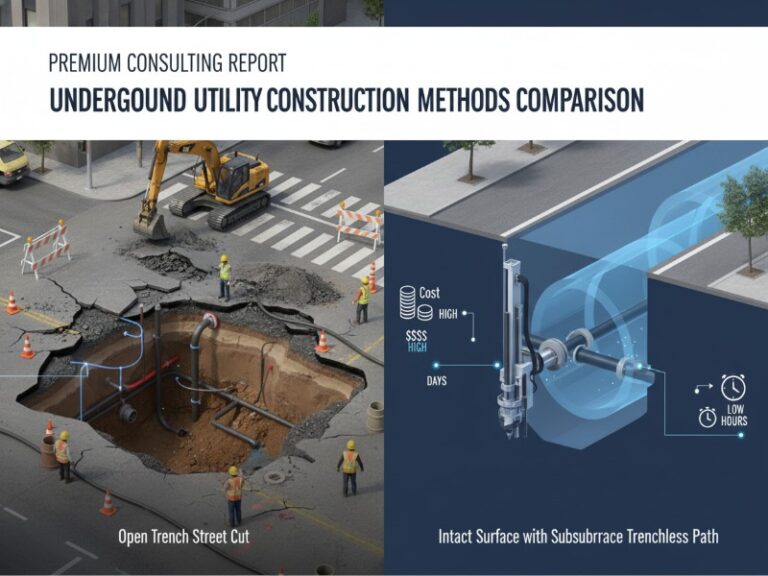
In developed areas, trenchless technology is often the better choice over open trench construction because it minimizes surface destruction, shortens project timelines, and reduces restoration costs. This article provides a direct comparison of the two methods, covering cost, schedule, environmental impact, and the specific project conditions where each approach is most suitable.
| Decision Factor | Technique sans tranchée | Open Trench Construction |
|---|---|---|
| Total Project Cost | Lower long-term cost when surface restoration is a major factor. | Lower direct pipe-laying cost, but surface restoration costs can significantly increase the total budget. |
| Perturbation de la surface | Minimal. Work is performed from small entry and exit pits. | Extensive. A continuous trench is required along the entire pipeline alignment. |
| Project Schedule | Faster completion, often measured in days or weeks. | Longer duration, often measured in weeks or months, including restoration and curing time. |
| Meilleur cas d'utilisation | Developed urban areas, under roads, landscaping, or near existing structures. | Greenfield sites, complex utility relocations, or difficult ground conditions requiring direct access. |
1. Defining the Two Construction Methods: Trenchless vs Open Trench
A clear understanding of each approach is the foundation for any engineering decision. One exposes the underground environment for direct intervention, while the other restores it with minimal surface evidence.
What Is Open Trench Excavation?
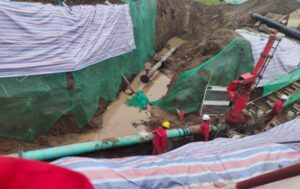
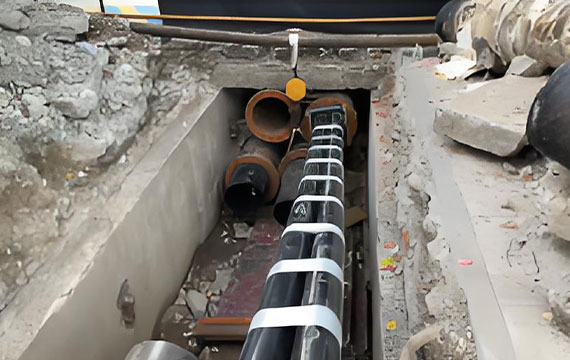
Open trench construction is the traditional method of installing, repairing, or replacing underground pipes and conduits. It involves excavating a continuous trench along the full length of the pipeline, removing the soil, placing or repairing the pipe, backfilling, and restoring the surface. The process is linear and sequential, with each phase of work dependent on the completion of the one before it. A long-term performance consideration is the potential for improper backfill compaction, which can lead to differential settlement and secondary pavement failure years after project completion.
What Is Trenchless Technology?
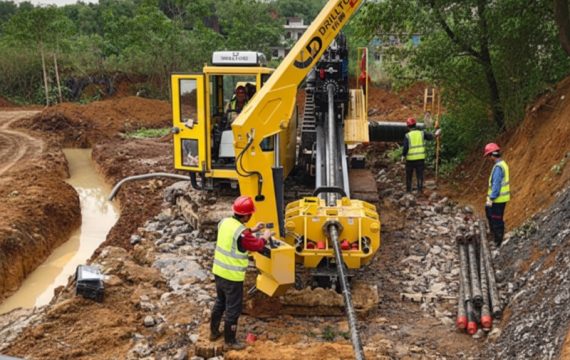
Trenchless technology encompasses a family of methods used to install, rehabilitate, or replace underground infrastructure with minimal excavation. Instead of a continuous trench, access is limited to strategically placed insertion and retrieval pits. Common techniques include Horizontal Directional Drilling (HDD) for new installations, pipe bursting for on-grade replacement, and Cured-in-Place Pipe (CIPP) for rehabilitating deteriorated pipelines from within. These methods are typically classified as either new installation or rehabilitation techniques, each suited to specific ground conditions and project goals.
2. Cost Comparison: Trenchless vs Open Trench
Project cost is rarely defined by the pipe material or installation labor alone. The more relevant figure is the total life-cycle cost, which includes surface restoration, traffic management, and long-term liability.
The direct cost of laying pipe in an open trench is well-documented and predictable. However, the ancillary costs that follow the excavation can constitute a much larger share of the final project invoice. These costs include full-depth pavement and landscape restoration, traffic control plans, dewatering, and the import and compaction of engineered backfill material. Project cost data indicates that these surface restoration and indirect expenses can become the dominant line items in an urban open trench project, sometimes exceeding the pipe work itself by a wide margin. Trenchless methods shift the financial weight from extensive surface restoration to specialized subsurface equipment and engineering, which can result in a more predictable total project budget.
3. Timeline Comparison: Trenchless vs Open Trench
The duration of a project is often dictated by the method chosen. This directly affects not only the contractor’s schedule but also the economic and social toll on the surrounding area.
A standard open trench project follows a sequential path: full-length excavation, pipe work, backfill, compaction, and multi-phase surface restoration. Each phase takes time, and the overall program for a typical city block can span multiple months. Trenchless methods, by contrast, operate on a different time model. The majority of the work is subsurface and continuous. For example, a pipe bursting operation can replace a block of pipe in a few weeks, and a CIPP liner installation can often be completed in a single working shift. The schedule advantage stems from the elimination of linear excavation and the reduced volume of surface restoration work, which compresses the project’s critical path.
4. Environmental Impact: Trenchless vs Open Trench
The choice of construction method creates a ripple effect that extends beyond the physical project boundaries, influencing soil displacement, carbon footprint, and community tolerance.
Traditional open trenching involves removing a significant volume of native soil and replacing it with imported granular material. This process generates a two-way haulage cycle of heavy trucks, contributing to traffic congestion and carbon emissions. Trenchless technology, particularly CIPP, can reduce this spoil generation to near zero. The social disruption—measured in noise, dust, road closures, and business access loss—is similarly concentrated with open trenching and distributed with trenchless work. In urban settings, the volume of public complaints logged for open-cut projects has been observed to be notably higher than for comparable trenchless interventions. The reduction in business interruption and merchant revenue loss is a critical, though sometimes unquantified, benefit of choosing a trenchless approach.
5. When Should I Choose Open Trench Over Trenchless?
Trenchless methods are powerful but they are not a universal solution. There are clearly defined project conditions where open trench construction is the more appropriate and lower-risk engineering choice.
- Greenfield Sites: On undeveloped land with no pavement, landscaping, or structures to restore, the cost benefit of avoiding surface damage is eliminated. Open trenching becomes the most direct and economical method.
- Dense, Unmapped Utility Corridors: When a project site contains a complex, poorly documented network of shallow utilities, the direct visibility provided by an open trench is essential for safe exposure and relocation.
- Challenging Soil and Geology: In ground conditions characterized by large cobbles, boulders, or flowing sands under a high water table, maintaining trenchless borehole stability can be exceptionally difficult. Direct access via open trenching may be the only safe option.
6. Quick Decision Flow: Trenchless vs Open Trench
Before diving into the detailed checklist, use this rapid assessment flow to narrow your options based on the most critical project characteristics.
- Greenfield site with no surface restoration concerns? → Open Trench
- Urban developed area with high-value finished surfaces? → Trenchless
- Complex unmapped utilities requiring direct exposure? → Open Trench
- Need capacity upsizing on an existing line? → Evaluate Pipe Bursting vs Open Trench first
7. Decision Checklist for Your Project
Selecting the right method requires a structured evaluation beyond the rapid flow. This checklist outlines the key factors that should guide the final decision-making process for an underground infrastructure project.
- Define the Core Objective: Is the goal to restore service integrity, or to significantly increase capacity? Capacity upsizing often requires open trench work unless specific trenchless methods like pipe bursting are geotechnically confirmed as feasible.
- Assess Surface Environment Value: Quantify the true cost of surface disruption. On a major arterial road in a central business district, the indirect economic and social costs of an open trench can dramatically outweigh the initial construction savings.
- Mandate a Geotechnical Investigation: Borehole logs are non-negotiable input data. The presence of unexpected ground conditions is a factor that can overrule all other preferences.
- Map All Utilities with Subsurface Utility Engineering (SUE): Achieving Quality Level A data (daylighting of existing lines) is a prerequisite in congested corridors before a trenchless method can be safely considered.
- Perform a Total Life-Cycle Cost Analysis: The analysis must model long-term costs, including the risk of future pavement settlement, pipe zone erosion, and potential business interruption claims from repeated excavation.
Questions fréquemment posées
When should I choose trenchless over open trench?
Trenchless is typically the preferred choice in developed urban areas, under roads, near buildings, or anywhere that surface restoration costs and community disruption are significant project concerns. The method excels where minimizing the construction footprint is a priority.
Is trenchless pipe as strong as open trench pipe?
Modern trenchless products, such as high-density polyethylene (HDPE) pipe installed via HDD or pipe bursting, feature fused, monolithic joints designed for extended service lives. The structural performance of an open trench installation can be compromised not by the new pipe material, but by the quality of the backfill compaction around it. Trenchless methods like pipe bursting preserve the existing soil structure, which can provide sound long-term support.
Does trenchless always cost less than open trenching?
Not always. In greenfield sites with zero surface restoration concerns, direct-bury open trenching may be the most cost-effective. The total project cost advantage of trenchless technology is most pronounced in developed areas where the cost of restoring finished surfaces and managing traffic is high.
Bottom Line: Trenchless excels in developed areas. Open trench wins on greenfield sites and complex utility corridors. Always base your decision on geotechnical data and total life-cycle cost analysis.







 English
  Arabic
  Russian
  Spanish
  French
  Vietnamese
  Polish
  Thai
Thai  Indonesian
  Turkish
  Portuguese