
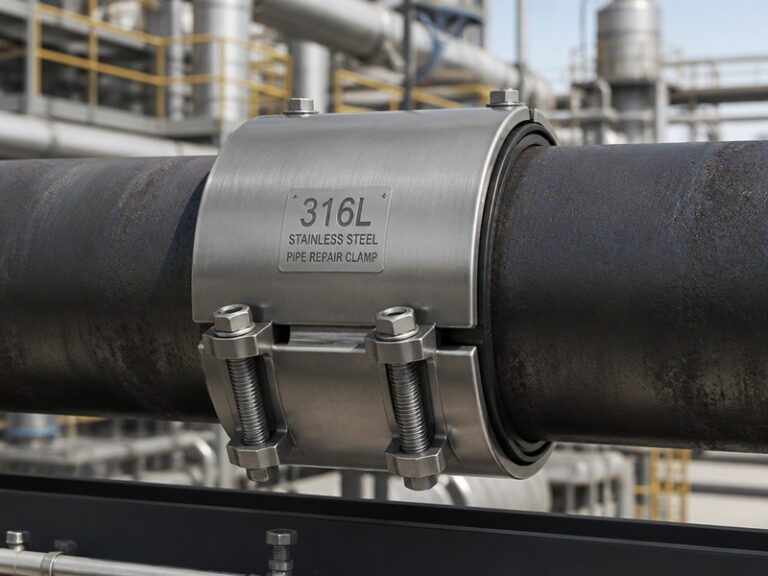
Are you facing accelerated pipe thinning where you’ve installed stainless steel clamps? The underlying risk of Galvanic Corrosion Stainless Steel Clamps on carbon steel systems is often underestimated. To protect refinery assets, the definitive solution is dielectric isolation per NACE SP0169, utilizing non-conductive buffers like EPDM or PTFE to break the electrochemical circuit. This comprehensive guide provides technical data on potential differences, insulation resistance standards (>1MΩ), and mandatory installation protocols to maintain long-term integrity in corrosive refinery environments.
1. Electrochemical Mechanisms: Why Dissimilar Metals Fail
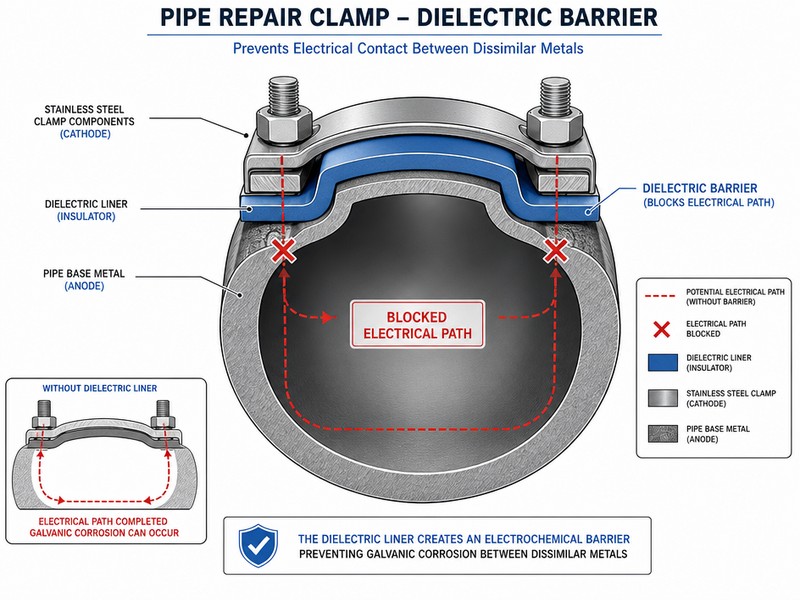
Galvanic Corrosion Stainless Steel Clamps occurs when two metals with different electrochemical potentials—typically 316L stainless steel and API 5L carbon steel—are in direct contact.
- The Anode-Cathode Flow: In the galvanic cell formed between a stainless steel clamp and a carbon steel pipe, the carbon steel invariably acts as the anode (the corroding element), while the stainless steel acts as the cathode (the protected element). This causes the pipe wall to thin rapidly under the clamp.
- The Area Ratio Effect: A critical “Information Gain” factor is the area ratio. A small anode (a local scratch on a carbon steel pipe) coupled with a large cathode ( the entire surface of a stainless steel clamp) dramatically accelerates corrosion rates. In chloride-rich environments, this effect can increase the local corrosion rate by 10 to 50 times compared to uniform corrosion.
- Potential Difference Data: According to the Galvanic Series in seawater, the potential difference between 316L stainless steel (-0.05V) and carbon steel (-0.60V) is approximately 0.55V. Industry standards suggest that any difference exceeding 0.25V requires active mitigation. Note that at temperatures >60°C, the potential difference between SS and CS may fluctuate significantly, requiring higher-specification PTFE liners to maintain stability.
2. NACE SP0169-2026: Standard for External Corrosion Control
NACE SP0169-2026 (Standard Practice for Control of External Corrosion), the latest iteration managed by the Association for Materials Protection and Performance (AMPP), serves as the global benchmark for protecting metallic piping.
- Mandatory Isolation: For Galvanic Corrosion Stainless Steel Clamps, NACE SP0169 dictates that dissimilar metals must be electrically isolated unless the galvanic current is proven negligible.
- Term Anchoring: This standard is the primary reference for refinery integrity management, ensuring that repair clamps do not become the catalyst for a new leak.
- Field Performance: Field inspections confirm that pipelines compliant with NACE isolation protocols maintain 95% of their original wall thickness over 10 years, compared to just 60% in uninsulated systems exposed to salt spray.
3. Step-by-Step Checklist for Dielectric Isolation
To maintain galvanic corrosion at a negligible level, engineers must follow a strict “Self-Contained” isolation protocol. While absolute elimination is the goal, NACE SP0169 focuses on reducing the corrosion rate to <0.025 mm/y through verified dielectric separation.
- Surface Preparation: Clean the carbon steel pipe surface to remove all conductive debris and salt crusts that could bridge the insulation.
- Buffer Selection: Choose an EPDM liner for temperatures up to 120°C or a PTFE sleeve for high-temperature/chemical applications.
- Oversize Protection: Ensure the clamp’s dielectric buffer (EPDM/PTFE) extends at least 10mm beyond the metal clamp edges to prevent “creepage” of electrolytes.
- Resistance Verification: After installation, use a megohmmeter to verify that the electrical resistance between the clamp and the pipe is >1 megohm.
- Final Coating: Apply a moisture-resistant topcoat to the edges of the clamp to provide a secondary barrier against electrolyte ingress.
- Bolt Insulation: Utilize specialized insulated washers and sleeves to prevent the bolt assembly from creating a secondary galvanic path through the installation holes (Bolt Coupling mitigation). Specialized JSW clamps utilize these components to ensure the entire assembly remains isolated.
- Controlled Torque: Adhere to the manufacturer’s specified torque limits to avoid crushing the dielectric liner, which could lead to compression-induced metal-to-metal contact.
4. Technical Comparison: Potential Differences and Risk
The table below provides quantitative electrochemical data for various stainless steel grades when mated with standard carbon steel (API 5L) in a corrosive environment.
| Material Combination | Potential Diff. (V) | Galvanic Risk | Recommended Protection |
|---|---|---|---|
| Carbon Steel + 304 SS | ~0.50V | Cao | Dielectric Isolation (>1MΩ) |
| Carbon Steel + 316L SS | ~0.55V | Critical | Mandatory NACE-compliant Buffer |
| Carbon Steel + Duplex SS | ~0.65V | Extreme | Reinforced Composite Isolators |
| Carbon Steel + Zinc (Galv) | ~0.30V | Thấp | Sacrificial Protection |
5. Frequently Asked Questions (FAQ)
What is the maximum humidity for uninsulated clamps?
For Facility Managers: The use of uninsulated stainless steel clamps is strictly limited to zero-humidity indoor environments (e.g., HVAC control rooms) where an electrolyte cannot form. If your facility is located in a coastal or high-humidity industrial zone, NACE SP0169-2026 mandates dielectric isolation to prevent rapid pipeline thinning.
How do I verify NACE SP0169 compliance in the field?
Field compliance is verified by measuring the electrical isolation resistance (typically >1MΩ) between the clamp body and the pipeline surface using a calibrated megohmmeter.
Why Choose JSW for Corrosion-Resistant Sealing Solutions?
At JSW, we specialize in Galvanic Corrosion Stainless Steel Clamps mitigation. Our engineering team combines deep industry expertise with high-performance materials to ensure your refinery piping remains leak-free. We don’t just sell clamps; we provide a complete isolation ecosystem designed for the most aggressive industrial environments.
- JSW Precision Isolation: Every clamp is available with pre-fitted, high-dielectric EPDM or PTFE liners that meet and exceed NACE SP0169 requirements.
- Data-Driven Reliability: Our clamps are tested for compression-induced contact, ensuring the insulation remains intact even under maximum bolt torque.
- Refinery Proven: JSW solutions are the preferred choice for major petrochemical operators who demand zero-corrosion integrity at Dissimilar Metal Connections.
Secure your infrastructure with JSW’s NACE-compliant technology. Contact us today.





































 English
  Arabic
  Russian
  Spanish
  French
  Vietnamese
  Polish
  Thai
Thai  Indonesian
  Turkish
  Portuguese