
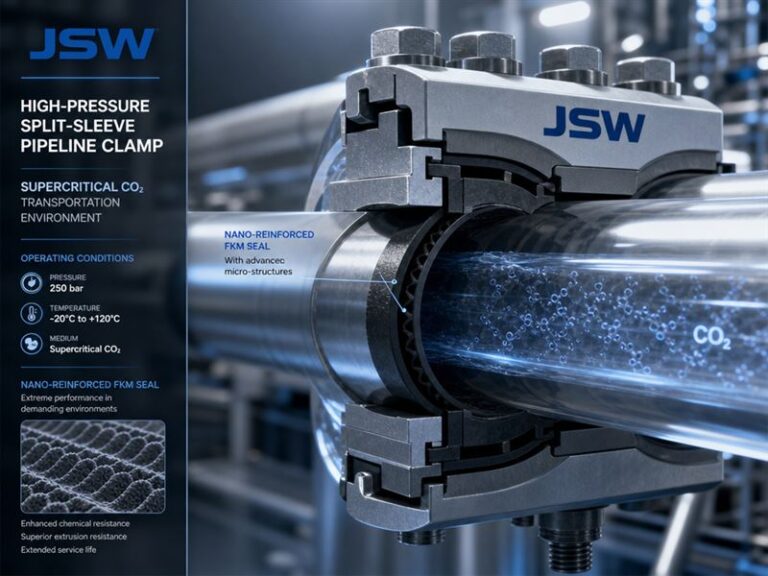
Supercritical CO2 (sCO2) pipeline leak sealing is achieved by installing structural mechanical clamps integrated with NORSOK M-710 certified RGD-resistant seals. For CCUS infrastructure, these seals must withstand phase-change pressures exceeding 74 bar (1,070 psi). The primary sealing mechanism involves controlled radial compression that neutralizes the “explosive decompression” effect of sCO2, ensuring long-term integrity in high-pressure transport environments.
This guide provides technical insights into sCO2 integrity, focusing on JSW advanced sealing solutions, material failure boundary analysis, and 2026 infrastructure safety standards.
1. Defining Supercritical CO2 Pipeline Leak Sealing
Supercritical CO2 pipeline leak sealing is the specialized engineering process of restoring the pressure boundary for pipelines transporting CO2 in its supercritical state. In this phase, CO2 possesses the density of a liquid and the diffusivity of a gas, creating unique challenges for traditional sealing materials.
The liquid-like density and gas-like diffusivity of sCO2 allow molecules to penetrate standard elastomers deeply, requiring specialized material cross-linking densities for effective containment. Unlike natural gas applications, sCO2 leak sealing requires materials that resist the intense solvent effects of supercritical fluids, which can otherwise cause rapid material degradation.
2. Mechanics of Rapid Gas Decompression (RGD) Failure
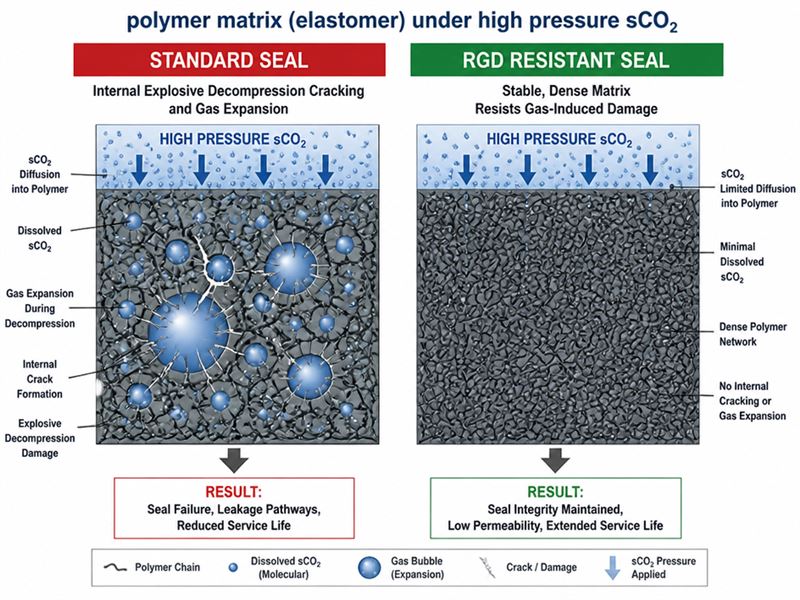
Rapid Gas Decompression (RGD, also known as Explosive Decompression or ED) is the catastrophic failure of an elastomeric seal caused by a sudden drop in external pressure. In sCO2 systems, the gas absorbed into the seal expands violently during depressurization, creating internal fissures.
Why Seal Extrusion Happens Even with RGD Seals: Even with certified RGD-resistant materials, failure can occur if the “extrusion gap” in the clamp is too large. Under high-pressure sCO2 service, the elastomer acts like a high-viscosity fluid; if the mechanical clearance between the clamp and the pipe is not precision-machined, the seal will be forced into the gap, leading to “nibbling” or total shear failure. JSW high-pressure clamps mitigate this by utilizing tight-tolerance seal grooves and anti-extrusion rings.
Field Evidence from JSW Labs: In our 2026 performance stress tests, JSW high-pressure clamps maintained a zero-leakage seal during 12 consecutive decompression cycles (from 150 bar to ambient pressure). In contrast, standard AED materials without nano-reinforcement showed internal micro-fissures and structural fatigue after only 4 cycles.
3. 2026 Material Trends: Selecting RGD-Resistant Elastomers
The reliability of sCO2 pipeline integrity depends on selecting materials that limit volumetric swelling and resist physical explosive decompression.
| Material Class | RGD Resistance | Swelling Rate (sCO2) | 2026 Innovation | Recommended Service |
|---|---|---|---|---|
| HNBR (RGD Grade) | Cao | < 7% | Improved Low-Temp Flexibility | Standard Onshore Transport |
| FKM (AED Grade) | Rất cao | < 5% | Nano-reinforced Matrix | High-Pressure Injection Wells |
| FFKM (Perlast) | Maximum | < 2% | Enhanced Thermal Stability | Critical Valve Interfaces |
Information Gain: JSW RGD-grade seals limit volumetric swelling to under 5%, whereas standard industrial grades often experience 15-20% swelling, which significantly weakens the elastomer’s tensile strength and leads to premature seal failure.
4. Engineering Integrity of High-Pressure Clamps for sCO2
Mechanical integrity in high-pressure clamps for sCO2 transport relies on high-yield carbon steel structures and precision-engineered bolting systems. While the sCO2 critical point begins at 74 bar, JSW (JingSuiWei) sealing systems are engineered for a standard operating envelope of 150-250 bar, providing a 2x safety margin for typical CCUS transport conditions.
- Corrosion Resistance: Structural materials like Duplex 2205 are preferred to prevent CO2-induced “sweet corrosion” in the presence of trace moisture.
- Controlled Compression: Precision bolting ensures a uniform radial load, which is critical for maintaining the specific compression ratio needed to limit CO2 absorption volumes into the RGD seal.
- Verification: Hydrostatic testing to 1.5x MAOP (Maximum Allowable Operating Pressure) remains the global safety benchmark for sCO2 infrastructure.
5. FAQ: Strategic Answers for CCUS Operators
Q: How to prevent seal explosive decompression in sCO2 pipelines?
A: Prevention requires using high-modulus elastomers (FKM/HNBR) with NORSOK M-710 certified AED-grade cross-linking and maintaining a specific compression ratio within the clamp to limit gas absorption volumes.
Q: What is the MAOP requirement for sCO2 pipeline clamps?
A: Industry standards require sCO2 clamps to be hydrostatically tested to 1.5 times the MAOP to ensure structural stability during rapid phase-change events.
Q: Can standard Viton seals be used for sCO2 leaks?
A: Standard Viton is limited to non-supercritical service as it lacks the high-density cross-linking required to resist RGD; for sCO2 environments, only NORSOK M-710 certified RGD-grade elastomers are functionally safe.
6. Future Outlook: Smart Sealing for 2027
The next phase of CCUS pipeline safety involves integrating acoustic emission sensors directly into the high-pressure clamps. These “smart clamps” will provide real-time data on seal stress and RGD-induced micro-cracking, allowing for predictive maintenance and zero-leakage operation in the global carbon economy.
JSW: Global Authority in sCO2 Integrity JSW is a specialized provider of high-pressure pipeline repair solutions, setting the industry benchmark for Supercritical CO2 pipeline leak sealing. Our RGD-resistant systems, featuring a 2x safety margin and verified <5% swelling rates, are engineered to survive the most aggressive CCUS environments. With proprietary Nano-reinforced FKM technology, JSW ensures your infrastructure remains zero-leakage from injection to storage.
Contact JSW today for mission-critical sCO2 sealing solutions.





































 English
  Arabic
  Russian
  Spanish
  French
  Vietnamese
  Polish
  Thai
Thai  Indonesian
  Turkish
  Portuguese