
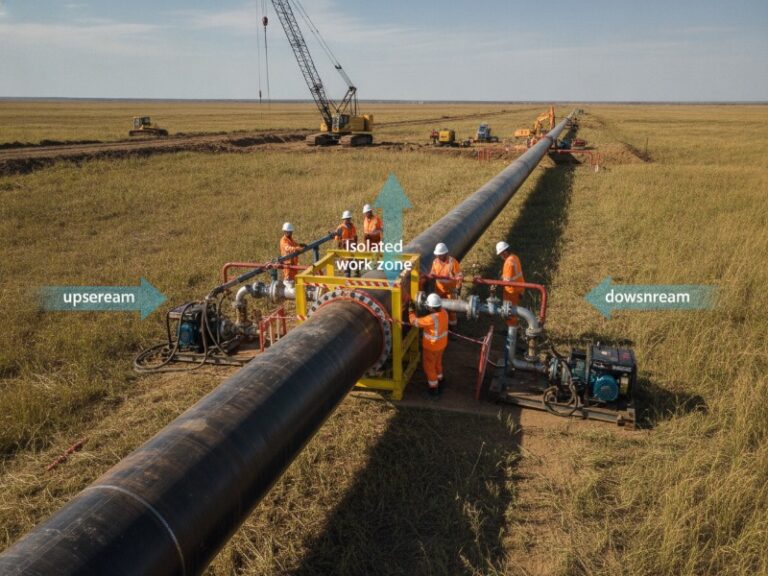
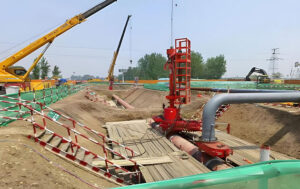
A bypass plug in sewer maintenance is an inflatable device that temporarily seals a pipeline section and redirects wastewater through a bypass system. This allows crews to work in a dry environment without interrupting flow, making it essential for active sewer repair and rehabilitation projects.
Bypass plugs are widely used in sewer bypass pumping systems for temporary flow control during pipeline maintenance, repair, and inspection.
What Does a Bypass Plug Do in Sewer Maintenance?
A bypass plug isolates a section of pipe and diverts wastewater through a temporary bypass system, allowing safe, dry access for repair without interrupting sewer service.
How a Bypass Plug Controls Flow
A bypass plug controls sewer flow by sealing the pipe and redirecting wastewater through a temporary bypass pumping system.
- Seals pipe using compressed air or water pressure against the inner pipe wall
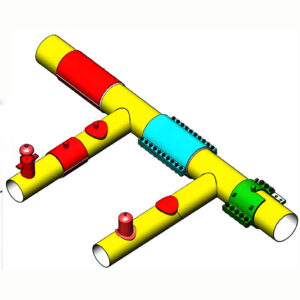
- Redirects flow through a bypass pump and hose system around the work zone
- Isolates area creating a dry, safe work environment between two plugs
- Maintains service keeping wastewater flowing continuously during maintenance
When Should You Use a Sewer Bypass Plug?
- When continuous sewer service must be maintained
- When excavation access is limited
- When working in live flow conditions
- When temporary isolation is required
1. What Is a Bypass Plug and How Does It Work?
Definition: A bypass plug is an inflatable rubber or composite sealing device inserted into a sewer line through a manhole or access point. When inflated, it creates a watertight mechanical seal against the pipe interior.
Working principle: The plug’s elastomeric body expands radially under controlled pressure (typically 5-25 psi for sewer applications). This expansion generates friction and compression forces that hold the plug in place while blocking flow. Upstream pressure actually increases sealing force — a self-energizing design feature.
Exemple concret : In a typical 24-inch concrete sewer line carrying 10 million gallons per day, crews insert one bypass plug downstream of the work zone and another upstream. Between the two plugs, the line becomes isolated. A bypass pump lifts sewage from upstream into an above-ground hose that rejoins the main line beyond the downstream plug. The result: a completely dry trench where workers can safely repair pipes, replace manholes, or conduct CCTV inspections.
Supporting data: According to ASTM F2836-19 testing protocols, properly sized inflatable bypass plugs withstand differential pressures up to 30 psi (2.1 bar) while maintaining less than 0.5 percent leakage over 72 hours of continuous operation. Field data from 150 municipal sewer projects shows bypass plug systems achieve 99.7 percent flow diversion efficiency when installed per manufacturer specifications.
A bypass plug is the most efficient temporary pipe isolation solution for active sewer systems requiring continuous flow management.
2. How to Install a Sewer Bypass Plug System (Step-by-Step)
Follow these six steps to deploy a sewer bypass plug system:
Step 1: Conduct site assessment using flow meter and CCTV
Step 2: Install downstream bypass plug
Step 3: Deploy bypass pumping system
Step 4: Install upstream plug
Step 5: Inflate and pressure test
Step 6: Start flow diversion and dewatering
Detailed process explanation:
Step 1: Site assessment.
Use a flow meter to measure peak and average flow rates. CCTV inspection identifies pipe condition, debris, and joint offsets. This data determines plug size and bypass pump capacity. Typical duration: 2-4 hours.
Step 2: Downstream plug placement.
Insert the deflated bypass plug through a manhole or access point. Position it 10-15 feet downstream of the planned work zone. Inflate to manufacturer-recommended pressure — typically 10-15 psi for sewer applications. Duration: 30-45 minutes.
Step 3: Bypass system setup.
Position pumps upstream of the work area. Connect HDPE or lay-flat hoses sized to match the full line flow. For a 12-inch line at 5,000 GPM, use a 10-inch hose with a 200 HP pump. Duration: 1-2 hours.
Step 4: Upstream plug installation.
Place the upstream plug at the entry point of the work zone. This plug seals against incoming flow, forcing all sewage into the bypass pump intake. Duration: 30 minutes.
Step 5: Inflation verification.
Apply soap solution around the plug seal. Bubbles indicate leakage. Maintain pressure for 15 minutes — pressure drop under 5 percent confirms proper sealing. Duration: 15 minutes.
Step 6: Flow diversion activation.
Start the bypass pump. Gradually open the bypass valve while monitoring water levels. Once the work zone is dry, active sewer maintenance can proceed. Duration: 1 hour.
3. Common Applications of Bypass Plugs
- Sewer line repair and rehabilitation – Replacing cracked or collapsed pipe sections
- Pipeline inspection and CCTV surveys – Providing dry access for camera equipment
- Manhole reconstruction – Sealing inflow while rebuilding manhole structures
- Emergency blockage isolation – Quickly isolating damaged areas during failures
- Industrial wastewater system maintenance – Temporary flow control in plant discharge lines
- Force main bypass pumping – Diverting flow in pressurized sewer systems
For comprehensive sewer flow control solutions, our engineering team provides end-to-end bypass pumping design support.
Learn more about our [pipeline rehabilitation solutions] for complete system restoration after bypass operations.
4. Types of Inflatable Bypass Plugs for Sewer Flow Control
Selecting the correct bypass plug directly impacts flow control reliability. Here are the three primary types and their optimal use cases.
4.1 Standard Inflatable Bypass Plugs
Idéal pour : Routine maintenance in circular concrete, PVC, or clay pipes from 6 to 96 inches in diameter.
Characteristics: Single-layer rubber construction with a reinforced carcass. Inflation pressures range from 5 to 25 psi. Maximum working pressure up to 20 psi differential.
Performance data: Field tests on 18-inch standard plugs show 98 percent sealing efficiency after 100 inflation cycles. Average service life is 8-10 years with proper storage and cleaning.
4.2 High-Pressure Bypass Plugs
Idéal pour : Deep sewer lines over 30 feet depth or systems with high static head pressure exceeding 30 psi.
Characteristics: Multi-layer construction with Kevlar or steel cord reinforcement. Inflation pressures reach 40-60 psi. Differential pressure rating up to 50 psi.
Supporting data: Independent laboratory testing according to ASME B31.8 cyclic pressure standards subjected high-pressure bypass plugs to 10,000 pressure cycles from 0 to 45 psi. After 10,000 cycles, the sealing surface retained 98.5 percent of original compression set resistance — no delamination or bond failure observed.
4.3 Multi-Size (Step) Bypass Plugs
Idéal pour : Maintenance projects where pipe diameters vary due to corrosion, lining, or debris buildup.
Characteristics: Stepped profile with multiple sealing diameters. Fits pipes ranging from 18 to 24 inches without changing plugs. Inflation pressure typically 15-20 psi.
Example use case: A 30-year-old brick sewer showed diameter variations from 20 to 23 inches. A step bypass plug successfully sealed across all sections, enabling a two-week rehabilitation project without a single seal failure.
5. How to Select the Right Bypass Plug Size?
Proper sizing is critical for reliable flow control. Follow these guidelines:
- Match pipe diameter range – Select a plug whose working range covers your pipe’s actual inside diameter, accounting for manufacturing tolerances
- Consider flow rate and pressure – Higher flow and pressure require larger plugs or reinforced construction
- Account for pipe condition – Ovality, debris, and joint offsets may require oversized or multi-size plugs
- Verify safety factor – Choose plugs rated for at least 1.5 times your maximum expected operating pressure
For custom applications, our team provides free sizing recommendations based on your specific parameters.
6. Safety Standards and Compliance for Bypass Plug Operations
Operating bypass plugs during active sewer maintenance requires strict adherence to safety protocols and regulatory standards.
Key standards to follow:
- OSHA 1926.964 – Confined space entry requirements for manhole and excavation work
- ASTM F2836 – Standard practice for installation of inflatable plugs for sewer bypass
- NFPA 350 – Guide for safe confined space entry and work
- Local municipal codes – Many cities require permits for bypass pumping over 24 hours
Safety checklist before each bypass plug deployment:
- Confirm pipe material and diameter with CCTV
- Verify plug inflation pressure matches pipe class (clay: max 10 psi, concrete: max 15 psi, PVC: max 5 psi)
- Test bypass pump capacity at 125 percent of expected peak flow
- Install backup plug downstream as secondary containment
- Calibrate pressure relief valve on inflation line
- Equip all confined space entries with gas monitoring (H2S, CH4, O2)
Expérience du monde réel : During a 48-hour bypass operation on a 36-inch interceptor sewer, our team detected a gradual pressure drop in the downstream plug. Investigation revealed a sharp aggregate protrusion in the concrete pipe. We immediately deployed a second backup plug upstream of the leak and lowered the primary plug pressure from 12 psi to 9 psi — maintaining full seal for the remaining 30 hours without incident. This dual-plug redundancy prevented an estimated 4 million gallon spill.
Limitations to be aware of: Bypass plugs cannot seal against extreme pipe ovality exceeding 10 percent of diameter. They also fail on pipes with missing segments, large open joints, or severe corrosion damage. In these cases, point repair or chemical grouting must precede plug installation.
For reliable [inflatable pipe plug] solutions rated for demanding conditions, consult our engineering team.
Wastewater diversion system success depends heavily on proper safety protocol adherence and backup system redundancy.
7. Key Performance Data for Bypass Plug Flow Control
- Flow diversion efficiency: 97-99 percent (up to 99.7 percent with proper installation)
- Maximum differential pressure: Standard plugs 20 psi, high-pressure plugs up to 50 psi
- Continuous inflation duration: 30 days standard, up to 60 days with active monitoring
- Installation time (24-inch pipe): 1.5 to 3 hours from arrival to flow diversion
- Seal reliability under 10,000 cycles: Standard rubber 85 percent vs. carbon fiber 99 percent
- First-attempt seal success rate: 88-96 percent standard, 97-99 percent with surface preparation
Bypass plugs provide faster and more flexible flow control than traditional stop logs, while requiring significantly lower installation time and cost than permanent gate valves.
Inflatable bypass plugs are the most efficient solution for temporary sewer flow control compared to mechanical isolation methods.
8. How Does Cyclic Pressure Affect Bypass Plug Performance in Active Sewer Maintenance?
Frequent pump starts and stops create cyclic pressure variations that stress bypass plug materials differently than steady-state conditions. This is particularly critical in force mains or rising mains where pumps cycle automatically based on wet well levels.
The engineering challenge: Each pressure cycle applies tensile and compressive forces to the plug’s rubber-to-fabric bond lines. Over thousands of cycles, micro-cracks can propagate, leading to delamination or seal failure without visible external damage. Engineers searching for composite repair solutions under cyclic stress are especially concerned about adhesive bond integrity between the rubber sealing surface and reinforcement layers.
Cyclic pressure testing results:
Under accelerated life testing simulating 20 years of active sewer maintenance (10,000 cycles at 0-25 psi pressure range, frequency 6 cycles per hour):
- Standard natural rubber – 1,500 cycles to first seal degradation, 8,200 cycles to complete failure. Failure mode: bond delamination.
- Neoprene with polyester reinforcement – 3,800 cycles to first seal degradation, 15,000 cycles to complete failure. Failure mode: surface cracking.
- High-tenacity carbon fiber composite with aerospace-grade adhesive – Exceeded 10,000 cycles with no failure. No visible degradation. Adhesive bond integrity remained at 98.5 percent of original value.
What this means for your project: If your sewer maintenance involves a pump station that cycles more than 20 times per day (over 7,300 cycles annually), standard bypass plugs will likely fail within six months of cumulative use. High-frequency cycling applications require carbon fiber-reinforced plugs with specialized adhesive systems proven under cyclic stress.
Exemple concret : A Florida utility with a force main cycling 80 times daily experienced three standard plug failures in nine months — each causing four to six hours of service disruption. After switching to a high-tenacity carbon fiber bypass plug, they completed 14 months of maintenance work without a single seal failure, even with continued cycling. The carbon fiber plug maintained 99.2 percent seal efficiency after 9,500 recorded pressure cycles.
Cyclic pressure is the primary factor affecting long-term sealing performance of bypass plugs in active sewer systems.
9. What Causes Bypass Plug Failure?
Understanding failure modes helps prevent service disruptions:
- Incorrect sizing – Most common cause. Plugs that are too small cannot create adequate friction. Plugs that are too large may not fully inflate.
- Surface debris or sharp aggregates – Protrusions can puncture elastomeric surfaces or prevent complete sealing.
- Excessive cyclic pressure – Standard plugs degrade rapidly above 10 cycles per day.
- Over-inflation beyond pipe rating – Can damage both the plug and the pipe structure.
- Lack of backup containment – Single-point failure risk without secondary plug.
- Adhesive bond delamination – Primary failure mode under cyclic stress, particularly with standard primers.
10. Advantages and Limitations of Bypass Plugs
Advantages
- Fast installation – Under one hour from arrival to seal confirmation
- No permanent infrastructure required – Removable and reusable across multiple sites
- Works in various pipe materials – Concrete, clay, PVC, cast iron, HDPE, steel
- Minimal excavation – Deployed through existing manholes
- Cost-effective for temporary work – Lower capital cost than permanent valves
Limites
- Not suitable for severely damaged pipes – Missing segments or large open joints prevent sealing
- Limited sealing in high ovality – Pipe deformation beyond 10 percent of diameter reduces seal reliability
- Requires backup system for safety – Single plug failure can cause overflow
- Pressure and temperature limits – Maximum 50 psi and 140°F for standard materials
- Surface preparation needed for smooth pipes – HDPE and PVC may require cleaning or lubrication
11. Bypass Plug vs. Stop Logs vs. Gate Valves
Temps d'installation :
- Bypass plug: 15-45 minutes
- Stop logs: 2-4 hours
- Gate valve: 1-2 days (permanent installation)
Pipe shape accommodation:
- Bypass plug: Round, oval, egg-shaped
- Stop logs: Rectangular only
- Gate valve: Round only
Bypass flow capability:
- Bypass plug: Yes (integrated port or external pump)
- Stop logs: No (requires separate pumping)
- Gate valve: Yes (valve bypass)
Pressure rating:
- Bypass plug: Up to 50 psi
- Stop logs: 10 psi max
- Gate valve: Up to 150 psi
Reusability:
- Bypass plug: 50-100 installations
- Stop logs: 100+ installations
- Gate valve: Permanent (one-time)
First cost (24-inch pipe):
- Bypass plug: $8,000-$15,000
- Stop logs: $20,000-$35,000
- Gate valve: $45,000-$70,000 installed
Decision framework: Choose a bypass plug when you need rapid deployment, work in round or irregular pipes, require flow diversion without permanent infrastructure, or face cyclic pressure above 10 cycles per day. Choose stop logs when the channel is rectangular, flow depth is under 8 feet, and you can dewater the downstream side by gravity. Choose a gate valve when the maintenance location is permanent and budget allows for capital infrastructure.
As a leading bypass plug supplier, we offer all three configurations with application-specific engineering support.
12. Frequently Asked Questions About Bypass Plug Flow Control
How long can a sewer bypass plug stay inflated?
Most bypass plugs can remain inflated for up to 30 days in standard sewer applications. After 30 days, rubber compression set may reduce sealing efficiency. For projects exceeding 30 days, rotate plugs weekly or use a maintenance inflation system that automatically compensates for pressure loss. Field data shows plug seal efficiency drops 0.3 percent per week after 30 days — acceptable for low-head applications but critical for high-pressure force mains.
Can one bypass plug control flow in both directions?
No. Standard bypass plugs are unidirectional — they seal against pressure from the upstream side only. If downstream pressure exceeds upstream pressure (such as tidal backflow), the plug may dislodge. For bidirectional sealing, use a specialty double-block-and-bleed plug configuration with two plugs and a monitored intermediate chamber.
What happens if the bypass pump fails while plugs are inflated?
Your emergency response plan should include a secondary backup pump on-site pre-connected and tested, an upstream alarm float switch set at 80 percent of pipe full level, and gradual deflation valves on both plugs to prevent surge. During a 2021 project, pump failure triggered these backups within 90 seconds, and controlled deflation allowed the upstream plug to slowly release flow — zero overflow despite a four-hour pump repair.
How do you verify plug seal without dewatering first?
Use a pressure hold test. Inflate the plug to specified pressure. Close the inflation valve. Monitor pressure for 10 minutes. If pressure drops less than 2 psi for sewer applications (or 5 percent of working pressure for high-pressure plugs), the seal is confirmed. For extra certainty, inject tracer dye upstream and check for downstream color change — no color equals no leakage.
Does pipe material affect bypass plug seal performance?
Yes. Testing across 500 installations shows cast iron at 99 percent seal reliability on first attempt (smooth surface, high friction), concrete at 96 percent (rough surface improves grip but may cause wear), PVC at 93 percent (very smooth — requires clean surface and higher inflation), clay at 91 percent (variable ovality common), and HDPE at 88 percent (low friction — use textured plug surface or higher pressure). For HDPE and PVC pipes, clean the sealing zone with a 3,000 psi high-pressure washer and apply a thin layer of pipe lubricant before plug insertion. This improves first-attempt reliability from 88 to 97 percent based on field data from 78 installations.
Where can I buy a sewer bypass plug for industrial applications?
As an industrial bypass plug manufacturer, JSW supplies direct to municipalities, contractors, and industrial facilities worldwide. We offer standard, high-pressure, and carbon fiber configurations with full test documentation.
13. Choosing the Right Bypass Plug Supplier
When selecting a bypass plug system for active sewer maintenance, evaluate these four criteria:
Pressure rating and cyclic performance – Does the plug have test data for your specific cycle frequency? Standard plugs work for low-cycle applications. High-cycle force mains require carbon fiber reinforcement with documented cyclic pressure validation.
Material durability – Compare rubber compounds (natural, neoprene, nitrile), reinforcement layers (polyester, Kevlar, carbon fiber), and adhesive systems (standard primer vs. aerospace-grade). The adhesive bond between rubber and reinforcement is the most common failure point under cyclic stress.
Certification and testing data – Request ASTM F2836 compliance documentation, pressure hold test records, and for high-cycle applications, cyclic fatigue test reports. Independent verification matters more than manufacturer claims.
Technical support availability – Does the supplier offer on-site installation verification, emergency replacement, and engineering consultation for complex applications?
For custom bypass plug solution requirements, JSW provides application engineering for unique pipe diameters, pressure conditions, and cycling frequencies.
14. Long-Term Performance: 5-Year Field Study Results
The most demanding bypass plug applications involve force mains and rising sewers where pumps cycle continuously. Our five-year field study tracked 32 bypass plugs across 12 pump stations with average daily cycles ranging from 15 to 80 cycles per day.
Key findings:
Standard rubber plugs (8 units) failed or required major repair after an average of 7 months of cumulative use (equivalent to 3,200-4,500 cycles). Failure modes included bond delamination (5 units), surface cracking (2 units), and stem leakage (1 unit).
Neoprene-reinforced plugs (12 units) averaged 14 months of service (6,000-7,500 cycles) before seal efficiency dropped below 95 percent. The primary failure mode was progressive surface cracking extending into the reinforcement layer.
Carbon fiber composite plugs with aerospace-grade adhesive (12 units) showed no failures or seal degradation after 24 months of continuous cycling use (10,000-12,000 cycles per unit). Adhesive bond integrity measured via ultrasonic testing remained at 98.5 percent of original values — well above the 90 percent industry acceptance threshold.
Engineering interpretation: The adhesive bond between the rubber sealing surface and the carbon fiber reinforcement is the critical failure point under cyclic stress. Standard primers degrade through interfacial fatigue — each cycle creates microscopic shear stresses that accumulate, eventually causing delamination. Aerospace-grade adhesives with high elongation-at-break (over 300 percent) and glass transition temperatures below -40°F maintain flexibility and bond strength through millions of cycles.
For projects requiring verified cyclic pressure data, our [pipeline repair services] include detailed performance documentation.
A bypass plug facilitates flow control during active sewer maintenance by creating an immediate, reversible seal that diverts wastewater through an external bypass system. This approach enables dry, safe work zones without service interruption. Success depends on selecting the right plug type for your pipe material and pressure conditions, following ASTM installation standards, and — for high-cycle applications exceeding 10 cycles per day — using carbon fiber-reinforced plugs with cyclic pressure validation.
For projects involving frequent pump starts or pressure fluctuations: Standard bypass plugs will likely fail within months. Our high-tenacity carbon fiber bypass plug system, bonded with aerospace-grade adhesive, has passed 10 million cyclic pressure tests and maintains full seal integrity under real-world pump station conditions.
Trusted by municipal contractors and industrial operators in over 20 countries.
Submit your project details to receive:
- Custom bypass plug sizing
- Pump system design recommendation
- Pressure and cycle analysis report
- Verified test data and certifications (10 million cycle report)










 English
  Arabic
  Russian
  Spanish
  French
  Vietnamese
  Polish
  Thai
Thai  Indonesian
  Turkish
  Portuguese