

Contractor prequalification for microtunneling should weigh verified past experience and a named machine operator above price, because the named crew and the site-specific method decide whether the drive succeeds more than the bid figure does.
Prequalification is the stage where an owner decides which contractors may bid at all, and on microtunneling that decision carries more weight than it does on conventional work. The criteria that predict performance are past project experience matched to the drive, the people who will run the machine, equipment suitability, bonding capacity, safety record, and a credible method statement. Each section explains what to verify, how to weight it, and which red flags should end a submission early. Contractor prequalification done well turns a long list into a shortlist worth pricing.
Which Prequalification Criteria Actually Predict Performance?
Five criteria carry most of the predictive weight: matched experience, the crew who will run the machine, equipment and spares, finance, and a site-specific work plan. A sixth, safety performance, filters behaviour recorded only in the field.
A track record verifies what a bidder has actually built. Price is compared only among prequalified bidders, so that every bid rests on the same verified capability.
En résumé : prequalify on capability, then compare price among capable bidders.
Why Generic Contractor Prequalification Fails for Microtunneling
Solvency, insurance and broad experience keep out unstable firms, and what separates a specialist microtunneling crew from an open-cut contractor is a record on remotely controlled drives.
Microtunneling – a remotely controlled, guided, face-supported pipe jacking drive as defined by ASCE 36-15 – concentrates risk in the machine, the guidance system and the operator. A generic pass can therefore still hand the drive to the wrong bidder, and the gap appears only once the machine is underground.
What a drive depends on is a crew that has steered a remotely controlled machine through water-bearing sand; an insurance file or a large bond is a separate question from that evidence. That is why contractor prequalification for this work leans on drive-specific evidence rather than company-level credentials.
Two adjacent questions belong elsewhere. What the owner should require sits with the specification writer, covered in writing a microtunneling specification. Who carries ground risk sits with the contract drafter, covered in risk allocation in microtunneling contracts. Prequalification decides who may bid; those documents decide what they bid on. For the wider method comparison that often sits behind a drive, see HDD vs microtunneling: which is better for your project.
En résumé : judge bidders on the drive in front of you, using evidence from that drive.
Past Project Experience: What Counts and What Does Not
If you are shortlisting for an 1,800 mm drive in water-bearing sand, past project experience counts only where it matches that drive. A record on 300 mm sewers in stiff clay tells you very little about it.
Verify four dimensions against the geology and geometry of your project:
- Diameter band: experience within roughly the same size class; a jump of more than one class needs justification.
- Ground type: soft clay, sand and gravel, rock, or mixed face; the site geology must appear in the record.
- Drive length class: comparable single-drive lengths, not only short crossings.
- Method: true remote-controlled microtunneling with continuous face support, not open-face hand-mined jacking.
A published state DOT microtunneling special specification requires the machine operator to show at least five previous projects of similar scope within the past three years. Treat that as a benchmark for the crew as a whole.
Read the reference list sceptically and ask what the machine and the crew did on each project. Ask for the diameter, the ground and the length of each claimed drive.
Where the method choice itself changes the risk profile, microtunneling versus jack and bore sets the accuracy and cost difference, and microtunneling versus conventional tunnelling compares the two on ground and access.
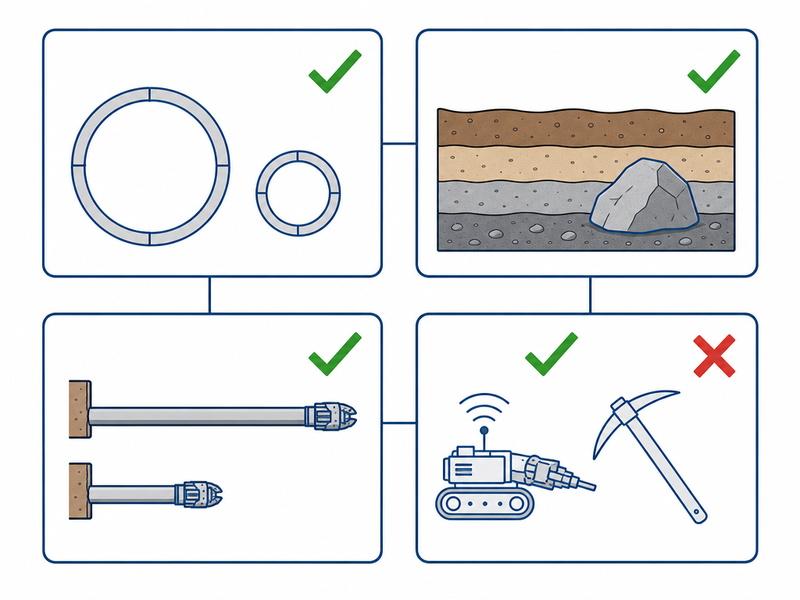
En résumé : comparable experience means the same diameter band, ground type, length class and remote-controlled method.
Key Personnel: The Machine Operator Is the Project
Who decides whether good equipment is used well? Key personnel. Name the operator who will sit at the control cabin in the submission itself, so the crew is fixed before award.
On projects we have executed, the largest single variable between a smooth drive and a difficult one has been the operator’s familiarity with the ground and the machine. Ask for the crew’s track record on comparable ground.
Name and verify the roles that carry the drive:
- Machine operator: controls face support, steering and advance rate.
- Guidance and laser surveyor: holds line and grade and manages corrections.
- Slurry system operator: keeps face pressure and separation balanced.
- Methods engineer: owns the site-specific approach and the response to changed ground.
- Site supervisor: coordinates shifts, spares and safety.
Treat the named operator’s written availability for the proposed dates as the criterion.
En résumé : a named, available operator with matching ground experience is worth more than any equipment list.
Equipment: Ownership, Suitability and Spares
What does equipment suitability actually mean? Fit: the machine size matches the product pipe diameter, the cutterhead matches the ground, and the slurry separation capacity matches the planned advance rate.
- Machine and pipe match: the machine and jacking system are sized for the finished bore.
- Cutterhead: configured for the expected soil, rock or mixed face.
- Slurry plant: separation and pumping capacity matched to the drive.
- Spares: cutter and wear-part stock on site, not on order.
- Ownership: owned equipment signals control over availability; rental is acceptable only when committed in writing.
An equipment list counts only where every named machine is under the contractor’s control or committed in writing. Ask when the machine was last used and what maintenance is scheduled before mobilization.
En résumé : committed, matched equipment with on-site spares beats a longer list of uncommitted machines.
Financial Capacity, Bonding and Insurance
Read financial capacity as a pass or fail screen. Confirm single-project bonding capacity against the contract value rather than annual turnover, and ask for working capital evidence and a claims and litigation history.
A published microtunneling case study required the general contractor to demonstrate safety experience, bonding, and management and financial capacity on a project of similar size. That combination is a reasonable template for the financial screen.
Insurance is a separate line item. Verify general liability, professional and pollution cover, and check that the insurance limits match the settlement and third-party exposure the drive creates.
En résumé : financial capacity and cover must match this contract, not the contractor’s overall size.
Safety Record: What to Measure Beyond the EMR
Read the safety record as behaviour, using the EMR as the starting point and the recent rates as the evidence. The Experience Modification Rate (EMR) is a starting point, while the contractor’s TRIR and LTIFR show recent performance on the ground.
- EMR: a baseline screen rather than a score.
- TRIR and LTIFR: recent recordable and lost-time rates.
- Confined-space rescue: a trained in-house team with its own equipment.
- Ground-collapse drills: evidence of exercises for face loss or surface movement.
- Near-miss reporting: a working reporting culture, which low rates alone cannot show.
A track record is only as strong as the drills behind it. For drives below the water table, our prequalification reviews treat a missing confined-space rescue plan as a disqualifying gap.
En résumé : a safety record is credible only when it is backed by drills, plans and reporting behaviour.
Method Statement and Geotechnical Response
If you want one document that shows whether a bidder has read your geotechnical report, that document is the method statement. A credible one states the face support method, the guidance and steering approach, the jacking force basis, and the response if ground conditions differ from the report.
It should reference the jacking force calculation and the settlement monitoring plan, and name the person who owns the response when the ground changes.
The owner’s own technical requirements belong in the specification document, discussed in writing a microtunneling specification. See microtunneling construction services for how that response is engineered in practice.
En résumé : a work plan that names the ground, the faces and the contingencies is the clearest single predictor of a competent bidder.
A Scoring Model: Weights That Work
A weighted model turns judgement into a repeatable decision. A published prequalification model in the trenchless industry weighted past project experience at about 40 points and key personnel at about 30 points, leaving the remainder for equipment, financial capacity, safety and the work plan.
| Critère | Suggested weight | What to score on |
|---|---|---|
| Past project experience | 40 points | Matching diameter band, ground type, length class and method |
| Key personnel | 30 points | Named operator, guidance surveyor, slurry operator, methods engineer |
| Equipment and spares | 10 points | Machine and cutterhead fit, separation capacity, committed spares |
| Financial capacity and bonding | 10 points | Single-project bonding, working capital, claims history |
| Safety record and method statement | 10 points | Recent rates, rescue plans, site-specific geotechnical response |
Score each criterion on evidence, and record the reason for every deduction. When two bidders score closely, the tie is usually broken by the operator and the geotechnical response.
Where the shortlist has to be priced, microtunneling cost per foot sets out the per-foot bands the same geometry produces.

Want your prequalification criteria reviewed before you invite bids? JSW plans and executes microtunneling drives with its own crews and machinery, so estimates reflect real site conditions.
Running the Prequalification Process
What makes a prequalification process defensible? Transparency, and a front-loaded timetable. Publish the criteria and the weights before submissions arrive, so every bidder prepares against the same list.
- Publish the criteria and weights in the invitation.
- Require structured submissions against each criterion.
- Check references directly, beyond the list provided.
- Interview the named operator and methods engineer.
- Score independently, then reconcile as a panel.
- Issue the shortlist with written reasons.
Scale the process to the buyer: an agency letting drives every year keeps a standing list, a municipality letting one drive runs a single round, and a general contractor screens subcontractors on the same dimensions.
Running the process in the open reduces protests, encourages better bids, and creates a record you can rely on if a losing bidder challenges the outcome.
En résumé : publish the criteria first, verify references yourself, and interview the operator, not only the office staff.
Red Flags in a Prequalification Submission
A red flag is a signal to ask a question; treat a cluster of flags, or any one touching a safety-critical role, as the point to end the submission.
| Red flag | What it suggests |
|---|---|
| Hand-mined jacking presented as microtunneling | No remote-controlled machine experience |
| Operator recruited ad hoc from a subcontractor | The critical role is not established |
| No comparable ground type in the record | Unproven in the site geology |
| Jacking force calculation missing | The work plan is not engineered |
| No settlement contingency plan | Settlement risk is underestimated |
| Equipment named but not owned or reserved | Availability is not committed |
| Claims or bonding issues left undisclosed | Financial transparency gap |
Record every flag and the answer it produced. A pattern of evasive answers is itself a finding, even when no single item would fail the bidder.
En résumé : treat clusters of red flags as a reason to stop, and treat an unanswered flag as an answer.
Questions fréquemment posées
What is contractor prequalification for microtunneling?
Contractor prequalification for microtunneling is the stage where an owner decides which contractors are allowed to bid. It screens experience, people, machinery, finance and the proposed approach before any price is opened.
How many similar projects should a machine operator have?
One state DOT microtunneling special specification requires the machine operator to show at least five previous projects of similar scope within the past three years. Treat that as a reasonable floor for the named operator on a drive of comparable diameter and ground.
Does the lowest prequalified bidder always win the work?
No. Prequalification narrows the field to contractors who can actually build the drive; price is then compared among those bidders. Because performance depends on the operator and the work plan, the lowest number from an unqualified bidder is not a comparable bid.
Can a contractor with no microtunneling experience be prequalified?
Usually not for the critical drive, because remote-controlled microtunneling with continuous face support is a distinct skill from open-face pipe jacking. A firm may qualify for lower-risk segments by naming an experienced operator and methods engineer, but that arrangement should be verified, not assumed.
How much does bonding capacity matter for a microtunneling bid?
Bonding capacity is a pass or fail screen, not a score. Confirm that single-project bonding covers the contract value, and check working capital and any claims history. A published case study required the general contractor to demonstrate bonding and financial capacity on a project of similar size.
What should a method statement include for prequalification?
A credible one states the face support method, the guidance and steering approach, the jacking force basis, and the response if ground conditions differ from the report. It should also reference the jacking force calculation and the settlement monitoring plan.
How long should the prequalification process take?
Allow enough time to check references directly and to interview the named operator rather than only reviewing paperwork. Publishing the criteria and weights in advance shortens the process and reduces protests, because every bidder prepares against the same list.
Building a Shortlist
Building a shortlist is the point of contractor prequalification: start from the criteria that match your drive, weight experience and the crew highest, and verify the operator and the work plan before you invite a price. A verified track record is the strongest single signal on the shortlist, and contractor prequalification is the first engineering decision on the project.
For the commercial picture behind the shortlist, see microtunneling cost per foot and pipeline construction services.
Want a prequalification checklist tailored to your drive? JSW reviews alignment data, geotechnical reports and bidder submissions, and recommends the shortlist that fits the ground whichever service the work turns out to need.
Sources
- ASCE 36-15, Standard Design and Construction Guidelines for Microtunneling.
- ASTM F1962, Standard Guide for Use of Maxi-Horizontal Directional Drilling for Placement of Polyethylene Pipe or Conduit Under Obstacles, Including River Crossings.
- NASTT Good Practices Guidelines (Microtunneling and Pipe Jacking).
- FIDIC, Conditions of Contract for Underground Works (Emerald Book).
- FHWA trenchless technology sample specification sections for public agencies, and state DOT special specifications for microtunneling.





































 English
  Arabic
  Russian
  Spanish
  French
  Vietnamese
  Polish
  Thai
Thai  Indonesian
  Turkish
  Portuguese