
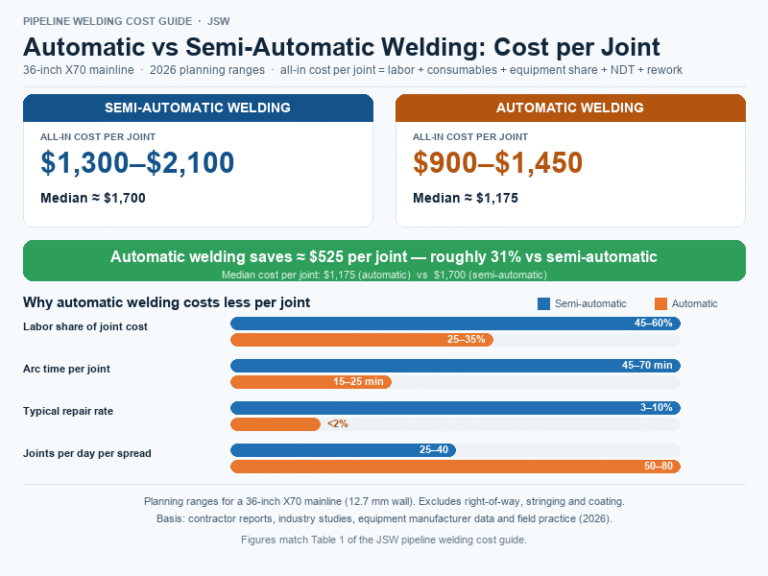
Automatic welding is typically 25-40 percent cheaper per completed joint than semi-automatic welding on long-distance mainline construction, with the largest savings in labor and rework. The saving holds once the project passes roughly 1,500 to 3,000 girth welds; below that volume, the comparison reverses and semi-automatic welding is usually the lower-cost option. Semi-automatic welding, which uses wire-fed processes such as STT and flux-cored arc welding with a welder guiding the torch, remains the lower-cost choice for short spreads, small diameters, and difficult terrain. This guide compares the automatic welding vs semi-automatic welding cost across labor, consumables, deposition rate, defect rates, NDT, and equipment cost, gives welding cost per joint planning ranges for 24-inch, 36-inch, and 48-inch lines, and provides a step-by-step method to estimate welding cost per joint for your own pipeline project.
Points clés à retenir
- Automatic welding saves 25-40 percent per joint on large-diameter mainlines once volume passes the break-even point, with the biggest savings in labor and rework.
- Labor is the biggest cost driver: it makes up 45-60 percent of a semi-automatic joint cost, and automatic welding cuts it roughly in half.
- Break-even volume is roughly 1,500-3,000 girth welds, equal to about 18-36 kilometers (11-22 miles) of 12-meter pipe at 36-inch diameter.
- Repair rates drop from 3-10 percent with semi-automatic welding to below 2 percent with automatic welding.
- Per-joint cost scales with diameter: planning ranges run from about $850-$1,350 for semi-automatic welding on 24-inch lines to $1,900-$3,200 on 48-inch lines.
- Semi-automatic welding still wins for tie-ins, crossings, small diameters, and projects below roughly 1,500 girth welds.
What Is Semi-Automatic Welding?
Semi-automatic welding is a wire-fed arc welding process in which the machine feeds the electrode continuously but a welder controls the torch, the travel speed, and the weld pool by hand. On pipeline spreads it normally means an STT or pulsed-GMAW root pass followed by flux-cored arc welding (FCAW) fill and cap passes. It replaced manual stick welding on most mainlines because it deposits metal two to three times faster with fewer starts and stops. The choice between root-pass technologies matters for cost and quality, which is why this guide compares STT vs RMD pipeline welding separately.
The process keeps one critical human element: the welder’s hand. The welder still positions the torch against the bevel, manages the puddle around the pipe circumference, and compensates for fit-up gaps. That makes quality dependent on individual skill, which is why semi-automatic welding shows a wider spread of defect rates across crews.
Semi-automatic welding is the workhorse for lines from 8 to 36 inches, for tie-ins, crossings, and repair welds, and for any spread where equipment must be moved frequently. It needs only a welding machine, a wire feeder, and a gas supply per station, so mobilization is simple. For a contractor, the semi-automatic spread is the low-capital baseline against which the automatic welding vs semi-automatic welding cost comparison is judged.
What Is Automatic Welding?
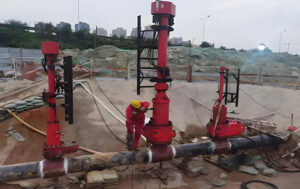
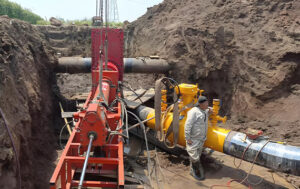
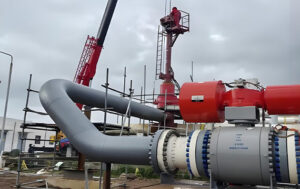
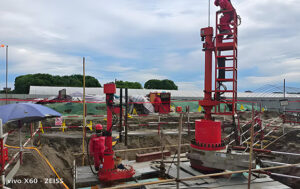
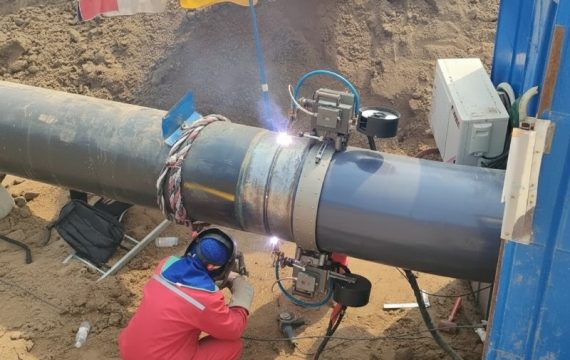
Automatic welding, also called mechanized welding in pipeline codes, is a process in which a carriage or band drives the torch around the fixed pipe while the machine controls travel speed, oscillation, and arc parameters. Most mainline systems use an internal line-up clamp with a backup bar for the root pass and an external dual-torch band for fill and cap passes, so two torches weld opposite sides of the joint at the same time.
An operator supervises the machine, monitors arc conditions, and adjusts parameters, but does not steer the puddle by hand. Because the torch path and speed are repeatable from joint to joint, weld geometry and heat input stay consistent across the entire line. That repeatability is the source of both the quality advantage and the cost advantage of automatic pipeline welding.
Automatic welding dominates modern large-diameter, high-grade lines: 36-inch and larger pipe in X70 or X80 steel over hundreds of kilometers. The process is qualified under the mechanized (automatic) welding provisions of API 1104, and automated ultrasonic testing (A-UT) is commonly paired with it because the consistent weld geometry suits automated inspection. On such projects, automatic welding is no longer an experiment; it is the standard production method.
Automatic Welding vs Semi-Automatic Welding: Cost Comparison at a Glance
The quickest way to read the automatic welding vs semi-automatic welding cost comparison is a side-by-side table. The figures below are 2026 planning ranges for a 36-inch, 12.7-millimeter wall, X70 mainline, excluding right-of-way, stringing, and coating. They are compiled from contractor reports, industry studies, equipment manufacturer data, and field practice. The all-in cost per joint includes labor, consumables, the equipment share, NDT, and a rework allowance. Ranges vary with location factors, labor rates, and owner requirements, but the ratios are consistent across projects.
| Cost driver | Semi-automatic welding | Automatic welding | Base |
|---|---|---|---|
| All-in cost per joint | $1,300-$2,100 | $900-$1,450 | Contractor reports |
| Labor share of joint cost | 45-60 percent | 25-35 percent | Contractor reports |
| Arc time per joint | 45-70 minutes | 15-25 minutes | Stage sur le terrain |
| Crew per station | 2 welders plus helper | 1-2 operators | Stage sur le terrain |
| Typical repair rate | 3-10 percent | Below 2 percent | Industry studies |
| Joints per day per spread | 25-40 | 50-80 | Contractor reports |
| Equipment investment | $150,000-$400,000 | $1,200,000-$2,500,000 | Equipment data |
| Best fit | Short spreads, tie-ins, 8-36 inch pipe | Long mainlines, 36-56 inch pipe | Stage sur le terrain |
The table answers the first question most owners ask: automatic welding is not automatically cheaper at any volume. It is cheaper per joint, but the equipment cost must be recovered first. The rest of this guide explains each line of the table and shows you how to calculate the crossover for your project.
Request the automatic vs semi-automatic welding cost calculator (spreadsheet) via our contact form: send your pipe diameter, wall thickness, joint count, and labor rates, and we will email the calculator with a worked 36-inch example.
Why Is Labor the Largest Cost Difference?
Labor is the largest single line item in pipeline welding cost, and it is where automatic welding wins the comparison by the widest margin. In the planning ranges above, labor makes up 45-60 percent of a semi-automatic joint cost but only 25-35 percent of an automatic joint cost, and the gap comes from how each method spends welder hours.
Why labor dominates: a semi-automatic welder is at the arc only a fraction of the shift. Time goes to fit-up, preheating, grinding, changing wire spools, repositioning around the pipe, and resting between passes, while an automatic band runs at 80-90 percent arc-on time once set up. The welder shortage makes this worse: the American Welding Society projects the United States will need about 330,000 new welding professionals by 2028, with an average welder age of about 55, according to The Welder’s 2025 AWS workforce outlook, so certified welder hours are scarce, expensive, and getting more so.
What this means on a spread: a semi-automatic station needs two welders plus a helper, while an automatic station needs one or two operators supervising a machine that does not fatigue or slow down at the end of a 12-hour day. Our field experience matches this pattern. One automatic station replaces two to three semi-automatic stations for the same daily output, and that labor saving is the main reason automatic pipeline welding cost per joint falls as joint count rises.
The honest caveat is that labor rates vary by region. A semi-automatic crew in a low-wage market narrows the gap; a project in a high-wage or welder-shortage market widens it. That is why the calculation in the break-even section must use your local rates, not national averages.
How Do Deposition Rate and Productivity Compare?
Speed is the second pillar of the cost comparison, and it rests on two measurable numbers: deposition rate and arc-on time. A hand-held semi-automatic welder deposits roughly 5 lb/h (2.3 kg/h) of weld metal; an automatic dual-torch GMAW/FCAW bug deposits 8-15 lb/h per torch with two torches running together, and it holds that rate through 80-90 percent of the shift. TWI process data puts mechanized duty cycles in that range, against roughly 15-30 percent arc-on time for manual stick welding.
Arc-on time is the multiplier. A hand-fed process that is at the arc 50-60 percent of the shift deposits far less usable metal across a day than a machine at 90 percent, before the deposition rate itself is even compared. That combination is why a semi-automatic spread completes 25-40 joints per day on a 36-inch mainline while an automatic spread of similar crew size completes 50-80 joints per day.
Two cautions keep the productivity claim honest. First, the gain depends on fit-up: automatic welding needs consistent bevel preparation and internal line-up, because a machine cannot see misalignment the way a welder can. Second, setup and commissioning are real; the speed advantage only appears once the band is running. For a detailed look at the productivity and quality side of this comparison, see our analysis of automatic pipeline welding productivity and quality.
How Much Does Each Joint Cost?
The girth weld cost per joint scales with diameter: larger circumference and thicker walls mean more passes, more filler metal, and more time at the joint. The planning ranges below follow the same cost structure as Table 1 (labor, consumables, equipment share, NDT, and rework allowance) and use the same 2026 basis. They are contractor-reported planning ranges for X70 pipe, excluding right-of-way, stringing, and coating.
| Diamètre du tuyau | Semi-automatic welding cost per joint | Automatic pipeline welding cost per joint | Typical saving with automatic welding | Base |
|---|---|---|---|---|
| 24-inch | $850-$1,350 | $600-$950 | About $325 per joint (about 30 percent) | Contractor reports |
| 36-inch | $1,300-$2,100 | $900-$1,450 | About $525 per joint (about 31 percent) | Contractor reports |
| 48-inch | $1,900-$3,200 | $1,300-$2,200 | About $800 per joint (about 31 percent) | Contractor reports |
Wall thickness and steel grade move these numbers as much as diameter does. The ranges assume typical wall classes for each diameter (about 12.7 mm on 24-inch and 36-inch, up to 15.9 mm or more on 48-inch). A heavier wall adds fill passes at every diameter and pushes the cost toward the top of the range; a lighter wall pulls it down.
How Much Does a 24-Inch Pipeline Joint Cost?
On a 24-inch X70 line, semi-automatic welding cost per joint typically runs $850-$1,350, while automatic pipeline welding cost per joint runs $600-$950. The smaller circumference means fewer passes and less filler metal, which is why 24-inch joints cost roughly 35 percent less than 36-inch joints. The typical automatic saving of about $325 per joint, close to 30 percent, is real but rarely enough to justify an automatic spread on a short 24-inch program.
How Much Does a 36-Inch Pipeline Joint Cost?
The 36-inch line is the anchor of the whole comparison: semi-automatic welding runs $1,300-$2,100 per joint and automatic welding $900-$1,450, with contractor-reported savings of $450-$650 per joint. Using the midpoints, the saving is $1,700 minus $1,175, about $525 per joint or roughly 31 percent, which sits inside the 25-40 percent range quoted across the industry. This is the diameter where the automatic welding vs semi-automatic welding cost comparison is most often decided.
How Much Does a 48-Inch Pipeline Joint Cost?
On a 48-inch mainline, per-joint costs rise to $1,900-$3,200 for semi-automatic welding and $1,300-$2,200 for automatic welding. The 48-inch pipeline welding cost is higher for three reasons: more weld volume per joint, heavier wall classes, and slower fit-up and preheat cycles. The saving per joint is also the largest, about $800, which is why very large programs recover the automatic equipment investment fastest.
When Does Automatic Welding Pay for Itself?
The break-even point for automatic welding is the joint count at which cumulative savings overtake the extra capital, and for typical mainline work it lands at roughly 1,500-3,000 girth welds. The formula is simple: break-even joints equal the incremental equipment, training, and mobilization premium divided by the saving per joint. The range exists because diameter, labor rates, and mobilization distance all shift the crossover within it.
Here is the calculation with the Table 1 midpoints. On a 36-inch line, semi-automatic welding costs about $1,700 per joint and automatic welding about $1,175, so the saving is about $525 per joint, roughly 31 percent. The relevant premium is the incremental capital above the semi-automatic baseline, not the full greenfield price of a spread; in practice contractors add automatic capability band by band, so equipment, training, and mobilization together typically run about $800,000-$1,600,000. Divide the premium by the saving: $800,000 divided by $525 is about 1,500 joints, and $1,600,000 divided by $525 is about 3,000 joints. That is where the rule of thumb comes from.
Expressed in pipeline welding cost per mile, the same logic applies to procurement language. A 36-inch mainline contains about 134 joints per mile at 12-meter pipe spacing; at the midpoints that is roughly $228,000 per mile for semi-automatic welding versus $158,000 per mile for automatic welding, a difference of about $70,000 per mile that repays the capital as the line grows longer.
How Many Joints Before Automatic Welding Pays Off?
The crossover is roughly 1,500-3,000 girth welds, equal to about 18-36 kilometers (11-22 miles) of 12-meter pipe. Below roughly 1,500 girth welds, semi-automatic welding is usually the lower-cost option because the capital premium has not been recovered. Above roughly 3,000 girth welds, the automatic advantage is large enough that the equipment decision is rarely in doubt. Between the two ends of the range, the answer depends on your diameter, labor rates, and mobilization distance, which is why the automatic welding ROI question needs a project-specific calculation rather than a rule of thumb alone.
Why Do Automatic Welds Need Less Rework?
Rework is the hidden cost line that can erase an apparent labor advantage, and it is the third pillar of the comparison. Because the machine controls travel speed, oscillation, and arc parameters, automatic welding typically produces repair rates below 2 percent, while semi-automatic and manual welding commonly run 3-10 percent and sometimes higher on difficult wall thicknesses. Industry studies consistently report this spread, and it translates directly into cut-outs, repair welds, and re-inspection time.
The cost of a rejected weld is far larger than the weld itself. Each repaired or cut-out joint on a 36-inch line can cost $800-$1,500 once rework labor, replacement consumables, re-inspection, and schedule delay are counted, with schedule delay valued at the spread’s crew-day rate. On top of that, every repair is re-inspected 100 percent with the original acceptance criteria, which doubles the NDT bill on repaired joints. At a 5 percent repair rate, that allowance alone adds roughly $40-$75 to the average semi-automatic joint cost; on difficult wall thicknesses at a 10 percent repair rate, the allowance reaches $80-$150 per joint.
The pairing of automatic welding with automated ultrasonic testing (A-UT) reinforces the advantage. A-UT relies on consistent weld geometry to size indications reliably, and the repeatable profile of an automatic weld suits it far better than the variable profile of hand-fed welds; A-UT is now standard on most large-diameter automatic spreads. The underlying defects still have to be prevented: contaminated bevels, damp consumables, and poor fit-up appear on automatic welds too, as our guide to common pipeline welding defects explains. What automation removes is the variability between welders and between shifts, not the process discipline around the weld.
Consumables, Equipment, and Mobilization Costs
Consumables are a smaller differentiator between semi-automatic and automatic welding than labor, because both processes use continuous wire, but the differences are still worth pricing. Welding consumables cost roughly 8-12 percent of the all-in joint cost on a hand-fed spread; the automatic process deposits only the programmed volume and wastes less on overwelding, grinding, and stub ends, typically saving $30-$60 per joint on filler, shielding gas, and preheat fuel. For context, continuous-wire processes already waste far less than stick electrodes, whose published consumption factor is about 1.5 times the deposited metal weight against about 1.05 for GMAW.
Welding equipment cost is where the two methods diverge most, and it is already shown in Table 1: a semi-automatic spread runs $150,000-$400,000, while a complete automatic spread with internal line-up clamp, external dual-torch bands, power sources, and generators runs $1,200,000-$2,500,000. The equipment price is only the start. Automatic spreads add operator training, calibration, and spare-part inventories, and the internal clamp and band systems are diameter-specific, so a contractor covering 24-inch to 56-inch pipe carries more iron. For a comparison of the leading suppliers and their mainline equipment, see our pipeline welding equipment suppliers comparison.
Mobilization cost is the final line, and it behaves oppositely to the others. Transporting, rigging up, commissioning, and decommissioning an automatic spread costs far more per move than a semi-automatic one, and on a short program it can add hundreds of dollars per joint. On a long program the same mobilization cost becomes a rounding error spread across thousands of joints. That single fact explains most of the geography of this comparison: automatic welding belongs where the equipment stays put, and semi-automatic welding belongs where the spread keeps moving.
When Should You Choose Semi-Automatic Welding?
Semi-automatic welding is the lower-cost option in four situations, and recognizing them prevents an expensive mistake. The first is low joint counts: when mobilization and setup exceed welding time, the automatic band never earns back its rig-up cost, and the semi-automatic pipeline welding cost stays the better answer. The second is tie-ins and specials: a station tie-in, a valve replacement, or a repair cut-out is one weld in a confined spot, and tie-in welding cost by an automatic system would be absurd for a single joint.
The third is small diameters and tight access. Below roughly 24 inches, the automatic spread loses its productivity edge because fewer passes fit on a small circumference, and in a ditch, a valve pit, or against an existing line, a welder’s hands fit where a band cannot. The fourth is weather and terrain: self-shielded flux-cored (FCAW-S) semi-automatic welding tolerates wind better than open-arc automatic processes, and rough or boggy terrain makes the heavy automatic support equipment hard to move.
On most real projects the pattern is hybrid, not either-or. Automatic welding builds the mainline at high speed, and semi-automatic crews close the tie-ins, make the repairs, and handle the crossings. This split delivers both the low per-joint cost of automation and the flexibility that only a welder provides, and it is the configuration we recommend unless the project is almost entirely straight-line mainline.
When Should You Choose Automatic Welding?
Automatic welding is the right choice when three conditions hold at once: enough joints to clear the roughly 1,500-3,000 girth weld break-even range, diameter and steel grade that use its speed, and a right-of-way that lets the equipment work without constant moves. In practice that means long mainlines of 36-inch and larger pipe in X70 or X80, the market segment where automatic pipeline welding is now the standard production method.
The technical prerequisites matter as much as the volume. The process must be qualified under the mechanized (automatic) welding provisions of API 1104, the welding procedure specification must be developed for the actual pipe grade and wall, and A-UT capability should be in place because the acceptance rates that make automatic welding profitable depend on fast, reliable inspection. Fit-up control is non-negotiable: the machine repeats what it is given, so line-up, bevel preparation, and internal clamp condition decide whether the promised repair rate is real.
The equipment decision belongs to the program, not the single spread. A contractor running several thousand girth welds across a year of mainline work can amortize an automatic spread properly; a contractor bidding one 500-joint line cannot. That is why many owners hire specialists for large mainline programs and keep semi-automatic capability for everything else, a split that also matches the equipment investment figures in Table 1.
How to Estimate Welding Cost for Your Project
Use this six-step method to estimate the automatic welding vs semi-automatic welding cost for a specific project. It takes about an hour with your own rates and removes the guesswork from the decision.
- Count the welds. List mainline girth welds, double joints, tie-ins, and repairs separately; only repeatable welds favor automatic welding.
- Fix the diameter and wall. Pick the per-joint range from Table 2 for your diameter, then adjust for wall thickness and steel grade; a heavier wall pushes toward the top of the range.
- Model labor. Apply your all-in crew rate to the joints per spread-day each method achieves (25-40 versus 50-80 on 36-inch), using your local rates rather than national averages.
- Add quality and rework. Apply your historical repair rate, 3-10 percent for semi-automatic and below 2 percent for automatic, and cost every repair at $800-$1,500 including re-inspection and schedule delay.
- Add equipment, training, and mobilization. Spread the incremental capital for automatic capability ($800,000-$1,600,000 above the semi-automatic baseline) across the joint count, and add per-move mobilization cost.
- Compare totals and check the break-even. Divide the capital premium by the saving per joint; if the result sits inside roughly 1,500-3,000 girth welds and your volume is above it, automatic welding pays.
| Calculation step | Semi-automatic welding | Automatic welding |
|---|---|---|
| 1. Joints per spread-day (12-meter pipe) | 25-40 (about 32 average) | 50-80 (about 65 average) |
| 2. Average all-in labor hours per joint (fit-up through cap pass, not arc time) | About 7 hours | About 3.5 hours |
| 3. All-in crew rate per hour (burden and supervision included) | $130-$170 | $120-$140 |
| 4. All-in cost per joint (Table 1 midpoint) | About $1,700 | About $1,175 |
| 5. Saving per joint | n/a | About $525 (about 31 percent) |
| 6. Incremental capital (equipment, training, mobilization) | n/a | About $800,000-$1,600,000 |
| 7. Break-even joints = premium divided by saving | n/a | Roughly 1,500-3,000 girth welds |
Note on the labor hours: the 7-hour and 3.5-hour figures are all-in crew hours, covering fit-up, preheat, grinding, and positioning as well as welding, which is why they are much larger than the 45-70 minute arc times in Table 1. Arc time counts only the minutes the torch is actually welding; the all-in hours are what the crew is paid for, so they are the correct basis for a cost estimate. Both the labor-share proportions in Table 1 and the hourly build-up in this table are planning estimates with roughly 15 percent elasticity; the build-up lands 10-20 percent above the Table 1 share because it uses all-in rates, and the relative comparison between the two methods is unchanged.
Two conversion formulas make the estimate portable. First, pipe length: multiply joints by the joint spacing, so roughly 1,500-3,000 girth welds at 12-meter joints equals about 18-36 kilometers (11-22 miles) of mainline. Second, cost per mile: divide your per-joint cost by the joints-per-mile figure for your spacing (about 134 joints per mile at 12-meter spacing), which gives the pipeline welding cost per mile used in procurement comparisons.
Two checks save money regardless of the method chosen. First, confirm the governing code accepts your planned process; the API 1104 vs ASME B31.3 choice affects procedure qualification and acceptance criteria. Second, confirm your consumables and preheat match the welding procedure specification; a procedure that was not qualified for automatic welding will not produce the low defect rate the cost model assumes.
Questions fréquemment posées
Is automatic welding cheaper than semi-automatic welding?
Yes, for long-distance mainline work. Automatic welding typically costs 25-40 percent less per completed joint than semi-automatic welding once the project passes roughly 1,500 to 3,000 girth welds, because it cuts labor hours, deposition time, and repair rates. Below that volume, semi-automatic welding is usually cheaper because automatic welding carries high equipment and mobilization costs.
What is the difference between automatic and semi-automatic welding?
In semi-automatic welding, a wire-fed process such as STT or flux-cored arc welding supplies the filler metal continuously, but a welder still guides the torch, sets the travel speed, and controls the weld pool by hand. In automatic welding, a mechanized carriage or dual-torch band moves the torch around the pipe while an operator supervises; the machine controls travel speed, oscillation, and arc parameters. The automatic process is more repeatable and faster but requires more capital equipment.
How much does automatic pipeline welding equipment cost?
A complete automatic welding spread for a mainline, including an internal line-up clamp, external dual-torch bands, power sources, generators, and preheating equipment, typically costs between 1.2 and 2.5 million US dollars. A semi-automatic spread built around STT root units, CV fill welders, and generators costs roughly 150,000 to 400,000 US dollars. The automatic spread is a capital decision that must be spread across thousands of joints.
Not sure the equipment outlay fits your program? Send us your weld count and pipe diameter, and we will check where your project sits against the break-even range before you spend anything.
How many joints per day can an automatic welding crew complete?
On a 36-inch mainline with 12-meter pipe, a well-run automatic welding spread typically completes 50 to 80 joints per day, while a semi-automatic spread of similar crew size completes 25 to 40 joints per day. Productivity depends on wall thickness, steel grade, terrain, weather, and how far ahead the pipe stringing keeps the spread supplied.
When does automatic welding become cost-effective?
Automatic welding becomes cost-effective once the project volume passes roughly 1,500 to 3,000 girth welds, which equals about 18 to 36 kilometers (11 to 22 miles) of 12-meter pipe. At 36-inch diameter, contractors typically report savings of 450 to 650 US dollars per joint, so the equipment investment pays back within that range. Below roughly 1,500 girth welds, semi-automatic welding is usually the lower-cost option.
Not sure if your weld count passes the break-even point? Send us your numbers and we will check for you.
Does automatic welding reduce weld defects and repair costs?
Yes. Because the machine controls travel speed and oscillation, automatic welding typically produces repair rates below 2 percent, while semi-automatic and manual welding commonly run 3 to 10 percent and sometimes higher on difficult wall thicknesses. Each repaired or cut-out joint on a 36-inch line can cost 800 to 1,500 US dollars in rework, re-inspection, and schedule delay (valued at the spread’s crew-day rate), which is why defect rate is a major part of the cost comparison.
Why is semi-automatic welding still used on pipelines?
Semi-automatic welding remains the standard for short spreads, small diameters, tie-ins, road and river crossings, and rough terrain where an automatic band cannot be positioned or where mobilization cost cannot be justified. Self-shielded flux-cored (FCAW-S) semi-automatic welding also tolerates wind better than open-arc automatic processes, and semi-automatic spreads need far less capital. Many projects use both: automatic welding for the mainline and semi-automatic welding for the specials.
Sources and References
The planning figures in Table 1, Table 2, and Table 3 are compiled from the following public and field sources. Each table row carries a basis label so the numbers can be traced when they are used in an estimate.
- API Standard 1104, Welding of Pipelines and Related Facilities (22nd Edition): procedure qualification and the mechanized/automatic welding provisions referenced throughout this guide.
- PRCI research report PR350-164500-R03: Semi-Automatic FCAW-S Welding Process and Implications to Pipeline Girth Weld Integrity: pipeline welding process research used for process and inspection assumptions.
- TWI Job Knowledge 96: Welding Costs: published data on duty cycle and consumable multiplication factors.
- The Welder (January/February 2025): Outlook, trends and pay for the welding workforce, according to AWS data: welder demand projections quoted in the labor section.
- Proprietary contractor cost surveys and equipment manufacturer data: automatic and semi-automatic spread pricing, joint productivity, and repair rate experience.
Get an Accurate Welding Cost Estimate for Your Pipeline
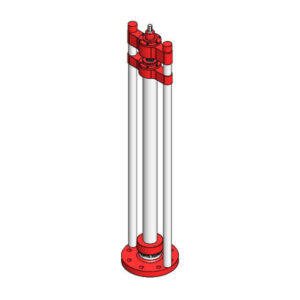
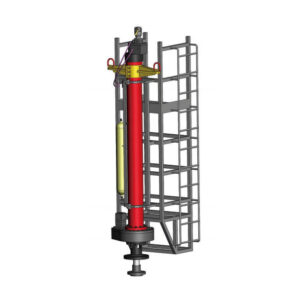
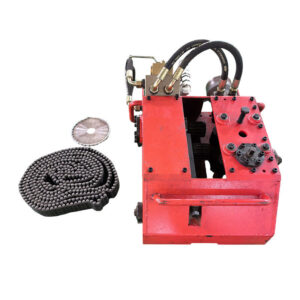
JSW provides automatic and semi-automatic pipeline welding services for cross-country mainline construction, with crews and welding procedure specifications qualified to the governing pipeline welding codes for each project. Our project record covers completed mainline programs across a range of diameters and regions, and our in-house line of pipeline welding equipment, including internal line-up clamps, external automatic welding bands, and pipeline cutting machines, is used on our own spreads. That is why our estimates carry equipment cost transparently instead of burying it in overhead, and why we can reproduce the cost-per-joint logic in this guide for your project.
Send us your pipe grade, diameter, wall thickness, weld count, and labor rates. Our welding engineers will run the cost-per-joint comparison for both methods, confirm where your project sits against the break-even range, and recommend the most economical welding method for your job, usually within 24 hours.
Get a Free Welding Cost Estimate for Your Pipeline










 English
  Arabic
  Russian
  Spanish
  French
  Vietnamese
  Polish
  Thai
Thai  Indonesian
  Turkish
  Portuguese