
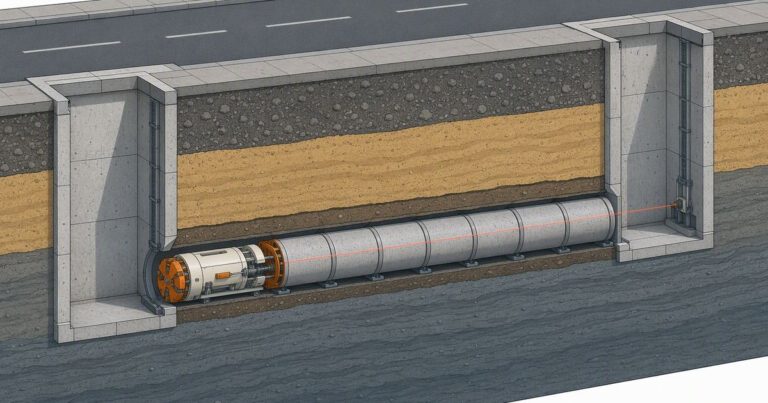
What is microtunneling? Microtunneling is a remotely controlled, guided pipe jacking method that installs a pipeline or utility tunnel between two shafts without a person entering the drive. A machine excavates behind a supported face, a jacking frame pushes pipe behind it, and guidance holds line and grade (also called line and level) from a control cabin at the surface. This guide answers what is microtunneling in size terms by basis: about 0.35–4 m is the published equipment envelope, 150–2,400 mm is the standard jacking pipe range, and ASCE/CI 36-15 sets no size limit.
It covers the microtunneling definition, the microtunneling diameter range, the four defining elements, materials and the cost stack.
Which Definition of Microtunneling Should a Tender Use?
Microtunneling is defined by its method, not its size. ASCE/CI 36-15, published in April 2015, states that microtunneling describes a method and does not impose size limitations on diameter. That sentence is the microtunneling definition that matters most: the boundary between a microtunneling drive and a conventional tunnel is a professional convention, not a technical rule.
Broad published descriptions answer what is microtunneling with the same three ideas: a small bore, remote operation, and pipe jacking as the permanent lining. Because the diameter is small, an operator cannot ride the machine, so the unit is controlled from above ground.
What Physically Defines Microtunneling? Four Elements That Must All Be Present
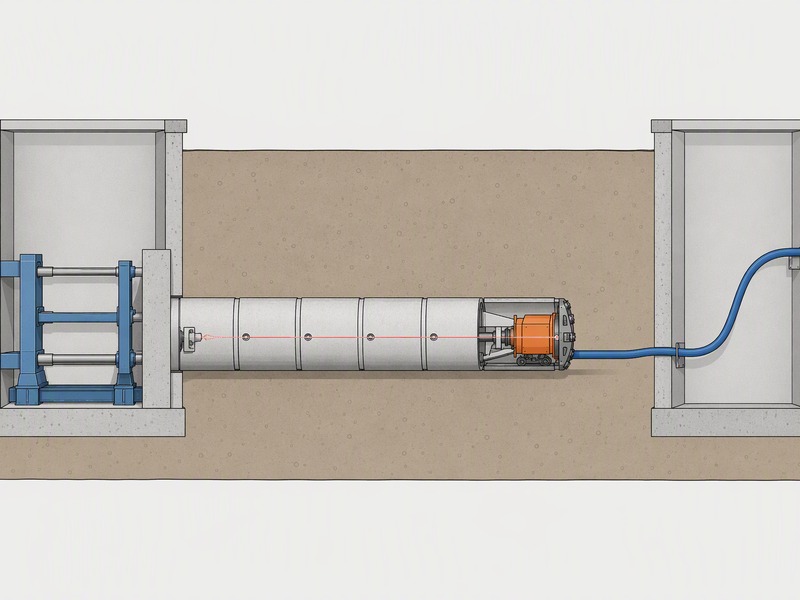
Four elements have to be present at the same time before a drive answers to what is microtunneling. These four elements are the test our engineers apply in bid reviews.
- Remote control. The drive is unmanned: a microtunnel boring machine (MTBM) is operated from a control cabin at the surface with telemetry for cutterhead load, jacking force and grade. Nobody can ride a machine only a few hundred millimeters across.
- Guidance. A microtunneling machine is steered to a designed line and level. Laser targets cover straight, shallow drives; gyro or inertial systems take over once sight is lost.
- Pipe jacking. The permanent lining is pushed behind the machine from the launch shaft. A jacking frame and thrust wall react the load; thrust rings and packers carry it through the joints.
- Face support. The cutterhead works behind a closed face so ground does not run in. Pipe Jacking Association guidance describes a microtunneling machine as typically a pressurized slurry or auger type, both with face support capability.
On the drives we have supported, these four elements decide a bid: who operates the machine, how grade is proved, how the pipe carries jacking force, and what happens when the ground changes.
The Microtunneling Diameter Range, and Why Published Sources Disagree
The widest published answer to what is microtunneling places the technique at approximately 0.35–4 m (about 14 in to 13 ft) in diameter, an envelope from encyclopaedic descriptions that stress the small diameter and the need for remote operation.
A narrower figure comes from the pipe. Pipe Jacking Association guidance notes that standard jacking pipe diameters generally range from 150 mm to 2,400 mm, or greater when required, so the microtunneling diameter range that governs supply is narrower than the method range.
The third position settles the argument. ASCE/CI 36-15 declines to impose a size limit at all, because the method is identified by remote control, guidance, pipe jacking and face support rather than by a number. The term now also covers automated pipe jacks at larger diameters controlled from above ground.
Table 1. Which jacking length does each nominal internal diameter support?
| Size class | Nominal internal diameter | Indicative jacking length between shafts | Typical applications |
|---|---|---|---|
| Small | below 0.9 m | about 150 m | laterals, ducts, short crossings |
| Standard | 0.9–1.2 m | about 200–450 m | gravity sewers, water mains |
| Large | 1.35–1.5 m | about 550–700 m | trunk sewers, road and rail crossings |
| Very large | 1.8–2.4 m | about 900–2,000 m | trunk mains, large casings |
These Pipe Jacking Association values are indicative only and require project-specific risk analysis, because ground, curvature and obstructions move the achievable length.
In our bid reviews the exact diameter rarely decides anything: what matters is whether the size can be supplied as jacking pipe and whether a microtunneling machine can hold tolerance.
How Deep Can a Drive Go, and How Long Can It Be?
Does a Bigger Diameter Always Mean a Shorter Drive?
Drives get longer as diameter grows, because friction per unit of lining falls; Table 1 gives the indicative length for each size class.
Depth is not part of what is microtunneling; it is a shaft-design question. Pipe Jacking Association shaft tables cover dry ground to about 15 m with sheet piling and about 20 m with secant piling, so the limit is usually the deepest shaft.
Indicative jacking length between shafts rises with nominal internal diameter, as the size-class table above sets out for each class. Lengths above 1 km follow only after project-specific risk analysis. Lengths are Pipe Jacking Association indicative values; diameter statements follow ASCE/CI 36-15.
Curvature and tolerance set the rest: standard 2.5 m pipes can be jacked to a radius of about 200 m, and the Pipe Jacking Association gives a typical tolerance of ±50 mm of line and grade in stable ground.
Our field teams record that grade, not length, usually decides the guidance package: long drives on a tight fall push the choice toward gyro or inertial guidance, short straight runs often toward a laser target.
Pipe Materials and the Shaft Footprint
Materials do not change what is microtunneling, but they change shaft size and jacking force. Reinforced concrete pipe is common for gravity sewers and is covered by EN 1916 and BS 5911-1; vitrified clay jacking pipe is covered by BS EN 295-7; glass-reinforced plastic, steel and ductile iron serve specific duties, and jacking force must pass through the joints without crushing the pipe. BS EN 12889 covers trenchless construction and testing of drains and sewers.
The surface footprint is set by the shafts. Precast caisson shafts of 2.4–4 m are described as suitable for microtunneling, and pilot tube microtunneling shafts are typically 8–16 ft. Even so, the area is far smaller than open-cut: a published comparison gives access doors above 60 inches (about 1.5 m) and an average staging area of about 11,000 sq ft (about 1,000 m²).
Because a jacked pipe is not re-opened, geometry and joints are confirmed by a pipeline inspection service after installation.
Where Microtunneling Sits in the Trenchless Method Family
The family map answers a different question from what is microtunneling. The family map asks which method fits a site. Microtunneling sits inside the wider family of technologies sans tranchée, and Table 2 compares the methods owners weigh most often.
Table 2. Which trenchless method fits which cutting principle and guidance need?
| Méthode | Cutting principle | Guidance and control | Typical best-fit | Main limitation |
|---|---|---|---|---|
| Microtunneling | Closed-face machine with face support | Laser, total station, gyro or inertial | Precise-grade sewers, deep or obstructed crossings | Higher unit cost than open-face methods |
| Horizontal directional drilling | Steerable pilot bore then reaming | Walk-over or downhole survey | Long crossings under rivers, roads and railways | Grade control is less precise than microtunneling |
| Auger boring | Open-face cased auger; no face support | Limited steering, often none | Short, straight, dry and stable ground | No face support and limited accuracy |
| Pipe ramming | Percussive or pneumatic displacement | Minimal steering | Short casings in soil | Little line and grade control |
| Éclatement de canalisations | Breaks and displaces an existing pipe | Follows the existing line | Replacement and upsizing of existing mains | Needs an existing pipe to replace |
| Direct pipe | Machine that thrusts the product pipe in one pass | Guided from the surface | Single-pass crossings with a smaller launch footprint | Different setup and thrust needs from a jacked drive |
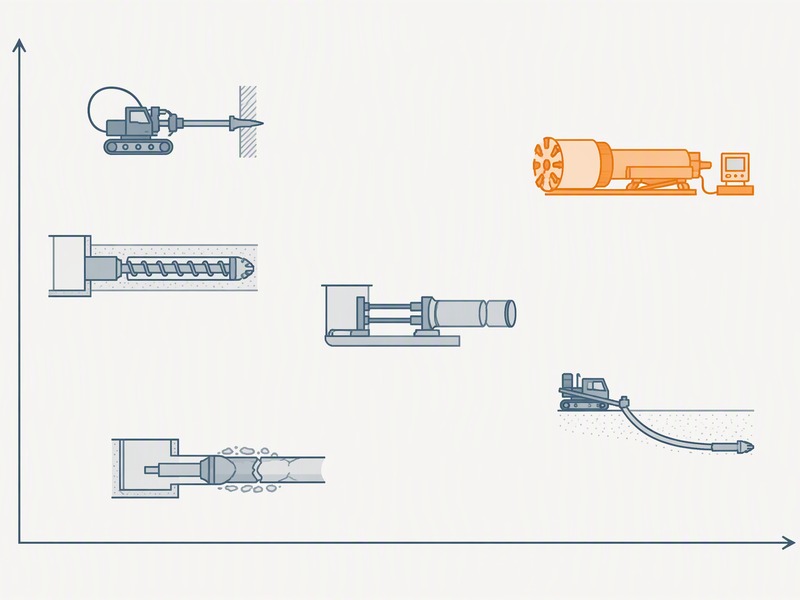
The split between microtunneling and horizontal directional drilling services comes down to grade: a sewer that must fall at a slope suits microtunneling, a line that only has to reach a point suits directional drilling.
What Microtunneling Is Not
The four elements above decide what is microtunneling; the five methods below are those it is most often confused with.
- À ciel ouvert installs pipe from a surface trench; microtunneling works between two shafts.
- A man-entry tunnel is walked by crews; the microtunneling drive is unmanned.
- Horizontal directional drilling pulls pipe through a drilled bore; with microtunneling the jacked pipe is the lining.
- Éclatement de canalisations replaces an existing pipe; microtunneling installs a new one.
- Auger boring is open-face and cased, without face support or precise steering.
The Microtunneling Cost Stack, and When It Is the Wrong Choice
Microtunneling cost is a stack of items, and the drive itself is only one. Published US contractor and municipal material quotes microtunneling at roughly USD 55–95 per foot per inch of diameter, while a cost-criteria memorandum cites about USD 35–75 per foot for microtunneling drives. The two bases differ, so the ranges are not comparable. These are published ranges, not quotations, and diameter, ground, depth, shaft cost and mobile plant move the number most.
Table 3. Why does each cost driver move the number?
| Cost driver | Why it moves the number |
|---|---|
| Diamètre | Bigger machines, more spoil, heavier pipe and more jacking force |
| Ground and face support | Slurry separation, conditioning and rock crushing add plant and labor |
| Depth and groundwater | Deeper shafts plus dewatering or wet launches raise shaft cost sharply |
| Drive length and interjacks | Long drives add lubrication, interjack stations and guidance complexity |
| Shafts and footprint | Shafts and the staging area are often the largest single visible cost |
| Mobilization and access | Setting up plant on constrained urban sites carries a fixed premium |
Microtunneling is the wrong choice in several cases. Short, shallow, dry runs with open surface access go to open-cut, where excavation is cheaper. Microtunneling suits crossings that must be bored to line and grade; where a long crossing only has to reach a point, horizontal directional drilling is the lower-cost route.
Questions fréquemment posées
What is microtunneling used for?
Microtunneling installs buried pipelines and utility tunnels where open-cut excavation is impractical. Typical uses include gravity sewers, water mains, pressure pipelines, casings for other utilities, ducts, and road, rail or river crossings.
What is the diameter range of microtunneling?
Published ranges span roughly 0.35 m to 4 m in the broad definition, while standard jacking pipe is generally supplied from 150 mm to 2,400 mm. ASCE/CI 36-15 states that microtunneling describes a method and does not impose size limitations on diameter, so the boundary is set by practice rather than by a rule.
How deep can microtunneling go?
Depth is limited mainly by shaft design and ground conditions, not by the drive itself. Pipe Jacking Association shaft tables cover dry ground to about 15 m with sheet piling and about 20 m with secant piling.
How long can a single microtunneling drive be?
Indicative jacking lengths rise with diameter, from about 150 m at diameters under 0.9 m to about 2,000 m at 2.4 m. The Pipe Jacking Association notes that drives can considerably exceed 1 km depending on diameter, ground and excavation method, and that such lengths need project-specific risk analysis.
Is microtunneling the same as pipe jacking?
Microtunneling is a subset of pipe jacking. Every microtunneling drive pushes pipe behind a machine from a launch shaft, but not every pipe jack is remotely controlled and guided from the surface.
Does microtunneling need large shafts?
Shafts are far smaller than an open-cut trench, but they are still the largest visible part of the works. Precast caisson shafts of 2.4 m to 4 m are described as suitable for microtunneling, and pilot tube microtunneling shafts are typically 8 ft to 16 ft.
Points clés à retenir
- A method-based microtunneling definition, not a size rule, decides what counts: remote control, guidance, pipe jacking and face support must all be present.
- The size-class table, not the micro boundary, is what a tender turns on.
- A nominal diameter, not a size rule, sets the jacking length a tender relies on.
- Shafts, not the drive, dominate the surface footprint and much of the cost.
- The four defining elements, not the diameter, decide what is microtunneling; the size-class table decides what a scope costs.
- Published microtunneling cost and market figures stay ranges, not quotations; every figure still needs validation against the geotechnical report and shaft design.
How JSW Supports Microtunneling Projects
JSW is a pipeline engineering and construction company that executes trenchless crossings with its own crews and equipment. Our scope covers construction par microtunnelage, trenchless technologies, horizontal directional drilling services and services d'installation de pipelines. We install pipelines from DN300 to DN1500 (12–60 inches) by microtunneling, with single drives up to 600 m.
Our crews use a VMT laser guidance system holding accuracy of about ±25 mm, at depths of about 2–25 m, in ground from soft clay and sand to cobbles, mixed ground and hard rock up to about 80 MPa UCS. Interjack stations are deployed roughly every 100–150 m, and JSW holds ISO 9001:2015, ISO 14001:2015 and ISO 45001:2018 certification.
- Prestation intégrée : engineering, shaft construction, jacking, guidance and tie-in handled by one team.
- Données de processus pouvant faire l'objet d'un audit : jacking force, grade and guidance records captured drive by drive.
- Tarification tenant compte explicitement du risque : ground, depth and obstruction risk stated rather than buried in a lump sum.
- Compliance: safety and environmental management certified to ISO 9001, ISO 14001 and ISO 45001.
Planning a microtunneling drive and not sure whether the diameter or depth fits the method? Send your route, target diameter, depth and ground data for a free technical review. Our engineers reply with a scope recommendation and an indicative budget range.





































 English
  Arabic
  Russian
  Spanish
  French
  Vietnamese
  Polish
  Thai
Thai  Indonesian
  Turkish
  Portuguese