
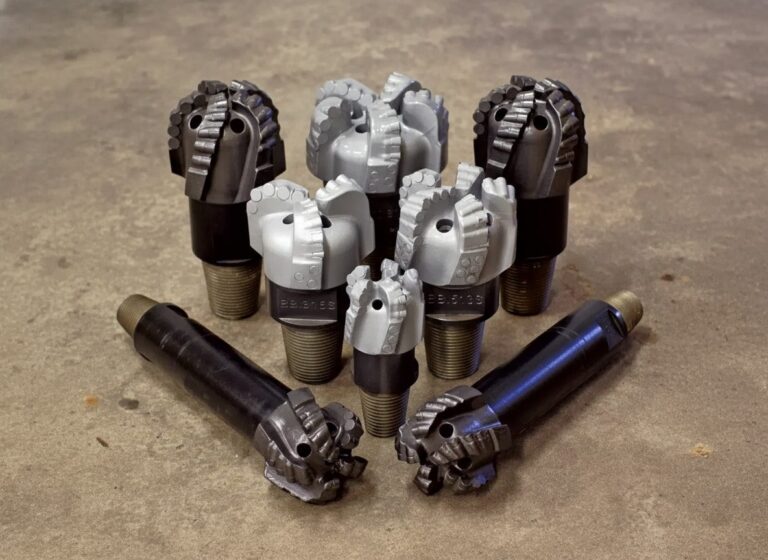
Selecting the right rock drill bits requires matching the bit design to your specific rock formations compressive strength (measured in PSI) and your drilling rigs capabilities. The four main categories are PDC bits for soft to medium rock, TCI tricone bits for versatile rock type coverage, air hammer systems for extremely hard abrasive rock, and conventional rock heads for short intermittent rock jobs. This guide covers how each type works, their PSI ranges, common operational pitfalls, and a step-by-step selection framework used by experienced drilling contractors worldwide.
1. What Are Rock Drill Bits and How Do They Work?
A rock drill bit is a cutting tool attached to the front of a drill string that fractures or shears rock formations to create a borehole. Unlike standard drill bits for soil or wood, rock drilling bits must withstand extreme axial loads, torsional stress, and abrasive wear.
1.1 The Basic Mechanics of Rock Drilling
All rock bits operate on one of two principles: shearing or crushing. Shearing bits use fixed cutters to scrape through rock like a lathe tool. Crushing bits use moving cones or hammering actions to impact-fracture the rock. The choice between these mechanisms determines your rate of penetration, bit life, and steering capability.
1.2 Key Performance Metrics You Need to Know
Three measurements determine whether a rock bit will work for your project:
- Compressive Strength (PSI): The pressure required to fracture the rock. Most sedimentary rocks range from 2,000 to 30,000 PSI. Hard igneous rocks exceed 40,000 PSI.
- Abrasiveness: High quartz content wears out steel-bodied bits rapidly.
- Formation Homogeneity: Layered or fractured rock affects steering and bit engagement.
| Bit Type | PSI Range | Best For | Requires Mud Motor |
|---|---|---|---|
| PDC Bit | 2,000-30,000 | Shale, sandstone, limestone | Yes |
| TCI Tricone | 4,000-40,000+ | All rock types | Yes |
| Air Hammer | 15,000+ | Granite, basalt, hard abrasive rock | No |
| Conventional Rock Head | Varies | Short rock shots, occasional use | No |
2. PDC Bits: The High-Speed Solution for Soft to Medium Rock
A PDC bit (Polycrystalline Diamond Compact bit) uses synthetic diamond cutters on fixed blades to shear through rock formations at high rotational speeds. These bits deliver the fastest rate of penetration in correctly matched formations but require precise hydraulic management to remove cuttings effectively.
2.1 How PDC Bits Cut Rock
Unlike rolling cone bits that crush rock, PDC bits shear rock continuously as the bit rotates. The diamond cutters are arranged on blades that spiral outward from the bit center. When you apply weight and rotation, each cutter scrapes a ribbon of rock from the borehole face. This shearing action produces small, uniform cuttings that must be swept away by drilling fluid immediately.
2.2 Blade Count Selection Guide
The number of blades on a PDC bit determines its formation compatibility:
- 3-blade PDC bits: Work in very soft formations (clay, sand, soft shale at 2,000-8,000 PSI). They offer the highest rate of penetration but lowest durability.
- 4-blade PDC bits: Handle soft to medium-soft formations (soft shale, soft sandstone at 6,000-11,000 PSI). A balanced choice for mixed conditions.
- 5-blade PDC bits: Cut medium-soft to medium-hard rock (shale, limestone, sandstone at 8,000-20,000 PSI). Most common choice for general drilling rock applications.
- 6-blade PDC bits: Designed for medium-hard to hard formations (sandstone, hard limestone at 15,000-30,000 PSI). Slower but more durable.
2.3 Common PDC Bit Failures and Prevention
Our field observations across multiple horizontal directional drilling (HDD) projects reveal two frequent failure modes. First, inadequate fluid flow causes the bit to sit in its own cuttings, leading to uneven wear and premature failure. Second, running a high-blade-count bit in soft formation reduces rate of penetration unnecessarily. Solution: Always verify your rigs gallons per minute (GPM) capacity against the bit manufacturers specifications before drilling.
3. TCI Tricone Bits: The Versatile Choice for Mixed Formations
TCI tricone bits (Tungsten Carbide Insert tricone bits) use three rotating cones with tungsten carbide buttons that crush and chip rock through a combination of weight-induced fracturing and cone-rolling action. These rock drilling bits have been refined since the early 1900s and remain the most versatile option for contractors who encounter varying rock types on a single bore.
3.1 The Cone Rolling Mechanism Explained
Each of the three cones rotates on its own bearing assembly as the bit turns. The tungsten carbide inserts on each cone strike the rock at different angles, creating a crushing and chipping action that fractures the formation. This design self-sharpens to some degree because the inserts wear against the rock while the cone body protects the bearing.
3.2 Matching TCI Tricones to Rock Hardness
Rock bit drilling success with tricones depends entirely on matching the insert shape and spacing to rock PSI:
| Formation Type | PSI Range | Insert Characteristics |
|---|---|---|
| Soft formation | 4,000-8,000 | Long, widely spaced inserts for deep penetration |
| Medium-soft | 8,000-15,000 | Medium length, moderate spacing |
| Medium-hard | 15,000-25,000 | Short, closely spaced inserts for durability |
| Hard formation | 25,000-40,000 | Dome-shaped inserts, very tight spacing |
| Very hard | 40,000+ | Rounded, button-type inserts |
3.3 Diagnosing Wear Patterns
Our service records show that most tricone failures are preventable. When carbide inserts wear out before the bearings fail, the cause is almost always insufficient weight on bit (WOB) . The bit skips across the rock surface rather than penetrating. Conversely, when bearings fail before inserts wear out, excessive RPM is typically the culprit. The ideal operating window requires balancing rotation speed against applied weight.
3.4 Frequently Asked Question: Can I Run a Tricone Without a Mud Motor?
No. TCI tricone bits require rotation to function, and most drill rigs cannot rotate the entire drill string fast enough to achieve optimal cone speed. A mud motor or rod-within-rod system provides the necessary rotational speed at the bit face while the drill pipe remains stationary or rotates slowly.
4. Air Hammer Systems: The Only Choice for Hard Abrasive Rock
An air hammer system uses compressed air to drive a piston that strikes the back of a hammer bit thousands of times per minute, fracturing extremely hard rock through percussive impact. This is the fastest method for drilling rock with compressive strength exceeding 15,000 PSI, including granite, basalt, and quartzite.
4.1 How Pneumatic Percussion Drilling Works
The system consists of three main components: an air compressor delivering 300-1,200 CFM at 150-350 PSI, a downhole air hammer that converts compressed air into mechanical percussion, and a hammer bit that receives the impact energy. Each hammer strike delivers a concentrated force that fractures rock, then the bit rotates slightly to position for the next strike. Exhaust air flows through the bit face to clear cuttings.
4.2 Slant Face vs. Round Face Hammer Bits
Two hammer bit designs exist for rock tooling applications:
- Slant face hammer bits: Designed specifically for HDD applications. The angled face creates a steering bias that helps directional drillers maintain bore path accuracy. Recommended for most horizontal drilling contractors.
- Round face hammer bits: Originally developed for oil and gas vertical drilling. They offer more durability but provide minimal steering response. Preferred by some experienced drillers in straight bore applications.
4.3 The Real Cost of Air Hammer Systems
While air hammers deliver unmatched speed in hard rock, the equipment investment is substantial. A suitable air compressor capable of 900-1,200 CFM costs $40,000-$80,000 new and consumes 15-25 gallons of diesel fuel per hour. For contractors who drill hard rock regularly, this investment pays for itself through reduced drilling time. For occasional hard rock encounters, a TCI tricone or conventional rock head may prove more economical.
5. Conventional Rock Heads: The Budget Option for Short Rock Shots
A conventional rock head is a fixed-cutter or rolling-cone bit designed to run directly on drill pipe without a mud motor or air hammer system. These rock drill heads work adequately for short rock sections (under 50 feet) but become inefficient and difficult to steer in longer rock runs.
5.1 When to Use a Conventional Rock Head
Our experience working with pipeline construction and restoration contractors shows that conventional rock heads serve specific niche applications:
- Short rock intervals within predominantly soil boreholes
- Emergency repairs where mud motor inventory is unavailable
- Pilot holes under 100 feet in consolidated cobble
- Occasional rock encounters during pipeline modification work
5.2 Limitations You Must Understand
Steering becomes problematic with conventional rock heads because the bit lacks the directional bias that mud motor-driven bits provide. When encountering boulders, the bit tends to deflect off the rounded surface rather than penetrate. Additionally, without a mud motor, you cannot achieve optimal rotational speed at the bit face. Recommendation: If your project involves more than 50 continuous feet of rock, upgrade to a PDC bit, TCI tricone, or air hammer system.
6. How to Select the Best Drill Bit for Rock: A Step-by-Step Framework
Step 1: Determine Your Rock Formation`s Compressive Strength
Obtain rock samples from the project site or review geotechnical reports. If laboratory testing is unavailable, use this field guide:
- Can you scratch the rock with a steel knife? Below 5,000 PSI (very soft)
- Does the rock crumble under a hammer strike? 5,000-15,000 PSI (soft to medium)
- Does the rock require multiple hammer strikes to break? 15,000-25,000 PSI (medium-hard)
- Does the rock spark when struck with steel? Above 25,000 PSI (hard to very hard)
Step 2: Match PSI to Bit Type Using This Decision Matrix
| If your rock PSI is… | Your best bit choice is… | Second choice |
|---|---|---|
| 2,000-8,000 | 3 or 4-blade PDC bit | Soft formation TCI tricone |
| 8,000-15,000 | 4 or 5-blade PDC bit | Medium-soft TCI tricone |
| 15,000-25,000 | 5 or 6-blade PDC bit | Medium-hard TCI tricone |
| 25,000-40,000 | Hard formation TCI tricone | Air hammer (if budget allows) |
| 40,000+ | Air hammer system | Very hard TCI tricone |
Step 3: Verify Rig Compatibility
Before purchasing any rock bit for drilling, confirm these three specifications with your equipment manufacturer or factory representative:
- Mud motor availability: Does your rig have a mud motor or rod-within-rod system? Required for PDC bits and TCI tricones.
- Air compressor capacity: For air hammer systems, does your compressor deliver at least 300 CFM at 150 PSI?
- Weight on bit capability: Can your rig apply the recommended WOB without stalling?
Step 4: Calculate Total Job Cost, Not Just Bit Price
Our analysis of pipeline stopple and pipeline tapping projects shows that bit price represents only 20-30% of total drilling tooling cost. The larger factors include:
- Rate of penetration (affects labor and equipment hours)
- Bit life (number of feet drilled per bit)
- Tripping time (pulling worn bits and running replacements)
- Fuel consumption (especially relevant for air compressors)
A $1,200 bit that drills 200 feet in 4 hours often proves cheaper than a $600 bit that drills the same 200 feet over 12 hours.
7. Rock Tooling Maintenance: Extending Bit Life in Tough Conditions
7.1 Pre-Drilling Inspection Checklist
Every drilling contractor should perform these checks before each rock drilling shift:
- Inspect cutters or inserts for visible damage or missing pieces
- Verify fluid nozzles are clear of debris
- Check bit connection threads for wear or galling
- Confirm recommended RPM and WOB ranges with manufacturer documentation
7.2 During-Drilling Monitoring
- Monitor rate of penetration continuously. A sudden drop indicates bit wear or formation change.
- Track standpipe pressure. Increasing pressure suggests fluid flow restriction or bit balling.
- Listen for unusual vibration or knocking sounds from mud motor or air hammer.
- Document footage drilled per bit for future bidding accuracy.
7.3 Post-Drilling Care
After completing a pipeline modification or trenchless pipe rehabilitation project, clean the bit thoroughly with fresh water or air. Inspect for damage and record remaining life estimate. Store bits upright in wooden racks to prevent cutter damage during transport.
8. Industry Applications: Where Different Rock Bits Excel
Pipeline Construction
Long, straight boreholes through varied formations require versatile rock tooling. TCI tricone bits dominate this space because they handle formation changes without bit changes. For pipeline stopper installations requiring precise borehole diameter, PDC reamers paired with pilot bits deliver accurate hole opening.
Water Well Drilling
Water wells often penetrate multiple rock layers. Hard rock drill bits in the TCI category handle the transition from overburden to bedrock. Air hammer systems excel in the final deep rock sections where water flow helps cuttings removal.
Oil and Gas Infrastructure
Pipeline tapping and hot tapping operations require clean, round boreholes through pipeline walls and surrounding rock. PDC bits with specialized cutter geometries produce the smooth bore surfaces needed for pipeline stopple equipment sealing.
Trenchless Pipe Rehabilitation
When rehabilitating existing pipelines, contractors sometimes encounter rock obstacles that block liner installation. Rock drill heads on directional drilling rigs can create bypass bores around obstructions without excavation.
Utility Installation
Fiber optic and electrical conduit installation often follows roadways where rock occurs in localized pockets. A conventional rock head or small PDC bit handles these short rock intervals cost-effectively.
9. Frequently Asked Questions About Rock Drill Bits
Q: What is the difference between a rock bit and a PDC bit?
A PDC bit is one type of rock bit. The term “rockbit” (sometimes written as two words) refers to any drilling tool designed for rock formations. PDC bits specifically use synthetic diamond cutters on fixed blades. TCI tricone bits use tungsten carbide inserts on rolling cones. Both are rock bits, but they operate on different cutting principles.
Q: Can I use the same bit for drilling rock and soil?
No. Bits optimized for soil have large fluid ports and widely spaced cutters that pack off and stop cutting in rock. Conversely, rock bits with tight cutter spacing drill very slowly in soil. For mixed formations, a medium-hard TCI tricone offers the best compromise.
Q: How do I know if I need a mud motor to run rock bits?
If your rock bit requires rotation speeds above 150 RPM to achieve optimal cutting action, you need a mud motor. Most drill rigs cannot rotate the entire drill string above 80-100 RPM without risking damage. PDC bits and TCI tricones typically need 120-300 RPM at the bit face, requiring a mud motor.
Q: What is rock tooling and how is it different from standard tooling?
Rock tooling encompasses the complete assembly used for drilling rock: the bit, the mud motor or air hammer, stabilizers, reamers, and any specialty subs. Standard soil tooling lacks the hardened components and bearing systems needed to survive rock abrasion and impact loading.
Q: Which companies manufacture quality rock drill bits?
Major equipment manufacturers include Sandvik, Atlas Copco, Baker Hughes, Halliburton, and numerous specialized factory operations. Many drilling contractors prefer working with a dedicated rock tooling company that provides application engineering support rather than just shipping product.
10. Maintenance and Restoration Services for Rock Drilling Equipment
Even the best rock drill bits eventually wear. Professional maintenance and restoration services can extend bit life by 40-60% compared to field sharpening. Services include:
- Cutter replacement and indexing on PDC bits
- Insert re-tipping and cone rebuilding on TCI tricones
- Bearing inspection and repacking
- Thread repair and hardfacing restoration
Pipeline modification and pipeline stopper projects often involve critical timelines where bit failure causes expensive delays. Working with a service provider that maintains inventory of rebuilt bits ensures you have replacements available immediately.
About JSW: Your Rock Tooling Partner for Challenging Drilling Projects
JSW provides engineering-driven rock drill bit solutions for pipeline construction, trenchless rehabilitation, and utility installation contractors worldwide. Unlike general tooling suppliers, we maintain a dedicated application engineering team that analyzes your rock formation data before recommending a specific bit.
Our advantages include:
- Factory-direct sourcing from qualified equipment manufacturers, eliminating markups
- Inventory of PDC bits, TCI tricones, and air hammer systems for 2-inch to 12-inch boreholes
- Custom bit modifications for unique formation conditions or rig limitations
- 24-hour technical support from drillers who have run these bits in the field
- Bit rebuild and maintenance services that restore worn bits to 85-95% of new performance
Whether you need a single bit for a pipeline tapping emergency or a fleet of rock tooling for an ongoing pipeline construction project, JSW delivers solutions backed by real drilling experience. Contact our engineering team with your rock PSI data and rig specifications for a free bit recommendation.









 English
  Arabic
  Russian
  Spanish
  French