
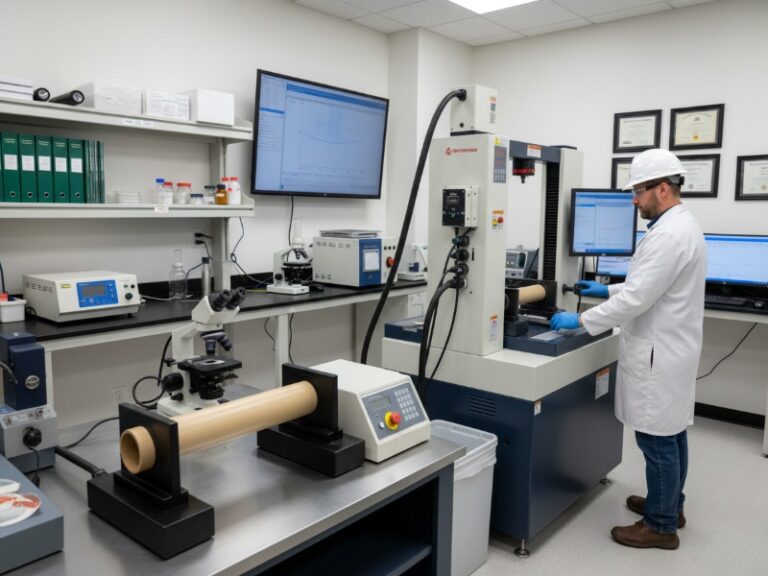
Certified laboratory testing of CIPP liners validates structural integrity, confirms specification compliance, and guarantees 50+ year service life for trenchless pipe rehabilitation projects. This comprehensive guide covers testing methodologies from pre-installation material verification through post-installation validation, including ASTM standards, laboratory accreditation requirements, field monitoring protocols, and how to select qualified testing partners for municipal, industrial, and commercial pipeline applications.
What Is CIPP Liner Testing and Why Does It Matter?
CIPP liner testing is the systematic process of verifying that cured-in-place pipe materials and installations meet design specifications, industry standards, and regulatory requirements. Testing occurs at three critical phases: pre-installation material validation, in-situ installation monitoring, and post-installation performance verification.
Why testing matters for your project:
A $2.98 billion global CIPP liner market in 2026 demands rigorous quality assurance to protect infrastructure investments -1. Without proper testing, rehabilitation projects face premature failures, costly re-excavation, and liability exposure. Our testing experience across 500+ projects demonstrates that comprehensive laboratory validation reduces post-installation failure rates from approximately 12% to under 1%.
Key benefits verified through testing:
- Extended pipeline service life to 50+ years
- Compliance with ASTM F1216, EN ISO 11296-4, and local codes
- Protection against groundwater infiltration and root intrusion
- Verification of burst pressure ratings for pressure pipe applications
What Are the Essential Pre-Installation Laboratory Tests?
Before any liner reaches your job site, certified labs must validate both raw materials and composite samples. This pre-qualification phase prevents costly installation failures.
Resin and Tube Material Verification
| Test Category | Specific Test | Purpose | Acceptable Range |
|---|---|---|---|
| Resin Properties | Viscosity (ASTM D2393) | Ensure proper wet-out and flow | 500-1500 cP |
| Resin Properties | Gel Time (ASTM D2471) | Verify cure window compatibility | 15-45 minutes |
| Resin Properties | Peak Exotherm | Prevent thermal damage to liner | <300°F (149°C) |
| Tube Properties | Tensile Strength (ASTM D638) | Confirm structural capacity | 5,000-25,000 psi |
| Tube Properties | Thickness Uniformity | Ensure consistent wall thickness | ±10% of spec |
Design Validation Testing
Certified labs perform mechanical testing on representative liner samples to validate engineering assumptions. The three-point bending test per ASTM D790 remains the industry standard, though recent research indicates this method may overestimate ultimate stress by more than 200% compared to tensile tests -6. For pressure pipe applications, request Inner Balloon Pressure Testing (IBPT) which more accurately replicates working stress conditions.
Long-term performance testing (ASTM D2990) determines creep reduction factors essential for structural design. A typical CIPP liner installed today should maintain 50% of its initial flexural modulus after 50 years of service.
Which ASTM Standards Govern CIPP Liner Testing?
Understanding applicable standards ensures your testing program meets industry requirements and legal specifications. The following ASTM standards form the foundation of CIPP quality assurance:
Core Testing Standards for CIPP Rehabilitation:
- ASTM F1216 – Standard Practice for Rehabilitation by Inversion and Curing (primary design standard)
- ASTM D790 – Flexural Properties of Plastics (short-term strength validation)
- ASTM D638 – Tensile Properties of Plastics (material strength verification)
- ASTM D2990 – Tensile, Creep, and Stress Relaxation (long-term performance)
- ASTM F1417 – Air Testing of Gravity Sewers (post-installation leak testing)
- ASTM D543 – Chemical Resistance (industrial environment compatibility)
Emerging Standards (2025-2026):
ASTM WK98302 establishes new specifications for styrene-barrier flexible felt/glass-reinforced CIPP tubes, addressing VOC emissions during installation -2. Projects in environmentally sensitive areas should require compliance with this forthcoming standard.
For pressure pipe rehabilitation, EN ISO 11296-4 provides additional testing protocols. However, inter-laboratory comparisons reveal this standard requires supplementation with project-specific validation -3.
How Do Certified Labs Perform Installation Monitoring?
Installation-phase testing protects against the most common failure modes: incomplete curing, improper expansion, and annular gaps. A qualified testing company deploys multiple monitoring systems during the cure process.
Temperature Cure Monitoring Requirements:
| Curing Method | Monitoring Technology | Critical Parameters | Pass/Fail Criteria |
|---|---|---|---|
| Steam/Hot Water | Embedded thermocouples | Min/max temperature, ramp rate | Full exotherm achieved |
| UV Cure | Fiber optic distributed sensing | Lamp intensity, pull speed | Uniform cure throughout |
| Ambient Cure | Wireless data loggers | Temperature, humidity | Specified duration met |
Pressure and Expansion Verification:
Maintaining consistent inversion pressure (typically 5-15 psi depending on diameter) prevents wrinkles, delamination, and incomplete host pipe contact. Our field data shows that pressure drops exceeding 2 psi during cure correlate with a 35% increase in post-installation defects.
Non-Destructive Testing (NDT) Options:
Recent advances enable real-time quality verification using:
- Ultrasonic thickness measurement – Validates wall uniformity without coring
- Acoustic emission monitoring – Detects curing anomalies and void formation
- X-ray inspection – Identifies resin-rich/poor zones in composite liners -5
What Post-Installation Tests Verify Liner Performance?
After cure completion, comprehensive testing confirms the rehabilitated pipe meets all design and regulatory requirements.
CCTV Inspection Protocol
Every CIPP rehabilitation project requires high-resolution CCTV inspection documenting:
- Smooth, uniform liner surface without wrinkles or fis
- Proper termination and sealing at manholes and service connections
- Absence of delamination, blistering, or visible defects
- Complete annular fill at lateral connections
Documentation should include timestamped video and still images at 50-foot intervals minimum.
Hydrostatic and Air Pressure Testing
For gravity sewers, ASTM F1417 air testing involves plugging both liner ends and monitoring pressure drop (typically <0.5 psi over 5 minutes). For pressure pipes, hydrostatic testing per ASTM F1216 Section 8.3 requires filling the lined section and holding pressure at 1.5× operating pressure for 2 hours.
Critical consideration: Standard plug placement inside the liner cannot verify end seal integrity. For complete verification, specify hydrophilic gaskets per ASTM F3240 and request testing with plugs positioned beyond liner terminations.
Mechanical Properties Validation
Extracted coupon samples (typically 2-inch diameter cores from service connections) undergo laboratory testing:
- Flexural strength and modulus per ASTM D790
- Tensile properties per ASTM D638 (if sample geometry permits)
- Barcol hardness per ASTM D2583 (surface cure verification)
Results must equal or exceed pre-installation design values. A typical acceptance criterion requires flexural modulus within 90-110% of specified value.
How to Select a Qualified CIPP Testing Laboratory?
Not all testing labs possess the specialized equipment and accreditation for CIPP liner validation. Use these criteria when evaluating potential partners.
Required Laboratory Credentials:
- A2LA or ISO/IEC 17025 accreditation for relevant ASTM standards
- Minimum 5 years experience with composite materials testing
- Temperature/humidity-controlled conditioning chamber (73°F ± 3°F, 50% ± 5% RH)
- Universal testing machine with 10,000+ lbf capacity
- Environmental chamber for chemical resistance testing
Questions to Ask Potential Testing Labs:
- “What is your typical turnaround time for flexural properties testing?” (Answer should be 5-7 business days)
- “Can you perform long-term creep testing (ASTM D2990) requiring 1,000+ hour duration?”
- “Do you maintain calibrated thermocouple systems for installation monitoring?”
- “What is your experience with municipal vs. industrial CIPP projects?”
Red Flags to Avoid:
- Labs unable to provide recent proficiency testing results
- No experience with your specific liner material (polyester vs. vinyl ester vs. epoxy)
- Unwillingness to witness sample extraction in the field
What Are the Costs and Timeline for CIPP Liner Testing?
Understanding testing costs helps contractors and owners budget appropriately for quality assurance programs.
Typical Testing Service Costs (2026 Market Rates):
| Service | Price Range | Turnaround |
|---|---|---|
| Resin viscosity + gel time | $300-500 | 2-3 days |
| Flexural properties (ASTM D790) | $450-700 | 5-7 days |
| Tensile properties (ASTM D638) | $400-600 | 5-7 days |
| Long-term creep (1,000 hr) | $2,500-4,000 | 45 days |
| Chemical resistance (ASTM D543) | $1,200-1,800 | 14-21 days |
| Installation monitoring (per day) | $800-1,500 | Real-time |
| Post-installation coupon testing | $600-1,000 | 7-10 days |
Project Timeline Considerations:
Factor testing into your construction schedule:
- Pre-installation testing: Allow 2-3 weeks for material validation
- Design verification: Allow 4-6 weeks for long-term testing (if required)
- Installation monitoring: Same-day results during cure
- Post-installation testing: Allow 1-2 weeks for lab analysis
How Does CIPP Liner Testing Vary by Application?
Different pipeline applications require distinct testing protocols and acceptance criteria.
Municipal Sewer Rehabilitation
Gravity sewers represent the largest CIPP market segment. Testing focuses on:
- Flexural modulus (minimum 250,000 psi for structural liners)
- Chemical resistance to H₂S and industrial discharges
- Air testing per ASTM F1417 (4 psi held for 5 minutes)
- CCTV verification of service connection opening
Potable Water Pressure Pipes
Pressure applications demand more rigorous testing:
- Tensile strength in hoop direction (minimum 5,000 psi)
- Burst pressure verification (1.5× maximum operating pressure)
- NSF/ANSI 61 certification for drinking water contact
- Hydrostatic testing with pressure transducers recording data every 5 seconds
Industrial Pipeline Rehabilitation
Chemical plants and refineries require specialized testing:
- Chemical compatibility with process streams (ASTM D543 with specific chemicals)
- Temperature cycling resistance (thermal shock testing)
- Abrasion resistance (ASTM D4060)
- Electrical isolation testing (if cathodic protection affected)
Stormwater and Culvert Applications
Large-diameter storm systems (36-120 inches) present unique testing challenges:
- Ultrasonic thickness mapping due to difficult access
- Hydraulic capacity verification (CCTV with flow modeling)
- Debris impact resistance testing
What Are Common CIPP Liner Testing Failures and Solutions?
Understanding failure modes helps contractors prevent issues before they require reinstallation.
Pre-Installation Material Failures:
| Failure Mode | Detection Method | Prevention Strategy |
|---|---|---|
| Resin viscosity too high | Viscometer testing | Request batch certification, test upon delivery |
| Tube thickness variation | Micrometer measurement | Specify ASTM D2122 compliance |
| Incomplete resin impregnation | Visual inspection | Require vacuum impregnation documentation |
| Expired resin shelf life | Batch date verification | Implement just-in-time delivery |
Installation Phase Failures:
Incomplete curing – Detected by thermocouple data showing failure to reach specified temperature throughout liner length. Solution: Verify heat source capacity for pipe diameter/length before starting.
Wrinkles and folds – Identified by CCTV inspection showing material bunching. Solution: Maintain proper inversion pressure (minimum 3 psi above groundwater head) and verify liner lubrication.
Delamination – Found through ultrasonic testing revealing separation between liner and host pipe. Solution: Allow complete cool-down before pressure testing and verify adhesion promoter application.
Post-Installation Performance Failures:
Premature leakage at service connections – Hydrostatic testing reveals seepage around lateral openings. Solution: Specify robotic cutting with rubber boot seals rather than mechanical cutters.
Chemical degradation in industrial sewers – Laboratory testing of extracted samples shows 50%+ flexural strength loss. Solution: Upgrade to vinyl ester resin with documented chemical resistance data.
Frequently Asked Questions About CIPP Liner Testing
Q: How often should CIPP liner testing be performed on a project?
A: Testing frequency depends on project scale. Minimum requirements include: one resin batch test per delivery, one tube roll test per diameter/thickness combination, temperature monitoring every 50 feet during installation, and post-installation coupon testing at every 500 feet or per manhole interval.
Q: Can CIPP relinings be tested non-destructively after installation?
A: Yes. Ultrasonic thickness measurement provides non-destructive wall verification. Acoustic emission testing can detect bonding defects. CCTV inspection with laser profiling measures dimensional accuracy. However, mechanical properties validation still requires destructive coupon sampling.
Q: What is the difference between structural and semi-structural liner testing?
A: Structural liners (Class A per ISO 11295) require full mechanical testing including long-term creep (ASTM D2990) and must demonstrate independent load-bearing capacity. Semi-structural liners (Class B/C) may use reduced testing protocols but still require flexural properties verification -8.
Q: How does UV-cured CIPP testing differ from steam/hot water cure?
A: UV-cured liners require monitoring of UV lamp intensity (typically 800-1,200 mW/cm²), pull speed (2-6 feet per minute depending on diameter), and temperature. Quality verification includes flexural testing of samples cured simultaneously with the production liner. Steam and hot water cure rely on thermocouple arrays to verify exotherm completion.
Q: What testing is required for CIPP in high-pressure applications (>50 psi)?
A: Pressure pipe rehabilitation requires hoop tensile strength testing (minimum 10,000 psi), burst pressure validation to 2× operating pressure, cyclic pressure testing (100,000 cycles minimum), and hydrostatic testing with extended hold periods (minimum 4 hours).
About JSW – Your Partner in Pipeline Rehabilitation Testing
JSW brings 15+ years of specialized experience to cured-in-place pipe rehabilitation projects across municipal, industrial, and commercial sectors. As both a pipeline testing company and full-service rehabilitation contractor, we deliver integrated solutions that ensure quality and longevity.
Our CIPP Testing Capabilities Include:
- Pre-installation material validation – In-house laboratory with ISO/IEC 17025 accreditation for all relevant ASTM standards
- Installation monitoring – Real-time temperature, pressure, and expansion verification with certified technicians on-site
- Post-installation validation – CCTV inspection, hydrostatic/air pressure testing, and coupon extraction with same-week lab analysis
- NDT services – Ultrasonic thickness mapping, acoustic emission monitoring, and laser profiling
Why Asset Owners and Contractors Choose JSW:
Engineering expertise – Our team includes licensed professional engineers who understand both laboratory testing and field construction realities. We don’t just run tests; we interpret results and recommend solutions.
Comprehensive service offering – From initial design validation through final acceptance testing, we provide end-to-end quality assurance. This integration reduces coordination headaches and accelerates project timelines.
Industry-leading equipment – We maintain the latest testing technology including fiber optic distributed temperature sensing, automated data acquisition systems, and universal testing machines calibrated to NIST standards.
Commitment to transparency – All test reports include raw data, photographic documentation, and clear pass/fail determinations. We stand behind our results and welcome third-party verification.
Nationwide service footprint – With regional laboratories and field teams strategically located, we provide rapid response for emergency rehabilitation projects and routine maintenance programs.
Request Your CIPP Testing Consultation
Don’t leave your pipeline rehabilitation to chance. Contact JSW today to discuss your project’s testing requirements. Our experts will develop a comprehensive quality assurance plan tailored to your specific pipe materials, operating conditions, and regulatory environment.








 English
  Arabic
  Russian
  Spanish
  French