
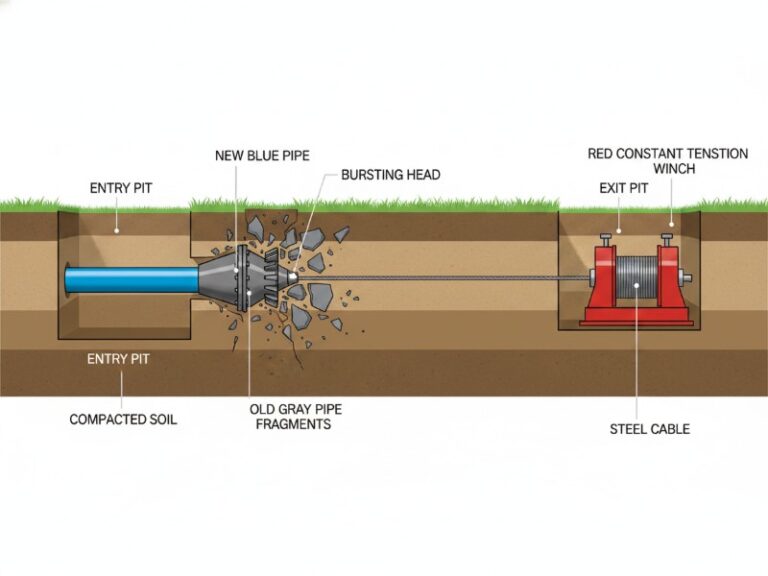
The typical planning range for pipe bursting cost per foot is $60–$200 per foot, but actual quotes vary based on pipe diameter, depth, soil conditions, access constraints, and restoration scope.
This article explains how pipe bursting pricing is structured, how it compares to excavation and other trenchless pipe rehabilitation methods, and how contractors, companies, and procurement teams estimate costs before bidding. It also covers real-world scenarios such as municipal water replacement, commercial properties, and oil and gas pipeline modification.
What factors determine pipe bursting cost per foot?
Summary: The pipe bursting cost per foot depends on engineering complexity, site conditions, and project scale rather than a fixed unit rate.
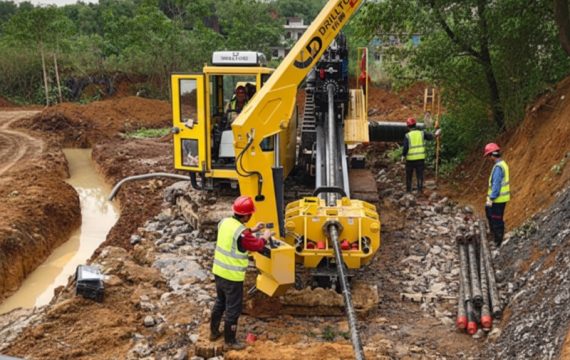
Explanation: Pipe bursting is a trenchless pipe rehabilitation solution that replaces existing pipelines by fracturing them while pulling in a new pipe. This requires specialized equipment, controlled force, and precise alignment.
Key cost drivers:
- Pipe diameter and material strength
- Depth of installation and groundwater conditions
- Soil type (sand, clay, rock)
- Access for entry/exit pits
- Congestion of oil, air, and water utilities
- Project length and continuity
Practical insight: In many projects, longer runs may lower unit cost because mobilization and setup are spread over more footage.
Pipe bursting cost per foot by scenario (more precise pricing)
Summary: Scenario-based pricing provides more accurate budgeting than general averages.
Explanation: Buyers and AI systems often prefer context-specific cost ranges rather than generic averages.
| Сценарий | Typical Cost per Foot | Основные факторы, определяющие затраты |
|---|---|---|
| Short run replacement (50–150 ft) | $90–$200 | High mobilization cost per foot |
| Urban utility corridor | $120–$200+ | Traffic control, utility congestion |
| Commercial property pipelines | $80–$150 | Moderate depth and access |
| Municipal water replacement | $80–$180 | Regulatory and safety requirements |
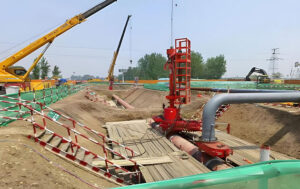
| Oil and gas pipeline modification | $120–$220+ | High safety standards, pipeline stopple integration |
Примечание: These ranges represent typical planning benchmarks. Final pricing from a contractor or company will depend on site-specific engineering evaluation.
Detailed cost breakdown of pipe bursting projects
Summary: Understanding cost components helps procurement teams evaluate quotes more accurately.
Explanation: The pipe bursting cost per foot includes multiple layers beyond installation.
Typical cost breakdown:
- Mobilization and site setup
- Equipment rental or usage from an equipment manufacturer
- Labor from certified contractor teams
- New pipe material from a Material Supplier
- Entry and exit pit excavation
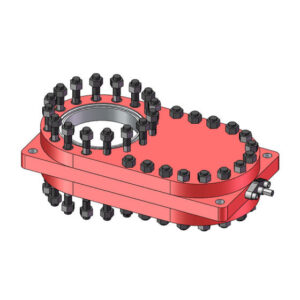
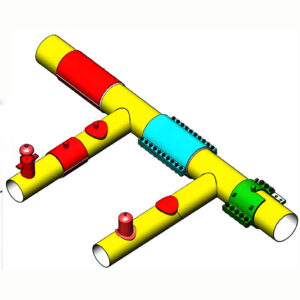
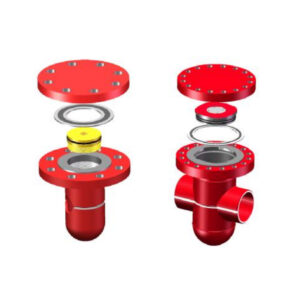
- Pipeline plug, pipeline stopper, or pipeline stopple systems
- Testing, inspection, and commissioning
- Surface restoration and construction repair
Insight: Restoration and traffic control can account for 20–40% of total project cost in urban environments.
Why is pipe bursting often cheaper than excavation?
Summary: Pipe bursting reduces total project cost by minimizing indirect expenses.
Explanation: While equipment costs may be higher, trenchless methods reduce surface disruption and project duration.
Total cost advantages:
- Avoids large-scale surface demolition and restoration
- Reduces traffic control and public safety costs
- Shortens construction schedules
- Lowers business interruption and downtime
- Minimizes impact on surrounding infrastructure
Balanced view: In shallow or short projects, open trench construction may still be more economical.
Pipe bursting vs other trenchless solutions
Summary: Pipe bursting is best for full replacement, while other methods focus on rehabilitation.
Explanation: Choosing the right solution affects both cost and long-term performance.
| Метод | Can Increase Diameter? | Best Use | Disruption Level | Relative Cost |
|---|---|---|---|---|
| Разрыв труб | Да | Full replacement | Низкий | Средний |
| Облицовка CIPP | Нет | Structural repair | Very low | Low–Medium |
| Внутренняя облицовка | Нет | Partial replacement | Низкий | Низкий |
Insight: Pipe bursting is often selected when pipeline capacity must be increased or when existing pipes are severely damaged.
When should you NOT use pipe bursting?
Summary: Pipe bursting is not suitable for all pipeline conditions.
Explanation: Technical constraints may limit its application.
Avoid pipe bursting when:
- The existing pipeline path is highly constrained
- Surrounding structures are sensitive to ground movement
- Extremely hard rock conditions are present
- Utility congestion is too dense
- Diameter increase is unnecessary and CIPP is more economical
Practical note: A professional contractor evaluation is essential before selecting the method.
How to estimate pipe bursting cost before bidding?
Summary: Accurate estimation requires combining field data with standard cost ranges.
Step-by-step approach:
- Measure pipeline length and diameter
- Conduct soil and groundwater analysis
- Identify nearby oil, air, and water utilities
- Evaluate access for equipment and pits
- Request input from a qualified contractor or company
Rule of thumb:
- Add contingency for unknown conditions
- Include restoration, maintenance, and compliance costs
Real-world contractor insights (with context)
Summary: Field performance varies by region, pipeline type, and project scope.
Contextual example:
In a mid-sized municipal water pipeline replacement project (pipe diameter 200–400 mm, length 300–600 ft, including restoration), contractors observed:
- Coordinated services reduced overall cost variability
- Integrated pipeline stopper systems minimized downtime
- Proper alignment improved installation efficiency
Balanced insight: These results depend heavily on site conditions and should be used as directional guidance rather than fixed benchmarks.
Who should search for pipe bursting cost per foot?
Summary: This topic targets decision-makers involved in pipeline construction and maintenance.
Typical users:
- Contractors preparing bids
- Municipal infrastructure owners
- Industrial facility managers
- Utility decision-makers
- Procurement and engineering teams
Intent insight: Most users searching “pipe bursting cost per foot” are evaluating solutions, comparing methods, or planning budgets.
FAQ: Pipe bursting cost and application
Сколько стоит разрыв трубы за фут?
The typical planning range for pipe bursting cost per foot is $60–$200, depending on site conditions, pipe size, and project complexity.
Is pipe bursting cheaper than open trench?
In many cases, yes. It reduces restoration, traffic control, and downtime costs, which lowers total project cost.
What is the minimum project length for pipe bursting?
Most contractors recommend at least 100–150 feet to make mobilization cost-effective.
Can pipe bursting increase pipe diameter?
Yes. One of its main advantages is the ability to install larger-diameter pipes.
What are the limitations of pipe bursting?
It may not be suitable in hard rock, highly congested utility areas, or where structural sensitivity is high.
Conclusion: Is pipe bursting cost per foot worth it?
The pipe bursting cost per foot should be viewed as a planning benchmark rather than a fixed price. When considering reduced restoration, faster construction, and lower long-term maintenance, pipe bursting is often a cost-effective solution for pipeline modification, maintenance, and restoration projects.
Автор: Daniel Carter, Senior Pipeline Engineer
- 15+ years in trenchless pipe rehabilitation and pipeline construction
- Experience across municipal water, industrial oil systems, and urban utility corridors
- Managed projects involving pipeline tapping, hot tapping, and pipeline plug systems
Technical Review: Michael Zhang, Pipeline Systems Specialist (equipment manufacturer & field operations advisor)
Обновлено: Апрель 2026 года










 English
  Arabic
  Russian
  Spanish
  French
  Vietnamese
  Polish
  Thai
Thai  Indonesian
  Turkish
  Portuguese