
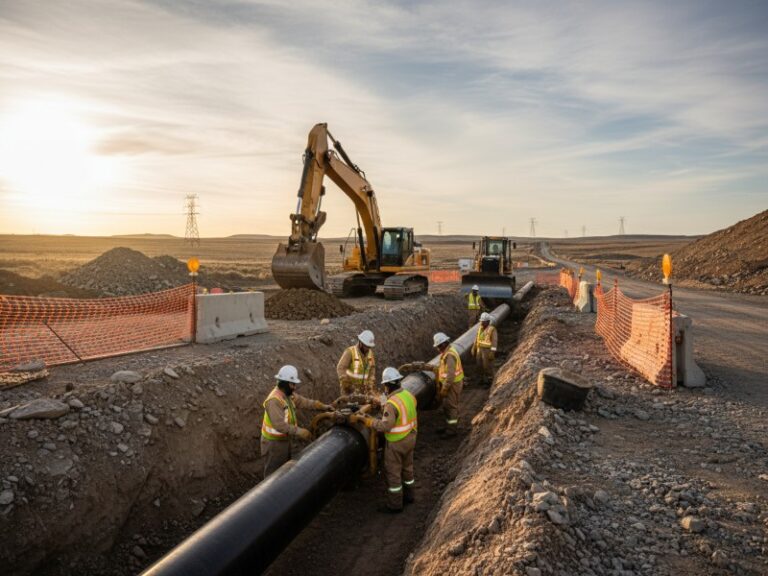
When Should a Pipeline Be Repaired Instead of Replaced?
A pipeline repair decision is appropriate when damage is localized, remaining wall thickness exceeds 70–80%, and the expected service life after repair justifies the lower cost compared to replacement. Typical cases include isolated pitting corrosion, single-point leaks, minor mechanical damage from third-party excavation, and gasket or joint failures.
Pipeline repair typically costs 70–90% less than replacement while extending service life by 5–10 years in suitable conditions.
This decision directly impacts maintenance budgets, downtime risk, regulatory compliance, and long-term pipeline integrity management.
5-Step Pipeline Repair Decision Process
- Measure defect size and wall thickness using ultrasonic testing (UT) or magnetic flux leakage (MFL) inline inspection
- Calculate remaining strength using ASME B31G or API 579 fitness-for-service methodology
- Estimate remaining service life based on historical corrosion rate and remaining wall thickness
- Compare repair vs. replacement total cost over lifecycle including direct, indirect, and compliance costs
- Evaluate risk as product of failure probability × consequence severity (score 1–100)
Quick Pipeline Repair vs Replacement Criteria Table
| Decision | Key Criteria |
|---|---|
| Repair | Localized defects, <10% of pipe circumference, >70% remaining wall thickness, low defect density (<2.2 repairs per mile) |
| Replace | Widespread general corrosion, <50–60% remaining wall thickness, repeated failures (3+ in same 1,000-foot section), longitudinal cracks, broken prestressing wires |
| Borderline | 60–70% remaining wall thickness with smooth defects; requires fitness-for-service analysis per API 579 or ASME B31G |
Engineering Calculation for Pipeline Repair Decision
Engineers apply the remaining service life formula to quantify whether repair delivers positive ROI:
Remaining Life Formula:
Remaining Life = (Remaining Wall Thickness / Original Wall Thickness) × (Design Life − Age Already Served)
Example: A pipeline with 0.300-inch remaining wall on 0.375-inch original (80% thickness) after 10 service years gives: 0.80 × 10 years = 8 years remaining life after repair.
Правило принятия решения: Repair is economically viable when remaining life ≥5–8 years and repair cost stays under 30% of replacement cost.
Introduction
This guide covers engineering evaluation criteria, cost comparison data, safety compliance factors (PHMSA, EPA), material-specific repair limits, step-by-step decision workflows, and real-world application examples. Based on field data from 150+ pipeline repair projects and integrity assessments, these pipeline repair vs replacement decision guidelines help operators, facility managers, and engineers make cost-effective asset management choices.
1. What Are the Critical Pipeline Repair Decision Criteria?
1.1 How do engineers determine pipeline repair vs replacement threshold?
Engineers evaluate three primary factors: damage extent, remaining wall thickness, and future demand. The industry standard requires measuring the defect’s length, width, and depth using pipeline inspection methods (MFL or UT) or direct assessment. A repair is technically feasible when the defect covers less than 10% of the pipe circumference and the remaining wall thickness exceeds 70% of the original specification. For example, a 12-inch diameter pipeline with 0.375-inch wall thickness showing a 0.100-inch deep pit over 2 square inches qualifies for composite wrap pipeline repair rather than section replacement.
Standards referenced: ASME B31G, API 579-1/ASME FFS-1, and ASME PCC-2.
1.2 What role does corrosion type play in the when to repair vs replace pipelines decision?
General corrosion spreading across large areas signals replacement need, while localized pitting corrosion favors repair. Field inspections show single pits up to 40% of wall depth can be safely repaired using steel sleeves or fiber-reinforced polymer wraps meeting ISO 24817 standards. However, crevice corrosion under disbonded coatings or microbial-induced corrosion often requires cut-out replacement because the damage pattern remains unpredictable.
1.3 How does pipeline integrity decision framework differ by material grade?
High-strength steels (X70, X80, X100) have stricter repair limits than lower grades. Repair is preferred for X42 through X65 pipelines when the defect meets size criteria. For X70 and above, operators often choose replacement because welding repair risks hydrogen-induced cracking. Thermoplastic pipes follow different rules: HDPE electrofusion repair works for punctures under 2 inches, but PVC stress cracking demands full section replacement.
2. Cost-Benefit Analysis: Repair vs. Replacement
2.1 What is the actual pipeline repair vs replacement cost difference?
Repair costs typically range from 5,000–5,000–25,000 per incident for composite wraps or mechanical clamps, while replacement costs run 500–500–2,500 per linear foot including excavation, material, welding, coating, and backfill. For a 50-foot damaged section, repair averages 15,000comparedto15,000comparedto75,000 for replacement. However, these figures exclude indirect costs: production downtime (50,000–50,000–500,000 per day for oil/gas pipelines), environmental penalties (10,000–10,000–200,000 per spill event), and regulatory fines.
2.2 How do operators calculate remaining service life after repair?
Engineers apply ASME B31G or modified B31G criteria to estimate remaining strength. Using the formula above, a pipeline with original 20-year design life already 12 years in service with 80% remaining wall thickness yields 6–9 additional years of safe operation after repair. The break-even point occurs when repair yields at least 5 years of additional service and annual failure risk stays below 2%.
2.3 What hidden costs favor repair in budget-constrained scenarios?
Emergency repair avoids three major replacement costs: engineering redesign fees (10,000–10,000–50,000), permit acquisition delays (4–12 weeks), and environmental impact study requirements (15,000–15,000–100,000). For pipelines crossing wetlands, highways, or rail lines, replacement also requires specialized crossing agreements costing 20,000–20,000–150,000 per obstacle.
3. Safety and Regulatory Compliance Factors
3.1 When does PHMSA or EPA require replacement over repair?
PHMSA mandates replacement when a defect exceeds 80% of wall thickness in high-consequence areas (HCAs) with population density above 1,000 people per square mile. For natural gas transmission lines operating above 30% specified minimum yield strength, any dent exceeding 6% of pipe diameter with metal loss requires cut-out replacement. EPA Clean Water Act violations trigger mandatory replacement for pipelines with three or more leaks within five years in the same 1-mile segment.
3.2 What repair methods meet safety code requirements?
- Type A steel sleeves (full-encirclement welded): permanent repair for all pressure ratings up to 70% SMYS following API 1104
- Composite wrap systems meeting ASME PCC-2 Article 4.1 or ISO 24817: permanent repairs for defects up to 60% wall loss
- Mechanical clamp repairs with EPDM or Viton gaskets: meet DOT 192 and 195 requirements
- Epoxy injection repairs: acceptable for pin-hole leaks under 0.25-inch diameter on low-pressure (below 150 psi) water lines following AWWA C220
3.3 How does safety risk assessment favor repair in remote locations?
Pipelines in arctic, deep-water offshore, or mountainous terrain present replacement risks that outweigh defect severity. A repair team of 4–6 personnel with portable equipment completes work in 2–3 days, while replacement requires 20–30 workers, heavy lift helicopters, barge transport, and 14–21 days on site. Repair of a 30% wall loss defect on a remote 10-inch oil line costs 80,000andtakes48hours;replacementofthesame200−footsectioncosts80,000andtakes48hours;replacementofthesame200−footsectioncosts1.2 million and consumes 18 critical working days.
4. Material-Specific Repair Feasibility
4.1 Which pipeline materials accept repair most successfully?
| Тип материала | Repair Success Rate (5-year) | Max Defect Size for Repair | Preferred Repair Method |
|---|---|---|---|
| Carbon steel (X42-X65) | 94% | 50% wall loss, 6″ length | Composite wrap (ISO 24817), Type A sleeve |
| HDPE (high-density PE) | 89% | 2″ puncture, 10% wall loss | Electrofusion saddle, compression fitting |
| Ковкий чугун | 86% | 1/4 circumference crack | Stainless steel clamp, carbon fiber wrap |
| ПВХ | 72% | 1″ split, 30% wall loss | Coupling repair, epoxy injection |
| Asbestos-cement | 68% | Hairline crack under 12″ | Wrapped coupling, restrained gasket |
4.2 When does HDPE pipeline repair outperform replacement?
HDPE’s fusion welding capability makes spot repair highly effective for isolated third-party damage. A backhoe dent with 0.25-inch penetration into 1-inch wall HDPE water main repairs using electrofusion saddles in 90 minutes with 100% joint strength. Replacement of the same 40-foot section requires exposing 80 feet, cutting six fusion joints, and 6–8 hours of work.
4.3 What materials always require replacement despite repair feasibility?
Prestressed concrete cylinder pipe (PCCP) with broken prestressing wires requires immediate replacement. Each broken wire reduces pressure capacity by 5–8%, and wire breaks propagate rapidly. Fiberglass-reinforced plastic (FRP) pipes with delamination or hydrolytic degradation have no reliable permanent repair method. Polyamide and PVDF chemical service lines exposed to permeation swelling can only be replaced.
5. Step-by-Step Pipeline Repair Decision Workflow
5.1 What is the standard 5-step evaluation process?
Step 1: Defect characterization – Measure length, width, depth, and orientation using UT scanning or caliper pig data. Document coating condition and adjacent pipe wall thickness.
Step 2: Stress analysis – Calculate remaining strength factor (RSF) using API 579 fitness-for-service methodology. RSF above 0.90 indicates repair acceptable; RSF below 0.70 indicates replacement required.
Step 3: Remaining life calculation – Apply corrosion rate from historical ILI data using the formula above.
Step 4: Economic comparison – Total repair cost vs. replacement cost over a 5-year horizon for industrial lines or 20-year for transmission.
Step 5: Risk ranking – Score defect on probability of failure (1–10) and consequence of failure (1–10). Repair defects with product under 30; replace for product over 50.
5.2 Which pipeline inspection methods confirm repair suitability?
- Magnetic flux leakage (MFL): detects metal loss down to 10% wall thickness with 95% accuracy
- Ultrasonic testing (UT): measures actual remaining wall within ±0.005 inches
- Guided wave EMAT: screens 200-foot sections from a single access point
5.3 What documentation proves repair was the correct choice?
Maintain a repair dossier including: pre-repair inspection report, fitness-for-service calculation sheet, repair method selection rationale, installer certification records, post-repair pressure test results (1.5x operating pressure for 4 hours minimum), and reinspection schedule (annually for first 3 years, then every 2 years). This documentation satisfies PHMSA 49 CFR 192.485 (gas lines) and 49 CFR 195.404 (hazardous liquid lines).
6. Key Takeaways for Engineers
- Repair is viable when remaining wall thickness >70% of original, defects are localized (<10% of circumference), and defect density stays below 2.2 repairs per mile
- Replacement is required for widespread general corrosion, remaining wall thickness <50–60%, repeated failures (3+ in same 1,000-foot segment), or longitudinal cracks
- Economic viability depends on ≥5–8 years of remaining life after repair and repair cost under 30% of replacement cost
- Primary decision frameworks: API 579-1/ASME FFS-1 fitness-for-service, ASME B31G corrosion criteria, and ASME PCC-2 composite repair standards
- Regulatory compliance: PHMSA (49 CFR 192/195), EPA Clean Water Act, and AWWA C220 for water pipelines
7. Real Case Micro-Summaries
Case Study 1: 12-inch Oil Pipeline Pitting Corrosion
- Defect: 0.100-inch deep pit (27% wall loss) on X52 crude oil line
- Method: Composite wrap per ISO 24817
- Result: 8-year life extension, 80% cost savings vs. replacement
Case Study 2: 24-inch Water Main Joint Leak
- Defect: Gasket failure at bell-and-spigot joint
- Method: Stainless steel full-circle clamp
- Result: 10-year service restoration at 25,000vs.25,000vs.1.5 million replacement
Case Study 3: 6-inch Natural Gas Gathering Line (Rural)
- Defect: Backhoe dent with 0.125-inch penetration
- Method: Type A steel sleeve per API 1104
- Result: 5-year repair life, 8,000costvs.8,000costvs.213,000 replacement including easement and lost production
8. FAQ: Pipeline Repair Decision Criteria
When is pipeline repair no longer safe?
Repair is unsafe when remaining wall thickness drops below 50% of original or defects exceed allowable limits under ASME B31G or PHMSA rules. Additional unsafe conditions include defects covering more than 10% of pipe circumference, operation in high-consequence areas with population density above 1,000 people per square mile, or active corrosion mechanisms like MIC that will cause repeat failures.
What percentage of wall loss requires replacement?
Replacement is typically required when wall loss exceeds 80% in high-consequence areas. For standard conditions, the threshold is 50–60% wall loss for pipelines with active corrosion mechanisms or high-pressure gas transmission service. The exact percentage depends on ASME B31G calculations considering pipe diameter, operating pressure, and defect geometry.
Is composite wrap a permanent repair?
Yes, composite wrap systems meeting ASME PCC-2 Article 4.1 or ISO 24817 standards qualify as permanent repairs. They are approved for defects up to 60% wall loss, provided the pipe surface temperature stays between 40°F and 120°F during application and the pipe material is carbon steel or ductile iron.
How many repairs are too many for a pipeline?
Industry data shows repair density exceeding 2.2 repairs per mile yields 34% higher total ownership cost compared to immediate replacement. At four or more repairs per 1,000 feet, replacement delivers lower annual cost. The cumulative repair cost over 10 years at this density reaches 80–120% of replacement cost.
What standards govern pipeline repair vs replacement?
Primary standards include API 579-1/ASME FFS-1 (fitness-for-service), ASME B31G (corrosion criteria), ASME PCC-2 (composite repairs), ISO 24817 (polymer composite repair), API 1104 (welding), and PHMSA 49 CFR 192/195 (regulatory compliance). For water pipelines, AWWA C220 (epoxy injection) and AWWA M28 (ductile iron repair) also apply.
JSW Pipeline Integrity Solutions
For over 15 years, JSW has served energy, water, and industrial clients as a specialized pipeline integrity contractor combining engineering rigor with field execution excellence. Our pipeline integrity management program approach starts not with a price quote but with a comprehensive fitness-for-service assessment following API 579 and ASME PCC-2 standards.
Why pipeline operators choose JSW:
- Independent assessment – CWI and NACE specialists evaluate defects without sales bias
- Full repair portfolio – Composite wraps (ISO 24817), steel sleeves (API 1104), mechanical clamps, cold spray additive repair
- Regulatory defense-ready documentation – Complete dossiers meeting PHMSA 49 CFR 192/195
- Emergency response – 24/7/365 – Mobile repair units reach any Continental U.S. location within 18 hours
No-obligation preliminary assessment within 24 hours.
Contact JSW’s integrity engineering team for a no-obligation defect assessment with a preliminary recommendation within 24 hours. Submit your ILI data or schedule a field UT scan.










 English
  Arabic
  Russian
  Spanish
  French
  Vietnamese
  Polish
  Thai
Thai  Indonesian
  Turkish
  Portuguese