
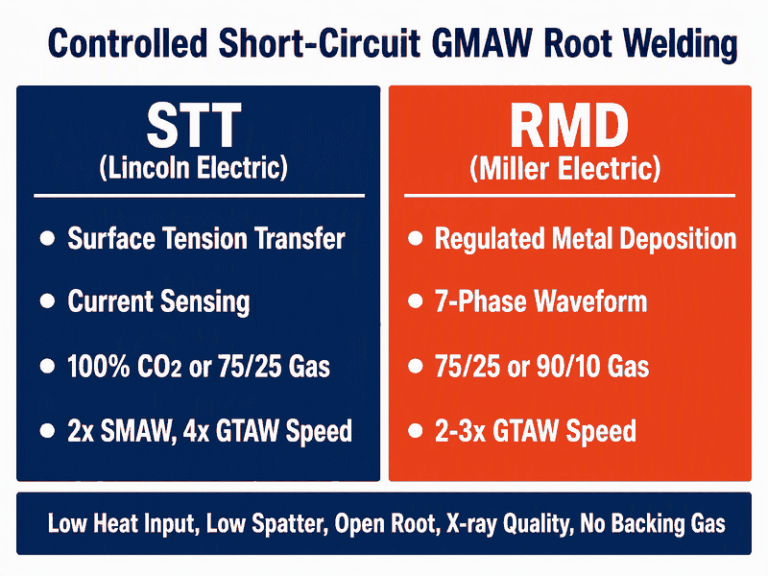
STT vs RMD is not a contest with one universal winner: both are controlled short-circuit GMAW processes that produce X-ray-quality pipeline root passes, and the better root welding process for your job depends on your equipment ecosystem, qualified procedures, material, and crew skill. STT welding, Lincoln Electric’s Surface Tension Transfer, reacts to each short circuit with current sensing, while RMD welding, Miller Electric’s Regulated Metal Deposition, anticipates the short with a staged waveform; both replace TIG or stick roots at two to four times the travel speed. This guide compares how each process works, their heat input, weld quality, productivity, cost, equipment, code qualification, and the specific pipeline scenarios where one clearly outperforms the other.
Key Takeaways
- STT (Lincoln Electric) and RMD (Miller Electric) are both controlled short-circuit GMAW root welding processes; the physics are close enough that hardware, procedures, and support usually decide the choice.
- STT senses the short circuit and cuts current at the necking point; RMD uses a staged, anticipated waveform with seven discrete phases for consistent droplet transfer.
- Both processes deliver low heat input, minimal spatter, open-root capability, and low-hydrogen deposits, and both run two to four times faster than TIG root welding.
- RMD is advertised as bridging fit-up gaps up to 3/16 in; STT is documented producing root ligament thickness of roughly 0.22 in in open-root pipe.
- Neither process is prequalified: the procedure must be qualified to the governing code, and GMAW short-circuit remains a restricted classification in some structural codes.
- Pick by brand ecosystem first, then by procedure: Lincoln shops run STT, Miller shops run RMD, and both pass X-ray when the WPS, gas, wire, and technique are controlled.
Key Data at a Glance: STT and RMD Root Welding
These are the published and field values our crews work to when comparing STT vs RMD on pipeline root passes. Each number is quoted in this guide and traceable to the basis column, so the table works as a quick reference during process selection and procedure review.
| Параметр | Значение | Context | Basis |
|---|---|---|---|
| STT background current | 50-100 A | Maintains the arc and heats the base metal | Lincoln STT root-pass procedure data |
| STT separation current | About 45-50 A | Applied when the liquid bridge is about to break | Lincoln STT root-pass procedure data |
| STT speed vs SMAW root | About 2x | Same joint, comparable conditions | Lincoln STT root-pass procedure data |
| STT speed vs GTAW root | About 4x | Open-root pipe, all positions | Lincoln STT root-pass procedure data |
| RMD speed vs GTAW root | 2-3x | Published field comparisons | Miller RMD pipe welding literature |
| RMD productivity gain case | About 50% | Root pass + pulsed MIG fill and cap | Published Sigma Thermal case |
| RMD gap bridging | Up to 3/16 in | Poor fit-up and field repair joints | Miller RMD pipe welding literature |
| STT root ligament | About 0.22 in | Open-root pipe joint | Lincoln STT root-pass procedure data |
| Bevel preparation | 37.5 deg per side | 75 deg included angle | Miller RMD joint-prep literature |
| Minimum root opening | 1/8 in | Open-root fit-up | Miller RMD joint-prep literature |
| Land (root face) | Knife edge to 3/32 in | Open-root fit-up | Miller RMD joint-prep literature |
| Conventional short-circuit rate | 90-200 cycles/s | Baseline for uncontrolled short-arc | Welding physics |
What Are STT and RMD Welding?
STT welding is Lincoln Electric’s patented Surface Tension Transfer process: a modified GMAW short-circuit transfer mode designed for open root welding on pipe and plate. RMD welding is Miller Electric’s Regulated Metal Deposition process: a modified short-circuit MIG mode with the same design goal. Both were created because conventional short-circuit GMAW is too violent and unpredictable for an open root.
In standard short-circuit transfer, the wire touches the pool 90 to 200 times per second. The current spikes, the electromagnetic pinch separates the droplet, and the arc re-ignites with the current still high, which throws spatter and varies cycle to cycle. On an open root, that behavior melts the root face away, causes burn-through, and leaves cold-lap and lack-of-fusion risks at the sidewall. For decades, the answer was a TIG root or a stick root, both slow and skill-dependent.
STT and RMD change the physics of that moment. The power source shapes the current through every phase of the short-circuit cycle, so the droplet separates quietly, the heat stays low, and the puddle remains controllable. The result is a root welding process that a competent MIG welder can learn faster than TIG, runs two to four times faster, and produces consistent X-ray-quality back beads in all positions. If you are new to pipe welding, start with our pipeline welding guide before choosing a root technique.
How Does STT Welding Work?
STT is a current-controlled process, not a voltage-controlled one. The STT machine has no voltage control knob; current controls adjust heat independently of wire feed speed, so changes in electrode extension do not change heat input. That independence is the core of the process.
The cycle runs in stages. A background current between 50 and 100 amps maintains the arc and heats the base metal. When the electrode shorts to the pool, the current is quickly reduced so the droplet seats solidly. A pinch current is then applied to squeeze the molten metal and start the neck of the liquid bridge. The power source monitors the electrical signal of the necking, and the moment the bridge is about to break, it cuts the current to about 45-50 amps. With current low, surface tension pulls the droplet into the pool instead of an explosive break separating it, which is where the process name comes from. A peak current pulse then re-establishes the arc and heats the wire and pool for the next droplet, and a tail-out ramp regulates the overall heat input.
The operator has four practical controls. Wire feed speed sets the deposition rate. Peak current sets the arc length. Background current is the fine heat control. Tail-out is the coarse heat control. On a pipeline job, the welder dials the procedure in once, then only adjusts background and travel speed for fit-up variation. This waveform structure is why STT works on open roots, thin material, and out-of-position joints with 100% CO2 shielding on carbon steel, and why it produces low-hydrogen deposits suitable for high-strength pipe steels.
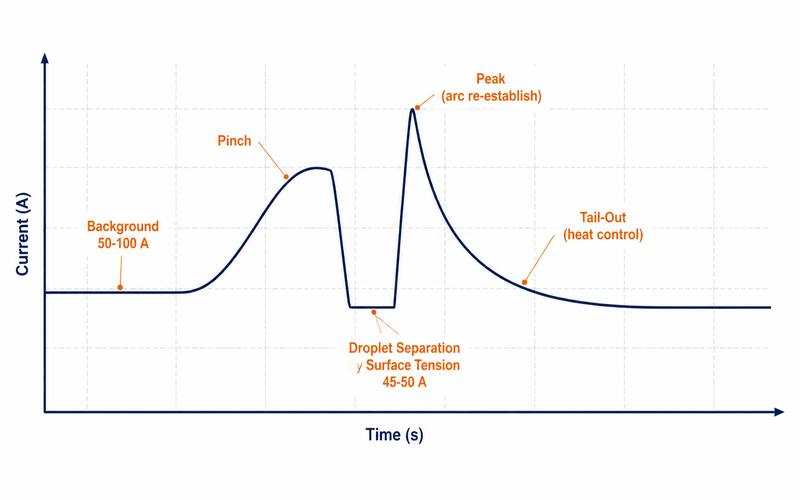
Figure 1. One STT short-circuit cycle: background current maintains the arc, pinch current squeezes the droplet, current drops at separation so surface tension transfers the metal, and peak plus tail-out control arc length and heat input.
How Does RMD Welding Work?
RMD takes a related but distinct path. Where STT reacts to the short circuit, RMD anticipates it. The system continuously monitors the electrical characteristics of the arc and reduces the welding current at the precise moment a short circuit is imminent, so the metal transfers the same way every cycle.
Miller describes the RMD cycle in seven phases: wet, pinch, clear, blink, ball, background, and pre-short. The droplet wets into the pool, a pinch phase squeezes it, the clear phase separates it at low current, the blink re-establishes the arc, the ball phase forms the next droplet, and the background and pre-short phases set the pool temperature for the next transfer. Because the profile repeats predictably, droplet size and timing stay uniform even when stick-out and gap change during hand welding, which is the tolerance advantage RMD is known for.
The practical result is a calm puddle with small ripples and a consistent tie-in to both sidewalls. The weld face is flatter and thicker than a conventional GMAW root, which improves reinforcement and reduces grinding. RMD is documented bridging fit-up gaps up to 3/16 in, and it runs two to three times faster than TIG root welding on the same joint. Published field cases, such as Sigma Thermal switching root passes to RMD and fill and cap to pulsed MIG, report productivity gains around 50% with the same wire, gas, and machine for the whole joint.
STT vs RMD: Side-by-Side Comparison
The two processes are often described as interchangeable, and at the weld they are close. The differences that matter are the control philosophy, the recommended shielding gas, the host equipment, and the way each vendor documents the procedure. This table summarizes the points that decide a pipeline specification.
| Characteristic | STT (Lincoln Electric) | RMD (Miller Electric) |
|---|---|---|
| Full name | Surface Tension Transfer | Regulated Metal Deposition |
| Process family | Controlled short-circuit GMAW | Controlled short-circuit GMAW |
| Control method | Current sensing; cuts current at the neck | Staged, anticipated waveform; seven phases |
| Heat input | Low, independently adjustable | Low, independently adjustable |
| Spatter | Very low | Very low |
| Typical gas, carbon steel root | 100% CO2 or 75/25 Ar/CO2 | 75/25 Ar/CO2 or 90/10 |
| Typical wire | ER70S-6 solid wire | ER70S-6 solid wire |
| Host power sources | Power Wave platform, Invertec STT, STT Field | PipeWorx 400, XMT 350 FieldPro, Big Blue 500X Pro |
| Positions | All positions, vertical down included | All positions |
| Primary use | Open-root pipe and plate, thin material | Open-root pipe and plate, thin material |
| Backing gas | Not required for carbon steel roots | Not required for carbon steel roots |
| Stainless capability | Welds stainless and nickel alloys | 304/316 without backing gas; duplex and P91 often with backing gas |
Gas selection is the most visible practical difference. STT was built around 100% CO2 on carbon steel, which is the lowest-cost shielding gas, while RMD is typically run with 75/25 Ar/CO2 or 90/10 blends that cost more but give a softer arc and slightly cleaner bead appearance. The governing welding procedure specification decides the gas, not the marketing material, and a coded job will lock both the gas and the wire.
Which Root Welding Process Is Better?
The honest answer from our field experience: neither process wins on merit alone, because both are proven root pass welding processes and the decision is usually made by the hardware already on the job. Lincoln shops run STT. Miller shops run RMD. Both produce roots of X-ray quality when the procedure, gas, wire, and technique are controlled, and the day-to-day difference for the welder is small once the procedure is dialed in.
When the choice is open, weigh these four factors in order:
- Equipment ecosystem: the waveform runs only on its vendor’s power sources. A Lincoln Power Wave with STT modules or an Invertec STT unit runs STT; Miller PipeWorx, XMT 350, and Dimension machines run RMD. Buying into a second ecosystem for a single root process is rarely justified.
- Qualified procedures: if your WPS and welder qualifications are already established on one process, switching means new procedure qualification records, new welder qualifications, and project approval cycles. That cost usually outweighs the small performance delta.
- Material and fit-up: RMD is documented bridging gaps up to 3/16 in, which helps on poor fit-up and repair joints; STT offers the independent heat control that helps on thin wall and high-strength pipe where burn-through and hydrogen are the risks.
- Local support and consumables: distributor support, wire and gas availability, and technician familiarity in your region often decide reliability more than the waveform name.
For new programs with no existing bias, our engineers typically recommend qualifying the root pass on whichever controlled short-circuit process your automatic pipeline welding system or field fleet already supports, because root pass quality is only one link in the joint. The fill and cap passes, the fit-up, and the inspection decide the final X-ray result. In our own programs, crews qualified to API 1104 and ASME B31.4/B31.8 have run both processes to radiographically clean roots on carbon steel line pipe from 6 to 36 inches, in positions from 1G to 6G, using either 100% CO2 or 75/25 gas per the approved procedure.
Not sure which process your WPS will accept? Send us your procedure documents and pipe details, and our welding engineers will recommend the qualification path before you commit to a machine purchase or a requalification program.
Root Pass Quality: Penetration, Back Bead, and X-Ray Results
The reason contractors pay for these processes is the inside of the weld. An open-root joint must fuse the root faces, produce a smooth back bead on the inside of the pipe, and avoid suck-back where the bead shrinks into the root. STT and RMD do this reliably because the low separation current keeps the puddle stiff between droplets and the consistent droplet placement bridges the gap.
Lincoln documents an open-root STT pass providing a weld ligament thickness of roughly 0.22 in, which is the fused wall section at the root. Miller documents RMD bridging gaps up to 3/16 in with consistent root penetration and reinforcement of the inside wall. In both cases the back bead is formed without backing rings and without purge gas on carbon steel, which eliminates the two biggest cost items of a TIG root: the argon purge and the backing consumables.
Quality still depends on the classic root defects. Lack of fusion at the sidewall, incomplete penetration, and suck-back appear when the arc position drifts: the arc must stay near the center of the puddle, not on the leading edge, or the weld stutters and spatters. Porosity appears when the shielding is lost to wind, the wire is dirty, or the travel speed outruns the gas coverage. These are the same failure families covered in our common pipeline welding defects guide, and the same controls apply: clean bevels, dry wire, controlled stick-out, and wind protection.
Verification is non-negotiable. Every root pass in a coded program is visually inspected on the outside, and the back bead is judged by radiographic testing or ultrasonic testing per the project specification. A root that looks clean on the outside can hide incomplete fusion on the inside, which is why the weld book, not the eye, decides acceptance. Our pipeline welding inspection checklist covers the hold times, NDT percentages, and acceptance rules we apply to every girth weld program.
Productivity and Operating Cost Comparison
Root pass speed is where controlled short-circuit GMAW pays back its equipment cost. STT is documented at about two times the travel speed of a stick root and about four times that of a TIG root on the same joint. RMD is documented at two to three times TIG speed, with the Sigma Thermal case reporting roughly 50% overall productivity gain when RMD roots were paired with pulsed MIG fill and cap passes.
| Фактор | STT | RMD | GTAW (TIG) | SMAW (stick) |
|---|---|---|---|---|
| Relative travel speed | 2x SMAW, 4x GTAW | 2-3x GTAW | Исходные данные | Исходные данные |
| Typical gas | 100% CO2 or 75/25 | 75/25 or 90/10 | 100% Ar | Нет |
| Backing gas or purge | Not required | Not required | Often required | Not required |
| Filler form | Solid wire, continuous | Solid wire, continuous | Manual filler rod | Coated electrode |
| Operator skill entry | Moderate, shorter training | Moderate, shorter training | Высокий | Высокий |
| Spatter and grinding | Very low | Very low | Нет | High, wagon tracks |
| Hydrogen deposit | Низкий | Низкий | Very low | Varies by electrode |
Cost follows speed and consumables. A 100% CO2 root with continuous wire eliminates electrode stub loss, purge gas, and most grinding, and the same machine and wire can run the hot pass and fill passes, which cuts changeover time. Against that, the power sources are industrial-priced, and the waveform depends on a clean liner, good contact tips, and consistent wire feed, so consumable discipline and maintenance cost appear where stick and TIG crews never paid them. On a large-diameter mainline program, the speed gain usually dominates; on a handful of tie-ins per year, the equipment cost may never pay back, and TIG or stick remains the rational choice.
Equipment Requirements and Cost
Neither process runs on a hobby constant-voltage machine. Both need an inverter power source with the waveform loaded and a matched wire feeder, and the waveform is locked to the vendor’s platform.
STT runs on the Lincoln Power Wave family, the dedicated Invertec STT units, and the STT Field package, which pairs a Flextec 350X Power Connect power source with an Activ8X Pipe wire feeder for field work. The same STT process runs in the shop on Lincoln PIPEFAB systems, so a crew can qualify once and switch between shop fabrication and field welding without changing the procedure. RMD runs on the Miller PipeWorx 400 system, the XMT 350 FieldPro with an ArcReach feeder, and the Big Blue 500X Pro engine-driven unit. The PipeWorx is built around the pipe-welding workflow, switching between an RMD root and a pulsed fill and cap process at the gun.
Budget for the complete system: power source, feeder, gun, gas equipment, and spares. Industrial pricing means a full STT or RMD package with a feeder and consumables runs into the thousands of dollars, and current quotes vary by region and distributor. Before committing, confirm three things: the machine stores the waveform you need, the feeder matches the power source protocol, and a local distributor can service it. A waveform that sits on the shelf because the feeder protocol is unsupported is a common and expensive mistake in our equipment reviews.
For pipeline contractors, the practical question is whether the root process integrates with the rest of the spread. If your mainline construction already uses automatic pipeline welding systems for fill and cap, the root pass machine must match the joint tracking and the shift schedule. On our mainline programs, the root welding process is selected together with the automatic welding equipment, the line-up clamps, and the inspection method, because the joint is a system, not a single pass.
Codes, Qualification, and Procedure Requirements
Controlled short-circuit processes are still classified as GMAW short-circuit electrically, and that classification carries consequences in some codes. The American Welding Society historically restricted GMAW-S in structural work because of cold-lap risk in plain short-circuit transfer, so do not assume an STT or RMD root is prequalified anywhere. Qualify the procedure to the code that governs your contract and verify the current edition.
For cross-country pipelines, the governing code is usually API 1104, with ASME B31.4 for liquid transmission and ASME B31.8 for gas transmission; pressure piping falls under ASME IX and B31.3. Every program needs a qualified welding procedure specification with supporting procedure qualification records, and each welder must be qualified for the process, position, and material. Our API 1104 vs ASME B31.3 guide explains which standard applies to which project type. The qualification tests for an STT or RMD root include guided bend tests, radiographic examination, and, for sour service or high-strength pipe, hardness and impact testing.
Two qualification details deserve attention. First, the root pass and the hot pass are separate events in the procedure: the hot pass must follow the root within the timing window in the WPS, because a cold root is a cracking risk in high-strength steel; our hydrogen cracking prevention guide covers the preheat, interpass, and hold-time controls that manage that risk. Second, welder qualification for a controlled short-circuit root is not transferable from a CV short-arc procedure; the welder must demonstrate the waveform-specific technique. Where a pipeline is welded in service, the added constraints of hot work on live lines apply, and our hot tapping and line stopping crews combine root welding qualification with the in-service welding controls covered in our burn-through prevention guide.
How to Weld a Pipeline Root Pass with STT or RMD
The procedure below reflects the joint preparation and technique our crews use for controlled short-circuit root pass welding on carbon steel line pipe, and it matches the joint-prep practice published for RMD pipe welding. It is a working method, not a substitute for a qualified WPS.
Step 1: Prepare the joint
Machine a bevel of 37.5 degrees per side for a 75-degree included angle. The land (root face) can range from a knife edge to 3/32 in, and the minimum root opening is 1/8 in. Clean the bevel faces to bright metal inside and outside the joint; oil, rust, moisture, and paint cause porosity in the root.
Step 2: Tack the joint
Tack at the 12, 6, 3, and 9 o’clock positions using the same process and wire as the root. On small-diameter pipe, tacks of 1/4 to 1/2 in are adequate; on large-diameter pipe, tacks can run to 1 in or longer. Grind the tacks to feather the ends so the root pass ties in without a bump, and confirm the root gap holds 1/8 in minimum around the full circumference.
Step 3: Set the parameters
Load the qualified procedure for open root welding. On carbon steel, STT typically runs 100% CO2 or 75/25 Ar/CO2 with ER70S-6 solid wire, and RMD typically runs 75/25 Ar/CO2 or 90/10 with the same wire. Set wire feed speed for the deposition rate, peak current for arc length, and background current for heat. If the machine has dual-procedure memory, store the root procedure and the hot pass procedure separately.
| Параметр | STT typical range | RMD typical range |
|---|---|---|
| Wire | ER70S-6, 0.045 in | ER70S-6, 0.045 in |
| Shielding gas | 100% CO2 or 75/25 | 75/25 or 90/10 |
| Gas flow rate | 25-35 cfh | 25-35 cfh |
| Wire feed speed | 120-180 in/min | 120-180 in/min |
| Background current | 50-100 A | Per machine procedure |
| Stick-out | 3/8-1/2 in | 3/8-1/2 in |
| Technique | Half-moon weave, arc at puddle center | Half-moon weave, arc at puddle center |
Values are starting points only; the qualified WPS overrides every number in this table; ranges vary by wire size, machine, and vendor procedure.
Step 4: Run the root pass
Keep the arc at the center of the puddle and use a half-moon motion back and forth across the gap. Do not run the arc on the leading edge of the puddle; it causes stuttering, spatter, and incomplete fusion. Watch the keyhole at the root: a stable keyhole of the right size means the root faces are melting together. If the keyhole opens too wide, reduce heat or travel faster; if it closes, the root will lack penetration. On vertical pipe positions, refer to our pipeline welding positions guide for 5G and 6G technique details.
Step 5: Hot pass, fill, and cap
Run the hot pass immediately after the root, within the timing window in the WPS, to reheat the root and prevent cracking in high-strength steel. The hot pass, fill passes, and cap can run on the same machine with a pulsed process or with flux-cored wire, depending on the procedure. On mainline programs, the fill and cap frequently move to automatic pipeline welding for consistency and speed.
Step 6: Inspect
Visually inspect the completed root for profile, undercut, and back bead, then verify the joint with the NDT specified in the contract, typically radiographic or ultrasonic testing. Hold high-risk joints for 48 hours before final inspection when hydrogen cracking is a concern. The acceptance criteria come from the governing code, and every indication is measured against the code tables, not judged by eye.
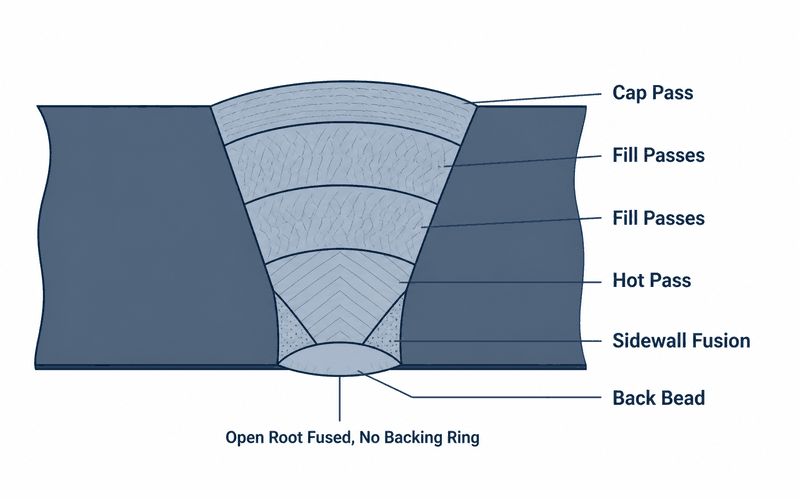
Figure 2. A completed open-root joint: the root pass must fuse the root faces and form a smooth back bead on the inside wall, then the hot pass and fill passes build the section to the cap.
Where Controlled Short-Circuit Roots Fall Short
For balance, the limitations matter as much as the advantages. Controlled short-circuit roots are not the answer to every joint.
- Code restriction risk: the GMAW-S classification carries restrictions in structural codes; verify qualification per the governing standard before planning around it.
- Material limits: duplex and super duplex stainless, chrome-moly grades like P91, and some alloy systems often require backing gas even when carbon steel and 304/316 do not.
- Fit-up dependence: the processes tolerate more gap than plain short-arc, but gross misalignment, wide gaps, and heavy internal mismatches still defeat the root and belong to a fit-up review, not a welding fix. Field fit-up corrections, including pipeline cold bending, happen before the root, not during it.
- Equipment cost and ecosystem lock-in: the waveform is vendor-locked, the machines are industrial-priced, and consumable discipline (liners, contact tips, wire feed) is stricter than stick or TIG.
- Wind sensitivity: shielding gas is the same exposure as any GMAW; winds above roughly 8 km/h with mixed gases, or 16 km/h with 100% CO2, require screens on open pipe.
- Not a skill substitute: the learning curve is shorter than TIG, but the arc position, keyhole control, and timing discipline still decide the X-ray result.
Where a root cannot be welded in place, or a pipeline is beyond welding repair, the alternatives remain: our crews rehabilitate and replace sections using trenchless pipeline repair, horizontal directional drilling, and microtunneling, and cut out defective welds with pipeline cutting machines before re-welding to the qualified procedure.
Часто задаваемые вопросы
What is the difference between STT and RMD welding?
Both are controlled short-circuit GMAW processes for open root welding on pipe. STT welding is Lincoln Electric’s Surface Tension Transfer, which senses each short circuit and cuts the current at the necking point. RMD welding is Miller Electric’s Regulated Metal Deposition, which anticipates the short with a staged seven-phase waveform. The weld results are close; the equipment, gas recommendations, and control philosophy differ.
Is STT better than RMD for root passes?
Neither is categorically better. Both produce X-ray-quality roots with low heat input and low spatter. The practical decision is driven by the equipment you already own, the qualified procedures on file, material type, and local support. On carbon steel line pipe in the 6-36 in range, our crews have achieved clean roots with both processes using the approved procedure.
Can STT or RMD replace TIG for pipe roots?
Yes, on most carbon steel and many stainless joints. As root pass welding processes, they run two to four times faster than TIG, eliminate the argon purge on carbon steel, and produce a smooth back bead without backing rings. TIG remains the choice where maximum control, cosmetic standards, or specific alloy requirements dominate.
Do STT and RMD need backing gas?
Not for carbon steel roots. Purge gas is eliminated because the root pass is made without backing rings and the back bead forms from the welding process itself. For duplex, super duplex, and chrome-moly grades such as P91, backing gas is often recommended to protect the hot root from oxidation.
What shielding gas do STT and RMD use?
STT commonly runs 100% CO2 or 75/25 Ar/CO2 on carbon steel, with 100% CO2 being the lowest-cost option. RMD typically runs 75/25 Ar/CO2 or 90/10 blends. The welding procedure specification for the job locks the gas, flow rate, and wire.
How fast is STT vs RMD vs TIG root welding?
STT is documented at about two times stick speed and four times TIG speed. RMD is documented at two to three times TIG speed. The Sigma Thermal case reports about 50% productivity gain when RMD roots are combined with pulsed MIG fill and cap passes on the same machine.
Do STT and RMD welds pass X-ray?
They pass X-ray when the procedure is controlled. The low separation current and consistent droplet transfer eliminate most spatter and burn-through, and the back bead forms smoothly. Acceptance still depends on the classic root defects: lack of fusion, incomplete penetration, porosity, and suck-back are all possible if the arc position, gas coverage, or fit-up drift.
What pipe sizes and positions can STT and RMD weld?
Both processes weld pipe from small bore to large diameter in all positions, including 5G and 6G, and STT supports vertical-down welding. The practical range on our programs covers carbon steel line pipe from 6 to 36 in, with the root procedure qualified per position and wall thickness.
Are STT and RMD qualified under API 1104?
They can be, but qualification is not automatic. The procedure must be qualified to API 1104 (or ASME IX and B31.3/B31.4/B31.8, depending on the project), with bend tests, radiography, and material-specific testing as required. Because controlled short-circuit is still classified as GMAW short-circuit, some codes carry restrictions, so verify the governing edition before planning.
Which is cheaper: STT or RMD welding?
Operating cost depends on gas and productivity more than the waveform. STT’s ability to run 100% CO2 lowers consumable cost; RMD’s typical 75/25 or 90/10 blends cost more per cubic foot. Both offset their gas and equipment cost through speed, reduced grinding, and eliminated purge gas. The capital cost of the power sources is similar, and the final comparison is project-specific.
Choosing a root welding process for your next pipeline job? Send us your pipe grade, wall thickness, position, and governing code. Our welding engineers will review the STT vs RMD fit, confirm the qualification path, and provide a quotation within 24 hours.
STT vs RMD is a choice between two mature, equivalent root welding processes, not between a good one and a bad one. Both are controlled short-circuit GMAW with low heat input, minimal spatter, open-root capability, low-hydrogen deposits, and back beads of X-ray quality at two to four times TIG speed. STT senses the short circuit and cuts the current at separation; RMD anticipates the short with a staged waveform. The weld at the root is close, and the decision belongs to your equipment ecosystem, your qualified procedures, and your project’s material and code requirements.
By the numbers: more than 1,200 hot tap and line stopping jobs completed; hundreds of pipeline girth weld programs; carbon steel line pipe from 6 to 36 in; positions 1G to 6G; more than 15 years of pipeline welding experience.
What separates a clean root from a reject is the system around the waveform: joint preparation, fit-up, gas coverage, wire discipline, arc position, hot pass timing, and inspection. In our pipeline construction, pipeline repair, and pipeline maintenance work, the joints that fail are the ones where one of those controls slipped, not the ones where the waveform name was different. Our crews qualify procedures to API 1104 and ASME B31.4/B31.8, run STT and RMD roots on carbon steel line pipe from 6 to 36 in, and verify every joint with the NDT the contract requires.
If you are planning a pipeline construction project, an in-service weld, or a repair, work with a team that treats process selection and qualification as routine. JSW has completed more than 1,200 hot tap and line stopping jobs and hundreds of pipeline girth weld programs across Asia, the Middle East, Africa, and South America, backed by our own equipment line including hot tapping machines, line stopping plugs, pipeline cutting machines, and automatic pipeline welding systems. Send us your pipe grade, wall thickness, welding process, and service, and our engineers will confirm the root welding process, qualification measures, and inspection plan for your job. Work with one accountable team: we qualify the procedure, supply the equipment, and execute the joint, so process selection, qualification, and execution never split across vendors.
Get a Free Root Welding Process Review














 English
  Arabic
  Russian
  Spanish
  French
  Vietnamese
  Polish
  Thai
Thai  Indonesian
  Turkish
  Portuguese