

What is horizontal directional drilling? It is a surface-launched trenchless method that drills a steerable, curved bore between an entry and an exit point, then pulls a prefabricated product pipe back through the enlarged hole. Unlike open-cut construction, HDD never opens the surface along the crossing. A crossing suits horizontal directional drilling when the service is a pressure line or duct that cannot be opened, the ground is cohesive soil or soft to medium rock, and the product diameter stays within about 1,200 mm (48 in.). Typical diameters run from 50 mm to 1,200 mm, and single bores reach 1,800 m and beyond.
What Is Horizontal Directional Drilling? A Working Definition for Design
HDD borrows its mechanics from oilfield drilling. A rig on the surface rotates and thrusts a drill string, while a bent housing or downhole motor near the bit steers the bore along a planned arc. Reaming passes then enlarge the pilot hole, and the product pipe is pulled through in one continuous operation.
Three properties define the method:
- The bore is curved, not straight. The alignment is a series of arcs governed by a minimum bend radius, so the pipe must tolerate curvature.
- The hole exists before the pipe arrives. The pipe is pulled, not pushed, so it carries pullback tension rather than jacking compression.
- The rig stays on the surface. There is no launch shaft, only an entry pit and a smaller exit pit, so the surface footprint is minimal.
Published ranges put entry angles at roughly 8-20° from horizontal, about 12° common, with shallower exit angles of typically 5-12°. Minimum bend radius is about 100 ft per inch of diameter, or roughly 1,000-1,200 times the outside diameter. The most useful answer to what is horizontal directional drilling is procedural: drill the hole first on a controlled curve, then pull the pipe as one prefabricated string.
Where HDD Sits Among Trenchless Methods
Any answer to what is horizontal directional drilling must place it in the wider trenchless family: method fit follows what the pipe must do.
| Метод | How the pipe gets in | Typical diameter | Typical drive length | Alignment control |
|---|---|---|---|---|
| Horizontal directional drilling | Curved bore drilled first, pipe pulled back | 50-1,200 mm (2-48 in.) | Hundreds of metres to 1,800 m and beyond | Curved arc; tolerance as a percentage of length |
| Microtunneling (pipe jacking) | Guided machine and pipe pushed from a launch shaft | 300-3,000 mm (12-120 in.) | 100-300 m routine; past 600 m with jacking stations | Straight or gently curved; tight line and grade |
| Auger boring | Auger inside a steel casing pushed from a pit | 200-900 mm (8-36 in.) | Typically 30-100 m | Straight only; no steering |
| Direct pipe | Guided machine and one pipe string pushed in a single pass | Up to about 1,500 mm (60 in.) | Several hundred metres | Guided; can follow a shallow curve |
| Open cut | Trench excavated, pipe laid, surface restored | Any | Any; restoration scales with length | Full control of line and grade |
If the line must hold a precise gravity fall, HDD is eliminated in favour of guided jacking. For very long pressure lines and ducts, HDD has no close competitor. Direct pipe suits long, large-diameter crossings under levees, rivers or rail embankments: it removes HDD pullback tension and avoids the jacking load of a long microtunneling drive.
The Anatomy of an HDD Crossing: Six Systems in One Operation
An HDD crossing is six systems inside one bore. Each owns part of the risk at bid stage.
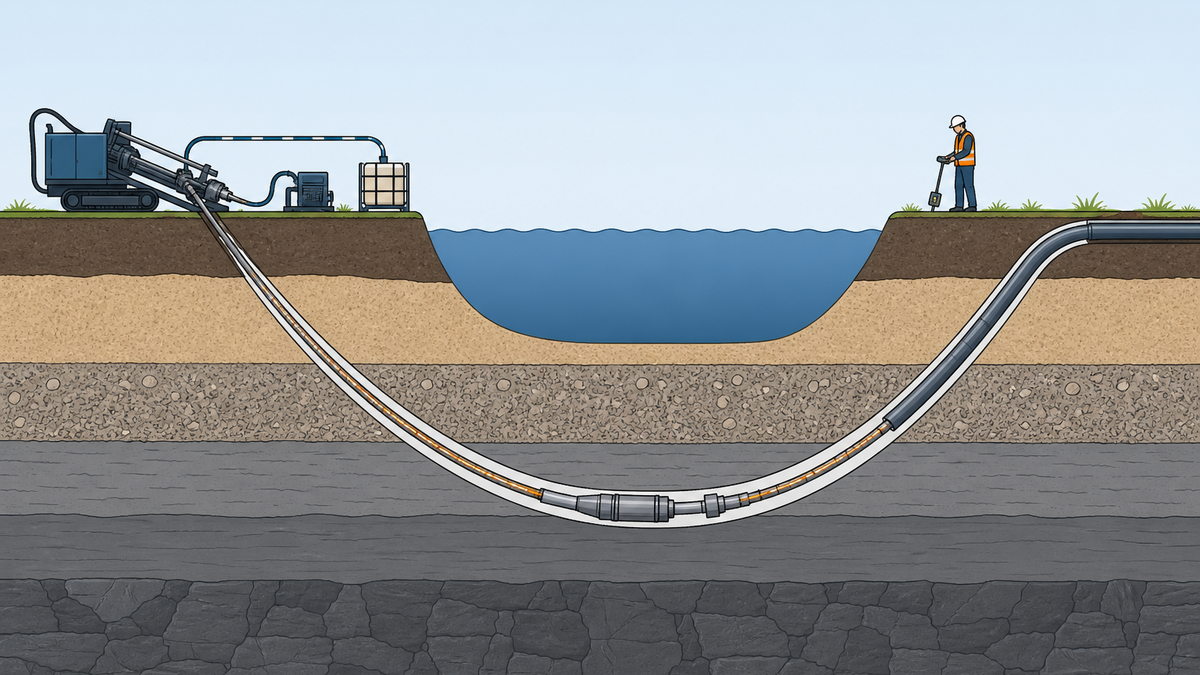
- Rig and power. The rig supplies rotation, thrust and pullback and sets the primary capacity limit through pull force, torque, rod handling and pump capacity.
- Drill string and downhole assembly. Rods transmit torque and thrust to a bottom-hole assembly that may include a mud motor, a bent sub, a bit and a reamer.
- Guidance system. A walkover locator reads a sonde behind the bit only to roughly 9-12 m; deeper bores use wireline or gyroscopic steering.
- Drilling fluid circuit. Bentonite or polymer fluid cools the bit, carries cuttings, stabilises the bore and lubricates the pipe during pullback, and is recycled on large crossings.
- Reaming tools. Reamers enlarge the pilot hole in passes, ideally to roughly 1.2-1.5 times the product pipe outside diameter.
- Product pipe and handling. The pipe is prefabricated on rollers, supported to limit bending stress, and connected through a swivel so it can move without picking up rotation.
Pipe Materials: How Steel, HDPE and Ductile Iron Change the Design
The product pipe often decides whether a crossing is buildable: it must survive bending around the bore’s curvature and axial tension during pullback.
Steel is the default for transmission pipelines. It is welded into a continuous string and carries high tensile load, so it suits large-diameter, high-pressure crossings. Its trade-offs are weight, welding cost and coating integrity; an abrasion-resistant overlay is often specified where the pipe drags on rock. Welding follows API 1104, and design follows ASME B31.4 or B31.8 by service.
HDPE is the opposite trade. It is fused into a jointless string and is nearly neutrally buoyant in the fluid-filled bore, so pullback loads are far lower than for steel. Its limits are pressure and temperature; its allowable bending strain governs the minimum radius, and ASTM F1962 covers maxi-HDD installation of polyethylene pipe.
Ductile iron sits in the middle and is usually specified for water and wastewater work. Because it arrives in jointed lengths, the joints must be restrained or welded so the string behaves as one during the pull; that restraint design is the critical detail.
| Материал | Joint in the bore | Relative pullback load | Key design check | Typical use |
|---|---|---|---|---|
| Сталь | Welded continuous string (API 1104) | Highest | Pull tension, bending stress, coating abrasion | Transmission and high-pressure lines |
| HDPE | Thermal butt-fusion; jointless | Lowest | Allowable bending strain and minimum radius (ASTM F1962) | Water, gas distribution, force mains |
| Ковкий чугун | Restrained or welded joints | Moderate to high | Joint restraint transferring tension | Water and wastewater mains |
| Fusible PVC / conduit | Fused or ducted | Низкий | Bend radius and cable pulling tension | Smaller products, ducts and cable |
Diameter and Length Envelopes by Rig Class
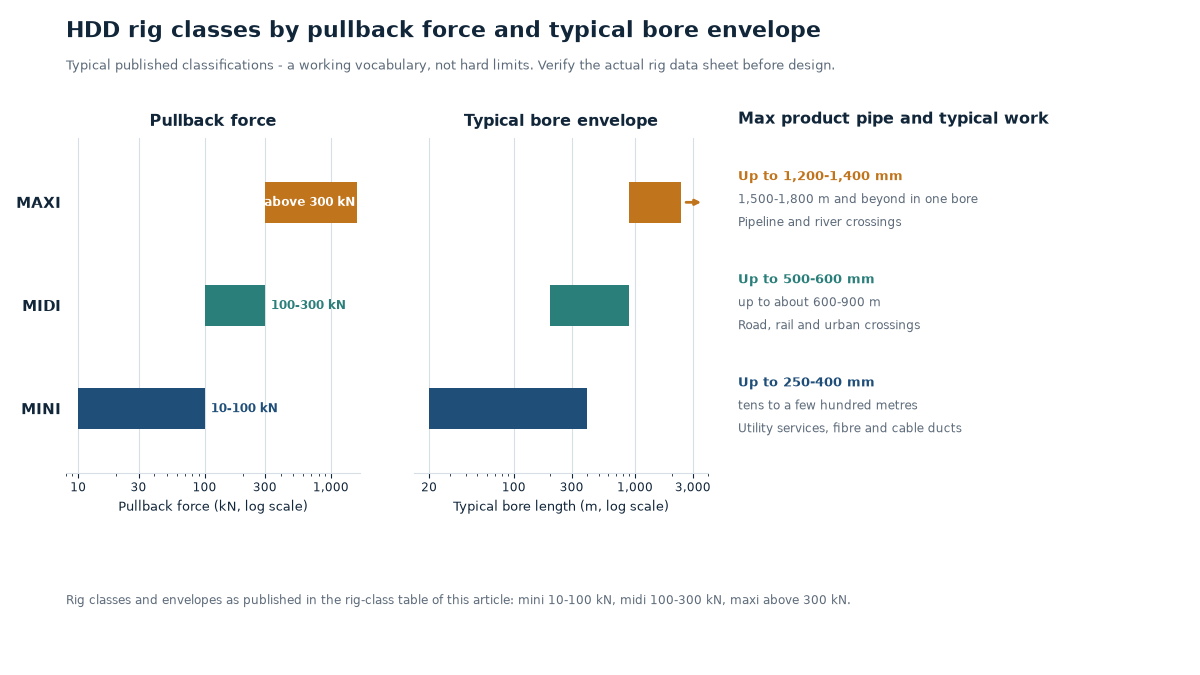
Rigs are grouped into classes by pullback force, and the class sets the practical diameter and length envelope. No single global standard fixes the boundaries, so treat the classes as a working vocabulary and verify the actual HDD rig data sheet.
Published classifications put mini rigs at roughly 10-100 kN (2,250-22,480 lbf) of pullback for utility work, midi rigs at 100-300 kN for road, rail and urban crossings, and maxi rigs above 300 kN. Market research reports the midi segment held the largest revenue share in 2024; most contract work sits in the middle of the range.
| Rig class | Pullback force | Typical product diameter | Typical bore length | Usual application |
|---|---|---|---|---|
| Mini | 10-100 kN (2,250-22,480 lbf) | Up to 250-400 mm (10-16 in.) | Tens to a few hundred metres | Utility services, fibre and cable ducts |
| Midi | 100-300 kN (22,480-67,400 lbf) | Up to 500-600 mm (20-24 in.) | Up to about 600-900 m | Road, rail and urban crossings |
| Maxi | Above 300 kN (67,400 lbf) | Up to 1,200-1,400 mm (48-56 in.) | 1,500-1,800 m and beyond in one bore | Pipeline and river crossings |
Above roughly 1,200 mm (48 in.) of product diameter, HDD stops being practical because pullback force and fluid volume rise faster than the rig envelope. Diameter and length also trade: a long bore has to be small, and a large-diameter bore short.
The Real Cost Stack: Why Short Crossings Carry a Premium
HDD is often priced on a rate per metre, which is not stable. Cost is length-independent work plus work that scales with metres, and the fixed part explains the per-metre premium.
Once the definition of what is horizontal directional drilling is fixed – a curved bore, drilled first, then pulled – the cost stack becomes predictable:
- Mobilisation and demobilisation. Rig transport, crane, site establishment and crew travel are largely fixed, so they spread over the bore length.
- HDD rig and crew time. Day rates scale with rig class, but productivity is set by geology, so two adjacent crossings can take very different days.
- Drilling fluid and disposal. Supply, recycling, tanks and disposal are a first-order cost on large bores and a regular surprise in reactive clay.
- Reaming passes. Each pass adds rig time and fluid volume, so ground needing more passes is a direct cost line.
- Pipe material and fabrication. Welding, coating, joint restraint and roller handling are often the largest material item.
- Entry, exit and restoration work. Pits, pads, access roads, water supply and surface reinstatement complete the picture; ground-risk contingency is the line whose omission makes a bid look low.
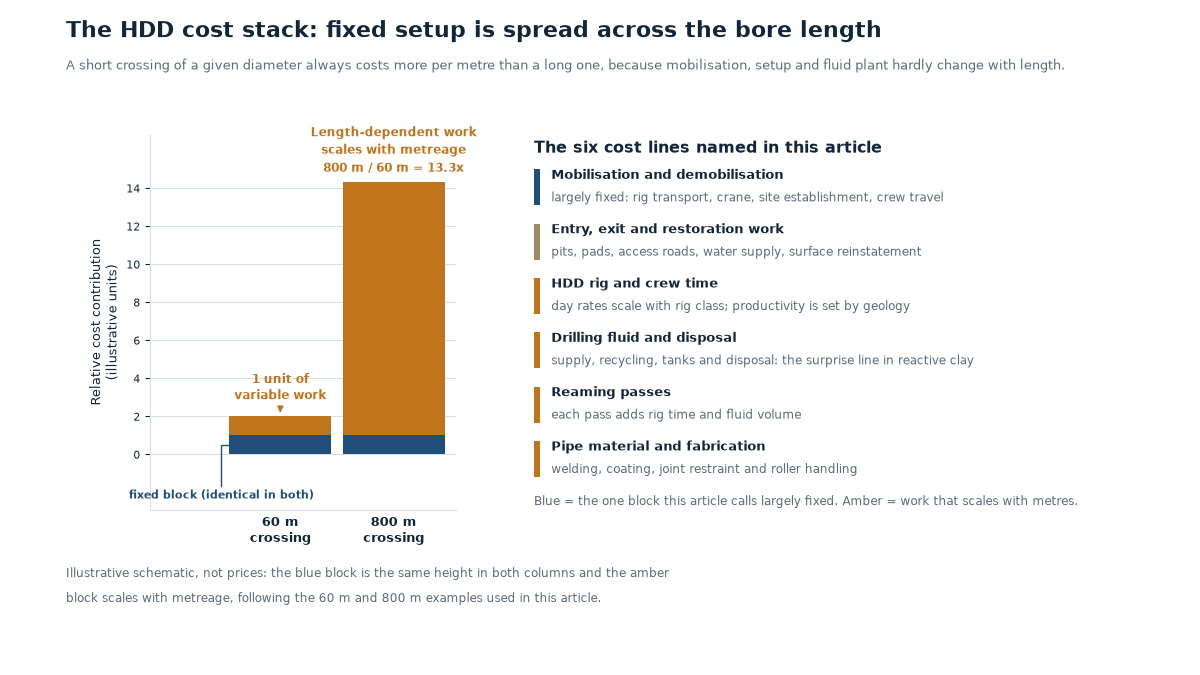
In our bid reviews, mid-size crossings commonly run from tens of thousands to several hundred thousand dollars, depending on bore length, diameter, geology and fluid handling. We have seen a short crossing cost more per metre than a long one of the same diameter, because mobilisation, setup and fluid plant are largely fixed. That premium is normal.
Failure Modes and Limitations: When HDD Is the Wrong Choice
Which ground conditions rule out horizontal directional drilling?
HDD fails in ways specific to an open, fluid-filled bore and a pulled pipe.
| Режим отказа | Механизм | Early warning | Mitigation |
|---|---|---|---|
| Inadvertent return (frac-out) | Fluid pressure fractures the ground and fluid reaches the surface | Loss of return volume; surface seepage | Fluid design, lower annular pressure, a monitored response plan |
| Bore collapse in cohesionless soil | Loose sand, gravel or cobbles fall into the open hole | Rising torque; poor cuttings return | Better fluid and revised reaming sequence |
| Excessive pullback force | Drag and curvature exceed the rig or the pipe limit | Pull load climbing above the predicted curve | Buoyancy control, more reaming passes, load monitoring |
| Pipe over-stress during pull | Tensile or bending stress exceeds the pipe allowable | Strain or load readings above design | Predict pull load, select by allowable strain, support the string |
| Steering loss at depth | Guidance signal degrades beyond walkover range | Unreliable readings; drift from the profile | Wireline or gyroscopic guidance on deep bores |
Some structural limits rule HDD out entirely rather than making it harder:
- Gravity lines. A curved bore cannot hold the constant, precise fall a gravity sewer needs, so HDD is excluded.
- Very large diameters. Roughly 1,200-1,400 mm is the practical ceiling, above which direct pipe or microtunneling becomes realistic.
- Loose gravel, cobbles and boulders. Cohesionless ground collapses into the bore and tooling can stall; identifying these zones before bid separates a priced risk from a claim.
- Shallow, permeable ground. Where cover is thin, the pressure that holds the bore open is the pressure that drives fluid to the surface.
Our field teams record that most difficult crossings trace back to one root cause: a geotechnical investigation too sparse to describe the ground along the whole alignment. Fluid loss, reaming trouble and steering difficulty are usually geological surprises, not equipment faults.
How to Specify and Scope an HDD Crossing
What do I need to send an HDD contractor before I ask for a price?
The engineering answer to what is horizontal directional drilling ends in a specification, not a catalogue selection. The inputs below are the minimum set to fix.
| Input | What the engineer must define | Why it changes the bid |
|---|---|---|
| Alignment and geometry | Entry and exit points, entry and exit angles, depth profile, minimum bend radius | Sets bore length, pull geometry and HDD rig class |
| Geotechnical basis | Soil and rock classification, groundwater, boulder and cobble assessment along the alignment | Drives reaming passes, fluid design and contingency |
| Pipe specification | Material, diameter, wall thickness, joint type, coating and allowable strain | Sets pull load, weight and handling requirements |
| Depth of cover | Design cover of roughly 0.9-1.5 m (3-5 ft), including scour allowance where a watercourse is crossed | Sets the length and the guidance system needed |
| Drilling fluid plan | Fluid type, recycling, containment and an inadvertent return response plan | Sets environmental control and cost |
| Tolerances and acceptance | Bore position tolerance, reamed-hole basis (roughly 1.2-1.5 times the pipe outside diameter), pull-load limits, coating acceptance and as-built accuracy | Gives both parties a measurable acceptance test |
A scope written this way fixes geometry, ground risk, pipe, environmental control and the acceptance test, so bids are comparable and each bidder’s contingency is visible. Where a client cannot supply a geotechnical investigation, the honest bid carries a large allowance. On crossings we have supported, that gap drives most of the bid spread.
Scope of Application: When Horizontal Directional Drilling Fits
Horizontal directional drilling fits pressure lines and ducts that cannot be opened, in cohesive soil or soft to medium rock, up to about 1,200 mm (48 in.).
- Gravity-flow lines: use guided jacking such as microtunneling, because a curved bore cannot hold a constant fall.
- Cohesionless gravel and cobbles: use a casing-first method such as auger boring, which controls the ground rather than relying on fluid.
- Long crossings above roughly 1,200 mm: use direct pipe, or a shorter open-cut crossing.
- Short, shallow crossings in well-characterised ground: open cut is usually the lower-cost and lower-risk choice.
How This Changes by Project Role
What should a utility engineer planning a short road crossing fix first?
Treat it as a small-rig job: expect a mini or midi spread, a bore of tens of metres, and cover set by the road authority rather than scour.
What changes for a midstream engineer specifying a long river crossing?
Scour, not road cover, sets the depth; guidance moves to wireline or gyro; and the reamed-hole basis, pull-load limit and fluid plan must appear in the scope before bids.
How does an EPC estimator price a crossing from a client’s brief?
Price the fixed items first – mobilisation, pits and fluid handling – then the per-metre items, and list every assumption you could not verify; those assumptions are the risk.
Key Takeaways
- What is horizontal directional drilling, in one line? A two-stage trenchless method: drill a steerable curved bore, enlarge it, then pull a prefabricated pipe through.
- Method fit is decided by alignment, not preference. A curved bore rules out gravity lines, and a practical product ceiling of roughly 1,200-1,400 mm rules out very large diameters.
- Rig class sets the envelope, and materials change the design. Mini, midi and maxi classes map to short utility bores, urban crossings and long pipeline crossings; steel carries the highest pull load and HDPE the lowest.
- Short crossings carry a premium, and the geotechnical investigation is the risk-pricing document. Mobilisation cost spreads over the bore length, and inadvertent return or bore collapse are usually ground surprises.
Часто задаваемые вопросы
These are the questions engineers, owners and contractors raise most often when scoping an HDD crossing.
What is horizontal directional drilling used for in pipeline and utility work?
HDD installs pressure pipelines, conduits and cables beneath obstacles that cannot be excavated. Typical uses are water mains, gas lines, force mains and fibre ducts beneath rivers, roads, railways and sensitive ground. Gravity sewers are generally excluded, because an HDD bore cannot hold a constant fall.
How deep can an HDD crossing go below a river or a road?
Depth is driven by the obstacle and the required cover, not a fixed rig limit. Published cover requirements for crossings commonly sit in the 0.9-1.5 m (3-5 ft) range, and reviewed projects have used a depth-of-cover-to-diameter ratio of about 1.5. River crossings often run 15-30 m or more below the bed.
What pipe materials can be installed by HDD?
Steel, HDPE and ductile iron are the three common pipeline choices, with fusible PVC and conduit for smaller products. Steel is welded and carries high pullback loads. HDPE is fused, is light in the fluid-filled bore and is covered by ASTM F1962 for maxi-HDD. Ductile iron needs restrained or welded joints to survive the pull.
What are the main limitations of horizontal directional drilling?
The main limits are alignment control, diameter ceiling, difficult ground and inadvertent returns. A curved bore cannot hold gravity grade. Practical product diameter tops out near 1,200-1,400 mm. Loose gravel and cobbles collapse into the bore, and deep bores need wireline or gyroscopic guidance.
How much does an HDD crossing cost per metre or per crossing?
There is no universal rate, because the same bore length can vary by a large multiple with geology and fluid handling. Cost is driven by bore length, diameter, ground, reaming and fluid management. In our bid reviews, mid-size crossings commonly run from tens of thousands to several hundred thousand dollars.
How JSW Supports HDD Crossing Design and Delivery
JSW is a pipeline engineering and construction company that executes trenchless crossings with its own crews and equipment. Our scope covers HDD crossing services, бестраншейные технологии, строительство методом микротуннелирования, pipe fabrication with automatic pipeline welding, and the full услуги по прокладке трубопроводов chain that connects them.
Because we plan, engineer and execute the work ourselves rather than reselling it, our crossing recommendations reflect real site conditions rather than catalogue pricing. We price the ground risk we can see in the investigation, state the risk we cannot, and recommend the method that fits the alignment – reviewed by professional engineers before bid.
- Комплексная доставка: design, fabrication, HDD and tie-in under one contractor, so interfaces are not handed off.
- Auditable process data: bore profiles, pull-load records, fluid returns and coating inspections are documented as deliverable records.
- Ценообразование с учетом риска: scopes separate fixed setup, length-dependent work and ground-risk contingency so bids compare honestly.
- Safety and compliance: work is planned around recognised industry good practice and applicable standards, including excavation safety requirements.
Scoping an HDD crossing and not sure it will price out? Send your alignment, pipe specification and geotechnical report for a free technical review. Our engineers respond with a scoped recommendation and a budget range.
Whatever answer to what is horizontal directional drilling a project needs, the deliverable is a defensible crossing design, an auditable bore record and a priceable scope.





































 English
  Arabic
  Russian
  Spanish
  French
  Vietnamese
  Polish
  Thai
Thai  Indonesian
  Turkish
  Portuguese