
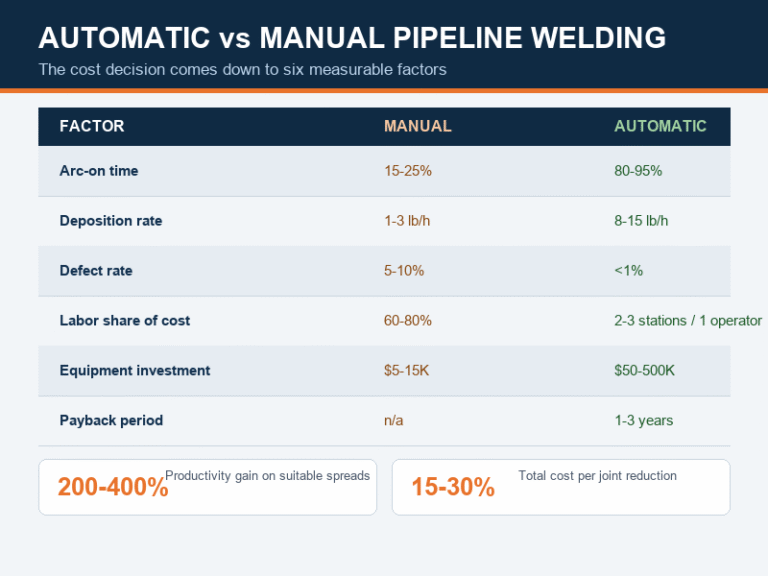
Automatic welding vs manual welding: for new mainline construction with a high number of girth welds, automatic welding is more cost-effective, typically cutting total cost per joint by 15-30%. The advantage comes from higher deposition rates, longer arc-on time, and lower defect rates, which outweigh the higher equipment investment.
For short tie-ins, repairs, and small-diameter work, manual welding remains the lower-cost option. This guide explains how the cost of each method is really built, which one welds faster and with fewer defects, when the payback point is reached, and how to run a cost-per-joint calculation for your own project before you choose.
In this guide:
- Key Takeaways
- Key Data at a Glance: Welding Cost and Productivity
- What Does Automatic Welding vs Manual Welding Mean in Practice?
- How Does the Cost of Pipeline Welding Break Down?
- How Much Faster Is Automatic Welding on the Spread?
- Does Automatic Welding Reduce Defects and Repairs?
- When Is Manual Welding the More Cost-Effective Option?
- How Do You Calculate the Break-Even Point?
- How to Choose: A Six-Step Cost Analysis
- How Does Welding Method Choice Affect In-Service Work?
- Common Mistakes When Comparing Welding Methods
- Часто задаваемые вопросы
- Conclusion
Key Takeaways
- Labor is the dominant cost in pipeline welding; a manual welder is only depositing metal 15-25% of the shift, while mechanized systems reach 80-95% arc-on time.
- Automatic welding on suitable spreads raises productivity by roughly 200-400% and typically lowers total cost per joint by 15-30% despite a 2-3x higher equipment outlay.
- Reported defect rates drop from a typical 5-10% on manual processes to below 1% with automated systems, which cuts rework, repair, and NDT cost directly.
- Manual welding wins the cost comparison on short runs, tie-ins, repairs, small diameters, and confined access, where setup and mobilization dominate.
- Payback for automatic pipeline welding equipment is typically 1-3 years on high-volume work; the break-even point sits at roughly 300-500 girth welds on 16-inch and larger pipe in our project data.
- A hybrid approach, automation for the mainline and manual crews for tie-ins, is the most common cost-effective solution on real projects.
Key Data at a Glance: Welding Cost and Productivity
These are the values our estimators use on every job. Each number is quoted in this guide and traceable to the published standard or study, or the anonymized JSW project data, shown in the basis column, so the table works as a quick reference during cost planning.
| Параметр | Значение | Context | Basis |
|---|---|---|---|
| Manual welder arc-on time | 15-25% of shift | Stick and semiautomatic welding | AWS Welding Handbook / AWS workforce surveys |
| Mechanized duty cycle | 80-95% | SAW, mechanized GMAW/FCAW, orbital GTAW | TWI Job Knowledge for Welding |
| SMAW consumable factor | 1.5x purchased weight | Stub ends and damaged flux | TWI Job Knowledge for Welding |
| SAW consumable factor | 1.02x purchased weight | Wire and flux | TWI Job Knowledge for Welding |
| Manual FCAW deposition | About 5 lb/h (2.3 kg/h) | Hand-held semiautomatic | JSW field records (anonymized) |
| Twin-wire SAW deposition | 30-50 lb/h (14-23 kg/h) | Mechanized, flat position | Manufacturer specifications |
| Manual process defect rate | 5-10% | Typical field rejections | PRCI defect studies |
| Automated process defect rate | Under 1% | Qualified systems in production | PRCI defect studies |
| Productivity gain, suitable spreads | 200-400% | Large-diameter mainline | JSW project data |
| Total joint cost reduction | 15-30% | Total cost of ownership models | JSW project data |
| Equipment payback | 1-3 года | High-volume production | JSW project data |
| New welders needed in the US by 2029 | 320,500 | Retirements and demand | AWS 2024 workforce study |
| Average welder age in the US | 55 | Workforce profile | AWS 2024 workforce study |
| Repair cost multiplier | 2-3x original weld cost | Cut-out, re-weld, re-NDT, schedule impact | JSW project data |
What Does Automatic Welding vs Manual Welding Mean in Practice?
Manual welding covers processes where the welder holds the torch or electrode and controls travel speed, arc length, and weave by hand. The common field processes are shielded metal arc welding (SMAW, stick) for the root, and semiautomatic gas metal arc welding (GMAW) or flux-cored arc welding (FCAW) for fill and cap passes.
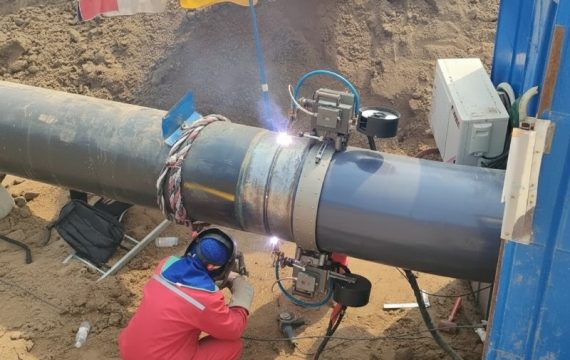
Automatic welding covers systems where a machine moves the torch and controls the parameters. Band-and-bug systems ride the pipe on a track, orbital welding heads serve small diameters, and submerged arc welding (SAW) carriages handle double-jointing. Dual-torch automatic GMAW/FCAW bugs cover large-diameter mainline fill passes. The welder becomes an operator who sets the program, watches the weld, and intervenes when something drifts.
The distinction matters for cost because the two families spend money differently. Manual welding spends on certified welder hours and rework; automatic welding spends on equipment, programming, and setup, then recovers it through speed and consistency. In our automatic pipeline welding work, we qualify the procedure once, then the machine repeats it weld after weld, which is why the cost curve flattens as joint count rises.
Neither method removes the need for a qualified welding procedure or a qualified crew. The difference is where the skill is applied: in the hand for manual welding, in the program and the fit-up for automatic welding.
| Процесс | Duty cycle | Typical deposition | Skill needed | Typical use |
|---|---|---|---|---|
| SMAW (stick), manual | 15-25% (arc-on) | 1-3 lb/h | Certified welder | Root pass, tie-ins, repairs |
| GMAW/FCAW, semiautomatic | 30-45% | 3-6 lb/h | Certified welder | Fill and cap passes, small spreads |
| Automatic GMAW/FCAW bug | 70-90% | 8-15 lb/h | Operator | Mainline fill passes, 16-inch and larger |
| Orbital welding (GTAW) | 80-90% | 1-3 lb/h | Operator | Small diameters, high-integrity pipe |
| SAW (mechanized) | 80-95% | 15-50 lb/h | Operator | Double-jointing, yard fabrication |
How Does the Cost of Pipeline Welding Break Down?
In this guide, welding cost per joint means the fully loaded cost of producing one accepted girth weld: welding labor, consumables, equipment, non-destructive testing (NDT), rework, and overhead, not the hourly wage of the welder or the price of the machine. Labor is by far the largest line item, which is why any comparison between automatic welding vs manual welding starts with how each method spends welder hours.
Industry cost models routinely put labor and labor-related overhead at 60-80% of total welding cost. When a manual welder is only at the arc 15-25% of the shift, the arc-on figure AWS surveys report for typical field work, most of the paid hour goes to grinding, de-slagging, changing electrodes, repositioning, and rest. Every one of those minutes is labor cost that automation removes or compresses.
Labor: the line item that decides the comparison
A certified pipeline welder is scarce and expensive. The American Welding Society projects that the US alone will need 320,500 new welding professionals by 2029, with more than 157,000 current welders nearing retirement and an average welder age of 55. Premium wages, overtime, and relocation costs follow directly from the welder shortage.
In our experience, one automatic welding station replaces two to three manual stations for the same daily output, and one operator monitors a machine that does not fatigue, slow down, or change technique at the end of a 12-hour day. That is the core of the labor saving, and it is why the welding cost per joint falls as joint count rises.
Consumables: process efficiency is measurable
Consumable cost follows the process, and the differences are documented in welding cost references. Coated stick electrodes lose roughly one-third of their purchased weight to stub ends, damaged flux, and incorrect storage, which is why the standard consumption factor for SMAW is about 1.5x the deposited weld metal weight.
Continuous-wire processes waste far less: the published factors are about 1.05x for GMAW and 1.02x for submerged arc welding (SAW). A welder who overwelds to be safe, adding reinforcement and extra passes, multiplies filler and gas consumption on every joint. Automatic welding deposits only the programmed volume, which trims both material cost and grinding time.
Rework, repair, and NDT: the hidden cost of quality
A rejected weld costs far more than the weld itself. The bill includes the NDT time that found the defect, the cutting or gouging to remove it, the replacement consumables, the premium labor to re-weld, and the schedule delay. Reported manual-process defect rates run 5-10% against under 1% for automated welding systems, so weld repair cost is not a rounding error; it is a decision variable.
Every weld repair is re-inspected 100% with the same acceptance criteria as the original, which doubles the NDT bill on repaired joints. On a large spread, cutting even 5% of welds out and re-welding them can erase the apparent labor advantage of a low welding cost per hour. See our pipeline welding inspection checklist for how NDT cost and hold times are built into project budgets.
How Much Faster Is Automatic Welding on the Spread?
Speed is the largest driver of cost per joint, and the gap comes from two numbers: deposition rate and arc-on time. A hand-held semiautomatic welder deposits roughly 5 lb/h of weld metal (about 2.3 kg/h); a mechanized twin-wire SAW setup deposits 30-50 lb/h (14-23 kg/h), and automatic GMAW/FCAW bug systems sit between them at 8-15 lb/h per torch with dual torches running together.
Arc-on time amplifies the deposition gap. AWS survey data put manual SMAW arc-on time at 15-25% of the shift, while TWI process data put mechanized duty cycles at 80-95%. A manual welder who is at the arc 20% of the shift effectively deposits about 1 lb/h of usable weld metal across the day; an automatic system at 90% arc-on time multiplies its deposition rate by that duty-cycle difference on top of the process difference.
Across our project records, automatic welding on suitable pipeline spreads delivers productivity gains of 200-400%, and a single pass on a 36-inch girth weld typically runs 50-100% faster than the same pass by hand. An automatic crew completes two to four times the joints per day of a manual crew of the same size, which is the number that drives everything else in the estimate.
One example from our records: on a 36-inch mainline program in the Middle East, a single automatic station matched the output of two to three manual stations across the welding window, consistent with the ratios above, and the schedule saving was the largest single line item in the client’s cost reduction. Records are anonymized, but the same pattern repeats across Asia, Africa, and South America.
Two cautions belong here. First, the gain depends on fit-up: automatic welding needs consistent bevel preparation and line-up, because a machine cannot see misalignment the way a welder can. Second, mobilization and setup time are real; the speed advantage only shows once the machine is running. That is why the calculation must be per project, not per hour.
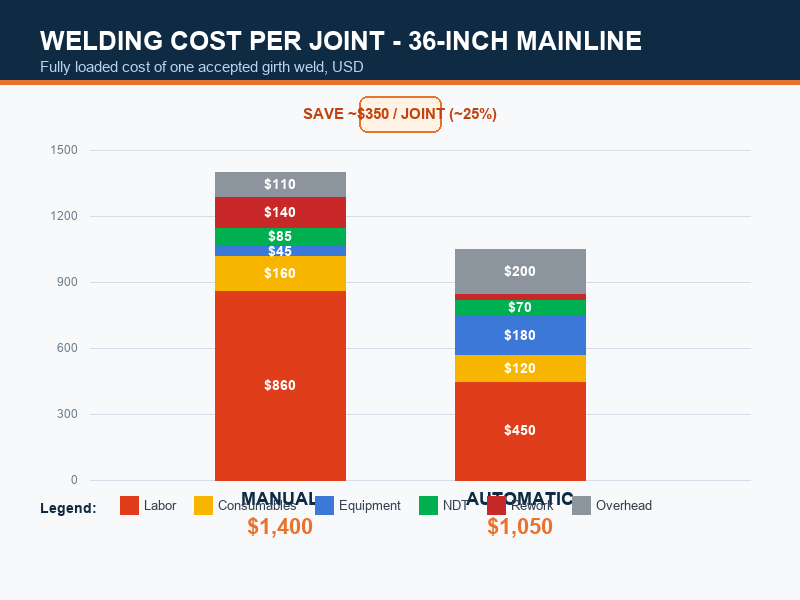
Figure 2. A cost-per-joint example on a 36-inch mainline: the automatic total is about 25% lower once equipment is spread across a high joint count, with labor and rework making up most of the difference.
Does Automatic Welding Reduce Defects and Repairs?
Quality is a cost line, not a separate topic. Automated systems remove the human variables behind the common pipeline welding defects: travel speed, arc length, weave width, and end-of-shift fatigue. The machine holds heat input and interpass temperature inside the qualified window and logs every parameter, so the welding defects caused by technique drift largely disappear.
Projects using automated welding routinely report non-destructive testing acceptance rates above 99%, against the 90-95% that is normal for disciplined manual crews. The defect rate comparison in the table above, 5-10% manual versus under 1% automated, translates directly into fewer cut-outs, fewer repair welds, and a shorter critical path.
One limit must be stated honestly. Automatic welding does not fix a bad procedure, contaminated bevel, or poor fit-up; it repeats them consistently. The root causes of welding defects are unchanged by the method: contaminated bevels, damp consumables, and poor fit-up still behave the same way on automatic welds. The welding procedure specification (WPS), consumable control, joint cleaning, and inspection still govern the result, exactly as they do for manual welding. What automation removes is the variability between welders and between shifts, not the process discipline around the weld.
Hydrogen cracking risk also applies to automatic welds. High-strength pipe welded with automatic GMAW still requires low-hydrogen consumables, controlled preheat, and, on hydrogen-risk joints, a 48-hour hold before final NDT. See our guide on hydrogen cracking prevention in pipeline welding for the full controls.
When Is Manual Pipeline Welding the More Cost-Effective Option?
In the automatic welding vs manual welding comparison, manual welding wins on cost in four situations, and recognizing them prevents an expensive mistake. The first is low joint counts: when mobilization and setup exceed the welding time, the machine never earns back its transport and rig-up cost.
The second is short tie-ins and repairs. A station tie-in, a valve replacement, or a repair cut-out is one weld in a confined spot; a manual crew with a pipeline cutting machine and a certified welder is faster and cheaper than commissioning an automatic system for a single joint. Our pipeline repair crews use manual welding for exactly this reason, reserving automation for repeat work.
The third is small diameters and tight access. Below roughly 12 inches, orbital welding competes with manual TIG on cost only at high joint counts or demanding quality requirements; in a ditch, a valve pit, or against an existing line, a welder’s hands fit where a carriage cannot. The fourth is variable fit-up: badly corroded pipe, out-of-round ends, and field adjustments favor the welder who can adapt the technique joint by joint.
The practical pattern on most projects is hybrid. Automatic welding builds the mainline at high speed, and manual crews close the tie-ins, make the repairs, and handle the valve stations. In our pipeline construction work, this split routinely delivers both the low cost per joint of automation and the flexibility that only a welder provides, and it is the configuration we recommend unless the project is almost entirely straight-line mainline. The break-even calculation in the next section shows exactly where that line sits for a 36-inch mainline.
How Do You Calculate the Break-Even Point?
The break-even point is the joint count where the cumulative savings of automatic welding overtake its extra cost, and it is where the automatic welding vs manual welding decision is actually settled, because the answer changes with every joint counted. The formula is simple: break-even joints equal the equipment and training premium divided by the savings per joint. The numbers on each side are project-specific, but the structure is the same every time.
Equipment tells the first half of the story. A manual pipe welding machine setup with tools and minor accessories typically runs $5,000-15,000. An automatic pipeline welding system, band-and-bug or dual-torch carriage plus power source and training, typically runs $50,000-500,000 depending on diameter range and features. Training adds roughly $5,000-15,000 for operators against $500-2,000 for manual welder familiarization, because automation replaces welder certification hours with operator and programming competence.
Rental and per-weld contract options change the return on investment (ROI) math. Automatic welding systems are available on a rental or per-weld basis, which converts the capital outlay into an operating cost and moves the break-even point sharply left: a leased system turns the equipment premium into a per-joint cost, so programs far below the 300-500 weld purchase threshold can still access automation without a capital decision. On multi-year programs, buying usually wins; on a single spread, renting often does, and a hybrid purchase-rental plan is common on large programs.
| Cost item | Manual (SMAW/FCAW) | Automatic (dual-torch GMAW/FCAW) |
|---|---|---|
| Welding labor, helpers, supervision | $860 | $450 |
| Consumables (filler, gas, electrodes) | $160 | $120 |
| Equipment, power, mobilization share | $45 | $180 |
| NDT and inspection | $85 | $70 |
| Rework and repair allowance | $140 | $30 |
| Overhead and project management | $110 | $200 |
| Total per joint | $1,400 | $1,050 |
Assumptions behind Table 3 (JSW estimating basis). Replace these inputs with your own numbers before making the call: the all-in certified welder rate, including helpers and supervision, varies widely by region and by project; joint counts per crew-day follow the productivity ratios in the speed section, where an automatic crew completes two to four times the joints per crew-day of a manual crew; the $175,000 equipment and training premium is a separate capital outlay, the difference between the automatic system purchase price and the manual setup price plus operator training, recovered through the operating savings in the table rather than amortized inside its line items, which carry only operating costs such as power, maintenance, mobilization, and project management; break-even = $175,000 divided by $350 per joint of operating savings = 500 joints; NDT unit prices are regional; and every repair is costed at two to three times the original weld, per Table 1.
For a 36-inch mainline with 500 girth welds, automatic welding saves about $350 per joint and reaches break-even at roughly 500 joints against a $175,000 equipment and training premium. On this example, that $350 saving, about 25% of the manual total, matches the 15-30% total joint cost reduction we see in our total cost of ownership models. The project is about $175,000 ahead of manual welding at 1,000 joints. At 100 joints, the same premium produces a loss of about $140,000, which is why small projects stay manual.
Our rule of thumb from project data is that automation usually wins above roughly 300-500 girth welds on 16-inch and larger pipe with consistent fit-up, and manual pipeline welding usually wins below that, with labor rates and mobilization distance shifting the line. The all-in welder rate is the single largest variable: in parts of Asia and the Middle East, all-in certified welder rates can run less than half of North American or European levels, which pushes the threshold toward a higher joint count, while high-rate regions move it down. Run the model with your local rate, not a headline number. The example above is deliberately transparent so you can replace the rates and volumes with your own numbers before making the call.
Want this worked out for your project? Send us your pipe diameter, wall thickness, weld count, and labor rates, and our welding engineers will run the cost-per-joint comparison for both methods, confirm the break-even point for your job, and recommend the more economical method, usually within 24 hours.
How to Choose: A Six-Step Cost Analysis
Use this sequence to decide for a specific project. It takes an hour with your own rates and removes the guesswork from the automatic welding vs manual welding decision.
- Count the welds. List mainline girth welds, double joints, tie-ins, and repairs separately; only repeatable welds favor automation.
- Check diameter and access. Automation suits 12-inch and larger pipe with clear right-of-way; below that or in confined spaces, manual wins on cost.
- Build the labor model. Apply your all-in certified welder rate to the joints per crew-day each method achieves, using the arc-on time and deposition rate figures above.
- Add quality and rework. Apply your historical rejection rate, 5-10% manual and under 1% automated, and cost every repair at two to three times the original weld.
- Add equipment, training, and mobilization. Spread the purchase or rental premium of welding equipment across the joint count and add operator training and site setup.
- Compare totals and split the work. Compare the per-joint totals, then check whether a hybrid plan, automation on the mainline and manual crews on tie-ins, beats either pure option.
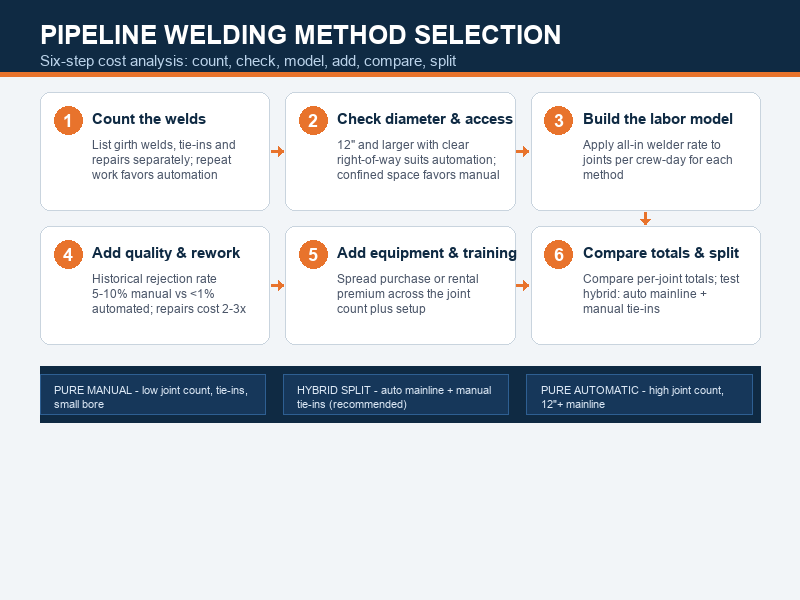
Figure 3. A six-step cost analysis decides the method: count the welds, check access, model labor, add rework, spread equipment cost, then compare pure and hybrid options.
Two further checks save money regardless of the method chosen. First, verify that the project specification accepts the process you plan to use; some clients still specify manual SMAW roots even where automatic fill passes are permitted, and the API 1104 versus ASME B31.3 choice affects both procedure qualification and acceptance criteria. Second, confirm that your planned consumables and preheat match the welding procedure specification (WPS); a procedure that was not qualified for automatic welding will not produce the low defect rate the cost model assumes.
How Does Welding Method Choice Affect In-Service Work?
The same cost logic applies to work on live pipelines, where the stakes are higher and the weld count is usually low. Hot tapping a branch connection or stopping a line to isolate a section is one or two critical welds in a confined space, and manual welding by qualified crews is normally the cost-effective choice, because the setup cost of an automatic system cannot be recovered on a handful of joints.
That does not mean automation has no place in hot tapping and line stopping programs. Contractors use automatic welding for repetitive branch fittings in shop fabrication, and mechanized systems are increasingly used on large-diameter hot tap saddles where a full penetration weld is required and consistency protects the live-line operation. The decision rule is the same as mainline work: count the welds before choosing the method.
In-service welds carry extra cost lines that change the comparison. Hot tapping equipment and line stopping plugs must be prepared, the weld is made against live pressure, ASME B31.4/B31.8 in-service rules apply, and hydrogen cracking controls, including preheat and a 48-hour hold before final non-destructive testing, add schedule time. On one or two critical welds, the premium for certified manual welders is small against these fixed costs; on a multi-tap program, automating the repeat welds pays for itself.
Common Mistakes When Comparing Welding Methods
The cost comparison goes wrong in predictable ways, and most of them inflate the apparent advantage of whichever method the estimator preferred at the start. These are the errors we see most often in project budgets.
- Comparing hourly rates instead of cost per joint. A welding cost per hour comparison is misleading: the hourly wage is only the visible part, while arc-on time, deposition rate, and rework behind that hour decide the real cost per joint.
- Ignoring rework and repair. A 5-10% manual rejection rate at two to three times the cost of the original weld can erase a lower apparent rate, while a sub-1% automated rate removes that line almost entirely.
- Pricing equipment against one small project. A $175,000 system premium looks absurd on a 100-joint job, where it loses about $140,000, and only earns itself back as the joint count approaches 500 and beyond; the equipment decision belongs to the program, not the single spread.
- Assuming automation removes qualification and inspection. The welding procedure specification, welder and operator qualification, and NDT still cost the same; automation changes the defect rate, not the compliance requirements.
- Forgetting fit-up and access until setup day. Out-of-round pipe, corroded ends, and tight right-of-way can turn a planned automatic spread into a manual job after the equipment is already mobilized.
- Overlooking the welder shortage in the schedule. When certified welders are not available at the planned date, the choice is not automatic versus manual; it is automatic versus waiting, and that changes the comparison completely.
Часто задаваемые вопросы
Is automatic welding more cost-effective than manual welding?
Whether manual welding vs automatic welding is cheaper depends on the project. On high-volume mainline work, yes: automatic welding typically cuts total cost per joint by 15-30% despite higher equipment investment, because labor and rework savings outpace the capital cost. On short runs, tie-ins, repairs, and small diameters, manual welding is usually the more cost-effective option. The decision depends on joint count, diameter, access, and local labor rates, not on the method alone.
How much does it cost to weld a pipeline joint?
Welding cost per joint depends on diameter, wall thickness, process, labor rates, and rework. For a 36-inch mainline example, the cost is about $1,400 per joint with manual welding and about $1,050 per joint with automatic welding once equipment is spread across 500 joints, a saving of about 25%. Small-diameter joints cost far less, and tie-in welds in confined spaces can cost several times a straight mainline weld.
How much faster is automatic welding than manual welding?
Automatic welding raises productivity by roughly 200-400% on suitable pipeline spreads and completes a single pass on a 36-inch girth weld 50-100% faster than the same pass by hand. The gain comes from higher deposition rate combined with 80-95% arc-on time, against 15-25% for a manual welder. The speed advantage only materializes after setup, so it applies to repeat work, not one-off joints.
Does automatic welding produce fewer defects than manual welding?
Yes. Reported defect rates drop from a typical 5-10% on manual processes to under 1% with automated systems, and projects using automation routinely report radiographic or ultrasonic acceptance rates above 99%. Automation removes the human variables of travel speed, arc length, and fatigue, but the procedure, consumables, and fit-up still decide the result, and welding defects from contamination or poor fit-up appear on automatic welds too.
When is manual pipeline welding the better choice?
Manual welding is the better choice for low joint counts, tie-ins and repairs, small diameters below roughly 12 inches, tight or confined access, and variable fit-up. In these situations the cost of mobilizing and setting up an automatic system exceeds the savings it can generate. A hybrid plan, automation on the mainline and manual crews on tie-ins, is the common solution.
What is the payback period for automatic pipeline welding equipment?
An automatic pipe welding machine typically pays back in 1-3 years on high-volume production. On a single project, the break-even point is the equipment and training premium divided by the savings per joint, which usually lands between roughly 300 and 500 girth welds on 16-inch and larger pipe.
How much does an automatic welding machine cost?
An automatic pipe welding machine typically costs $50,000-500,000 depending on diameter range, process, and features, with operator training adding roughly $5,000-15,000, against $5,000-15,000 for a manual pipe welding machine setup. The equipment gap is recovered through welding cost per joint savings, which is why the break-even calculation matters more than the sticker price.
Do you still need qualified welders with automatic welding?
Yes. Automatic welding needs qualified operators, and the welding procedure specification still requires welder and procedure qualification to the governing code, typically API 1104 or ASME B31.4/B31.8. Operators must understand heat input, interpass temperature, and weld defects to catch problems the machine cannot see. The skill moves from the hand to the program and the monitoring.
What is the difference between mechanized and automatic welding?
Mechanized welding uses a machine to move the torch while an operator adjusts parameters in real time; automatic welding uses a machine for both torch movement and parameter control, with the operator monitoring rather than adjusting continuously. For cost purposes the two are usually grouped together, since both deliver the high arc-on time and consistency that manual welding cannot.
Can automatic welding be used for tie-ins and repairs?
Yes, but it is rarely cost-effective for a single joint. Automatic welding earns its value on repeat work, where setup time is amortized across many welds. Tie-ins and repairs are usually welded manually by certified crews, which is why most projects run automation on the mainline and manual welding on the exceptions, a split our pipeline maintenance and repair programs follow.
How does welder skill affect manual welding cost?
Skill is the largest variable in manual welding cost. Highly skilled certified welders command higher rates but produce fewer defects, less rework, and faster completion; less experienced welders cost less per hour but generate more rejections and slower output. Over a project, the difference in repair and NDT cost usually exceeds the difference in hourly rate, which is one reason the cost per joint is the right unit of comparison.
Not sure which method is cheaper for your project? Send us your pipe diameter, wall thickness, weld count, and labor rates. Our welding engineers will run the cost-per-joint comparison and confirm the most economical welding method for your job, usually within 24 hours.
Conclusion
Neither method is universally cheaper. The manual welding vs automatic welding decision settles into a quick rule: automate above roughly 300-500 girth welds on 16-inch and larger mainline with consistent fit-up; weld manually below that, and for tie-ins, repairs, and confined access; on most projects, run both. The deciding factors are joint count, diameter, access, labor rates, and rework history, not the sticker price of the equipment.
Most owners and contractors do not have to choose one method for the whole project. The hybrid model, automatic welding on the mainline and certified manual crews on tie-ins and repairs, delivers the low cost per joint of automation and the flexibility of manual welding in the same program, and it is the configuration we recommend after running the numbers.
JSW supplies automatic welding services and equipment, with crews and procedures qualified to API 1104 and ASME B31.4/B31.8, supported by our own line of hot tapping machines, line stopping equipment, and pipeline cutting machines. We have completed more than 1,200 hot tap and line stopping jobs and hundreds of pipeline girth weld programs across Asia, the Middle East, Africa, and South America, including live-line hot tapping and line stopping on live lines where weld integrity is non-negotiable.
Send us your pipe grade, diameter, wall thickness, weld count, and labor rates, and our engineers will run the welding cost per joint comparison for both methods, recommend the most cost-effective approach for your project, and provide a quotation, usually within 24 hours. Where a section cannot be welded in place, our crews can also plan replacement using trenchless pipeline repair, horizontal directional drilling, or microtunneling.










 English
  Arabic
  Russian
  Spanish
  French
  Vietnamese
  Polish
  Thai
Thai  Indonesian
  Turkish
  Portuguese