
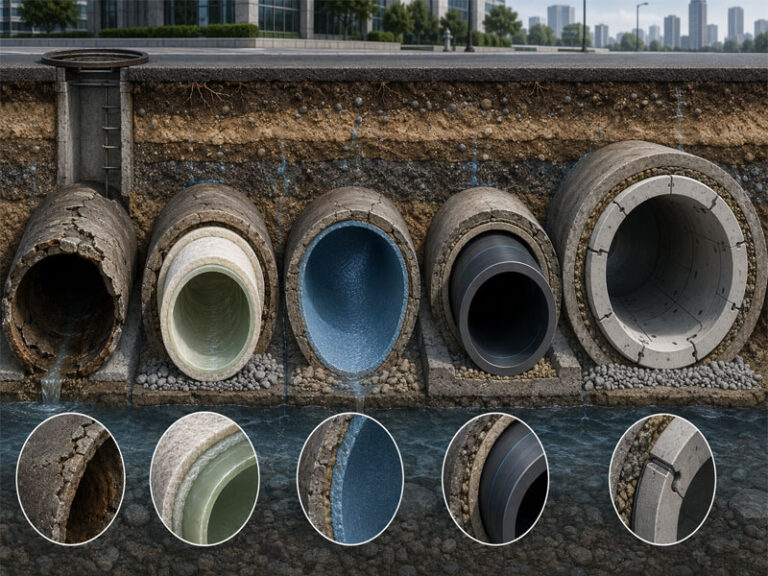
Best Materials for Trenchless Pipe Rehabilitation
The most widely used and effective materials for trenchless pipe rehabilitation are thermosetting resin systems—specifically epoxy, polyester, and vinyl ester—combined with reinforcement fabrics such as fiberglass or polyester felt. For most municipal sewer rehabilitation projects, polyester CIPP offers the best cost-to-performance balance, while epoxy CIPP is preferred for pipes requiring superior adhesion and chemical resistance. When diameter preservation is critical, modified polyurea spray linings provide structural reinforcement with minimal thickness loss. For large-diameter structural repairs, UHPC prefabricated linings deliver maximum strength and longevity.
| Материал | Лучшее приложение | Main Advantage |
|---|---|---|
| Epoxy CIPP | Residential/commercial pipes, potable water | Superior adhesion, low shrinkage |
| Polyester CIPP | Municipal sewer rehabilitation | Most cost-effective |
| Fiberglass CIPP | Large diameter pipelines (≥24 inches) | High structural strength |
| Polyurea Spray Lining | Concrete sewer repair, corrosion protection | Minimal thickness loss |
| HDPE Sliplining | Pipe replacement, pressure pipelines | Long service life (50+ years) |
| UHPC Prefabricated Lining | Large diameter structural repair | Maximum load-bearing capacity |
For most trenchless rehabilitation projects:
- Choose polyester CIPP for standard municipal gravity sewers.
- Choose epoxy CIPP for pipes with corrosion issues or where adhesion is critical.
- Choose polyurea spray lining when preserving internal diameter is the top priority.
- Choose UHPC segmental lining for large-diameter pipes requiring full structural independence.
What Is Trenchless Pipe Rehabilitation?
Бестраншейное восстановление труб is a no-dig method used to restore damaged underground pipelines without full excavation. Instead of replacing the entire pipe, rehabilitation methods create a new structural layer inside the existing pipe or install a new pipe through the original alignment.
This approach offers significant advantages over traditional open-cut replacement:
- Minimal surface disruption – no digging of roads, landscaping, or structures
- Faster project completion – days or weeks rather than months
- Lower environmental impact – reduced material waste and carbon emissions
- Сокращение затрат – eliminates restoration costs for pavement and landscaping
- Extended asset life – adds 50+ years of service life
Common trenchless rehabilitation technologies include:
- Футеровка труб с затвердевшей поверхностью (CIPP)
- Spray-applied coatings
- Sliplining
- Разрыв труб
- Spiral wound lining
- Segmental lining
Trenchless Pipe Rehabilitation Materials Comparison
| Material System | Прочность конструкции | Гибкость | Химическая стойкость | Diameter Preservation | Relative Cost |
|---|---|---|---|---|---|
| Polyester CIPP | ★★★★ | ★★★★ | ★★★ | Хорошо | Низкий |
| Epoxy CIPP | ★★★★★ | ★★★★ | ★★★★★ | Хорошо | Средний |
| Vinyl Ester CIPP | ★★★★★ | ★★★★ | ★★★★★ | Хорошо | Medium-High |
| Fiberglass CIPP | ★★★★★ | ★★★ | ★★★★★ | Хорошо | Medium-High |
| Polyurea Spray | Structural Enhancement ★★★★ (depends on formulation) | ★★★★★ | ★★★★★ | Превосходно | Средний |
| HDPE Sliplining | ★★★★★ | ★★★★★ | ★★★★ | Reduced | Средний |
| UHPC Segmental | ★★★★★ | ★★ | ★★★★★ | Reduced | Высокий |
Types of Trenchless Pipe Rehabilitation Methods and Materials
Understanding the full range of trenchless rehabilitation methods helps in selecting the right material for each application. The main methods include:
- Футеровка труб с затвердевшей поверхностью (CIPP) – creates a new structural pipe inside the host pipe using resin-saturated liners
- Spray-applied pipe lining – applies protective and structural coatings directly to the pipe interior
- Sliplining – inserts a new pipe (HDPE, PVC, or GRP) into the existing line with annular grouting
- Разрыв труб – fractures the existing pipe and pulls a new pipe into place
- Spiral wound lining – forms a new pipe from continuous PVC or HDPE strips wound inside the host pipe
- Segmental lining – assembles prefabricated sections (UHPC or GRP) inside large-diameter pipes
Each method has specific material requirements and is suited to different pipe conditions, diameters, and structural needs.
Cured-in-Place Pipe (CIPP) Materials
CIPP is one of the most widely adopted trenchless rehabilitation methods worldwide, especially for sewer rehabilitation. The method involves inserting a resin-saturated liner into the host pipe and curing it in place to form a structural new pipe.
Polyester Resin CIPP
Polyester resin is the most commonly used CIPP material, representing approximately 90% of CIPP applications depending on region and application requirements. This is due to its cost-effectiveness, rapid cure times, and compliance with ASTM F1216 requirements.
Преимущества:
- Lowest material cost among CIPP resins
- Fast curing (hot water or steam)
- Wide availability and proven track record
Ограничения:
- Lower chemical resistance compared to epoxy
- Higher styrene emissions during installation
- Moderate adhesion to host pipe surfaces
Лучшее для: Standard municipal gravity sewers, storm drains, and non-aggressive environments.
Epoxy Resin CIPP
Эпоксидная смола offers superior adhesion, low shrinkage during cure, and significantly lower odor and VOC emissions compared to polyester. Epoxies are the preferred choice for:
- Residential and commercial building drains where odor is a concern
- Corroded cast iron and concrete pipes where adhesion is critical
- Potable water applications with NSF/ANSI 61 approval
Преимущества:
- Excellent adhesion to various host pipe materials
- Low shrinkage and high strength
- Low odor and VOC emissions
Ограничения:
- Higher cost than polyester
- Longer cure times in some applications
- More sensitive to installation temperature
Лучшее для: Potable water lines, industrial pipes, residential drains, and pipes requiring strong adhesion.
Vinyl Ester Resin CIPP
Винилэфирная смола provides enhanced chemical and thermal resistance, bridging the gap between polyester and epoxy performance characteristics.
Преимущества:
- Superior chemical resistance (especially to acids and solvents)
- Higher temperature tolerance than polyester
- Better adhesion than polyester
Ограничения:
- Higher cost than polyester
- More complex handling requirements
Лучшее для: Industrial effluent lines, chemical plant piping, and high-temperature applications.
Felt vs. Fiberglass CIPP Liners
| Characteristic | Felt Liners | Fiberglass Liners |
|---|---|---|
| Material Composition | Non-woven polyester or blended fabric | Woven or stitched glass fiber fabric |
| Прочность конструкции | Lower modulus; thicker walls required | Higher stiffness-to-thickness ratio |
| Гибкость | Excellent; navigates bends and diameter changes | Limited; best for straight runs |
| Типичные области применения | 2–8 inch residential and building drains | Large-diameter municipal mains, culverts |
| Installation | Inversion or pull-in; multiple cure methods | Pull-in with UV or thermal cure preferred |
| Relative Cost | Lower material cost | Higher initial cost |
UV-CIPP Materials
UV-CIPP uses light-cured resin systems with fiberglass liners that cure in minutes rather than hours. This method employs styrene-free or low-styrene resin formulations that address environmental and health concerns.
Advantages documented in industry research:
- Faster cure times compared to hot water or steam-cured CIPP
- Reduced carbon emissions and environmental footprint
- Consistent quality through factory-controlled wet-out processes
- Applicable in sensitive locations where odor is a concern
Spray-Applied Pipe Lining (SAPL) Materials
Spray-applied linings are applied directly to the interior surface of the host pipe using specialized spray equipment. These materials create a seamless, corrosion-resistant barrier and, in some cases, provide structural reinforcement.
Modified Polyurea (MPU)
Modified polyurea has gained significant traction as a spray-applied pipe lining material. Laboratory studies and field evaluations have reported performance metrics that exceed traditional cementitious and epoxy alternatives:
- Толщина: 3–8 mm linings achieve structural reinforcement while preserving nearly all internal diameter
- Cracking load improvement: 61.7–145.7% increase over damaged unlined pipes
- Ultimate load improvement: Up to 162.2% increase
- Failure mode transformation: Changes from brittle fracture to ductile failure
- Hydrostatic pressure resistance: 1.23 MPa critical failure pressure for 3 mm linings on perforated defects
Преимущества:
- 100% solids, solvent-free – no volatile organic compounds
- Adjustable gel time – supports reliable multi-layer spraying
- Adaptability to wet substrates – superior to polyurethane coatings
- Chemical and biological corrosion resistance
Ограничения:
- Surface preparation is critical for proper bonding
- Primer may be required for optimal performance
- Best suited for larger-diameter applications (≥24 inches)
Лучшее для: Concrete sewer rehabilitation, storm drains, and pipes with hydrogen sulfide corrosion.
Spray-Applied Epoxy
Spray-applied epoxy linings provide excellent corrosion protection and are commonly used in smaller-diameter pipes where access prevents CIPP installation.
Лучшее для: Potable water lines, small-diameter pipes, and pipes requiring corrosion protection only.
CIPP vs Spray-Applied Lining: Which Is Better?
| Характеристика | Прокладка CIPP | Spray-Applied Lining |
|---|---|---|
| Installation Method | Liner insertion and cure | Direct spraying onto pipe surface |
| Типичная толщина | 3–12 mm (varies by design) | 2–8 mm |
| Diameter Loss | Moderate (liner wall thickness) | Minimal (thin coating) |
| Структурные возможности | Full structural (independent) | Semi-structural to structural |
| Primary Purpose | Structural renewal | Corrosion protection + structural enhancement |
| Best Pipe Diameter | 2–108+ inches | 24–180+ inches (optimal) |
| Surface Preparation | Moderate (cleaning required) | Critical (must be water-jet cleaned) |
| Cure Time | Hours (thermal/steam) to minutes (UV) | Minutes to hours |
| Relative Cost | Low to medium | Medium to high |
Conclusion: CIPP is generally preferred for structural rehabilitation where the host pipe has lost significant load-bearing capacity. Spray-applied polyurea is ideal when maintaining maximum internal diameter is critical and the host pipe retains some structural integrity.
CIPP vs Pipe Bursting: Which Rehabilitation Method Is Better?
| Характеристика | Прокладка CIPP | Разрыв трубы |
|---|---|---|
| Метод | Creates liner inside existing pipe | Breaks old pipe and replaces it |
| Excavation | Minimal (access pits only) | Minimal (insertion and reception pits) |
| Diameter Increase | No (liner reduces diameter slightly) | Possible (can upsize one or two sizes) |
| Structural Renewal | Yes (new structural liner) | Yes (entirely new pipe) |
| Лучшее для | Damaged but accessible pipes | Failed or collapsed pipes |
| Main Material | Resin-saturated liner (felt or fiberglass) | HDPE, PVC, or GRP pipe |
| Relative Cost | Ниже | Выше |
| Разрушение поверхности | Минимум | Moderate (larger pits required) |
| Время установки | 1-3 days typical | 2-5 days typical |
Conclusion: CIPP is preferred when the existing pipe can serve as a host and rehabilitation is feasible without removal. Pipe bursting is better when complete replacement is required, upsizing is desired, or the existing pipe is too severely damaged to host a liner.
Sliplining Materials
Sliplining involves inserting a new pipe into the existing host pipe and grouting the annular space. This method is suitable for both gravity and pressure pipelines.
HDPE Sliplining
HDPE (High-Density Polyethylene) is the most widely used sliplining material, offering flexibility, corrosion resistance, and a service life of 50 years or more, with some properly designed systems exceeding 100 years.
| Sliplining Material | Диапазон диаметров | Типичные области применения |
|---|---|---|
| HDPE | 4–63 inches | Gravity and pressure pipelines; close-fit systems |
| ПВХ | 4–63 inches | Gravity pipelines; spiral-wound systems |
| GRP | 24–160+ inches | Large-diameter sewers, culverts, storm drains |
| PP | 4–63 inches | Chemical resistance applications |
Advantages of HDPE:
- Exceptional durability and chemical resistance
- Flexible and resistant to seismic movement
- Suitable for pressure applications
- Can be installed via pipe bursting or sliplining
Ограничения:
- Reduced internal diameter due to annular grout space
- Требуются ямы для доступа с обеих сторон
- Joints require fusion welding
Spiral Wound Lining
Spiral wound lining creates a new pipe from a continuous PVC or HDPE strip wound inside the host pipe, forming a tongue-and-groove joint.
Applications and advantages:
- Non-circular rehabilitation – square or rectangular boxes and pipes
- Customizable profile to match irregular shapes
- 100% trenchless – no excavation required for access
- Often completed without full flow bypass
Ограничения:
- Reduced internal diameter
- Significant quality control requirements
- Less suitable for small-diameter pipes
Pipe Bursting Replacement Materials
Pipe bursting is a trenchless replacement method that fractures the existing pipe and pulls a new pipe into place. It is commonly used when the host pipe is severely deteriorated, collapsed, or has insufficient structural integrity for lining.
HDPE Pipe Bursting
HDPE is the most common replacement pipe material for pipe bursting because of its:
- Гибкость – allows navigation through bends and shifts
- Corrosion resistance – ideal for aggressive soil and wastewater conditions
- Fusion-welded joints – creates a continuous, leak-free pipe
- Long service life – 50+ years with proper installation, with some systems exceeding 100 years
- Slightly larger diameter capability – can upsize the pipe during replacement
HDPE is suitable for both gravity and pressure pipe bursting applications, including water mains, sewer lines, and gas pipelines.
PVC Pipe Bursting
ПВХ pipe bursting is suitable for:
- Gravity sewer replacement
- Lower pressure applications
- Projects where HDPE is not specified
PVC offers lower material cost but is less flexible than HDPE, limiting its use in curved alignments.
GRP Pipe Bursting
GRP (Glass-Reinforced Plastic) is used in pipe bursting when:
- Higher stiffness is required
- Chemical resistance is critical
- The application involves pressure pipelines
GRP offers excellent corrosion resistance and high structural strength but has lower flexibility compared to HDPE.
UHPC Prefabricated Structural Linings
For large-diameter pipelines where conventional lining methods would cause excessive flow capacity loss, prefabricated UHPC (Ultra-High Performance Concrete) segments offer a high-strength structural solution.
Recent full-scale testing of prefabricated UHPC lining pipes demonstrates exceptional mechanical performance:
- UHPC composition provides superior compressive and tensile properties
- Iron-based shape memory alloy (Fe-SMA) reinforcement can induce self-prestress
- Cracking load increased by 37.6% compared to non-prestressed pipes
- Load at 0.2 mm crack width increased by 19.3%
Лучшее для: Large-diameter sewer rehabilitation (≥48 inches), box culverts, and tunnels requiring full structural independence.
Material Cost, Lifespan, and Service Life Comparison
How Long Does Trenchless Pipe Rehabilitation Last?
The service life of trenchless rehabilitation depends on material selection, installation quality, and operating conditions. Typical service life expectations:
| Материал | Relative Cost (per linear foot) | Expected Service Life |
|---|---|---|
| Polyester CIPP | Низкий | 50+ лет |
| Epoxy CIPP | Средний | 50+ лет |
| Vinyl Ester CIPP | Medium-High | 50+ лет |
| Polyurea Spray | Medium-High | 30-50 лет |
| HDPE Sliplining | Средний | 50-100+ years |
| UHPC Segmental | Высокий | 75+ years |
Costs vary significantly based on pipe diameter, access, and installation conditions. Always request site-specific estimates.
What Factors Affect Trenchless Rehabilitation Cost?
The total cost of trenchless rehabilitation depends on multiple factors:
- Диаметр трубы – larger diameters require more material and specialized equipment
- Pipe length – longer runs increase material and labor costs
- Access conditions – limited access increases setup time and cost
- Existing pipe damage – severe damage may require more extensive preparation
- Material selection – epoxy and vinyl ester resins cost more than polyester
- Structural requirements – thicker liners cost more
- Flow bypass requirements – pumping during installation adds cost
- Site conditions – depth, soil type, and groundwater affect installation complexity
Applications by Industry
| Промышленность | Recommended Materials | Typical Pipe Types |
|---|---|---|
| Municipal Sewer | Polyester CIPP, HDPE | Gravity sewers, force mains |
| Industrial Wastewater | Vinyl Ester CIPP, Polyurea | Chemical effluent lines, process piping |
| Drinking Water | Epoxy CIPP (NSF/ANSI 61 approved) | Water mains, distribution lines |
| Stormwater Systems | Polyurea, GRP, UHPC | Storm drains, culverts, outfalls |
| Chemical Plants | Vinyl Ester CIPP, Polyurea | Acid waste lines, solvent piping |
| Tunnels & Large Structures | UHPC segments, GRP | Large-diameter tunnels, box culverts |
| Residential / Commercial | Epoxy CIPP, Polyester CIPP | Building drains, lateral lines |
How to Choose the Right Trenchless Rehabilitation Material
Use this decision framework for material selection:
Step 1: Assess Host Pipe Condition
- Conduct CCTV inspection to identify cracks, joint offsets, corrosion, deformation
- Determine if the pipe remains structurally sound, is partially deteriorated, or near collapse
Step 2: Define Structural Requirements
- Non-structural → spray-applied epoxy or polyurea
- Semi-structural → CIPP or spiral wound lining
- Structural → thick-wall CIPP, HDPE, or UHPC
Step 3: Evaluate Operating Environment
- Domestic sewage → polyester CIPP (cost-effective)
- Industrial/aggressive chemicals → vinyl ester CIPP or polyurea
- Hot water (>60°C) → vinyl ester or epoxy
- Pressure pipe → HDPE sliplining or structural CIPP
Step 4: Consider Diameter and Access
- <24 inches → CIPP, pipe bursting, or HDPE sliplining
- ≥24 inches → CIPP, polyurea spray, or UHPC segments
- Irregular shapes → spiral wound lining or spray-applied
Step 5: Verify Regulatory and Code Compliance
- Confirm ASTM, NASSCO, or local municipal specifications
- Verify potable water approvals (NSF/ANSI 61) for drinking water applications
Common Material Selection Mistakes
- Choosing polyester for chemical exposure – polyester has limited chemical resistance; vinyl ester or epoxy is required for aggressive environments
- Selecting CIPP without verifying adhesion – some host pipe materials (PVC) require special surface preparation
- Overlooking temperature limitations – polyester has lower temperature tolerance than epoxy or vinyl ester
- Not considering future access – smaller diameter from sliplining may complicate future maintenance
- Ignoring cure time requirements – UV-CIPP offers faster cure but may not be suitable for all pipe geometries
Часто задаваемые вопросы
What is the most common material used for CIPP lining?
Polyester resin is the most commonly used CIPP material because it provides a balance of cost, strength, and installation efficiency. It represents approximately 90% of CIPP applications depending on region and application requirements.
Is epoxy better than polyester for CIPP?
Epoxy provides superior adhesion and lower shrinkage, while polyester offers lower cost and faster installation. Choose epoxy for pipes requiring strong bonding (corroded cast iron) or potable water applications. Choose polyester for standard municipal sewers where cost is the primary factor.
What is the longest lasting trenchless pipe material?
HDPE and properly designed CIPP liners can provide service lives exceeding 50 years. UHPC segmental linings can exceed 75 years in large-diameter applications.
Can polyurea lining repair severely damaged pipes?
Polyurea is effective for corrosion protection and structural enhancement but may not replace fully structural liners in severely collapsed pipes. For near-collapse conditions, structural CIPP or UHPC linings are recommended.
What is the cheapest trenchless pipe rehabilitation method?
Polyester CIPP is generally the most cost-effective method for standard gravity sewers, offering the best balance of cost, durability, and installation efficiency.
How do I know which material is best for my pipe?
Conduct a thorough CCTV inspection, structural assessment, and chemical exposure analysis. Consider diameter, access constraints, and regulatory requirements. Consult a trenchless rehabilitation specialist for site-specific recommendations.
How long does CIPP pipe lining last?
Properly installed CIPP liners typically last 50 years or more, with many installations exceeding this benchmark when operating under normal conditions.
What is the difference between CIPP and pipe bursting?
CIPP creates a new liner inside the existing pipe without removing it, while pipe bursting fractures the existing pipe and replaces it with a new pipe of the same or larger diameter. CIPP preserves the existing pipe as a host, while pipe bursting achieves full replacement.
Can trenchless rehabilitation repair cracked pipes?
Yes. CIPP, spray-applied linings, and structural liners can rehabilitate cracked pipes depending on damage severity. Minor to moderate cracks can be addressed with CIPP or spray linings; severe fractures or collapsed sections typically require pipe bursting or full replacement.
Which pipe materials can be rehabilitated using CIPP?
CIPP can commonly rehabilitate clay, concrete, cast iron, steel, ductile iron, and some plastic pipelines when proper surface preparation is performed. Compatibility depends on adhesion and the specific resin system selected.
Does trenchless rehabilitation reduce pipe diameter?
Most lining systems slightly reduce internal diameter, but the reduction is typically minimal (3–12 mm for CIPP, 2–8 mm for spray-applied linings). Spray-applied coatings minimize diameter loss compared with traditional liners, making them preferred when hydraulic capacity preservation is critical.
Standards and Certifications
Trenchless rehabilitation materials commonly follow these industry standards:
- ASTM F1216 – Standard practice for rehabilitation of existing pipelines by CIPP
- ASTM F1743 – Standard practice for rehabilitation of existing pipelines by inversion CIPP
- ASTM F2019 – Standard practice for rehabilitation of existing pipelines by UV-cured CIPP
- NSF/ANSI 61 – Drinking water system components (potable water applications)
- NASSCO PACP – Pipeline assessment and certification program
- ISO 11296 – International standard for trenchless rehabilitation
Technical Review Information
This guide has been reviewed against the following technical criteria:
- ✓ Material compatibility analysis for common host pipe types
- ✓ Structural rehabilitation requirements per industry standards
- ✓ Chemical exposure evaluation for typical operating environments
- ✓ Industry standard verification (ASTM, NSF/ANSI, NASSCO)
- ✓ Installation and quality control best practices
Need Help Selecting a Rehabilitation Material?
Contact JSW engineers for a project-specific material recommendation based on pipe condition, diameter, and service environment. Our team provides:
- Site-specific material selection guidance
- Structural design and installation planning
- Turnkey rehabilitation services
- Quality verification and post-installation inspection
JSW: Your Partner in Trenchless Rehabilitation Solutions
At JSW, we bring over a decade of specialized expertise in trenchless pipeline rehabilitation and construction. Our comprehensive service portfolio includes CIPP lining, spray-applied polyurea systems, pipe bursting, and custom prefabricated lining solutions for municipal, industrial, and commercial infrastructure projects.
Our approach combines rigorous material science with field-proven installation practices:
- Material verification and selection – we match resin and liner systems to your specific host pipe condition and service environment
- In-house engineering support – structural design and installation planning for complex rehabilitation challenges
- Quality control protocols – CCTV inspection, cure monitoring, and post-installation verification
- Access to emerging technologies – including UV-CIPP and modified polyurea systems for demanding applications
Contact our technical team to discuss your pipeline rehabilitation needs. We provide site-specific material recommendations, project planning, and comprehensive installation services designed to extend asset life while minimizing operational disruption.




 English
  Arabic
  Russian
  Spanish
  French
  Vietnamese
  Polish
  Thai
Thai  Indonesian
  Turkish
  Portuguese