
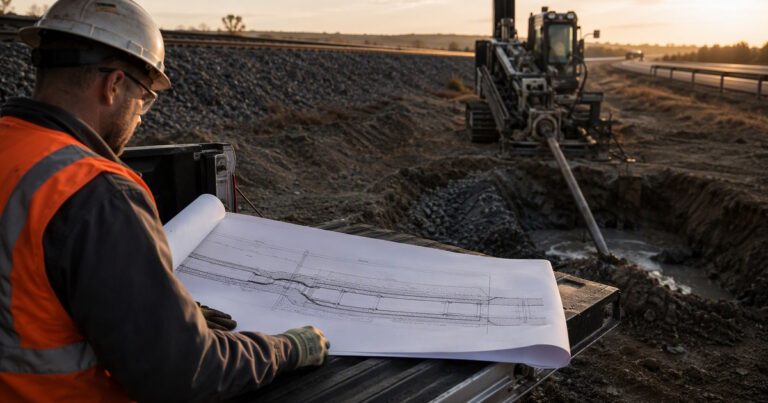
HDD casing design comes down to one question: is a product pipeline pulled bare through the reamed bore, or carried inside a separate, larger pipe that shields it from surface loads? A cased crossing runs the product pipe inside that protective pipe; an uncased crossing pulls the product pipe bare through the reamed bore. Which one applies is set by the crossing authority’s requirement, the settlement tolerance the track or pavement can accept, and the load case, not by preference. This guide defines carrier pipe and casing sleeve, sets out when a casing is required, compares load transfer and settlement, and works through the sizing checks.
What Is the Difference Between a Carrier Pipe and a Casing Sleeve?
Two installations share the word “casing”: a carrier pipe carries the product, and a sleeve protects it.
| Term | What it is | Installed as | Typical role |
|---|---|---|---|
| Carrier pipe | The pipeline that carries the product | The line itself | Conveys gas, oil, water or product in service |
| Casing sleeve | A larger pipe set around the carrier | Protective sleeve only | Shields the carrier from surface loads and allows later replacement |
| Casing pipe as the product | A pipe that carries product and is set by bore or jack | The line itself | Used where the pipe itself suits the load case |
| Casing insulator | A spacer and electrical break on the carrier | Accessory in the sleeve | Centres the carrier and separates it electrically |
In this guide, the carrier pipe is the product line, the casing sleeve is the separate protective pipe set around it, and a casing pipe that carries product itself while being set by bore or jack is named in full. Where the text says “casing” without a qualifier, it means the sleeve.
What Is HDD Casing Design, and When Does a Crossing Need a Casing?
HDD casing design answers one question first: does the crossing authority require the product line to be encased? A casing is needed where the authority’s rule applies, or where the load case or the owner’s settlement limit requires it. Railroad and highway owner requirements vary by jurisdiction and must be confirmed with the authority for the actual crossing.
The drivers behind a cased decision are consistent even where the rules differ. When a crossing is required to be cased, the driver is almost always one of three: the authority’s encasement rule for the crossing type, a settlement or stress limit the owner sets, or the need to keep the line replaceable without a new bore.
- Authority requirements: many railroads require a casing under live track, and some highway owners require a sleeve at defined crossings.
- Settlement tolerance: a track or pavement accepts only limited ground movement, and the owner sets how much.
- Future replacement without re-boring: a sleeve keeps open the option of pulling a new line through the crossing.
- Separation rules for gas: gas lines often carry their own casing sleeve rules in place of the general case.
An empty casing also needs its annulus treated: a vent at the high ends or a fill, and sealed ends.
How Do Load Transfer and Settlement Differ Between Cased and Uncased Crossings?
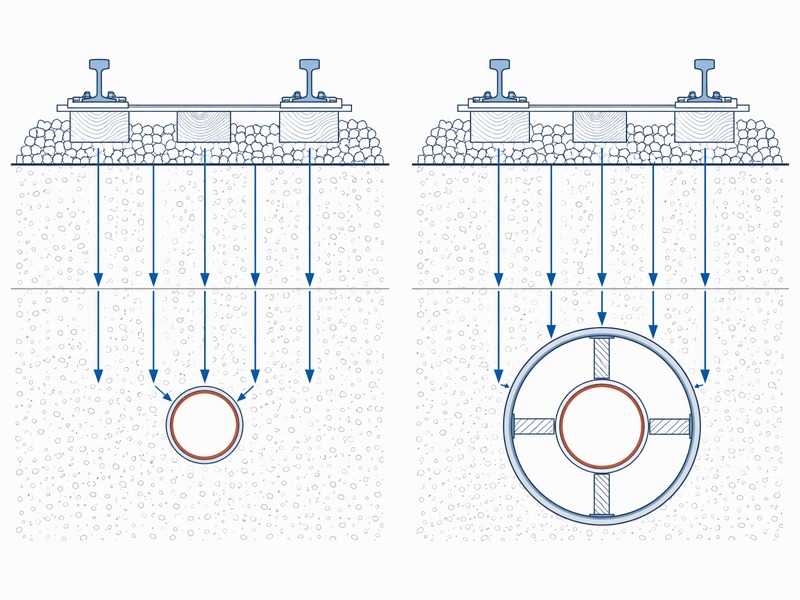
Under a road or a railroad, the governing difference between a cased and an uncased crossing is how the surface load reaches the carrier pipe, not only what the crossing costs. Before cost is discussed, the load path decides most of the engineering difference. A casing adds pipe, annulus treatment and venting to the crossing, while an uncased crossing avoids that scope but must still pass the stress check; in HDD casing design the order keeps the cost comparison honest.
- Uncased: the product pipe takes wheel and axle load through the soil, so the wall must resist that bending.
- Cased: the sleeve is meant to carry that load off the carrier, if it is stiff enough for the load case.
- Settlement (both): ground movement is assessed from the geotechnical profile; the casing only controls the load path.
For an uncased crossing, the usual design route is the crossing calculation method published by API for steel pipelines crossing railroads and highways, which applies an impact factor to the surface load and a stiffness factor for the pipe.
For a cased crossing, railroad practice limits the vertical deflection of a flexible steel casing to about 3 percent of the casing diameter plus 1/2 in, so no roadbed, track or traffic load reaches the carrier. The figure is a published limit for the loaded crossing case, and the edition in force still has to be confirmed.
The ground under a rail embankment or a highway can settle differentially along the crossing, and the carrier follows the sleeve only as far as the annulus allows. On crossings we have supported, the settlement tolerance was the owner’s number to give, not the designer’s to assume.
When Does the Requirement Point to Cased, Uncased or a Casing Sleeve?
For HDD casing design, the outcome turns on the authority’s encasement rule, the load case and whether the line must stay replaceable.
| Requirement or condition | Screened outcome | Reason |
|---|---|---|
| Line under a live main-line railroad track | Cased | Railroad guidelines commonly require a casing sleeve under track, with limited exceptions |
| Plastic line under a railroad | Cased | Plastic carrier material is usually excluded from the uncased allowances |
| Steel line where combined stress stays below a stated fraction of yield | Uncased, subject to approval | Casing may be omitted where the combined stress stays below the stated fraction of yield |
| Gas line meeting the owner’s uncased design criteria | Uncased, with a heavier wall | A heavier pipe wall in place of a casing is accepted where the criteria are met |
| Crossing installed by HDD under the railroad’s drilling clause | Uncased, subject to approval | Some railroad guidelines exempt HDD installations from the standard casing rule |
| Owner wants the line replaceable without a new bore | Casing sleeve | The sleeve keeps the crossing open for a future pull |
This screening is an input to project-specific design: in our design reviews it is run against the authority’s standard before the geometry is fixed, and a competent engineer and the crossing authority confirm it before installation.
How Do You Size a Casing? Diameter, Wall, Length and Vents
In HDD casing design, sizing has four inputs: the annular clearance the carrier needs for future removal, the authority’s minimum wall for the diameter and load case, the length that reaches beyond the loaded zone at each end, and the vent and seal arrangement. Each is a calculation input, not a default value, and the checks that bring them together are listed at the end of this section.
How Much Annular Clearance Should the Casing Leave?
The casing inside diameter must let the carrier be removed later without disturbing the casing, checked at the worst point along the line. Railroad practice commonly sets the inside diameter at least 2 in larger than the carrier outside diameter below 8 in, at least 3-1/4 in larger from 8 in to 16 in, and at least 4-1/2 in larger at 18 in and above where insulators are used. That annular clearance is a removal allowance rather than a comfort margin, and it also sets the bore size and the sleeve wall. These are published railroad clearance minimums used for the loaded crossing case; they are not site-measured values, and the edition in force at the time of design should be confirmed with the crossing authority.
How Is Wall Thickness Set Under Road and Rail Load?
Casing wall thickness is normally taken from the authority’s minimum table for the casing diameter and the load case, then checked for the crossing. Railroad guidelines publish a minimum wall thickness table for steel casing under standard rail loading, and state highway pipe casing specifications commonly set a minimum by diameter range, for example about 0.25 in for casing from 4 in to 24 in, about 0.375 in from 25 in to 42 in, and about 0.50 in from 43 in to 60 in. A casing installed without a protective coating or cathodic protection takes a heavier wall, and a typical specified minimum yield strength for crossing casing is 35,000 psi. We have seen casings specified on diameter alone, with the deflection and load checks left out of the submittal.
How Far Should the Casing Extend Beyond the Crossing?
The casing has to reach beyond the loaded zone so its ends stay accessible and the sleeve does not sit under the track or pavement. Railroad practice extends it a set distance beyond the toe of slope or beyond the ditch, measured at right angles to the track centreline. Where future track or a widened roadbed is planned, that must be allowed for in the length.
How Are the Vent Pipe and the Annulus Treated?
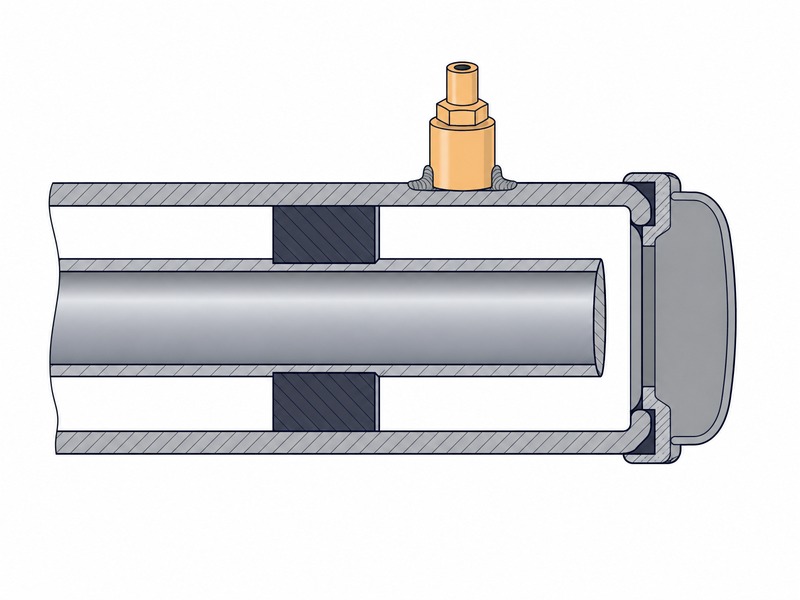
Where the annulus stays empty, a vent at the high ends lets it breathe and be monitored. Practice requires the hole cut through the casing to be at least half the vent pipe diameter before the fitting is welded over it, so the weld cannot close the passage. The ends are then sealed against soil and water, and the sleeve is kept electrically separate from the carrier by insulators and isolated test points. Where the owner prefers it, the annulus may instead be filled, which changes the venting and the future-removal allowance.
| Design check | Basis | What to confirm with the asset owner |
|---|---|---|
| Casing inside diameter against carrier outside diameter | Carrier removable without disturbing the casing | The minimum clearance the owner requires |
| Wall thickness | Authority minimum table plus the crossing load case | Which table, specification and edition applies |
| Casing length | Distance beyond the loaded zone at each end | Required extension and planned track or roadbed widening |
| Vent pipe sizing | Gas escape and leak monitoring | Number, size and location of vents, and any monitoring duty |
| Casing end seals | Keeping soil and water out of the sleeve | Seal type and inspection |
| Annulus fill | Owner preference and coating protection | Whether the space stays dry and vented, or is filled |
What Do Railroad and Highway Owners Require, and What Varies by Jurisdiction?
Railroad: under track, AREMA guidelines are the usual reference for when a casing is required and for the wall, deflection and extension limits; local law or a more stringent owner specification governs.
Highway: state DOT pipe casing specifications set the wall by diameter range, centring insulators and sealed ends for a road crossing; a national roadway owner may add to them.
Calculation: the API crossing calculation method for steel pipelines covers both cased and uncased crossings, and is commonly used to show either arrangement works for the live load. Where the geometry, soil or loading falls outside the published tables, the owner usually asks for a project-specific calculation.
Our field teams record the casing sizes, lengths and vent arrangements actually built, and those records feed the next design. In our design reviews, the crossings that are reworked late are the ones where the casing question was treated as a contractor detail after the authority had already taken a position. HDD casing design cannot be settled until the owner’s answer is in hand: railroad and highway owner requirements vary by jurisdiction and must be confirmed with the authority for the actual crossing, using the edition in force at the time of design.
| Authority / document | What it sets | Applies to |
|---|---|---|
| AREMA railroad guidelines | Whether a casing sleeve is required, the minimum wall table and the deflection limit | Railroad crossings under track |
| State DOT pipe casing specifications | Minimum wall by diameter range, insulators that centre the carrier, and sealed casing ends | Highway crossings and roadway owner specifications |
| FHWA-style highway practice | The highway documents behind the state specifications | Road crossings on the national network |
| API crossing calculation method | Cased and uncased stress verification under live load | Showing either arrangement works |
Часто задаваемые вопросы
Is a casing required for every HDD road or railroad crossing?
Not for every crossing: whether a casing is required depends on the crossing authority and the load case, not on the method. Many railroads require a casing under live track, while some allow an uncased crossing on secondary track, where the calculated stress stays within a limit, on certain gas pipelines, or on HDD installations where the railroad’s own clause applies. The requirement must be confirmed with the road or railroad owner for the actual crossing.
What is the difference between a carrier pipe and a casing sleeve?
The carrier pipe is the product line; the sleeve is a separate protective pipe set around it. The carrier conveys gas, oil or water in service, while the sleeve shields it from surface loads and keeps open the option of replacing the line without re-boring. Some crossings use a casing pipe that carries product itself, which is a different case with a different wall basis.
How much annular clearance does a casing need?
Enough that the carrier can be withdrawn later without disturbing the casing. Railroad practice commonly sets the casing inside diameter at least 2 in larger than the carrier outside diameter below 8 in, at least 3-1/4 in from 8 in to 16 in, and at least 4-1/2 in at 18 in and above when insulators are used. The controlling test is future removal, not installation alone.
Why does a casing need a vent pipe?
An empty casing can trap gas or water, so a vent at the high ends lets the annulus breathe and be monitored. Venting also lets an operator detect a carrier leak before it reaches the surface. Practice requires the hole cut through the casing to be at least half the vent pipe diameter before the fitting is welded over it, and the casing ends are sealed against soil and water.
Does a casing protect the crossing from settlement and surface loads?
A casing can carry the road or rail load and keep it off the carrier, but only if it is sized and stiff enough to do so. A flexible steel casing is normally limited to a vertical deflection of about 3 percent of its diameter plus 1/2 in, so that no load from the roadbed, track or traffic reaches the carrier. Settlement of the ground itself is a separate check. The casing controls the load path, while ground movement is assessed from the geotechnical profile along the crossing.
Who confirms the casing requirements for the actual crossing?
The road or railroad owner, together with a competent engineer who has designed the crossing. Casing requirements differ by jurisdiction, so the authority’s current standard, the load case and the crossing geometry must be confirmed before a casing is ordered. Figures quoted in this guide are inputs to that confirmation, not a substitute for it.
Key Takeaways
- HDD casing design comes down to three outcomes first: an uncased crossing where the load case allows it, a cased crossing where the authority requires it, or a casing sleeve where the owner wants the line replaceable without a new bore.
- Definitions decide the rest: a carrier pipe is the product line, and a sleeve only protects it.
- Load transfer, not cost, is the engineering difference between cased and uncased crossings.
- Sizing hinges on the annular clearance needed for removal, the authority’s wall table, the casing length, and the vent and seal arrangement.
- Wall, clearance and deflection figures are authority inputs, to be confirmed by a competent engineer.
How JSW Supports HDD Casing Design and Cased Crossings
JSW is a pipeline engineering and construction company that plans and builds road, rail and watercourse crossings with its own engineering team, crews and equipment. Our scope covers HDD crossing services и бестраншейные технологии for road, railroad and watercourse crossings. It extends to automatic pipeline welding, услуги по прокладке трубопроводов и pipeline inspection service, so a casing or sleeve requirement under a highway or railroad is met by one team.
Because the same team carries out the review and then builds the crossing, our HDD casing design basis reflects what the equipment and crews can achieve. We track the authority’s requirement against the load case and hand over the records an integrity team will need later. If the authority’s position is still open, we say which documents we need and which checks we will run before a casing size is fixed. Where an uncased crossing is genuinely acceptable to the owner, we say so rather than defaulting to a sleeve.
- Комплексная доставка: crossing review, casing sizing, pipe string fabrication and pullback sit inside one scope, so the design and the construction agree.
- Authority-facing documentation: the casing requirement, load case and sizing basis are recorded against the owner’s specification for approval.
- Ценообразование с учетом риска: casing, annulus treatment and vent costs are priced openly rather than absorbed into a lump sum.
- Crossing experience: road, rail and watercourse crossings, including vented and sealed casing arrangements.
Not sure whether your road or railroad crossing needs a casing or a sleeve? Send your crossing drawings, the carrier and casing diameters, the crossing extents, the authority’s requirement and the design load case for a free technical review. Our engineers respond with a cased or uncased recommendation, the checks behind it, and a budget range.





































 English
  Arabic
  Russian
  Spanish
  French
  Vietnamese
  Polish
  Thai
Thai  Indonesian
  Turkish
  Portuguese