
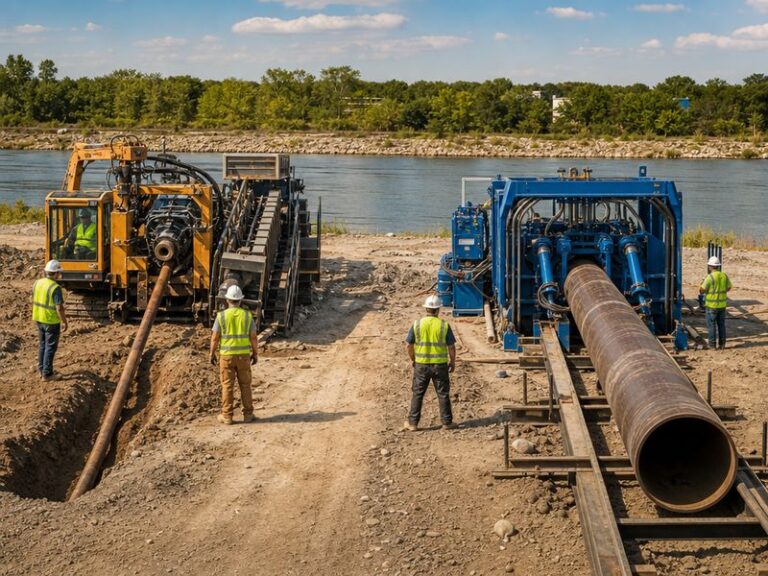
Direct Pipe is the lower-risk trenchless technology when hydraulic fracture, shallow cover or unstable ground dominates the hazard profile, while horizontal directional drilling (HDD) remains the lower-risk and lower-cost choice in stable soils for long, small-diameter bores — no single method is universally safer.
This guide explains how each method works, why fluid-pressure risk differs so sharply between them, where real projects have switched methods, how the costs compare, and how to run a site-specific risk assessment before you commit. It draws on published installation records, regulatory guidance and our field experience supporting pipeline crossings across utility, oil and gas and infrastructure sectors.
Key Takeaways
- Hydraulic fracture (frac-out) is the decisive risk difference: HDD circulates pressurized drilling fluid through an open bore, while the closed-loop method keeps fluid pressure near hydrostatic.
- The closed-loop method suits welded steel pipe from 28 to 60 inches down to about 100 ft (≈30 m, 3 bar); HDD has no standard depth limit and excels below 28 inches.
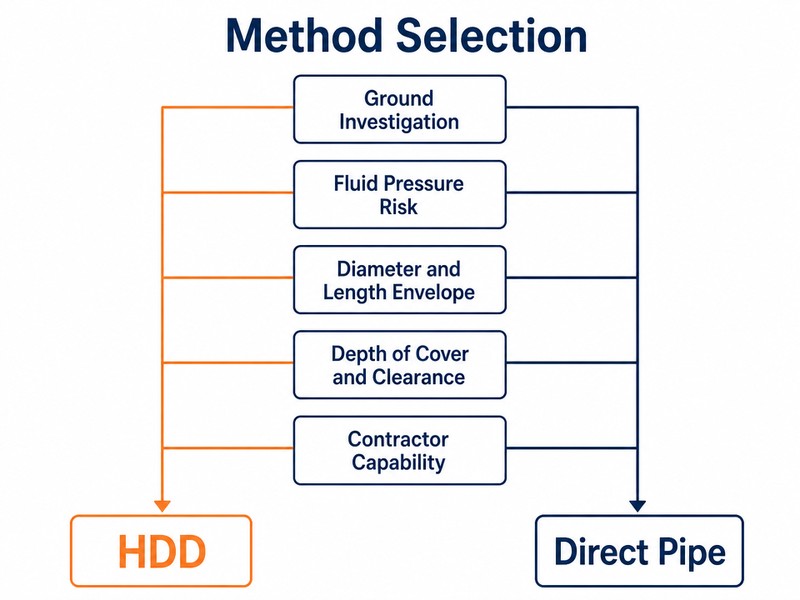
- Choose with a five-step assessment: ground truth, fluid-pressure risk, diameter and length envelope, cover and clearance, contractor capability.
What Is Horizontal Directional Drilling (HDD)?
Horizontal directional drilling (HDD) is a steerable trenchless method that installs pipelines, conduits and cables along a controlled underground arc without open-cut excavation. The drill rig advances a pilot hole with a steerable downhole assembly, reams the bore to final diameter in one or more passes, then pulls the product pipe back through in a single continuous operation.
HDD is the most widely used method for river crossings, road crossings and utility installations because it is fast, flexible and works in a broad range of soils and soft rock. The global horizontal directional drilling market was valued at roughly USD 9.2 billion in 2025 and is projected to approach USD 25 billion by 2034, a compound annual growth rate of about 11.7 percent, according to industry research published in 2025 and 2026.
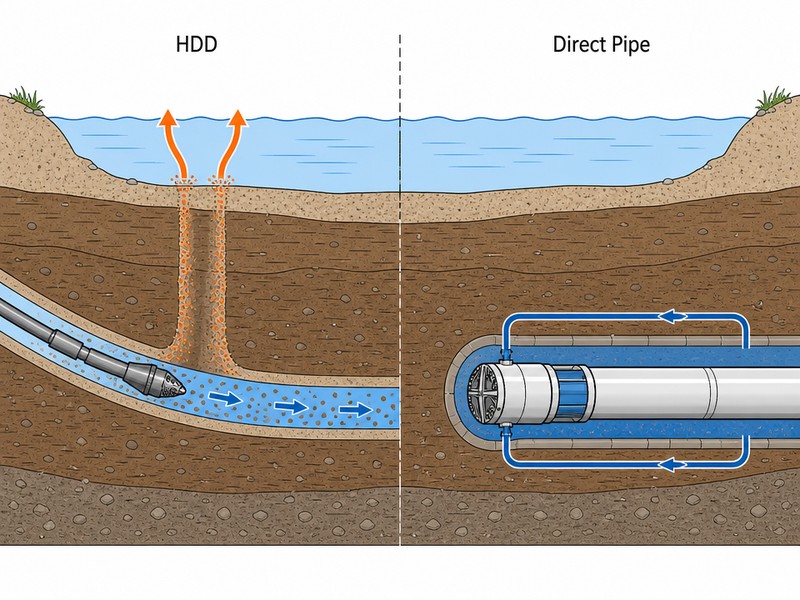
The defining characteristic of HDD is that the bore is open only while fluid holds it open. Drilling fluid is pumped down the drill string under pressure to cool the tool, carry cuttings and stabilize the hole, and that pressure is one of the method’s central risk controls and its central risk source, as the next section explains.
What Is Direct Pipe?
Direct Pipe is a single-pass trenchless method that combines microtunneling with a steerable, HDD-style curved bore profile. A modified microtunnel boring machine (MTBM) excavates the hole while a hydraulic Pipe Thruster simultaneously pushes the welded steel pipe string forward, so the finished pipe is installed in one continuous operation rather than in a separate pullback stage. The closed loop this creates — fluid circulated at near-hydrostatic pressure — is why we also refer to it as the “closed-loop method” throughout this guide.
The method was developed in the early 2000s and first installed commercially in 2007, when a 48-inch casing was driven under the Rhine River. Installations now number roughly 200 worldwide, with more than 50 in North America, and the method holds the record for the longest single pipe string ever installed: 1,496.48 meters at Whangaparaoa, New Zealand, completed in 2018.
Because the MTBM continuously supports the excavated face and the pipe is thrust rather than pulled, the bore never stands open. Navigation is handled by a gyrocompass system inside the machine, which eliminates the walkover or wireline survey errors that complicate long HDD bores.
Why Hydraulic Fracture Is the Decisive Risk Difference
Hydraulic fracture, usually called frac-out, is the dominant environmental and safety risk in HDD, and it is the single biggest reason owners choose the closed-loop method instead. Frac-out happens when fluid pressure inside the bore exceeds the strength of the surrounding ground, fracturing the formation so that fluid escapes to the surface, into a waterway or along the path of least resistance.
In HDD, the drill string is open to the surface at the entry point, and fluid pressure must overcome cuttings transport and annular friction; in weak or shallow ground that pressure can exceed formation strength.
The closed-loop design changes the risk equation: fluid is circulated from the machine to the surface at pressures only slightly above hydrostatic, so the formation is never asked to contain high-pressure fluid. In our risk reviews, this single difference removes most fluid-escape scenarios entirely.
Regulators have noticed. The U.S. Army Corps of Engineers, in its USACE engineering publications on levee crossings, requires that HDD penetrate a competent cohesionless layer beneath the levee; where that layer cannot be achieved, the guidance identifies Direct Pipe as the only viable alternative.
Our experience on waterway and levee projects matches that rule: whenever shallow cover or weak ground made HDD fluid escape likely, the closed-loop method was the one that let the crossing proceed at all.
HDD vs. Direct Pipe: Side-by-Side Risk Comparison
The table below summarizes the risk profile of each method across the factors that decide real projects. Read it as a decision aid, not a verdict: the lower-risk method changes with site conditions.
| Risk Factor | HDD | Прямая труба |
|---|---|---|
| Hydraulic fracture (frac-out) | Primary risk; fluid under pressure can fracture weak ground | Minimal; fluid pressure stays near hydrostatic in a closed loop |
| Bore stability | Hole stands open only during drilling; collapse risk in unstable ground | Face continuously supported by the MTBM; no open bore |
| Coarse gravel and cobbles | High wear, steering loss and stuck-pipe risk | Can ingest boulders up to about one-third of the face diameter |
| Depth of cover | Works at deep cover with no standard limit | Shallow cover works well; standard limit about 100 ft (≈30 m, 3 bar) unless machine seals are modified |
| Bore length | Long proven distances in competent ground | World record 1,496.48 m; long but shorter than HDD extremes |
| Диапазон диаметров | Very small to very large; excels below 28 inches | Typical welded steel pipe envelope of 28 to 60 inches |
| Drilling fluid management | Large volumes; recycling and containment are major cost and risk items | Closed-loop circulation; lower volumes, simpler containment |
| Navigation accuracy | Walkover or wireline systems; survey error grows with length | Gyrocompass inside the machine; tight control in congested alignments |
| Utility conflicts | Clearance managed manually along an open hole | Continuous support and guidance allow closer approach to existing lines |
| Unit cost in favorable ground | Lower; the most economical method in stable soil | Higher; more equipment and thrusting per meter |
| Unit cost in difficult ground | Escalates fast; failures consume contingency | Predictable; often cheaper than a failed HDD attempt |
When Is the Closed-Loop Method the Lower-Risk Choice?
The closed-loop method is the lower-risk choice when the dominant hazard is ground-related: hydraulic fracture, low cover, coarse soils or congested alignments near existing pipelines. In those conditions, an HDD program spends its budget on containment, mitigation and recovery; the closed-loop method spends it on controlled installation.
- Levee and waterway crossings where a frac-out is unacceptable.
- Shallow crossings under roads, railways and canals with low depth of cover.
- Coarse gravel, cobble or heterogeneous ground where reamers lose steering.
- Congested alignments running close to existing pipelines and utilities.
Polish projects illustrate the pattern. In 2016, two natural gas pipelines under fish ponds near Czeszow and Wierzchowice were installed by the closed-loop method in sticky clay: the 700 m line was finished in 13 working days and the 464 m line in 16, with a best daily progress of 147 meters, using a gyrocompass-guided machine and a 500-tonne Pipe Thruster. In conditions like those, an HDD attempt would have risked fluid loss into the ponds and weeks of lost schedule.
The New Zealand record installation shows the same logic at scale: 1,496.48 meters of sea outfall in a single string at Whangaparaoa, driven by a 750-tonne Pipe Thruster.
The wider damage statistics support the caution. The Common Ground Alliance’s 2026 damage report estimated that damage to buried utilities costs the United States economy about USD 83.2 billion per year — damage that is largely avoidable when crossing methods match the ground. In our assessment, the closed-loop method is rarely the wrong answer when you are crossing water, crossing a levee, or threading between live utilities at shallow depth.
When Is HDD the Lower-Risk Choice?
HDD is the lower-risk choice in stable, cohesive ground with adequate cover, where the risk of fluid escape is low and the bore length or diameter favors the method’s economics. Horizontal directional drilling delivers a safer and cheaper outcome for long crossings in competent soil or soft rock, and for diameters below the 28-inch threshold of the closed-loop method.
- Long crossings in competent ground where HDD distances are proven.
- Small-diameter bores below 28 inches.
- Deep alignments beyond the standard depth limit of the closed-loop method.
- Projects where unit cost in favorable ground is the deciding factor.
The closed-loop method is not a panacea either. Its standard depth limit is about 100 ft (≈30 m, 3 bar) unless the machine seals are upgraded, it is built for welded steel pipe rather than flexible products, and it is generally not suited to gravity systems. In favorable HDD ground, the closed-loop method’s equipment footprint and thrusting cost make it more expensive per meter — and the risk difference that matters is simply not present. That is precisely when HDD carries the lower risk and the lower cost.
The honest rule we apply in method reviews: if a geotechnical investigation shows stable soils, if cover is sufficient, and if the risk of fluid escape is low, HDD carries lower risk and lower cost. Reserve it for the conditions where HDD’s failure modes are actually likely.
How Do the Two Methods’ Installation Costs Compare?
Cost comparison only makes sense against a defined crossing, because both methods are dominated by site conditions and machine time. In favorable HDD ground, HDD is typically the lower-cost method; the closed-loop method carries a premium for its larger equipment spread and continuous thrusting.
In difficult ground, the order reverses. Our bid reviews on gravel, low-cover and waterway crossings have repeatedly found that a higher unit price is still cheaper than an HDD program that fails mid-bore and consumes its contingency on fluid control, stuck-pipe recovery and restoration.
| Сценарий | HDD | Прямая труба |
|---|---|---|
| Favorable ground (stable soil, adequate cover) | Typically lower total cost | Premium from larger equipment spread and continuous thrusting |
| Difficult ground (gravel, low cover, waterway) | Low unit rate, but failures consume contingency | Predictable total cost; often cheaper than a failed HDD attempt |
| Сценарий | HDD | Прямая труба |
|---|---|---|
| Favorable ground (stable soil, adequate cover) | Typically lower total cost | Premium from larger equipment spread and continuous thrusting |
| Difficult ground (gravel, low cover, waterway) | Low unit rate, but failures consume contingency | Predictable total cost; often cheaper than a failed HDD attempt |
When comparing bids, ask for itemized pricing on:
- Drilling fluid handling and disposal
- Thrust and excavation time
- Contingency and restoration
Judge the two methods on total installed cost including failure risk, not on unit rate alone.
Weighing HDD vs. Direct Pipe for a specific crossing? Our engineering team can turn your geotechnical report into a scoped cost comparison — the details are at the end of this guide.
How to Choose the Lower-Risk Method: Five-Step Assessment
We use this five-step framework when owners ask us to recommend a crossing method. Each step narrows the decision, and each one is verifiable in writing.
If you prefer, our engineering team can run this five-step assessment for your site and document the reasoning.
1. Verify the Ground Truth
Conduct a geotechnical investigation and pothole or vacuum-excavate every utility crossing along the proposed arc. The most common cause of method mis-selection is a soil model that does not match what the machines actually find.
2. Quantify HDD Frac-Out Potential
Compare expected fluid pressure against formation strength along the entire profile, especially under waterways and shallow cover. If the safety margin is thin, the closed-loop method removes the hazard rather than managing it.
3. Check the Diameter and Length Envelope
Confirm the product pipe size and bore length against each method’s proven limits. Below 28 inches, HDD is usually the only realistic option; within the 28 to 60-inch envelope and moderate lengths, both methods are viable and the ground decides.
4. Assess Cover and Clearance
Measure depth of cover against the roughly 100 ft (≈30 m, 3 bar) standard limit of the closed-loop method, and against the utility clearance required along the arc. Shallow, congested alignments favor the closed-loop method; deep, open alignments favor HDD.
5. Verify Contractor Capability
Confirm the contractor has the rig or MTBM capacity, a gyro or wireline guidance system matched to the bore, a written drilling fluid plan and records from comparable crossings. Capability gaps convert a sound method choice into a failed project.
HDD vs. Direct Pipe FAQ
Can one method replace the other?
No. The closed-loop method replaces HDD where ground-related risk is dominant, but HDD remains the better method for long bores, small diameters and favorable soils. The methods complement each other, and a mature contractor should be able to offer both. Where ground-related risk is dominant, the closed-loop method removes most fluid-escape scenarios entirely — that is the core of its risk advantage.
Which method is cheaper?
In stable ground, HDD is cheaper. In coarse, shallow or waterway conditions where fluid escape is likely, the closed-loop method’s predictable cost is often lower than a failed or heavily mitigated HDD program. Our bid reviews on gravel, low-cover and waterway crossings have repeatedly found that a higher unit price still beats an HDD program that fails mid-bore and burns its contingency.
What depth limits apply to each method?
Standard installations of the closed-loop method work to roughly 100 ft (≈30 m, 3 bar) unless the machine seals are modified for deeper service. HDD has no comparable standard limit and is the better choice for deep crossings. Below about 100 ft (≈30 m, 3 bar), HDD’s economics and proven record improve relative to the closed-loop method.
What pipe diameters can be installed?
The closed-loop method typically installs welded steel pipe from 28 to 60 inches. Diameters below 28 inches are possible with specialized systems but remain rare, which is why small-diameter bores stay with HDD. Within the 28 to 60-inch envelope and moderate lengths, both methods are viable and the ground decides.
How many Direct Pipe trenchless installations exist worldwide?
Roughly 200 installations worldwide, more than 50 of them in North America, since the first commercial installation under the Rhine River in 2007. The longest single string installed is 1,496.48 m at Whangaparaoa, New Zealand (2018), driven by a 750-tonne Pipe Thruster.
How JSW Supports HDD and Pipeline Projects
JSW is a pipeline engineering and construction partner that supports owners and contractors across the full lifecycle of trenchless crossings. We provide pipeline construction services, trenchless pipeline repair technology and pipeline maintenance services, alongside the specialized capabilities crossings depend on: pipeline automatic welding technology, pipeline cold bending, pipeline hot tapping and plugging services, и microtunneling support. Our fabrication and tooling layer includes pipeline hot tapping equipment, pipeline plugging pigs and pipeline cutting machines used to prepare and join pipe strings on the entry spread.
What distinguishes our support is integrated risk management:
- Data-driven method selection — grounded in geotechnical data and fluid-pressure risk assessment, not a sales pitch for one method.
- Full-chain integration — bore planning, pipe string fabrication and welding, cold bending, pullback and restoration in one delivery.
- Transparent engineering data — daily drilling records, drilling fluid logs and as-builts that stand up to audit.
- Explicit risk pricing — itemized contingencies for fluid handling, restoration and recovery, no hidden change orders.
- International field experience — utility, oil and gas and infrastructure crossings across multiple continents.
Our bore planning accounts for pipe string fabrication and welding, drilling fluid plans that respect environmental limits, and restoration that returns the site to a defensible condition. If you are weighing HDD vs. Direct Pipe for an upcoming crossing, contact our engineering team with your pipe diameter, length, geotechnical report and crossing type, and we will provide a technical risk review and a scoped proposal within five working days.
Not sure which method fits your ground?
Our engineers will review your geotechnical data and document why one method beats the other for your crossing — free technical risk review within five working days. Reach us via our contact form.





































 English
  Arabic
  Russian
  Spanish
  French
  Vietnamese
  Polish
  Thai
Thai  Indonesian
  Turkish
  Portuguese