
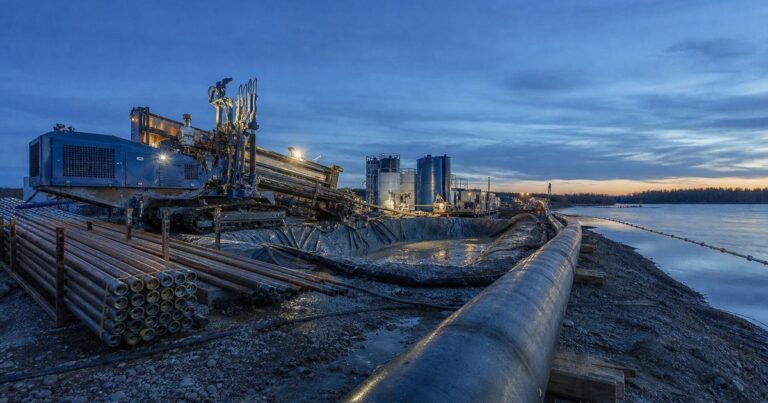
How long does horizontal directional drilling take? Plan on one to three days for a short utility bore, one to three weeks for a mid-size road or rail crossing and four to twelve weeks or more for a large river crossing. Those ranges cover the whole sequence, from mobilisation and pit preparation through rig-up, pilot hole, at least one reaming pass, pullback and restoration. Pullback is rarely the longest item. The pilot hole and the number and size of the reaming passes usually decide the calendar.
A crossing’s schedule is set by the phases that consume time, the rate behind each, the fluid budget that governs reaming and a worked estimating method that holds up in a bid review. Timelines for other trenchless methods, and productivity rates grouped by project type, are separate questions treated on their own pages.
The Phases That Actually Consume an HDD Schedule
How long does horizontal directional drilling take? It is the sum of a short list of activities with different rates and different constraints, and splitting those activities out is what makes an estimate defensible, because each line can then be challenged with a rate instead of a feeling.
The sequence itself is settled: site preparation, then the pilot hole, then one or more reaming passes, then pullback, with restoration afterwards. ASCE Manual of Practice 108, ASTM F1962 and the NASTT HDD Good Practices Guidelines all describe that order. What changes is how the elapsed time divides among the phases.
- Mobilisation: moving the rig, mud plant, tooling and support equipment to site, and establishing access.
- Site and pit preparation: entry and exit pits, fluid containment and mixing, spoil handling and traffic control.
- Rig-up: setting the rig on the design entry angle, anchoring, commissioning guidance and pressure-testing the fluid circuit.
- Pilot hole: the guided first pass, drilled at the highest advance rate among trenchless new-installation methods.
- Reaming passes: one or more enlargement passes, each needing a full fluid volume per rod over the whole length.
- Pullback: installing the product pipe, typically at about 1 to 3 m/min.
- Restoration: demobilisation, surface reinstatement, tie-in and verification.
| Phase | Typical share of schedule | Key driver |
|---|---|---|
| Mobilisation | About 5-10% | Travel distance, access, rig size, permits |
| Site and pit preparation | About 10-20% | Pit size, fluid containment, spoil handling |
| Rig-up | About 5-10% | Entry angle, anchoring, guidance setup |
| Pilot hole | About 20-30% | Ground conditions, steering corrections, obstructions |
| Reaming passes | About 25-40% | Pass count, reamer size, fluid per rod against pump output |
| Pullback | About 5-15% | Pipe stress limit, buoyancy control, pump output |
| Restoration | About 5-10% | Surface reinstatement, tie-in and inspection |
The phase shares in Table 1 are a planning starting point from typical crossing experience, not measured data from one project. Use them to test a contractor’s programme, then replace them with committed rates.
How Long Does Horizontal Directional Drilling Take? Ranges by Crossing Class
Crossing class is shorthand for the variables that shape HDD crossing duration: bore length, product diameter, ground conditions and the number of reaming passes the hole needs. Typical HDD crossing duration by class is more useful than a single average, because the spread inside each class is driven by the same few variables.
| Crossing class | Typical length and product size | Typical HDD crossing duration | What dominates |
|---|---|---|---|
| Short utility bore | Up to about 300 ft (90 m); 2-8 in pipe | 1-3 days | Mobilisation and pit preparation can match the drilling time |
| Mid-size road or rail crossing | About 300-1,200 ft (90-370 m); 8-24 in pipe | 1-3 weeks | Reaming passes and fluid handling; permit and access windows |
| Large river crossing | About 1,200-6,000 ft and above (370-1,800 m plus); 16-48 in pipe | 4-12 weeks or more | Multiple reaming passes, fluid volume per rod, continuous operation, weather |
A short utility bore can be finished inside a long day of drilling.
Applies to the full crossing, including permitting, mobilisation and restoration: a one-day duration holds only on a short bore in stable ground with good access. When an owner asks about HDD crossing time by length alone, a large river crossing multiplies length, diameter and passes together, so weeks of elapsed time are normal. Length sets the number of rods but not the number of reaming passes; every additional pass adds a full-length traverse and another fluid budget.

Why Is the Pilot Hole the Least Predictable Phase of an HDD Crossing?
The pilot hole is where the crossing is steered, and also the fastest part of the work per unit of length. Comparative trenchless studies, including the US DOT ROSAP decision-support work, place HDD at the highest pilot-hole advance rate among new-installation methods, while also recording that the pilot hole remains the least predictable phase, because progress depends on what the bit meets.
Entry and exit angles are usually designed in the 8-15 degree band, with guidance often landing at about 8-12 degrees; shallower angles lengthen the whole crossing.
- Ground transitions: leaving clay for gravel or fractured rock changes advance rate within metres.
- Steering corrections: each correction slows penetration and adds survey stops.
- Buried obstructions: unknown utilities, old foundations and boulders force a new profile.
Our field teams record progress by rod with a note on every correction, so HDD pilot hole duration can be traced to a cause when a crossing falls behind programme.
How Much of the Schedule Do Reaming Passes Take on a Large Crossing?
Reaming is where most of the elapsed time sits on a large crossing. The reamer is typically about 1.5 times product outside diameter up to 9 in, and about 1.3 times at 10 in and above, while broader good practice is often quoted as a reamed hole of about 1.2-1.5 times product OD. Polyethylene enlargement is commonly held in the same 1.3-1.5 times band.
The geometry explains the cost: fluid volume per unit of length scales with the area of the reamed hole rather than its diameter, so a modest increase in reamer size produces a much larger increase in volume. Enlargement is therefore stepped, and every stage is a full-length traverse.
- Number of stages: small bores may need one pass; large river crossings often step up through several.
- Rig torque and pump capacity: larger reamers demand more of both, and both are finite on a given rig.
- Fluid volume per rod: the practical constraint on reaming rate, covered below.
- Cuttings removal: fluid that cannot carry cuttings out slows the pass and degrades the hole.
We have seen a programme lose a day per pass because the hole was enlarged in steps too large for the pump to clean.
HDD Pullback Time: What 1-3 m/min Really Means for the Calendar
HDD pullback time is short compared with reaming. Pullback speed is typically on the order of 1-3 m/min, governed by the allowable stress in the product pipe, buoyancy control and the rig pump output needed to keep the hole lubricated and supported during the pull.
The arithmetic for HDD pullback time is easy to run. A 300 m crossing pulled at 1-3 m/min needs roughly 100 to 300 minutes of continuous pulling, about one and a half to five hours. Drag, curvature and buoyancy control push a long or large-diameter installation toward the slow end of that band.
- Buoyancy control: a flooded or weighted string changes drag and the load at the rig.
- Coating protection: rollers and slings cost time but prevent a far longer repair.
On crossings we have supported, HDD pullback time has been the shortest phase of the programme and the one most often stretched to recover a lost day. Pulling beyond the stress limit is how coating damage enters the project.
How Do You Calculate Fluid Volume Per Rod for Each Reaming Pass?
For a given reamed diameter, fluid volume per rod can be calculated before mobilisation, and dividing it by the rig pump output gives the minutes per rod, which is the honest reaming rate.
In the published worked example used by equipment makers, a 300 ft bore in sandy clay with 4 in product pipe and a 6 in reamer is pumped at 25 gpm. The factor is 1.47 gal/ft and the soil safety factor is 3: about 44 gal per 10 ft rod, about 1,320 gal for the crossing and roughly 1.8 minutes per rod.
| Шаг | Input | Value in the published example |
|---|---|---|
| Hole-volume factor | Per-foot factor for the reamed hole | 1.47 gal/ft |
| Soil safety factor | Allowance for losses and cuttings loading | 3 |
| Fluid per rod | 1.47 gal/ft × 10 ft × 3 | About 44 gal per 10 ft rod |
| Total volume | 44 gal × 30 rods (300 ft) | About 1,320 gal |
| Pumping time | 1,320 gal ÷ 25 gpm | About 53 minutes |
| Minutes per rod | 44 gal ÷ 25 gpm | About 1.8 minutes |
The fluid-volume method matters more than any single factor value: recalculate the per-foot factor for the actual reamed diameter before using it, then divide by the pump output the rig will deliver.
Round-the-Clock Operation, Weather, Permits and Access
On large crossings, HDD is normally continuous rather than daytime work. Permit documentation for pipeline HDD crossings records pilot-hole and pre-ream work outside the normal 7 a.m. to 7 p.m., Monday to Saturday construction window, because a hole left partly reamed overnight risks cuttings settling into a bed that must be cleared before work resumes.
How long does horizontal directional drilling take? Permits shape the answer as much as ground conditions do. Crossings of regulated pipelines, rivers and wetlands may require an inadvertent return plan covering monitoring, response actions, containment and notification, and continuous examination of fluid pressures and return flows is a standard permit condition.
- Weather: frozen ground, flooding, river stage and wind affect pit stability, access and pumping.
- Permit windows: fixed hours or seasonal restrictions can idle a rig that is otherwise ready.
- Доступ: rig placement, spoil removal and pipe string layout need continuous access along the alignment.
- Restoration timing: reinstatement may be tied to crop cycles or road reopening.
Asking how long does horizontal directional drilling take without separating the drilling from the permitting produces an answer that is either optimistic or vague. Weather, permits and access belong in the programme as their own lines. Applies to the full crossing, including permitting and restoration. Mobilisation, pit preparation, rig-up and restoration are part of the duration, which is why a one-day assumption holds only on a short bore in stable ground with good access.
- Owner setting a target in-service date: add permitting and restoration as their own lines, because they can idle a ready rig and they are not drilling days.
- Contractor planning a large river crossing: plan round-the-clock, and staff the reaming sequence rather than the pullback.
- Municipal engineer on a short utility bore: one to three days is the planning figure, and pit preparation often consumes as much time as the drilling.
How Long Does an HDD Crossing Take Compared With Microtunneling?
- HDD: fastest pilot hole, longest reaming sequence, greatest variability in line and grade.
- Microtunneling: slower and steadier, with tight control of line and grade and continuous operation.
For new installation under an obstacle, HDD crossing services usually win on duration for anything long, and lose that advantage when the ground is coarse, the cover is shallow or the tolerance is tight.
How to Build an HDD Duration Estimate You Can Defend
A defensible answer to how long does horizontal directional drilling take is built from four inputs: the ground, the hole, the fluid and the plant. Each has a rate attached, and each can be audited by a third party.
- Ground: geotechnical investigation sufficient to classify the material along the alignment and identify rock transitions, boulders, karst or artesian conditions.
- Hole: the final reamed diameter, the number of enlargement stages and the reamer size for each stage, with polyethylene enlargement held in the 1.3-1.5 times OD band.
- Fluid: fluid volume per rod for each pass, from the per-foot factor for that diameter and soil, multiplied by rod length and a soil safety factor, then divided by pump output.
- Plant: the rig class selected for the governing case, and the pullback load checked against the allowable pull stress of about 1,000 psi with a 1.5-2.0 margin against rig capacity.
Add the non-drilling lines explicitly: mobilisation, pit preparation, rig-up, string fabrication and restoration. String fabrication is easy to underestimate, which is why automatic pipeline welding belongs in the programme review alongside the drilling. A crossing ready to pull on day ten with a pipe string welded on day twelve has a twelve-day problem.
In our bid reviews, the most useful question is not how long the crossing will take but which line the contractor will hold if the ground proves worse than expected. A programme with rates attached to every phase answers it; a bar chart without rates does not.
The controlling line is the one with the least float, and on most crossings it is the reaming sequence, not the pilot hole. Reaming is where fluid volume per rod meets finite pump output, so it absorbs the delay the pilot hole creates. Two conditions justify stopping rather than pushing: returns that do not recover when pump rate is restored, and annular pressure above the modelled limit at the target rate.
Часто задаваемые вопросы
How long does horizontal directional drilling take for a small utility bore?
A short utility bore usually takes one to three days. Mobilisation, pit preparation and rig-up can consume as much time as the drilling itself, while the pilot hole, a single reaming pass and pullback of a small-diameter pipe may each be measured in hours.
Can an HDD crossing be finished in one day?
Sometimes, on a short bore in stable ground with good access, but it is not a safe planning assumption. Permits, pit preparation, coating protection and restoration usually push first-day completion into a second or third day, and treating one day as the answer to how long does horizontal directional drilling take is how programmes overrun.
How many reaming passes does a typical HDD crossing need?
The number of reaming passes depends on the final hole size relative to the product diameter, and on the rig torque and pump capacity available. The reamer sizing rule above sets the step for each pass, and a large crossing is often stepped up through two to four reaming passes rather than one.
How long does the pullback phase itself take on a long crossing?
Pullback typically runs at about 1 to 3 m/min, so the pulling time is usually measured in hours rather than days. On a crossing of about 300 m, expect roughly 100 to 300 minutes of continuous pulling before stops for coating checks, tension monitoring and fluid top-up are added.
Does an HDD crossing run around the clock through the whole permit window?
Large crossings routinely do. Working hours are set by the permit and the method statement, and the sequence is planned so that no enlargement pass is left halfway when a shift ends.
What delays an HDD crossing most often once the rig is on site?
Permit windows, access restrictions and weather at the entry and exit pits come first. Underground surprises are close behind: boulders, karst, abrupt rock transitions and abandoned utilities that force steering corrections, extra reaming passes or a redesign of the alignment.
Key Takeaways
- The pilot hole is the fastest phase per unit of length, but also the least predictable.
- Reaming passes, not pullback, dominate a large crossing, because fluid volume per rod grows with reamed hole area.
- How long does horizontal directional drilling take is really a question about the number of passes and the fluid budget behind them.
- Estimate every phase with a rate; minutes per rod from fluid volume against pump output is the most auditable number.
How JSW Supports HDD Schedule and Productivity Planning
JSW is a pipeline engineering and construction company that executes trenchless crossings with its own crews and equipment. Our scope covers HDD crossing services, бестраншейные технологии, automatic pipeline welding, услуги по прокладке трубопроводов и pipeline inspection services.
- One contract, design to inspection: crossing design, drilling, welding, installation and inspection under one contract.
- Pass-by-pass records: pilot-hole logs, fluid properties and pass-by-pass records.
- Governing case stated openly: the governing case, the fluid budget and the contingency stated openly.
- Containment in the method: inadvertent return planning, containment and monitoring built into the method statement.
Working out how long does horizontal directional drilling take on your crossing? Send your alignment, product diameter, ground information and target bore length for a free technical review. Our engineers respond with a scoped recommendation and budget range.





































 English
  Arabic
  Russian
  Spanish
  French
  Vietnamese
  Polish
  Thai
Thai  Indonesian
  Turkish
  Portuguese