
To find and vet an HDD contractor for your pipeline project, build a shortlist from owner referrals and industry directories, then verify each candidate’s licenses, insurance, safety record, equipment, crew and references in writing before you compare bids. This guide walks through the full sourcing and vetting process in eight steps, explains the pipeline-specific checks that generic contractor guides miss, and ends with a printable vetting checklist. It draws on our engineering review and construction support for pipeline crossings, trenchless repair work and horizontal directional drilling technology applications across utility, oil and gas, and infrastructure sectors.
Key takeaways:
- Source candidates from people who pay for HDD work, not only from contractor websites: owners, engineering firms, association directories and utility-approved lists.
- Gate candidates with a prequalification questionnaire before they invest time in bidding, so you compare qualified firms only.
- Verify in writing, not on trust: licenses, certificates of insurance, EMR, welder certifications, equipment ratings and three direct references.
- Add pipeline-specific checks: steel pipe string fabrication, weld quality and NDT hold points, coating repair, and restoration along the right-of-way.
Step 1: Define the Bore Scope Before You Search
Vetting is only as good as the scope it is measured against. A contractor who looks excellent for a 200-meter telecom bore can be the wrong fit for a 900-meter steel pipeline crossing under a river, and the reverse is equally true.
Write down the design basis before you contact anyone: pipe parameters (diameter and wall thickness, product and operating pressure, string and joint specifications, coating and field-joint requirements); bore parameters (length, entry and exit angles, depth of cover, soil and rock conditions from the geotechnical report, required pullback load); and site context (waterway or highway crossings, and whether the crossing must coordinate with an existing mainline construction schedule).
In our bid reviews, the single most common source of mismatched proposals is an underspecified scope. Contractors then price different assumptions, and the comparison tells you nothing. A one-page scope summary shared with every candidate keeps their proposals comparable and makes vetting a structured exercise instead of a gut call.
Step 2: Where to Find HDD Contractor Candidates
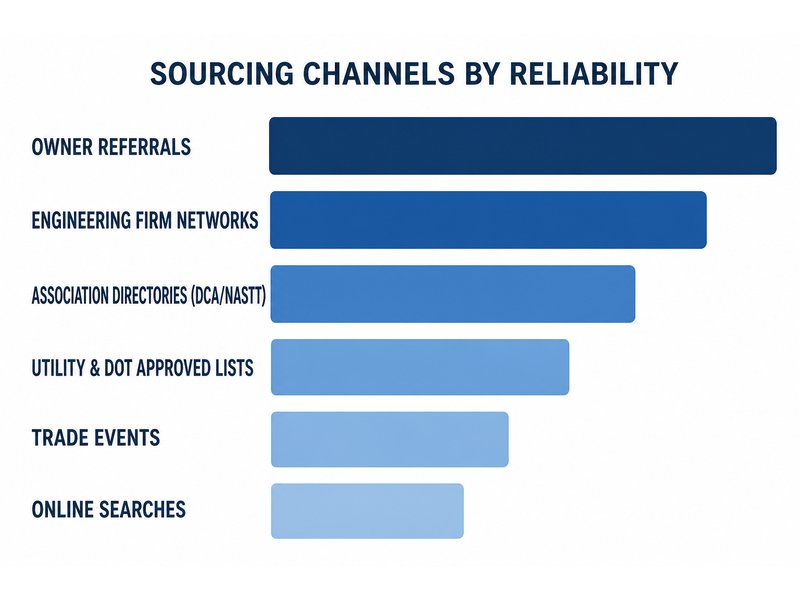
Start your search where the people who pay for HDD work actually look. The firms you are vetting market themselves under several names, such as directional drilling contractors or simply directional boring contractors, but the qualification bar is the same. The most reliable channels are referral-based, because the recommender carries reputation risk; directories and registries come second, because membership filters for minimum competence but not for quality.
- Owner and operator referrals. Pipeline owners, utilities and municipal operators maintain lists of contractors who have performed crossings for them. These are the strongest leads because performance is already documented.
- Engineering and EPC firms. The engineer of record on pipeline projects usually knows which directional drilling contractors deliver clean as-builts and honest change orders.
- Industry association directories. The Directional Drilling Contractors Association (DCA) and the North American Society for Trenchless Technology (NASTT) publish member directories, and membership signals a baseline commitment to industry practice.
- Trade events and chapter meetings. Events such as UCT and the Directions conference put you in a room with drilling contractors, locator suppliers and mud engineers, and face-to-face screening is faster than cold outreach.
- Utility and DOT approved-contractor lists. Many states and utilities publish prequalified contractor lists for work near their facilities.
- Public letting and bid records. Recent award lists for crossings in your region show who is actually working, at what scale, and for which owners.
Aim for a pool of five to eight candidates per bore, weighted toward those with documented pipeline crossing experience. A wider pool is rarely useful; the bottleneck in HDD is qualified crews and honest documentation, not the number of firms that own a rig.
Step 3: Prequalify Candidates Before They Bid
A prequalification questionnaire (PQQ) separates qualified firms from hopeful ones before anyone spends money on a full bid. It also gives you a written, comparable record for every candidate, which is exactly what a defensible award decision needs.
Send the same PQQ to every candidate, with the scope summary attached, and require completion within a fixed window. Treat incomplete answers as a signal; in our experience, the firms that return thin questionnaires deliver thin documentation on site. Table 1 below lists the seven core sections; send it as the PQQ structure so every candidate answers the same questions.
| Section | What to Request | Why It Matters for Pipeline Work |
|---|---|---|
| Company and financials | Years in business, ownership, financial statements or bank references, bonding capacity | A crossing that stalls mid-pullback is expensive; the firm must survive it financially. |
| Licenses and insurance | Contractor licenses, certificates of insurance, coverage limits, additional-insured status | Pipeline projects carry third-party and environmental exposure that small policies do not cover. |
| Safety program | EMR (experience modification rate), recordable rates, written HSE plan (health, safety and environment), near-miss reporting, damage-prevention procedures | One utility strike on a pipeline ROW can halt the whole corridor, not just the crossing. |
| Equipment inventory | Rig pullback and torque ratings, guidance systems, mud plant, reamer sizes | Machine capacity must exceed the design pullback load for the pipe string. |
| Crew qualifications | Drill operator, locator and mud engineer experience; welder certifications (API 1104 or ASME IX) | Steel pipe strings for pipeline crossings are welded to code; certification must be verifiable. |
| Comparable experience | Three completed crossings of similar diameter, length and geology, with owner contacts | Comparable experience is the strongest predictor of a successful pullback. |
| QA/QC and documentation | Welding procedures, NDT (non-destructive testing) subcontractors, drilling log and as-built deliverable policy | Pipeline operators need auditable records for hydrotesting, integrity and future maintenance. |
Get a second opinion: if a shortlisted directional drilling contractor’s PQQ answers are close but you are unsure which assumptions are realistic, send the PQQ responses and bore plan to JSW’s engineers, and we will flag which assumptions are unrealistic before you commit to full bids.
Step 4: Verify Licenses, Insurance and Financial Capacity
Licenses and insurance are the legal floor, and financial capacity determines whether the contractor can finish when the ground turns difficult. Each check takes minutes but removes a different class of failure.
- Confirm that state or provincial contractor licenses are current and match the work classification, and that the firm holds the specific certifications the project requires.
- Request certificates of insurance directly from the insurer or broker, not as PDF copies from the contractor: general liability, workers compensation, automobile and pollution liability, with your company named as an additional insured.
- Check limits against project risk. USD 1 million general liability is common but can be low for crossings near waterways or high-pressure gas lines; confirm pollution coverage for drilling fluid incidents.
- Review bonding capacity and financial statements for long or seasonal campaigns. A contractor that cannot bond a crossing usually cannot absorb a frac-out remediation either.
In one pipeline program we reviewed, a shortlisted directional drilling contractor carried strong insurance certificates but had negative working capital across two consecutive years. The crossing was rescued mid-season only because the owner had verified financial capacity before award and structured progress payments accordingly. The paperwork stage is where that kind of risk is caught cheaply.
Step 5: Audit Safety and Damage-Prevention Performance
Safety performance is the most reliable predictor of field discipline, and damage prevention is where HDD crews most often cut corners. The stakes are documented: in the United States, the 811 call-before-you-dig system processed more than 43.5 million locate requests in a recent year, generating nearly 265 million transmissions to facility operators, according to Common Ground Alliance figures published in 2026. Even so, the CGA DIRT report recorded 189,549 unique reported damages in 2023 alone. A contractor’s locate discipline is therefore not administrative detail; it is the main defense against a utility strike.
- Review the EMR for the last three years (1.0 is the industry average) and OSHA or equivalent recordable rates, and ask for explanations of any spikes.
- Confirm the crew uses 811 one-call processes, verifies locate marks by potholing or vacuum excavation, and maintains positive clearance from existing utilities along the entire bore path.
- Check for a written drilling fluid management plan: containment, recycling, frac-out response (drilling fluid escaping to the surface) and waterway protection, plus the environmental permits the crossing requires.
- Ask how near-misses are logged and reviewed. A contractor that cannot produce a near-miss log is not tracking the data that prevents incidents.
For pipeline work near in-service lines, add hydrocarbon and confined-space awareness to the audit, and confirm the crew has procedures for working in a live corridor. These checks belong before award, because once the rig is set up, schedule pressure does the deciding.
Step 6: Match Equipment and Crew to Your Bore Plan
A crossing succeeds when machine capacity, guidance accuracy and crew skill match the design loads of your specific bore. Underpowered rigs cause stuck pipe; crews without the right guidance system drift off profile; and unqualified welders put the pipe string itself at risk.
- Compare rig pullback and torque ratings against the design pullback load, including the heavier demand of thick-walled steel pipe for pipeline service.
- Check the guidance system against depth and length: walkover locators (surface-based steering locators) suit shallow, short bores, while wireline or gyro steering is required for long and congested crossings.
- Verify mud pump capacity and recycling equipment can deliver the flow and volume the bore plan specifies, and that reamer sizes match the reaming schedule.
- Request welder qualification records for the string fabrication crew (API 1104 or ASME IX, depending on the code), plus the NDT subcontractors who will inspect the welds.
- Ask about coating and field-joint repair capability for the pullback spread, and who holds responsibility if the coating is damaged during installation.
Equipment planning is a systems exercise. Contractors we recommend coordinate the bore with pipe string fabrication, pipeline automatic welding technology, cold bending for profile transitions and the cutting and bevelling tools used on the entry spread. When you vet, ask how the drill crew and the pipe crew communicate, because that interface decides pullback quality more than either crew alone.
Step 7: Interview, Visit Active Sites and Check References
Documents prove capability; interviews and site visits reveal how a contractor actually works. Run the interview with specific questions, visit an active jobsite if one exists within reach, and call references with a structured script rather than asking for general impressions.
Questions to Ask in the Interview
- What pullback and torque capacity will you assign to this bore, and how does it compare with the design loads?
- Which guidance system will you use, and what accuracy can it realistically hold at this depth and length?
- How do you verify existing utilities on this crossing, and what clearance do you maintain from them?
- Who is the designated project manager, who will be on site daily, and who makes decisions when the superintendent is off shift?
- How do you manage drilling fluids, and what is your frac-out response procedure near this waterway?
- Can you produce drilling logs and as-built documentation from a comparable completed crossing this month?
What to Observe on a Site Visit
When you visit an active HDD site, you are auditing behavior, not presentation. A site visit takes half a day and answers questions no proposal can. Table 2 below turns that audit into a scored observation sheet.
| Observation Point | Strong Signal | Warning Signal |
|---|---|---|
| Housekeeping | Organized laydown, contained fluids, clear walkways | Hoses across paths, spilled mud uncontained |
| Safety behavior | Crew wearing correct PPE and using spotters | PPE gaps tolerated in front of visitors |
| Drilling logs | Logs completed in real time at the operator station | Logs filled in later, or “in the office” |
| Equipment condition | Clean, serviced rig and mud plant with spare parts on site | Leaking components and improvised repairs |
| Pipe handling | Stringers staged with coating protection | Steel dragged across the ground unprotected |
Reference Checks That Actually Verify
Call the owner’s representative and the engineer of record, not only the contractor’s nominated project manager. Ask how actual schedule and cost compared with the bid, how frac-outs or stuck pipe were handled, whether as-built documentation arrived complete and on time, and whether the contractor would be hired again. Three direct references, checked this way, are worth more than a decade of marketing materials. If the references check out, move to Step 8 and compare itemized bids; the printable checklist below keeps every step comparable.
Step 8: Compare Bids and Award on the Full Picture
Award on the whole evaluation, not the lowest number. For the scoring criteria behind that evaluation (references, equipment match, safety record and contract terms), see how to choose the right horizontal directional drilling contractor in our companion guide. Itemized bids reveal how a contractor plans to deliver the job; lump sums hide it. Require line items for mobilization and demobilization, pilot hole, prereaming passes, pullback, drilling fluids and disposal, water supply, restoration, contingency and, for pipeline crossings, string fabrication and NDT. Reject bids that omit fluid management or restoration, because those costs reappear as change orders later.
Treat a very low bid with suspicion if its assumptions about geology, bore length or pullback loads differ from your engineering basis.
Before signing, confirm in the contract: change-order triggers for ground conditions that differ from the geotechnical report; liability for third-party utility damage and frac-outs; warranty terms; and documentation deliverables (drilling logs, as-built drawings, locate records). Then confirm the schedule realistically allows for reaming passes, hydrostatic testing coordination and restoration.
Pipeline-Specific Checks Most HDD Contractor Guides Miss
Pipeline crossings differ from telecom and water-service bores in four ways that change how you vet. General guides stop at the drilling itself; pipeline projects extend into fabrication, welding, testing and corridor management. Pipeline projects often reach the drilling firm through a main pipeline contractor that subcontracts the crossing. Vet the drilling contractor that carries the underground risk independently; do not rely on the main contractor’s screening alone.
- Weld quality and NDT hold points. The welded steel string is part of the pipeline, so verify weld procedures, welder qualifications and radiography or ultrasonic testing provisions before pullback, not after.
- Coating integrity through the bore. Ask how the contractor protects field joints and repairs coating damage during pullback; a damaged coating on an installed crossing is expensive to fix and hard to prove.
- Right-of-way and corridor coordination. On a multi-spread pipeline project, the HDD crossing must fit the mainline construction schedule, pipeline construction services and restoration sequence. Ask how the drilling contractor coordinates with the mainline contractor and the inspection team.
- Testing and tie-in interfaces. Confirm who prepares the crossing for hydrostatic testing and who handles tie-ins with existing lines, which can involve pipeline hot tapping and plugging services when the crossing connects to an in-service pipeline.
If the design or ground conditions make HDD a poor fit, a qualified vetting process should also tell you so. For short drives through stable ground, microtunneling can be the more controlled option, and an honest contractor will say so instead of bidding a marginal bore.
Printable HDD Contractor Vetting Checklist
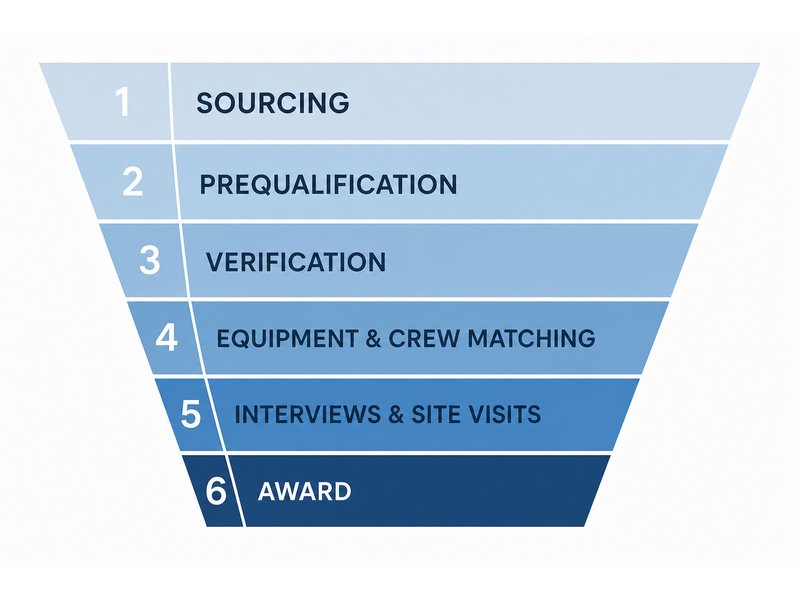
Use the table below as the working document for every candidate. If any row cannot be completed in writing, treat it as an open risk item until it is closed. The ten gates below execute Steps 2-8 in checklist form; Step 1’s scope summary is the measuring stick every gate is checked against.
| Gate | Verify in Writing | Minimum Standard |
|---|---|---|
| 1. Sourcing | Owner or engineer referral, directory or approved-list status | At least one independent source beyond the contractor’s website |
| 2. Prequalification | Completed PQQ against your scope summary | Full answers on comparable pipeline experience |
| 3. Licenses | Current contractor licenses and certifications | License class matches the work |
| 4. Insurance | Certificates from the insurer; additional insured status | Limits match crossing and environmental risk |
| 5. Financial capacity | Bonding capacity and financial statements | Capacity to absorb a mid-project disruption |
| 6. Safety | EMR, recordable rates, HSE plan, locate and potholing procedures | EMR at or below 1.0 with no unexplained spikes |
| 7. Equipment and crew | Rig ratings vs. design pullback, guidance system, mud plant, welder certifications | Capacity above design loads; welders qualified to code |
| 8. References | Three direct owner and engineer references | Schedule, cost and documentation performance confirmed |
| 9. Bid | Itemized proposal matching the scope summary | Fluids, restoration, contingency and NDT line items present |
| 10. Contract | Change-order triggers, liability, warranty, documentation deliverables | Ground-condition differences priced explicitly |
Need an independent read on your checklist? Send the completed checklist with the PQQ responses and itemized bids to JSW’s engineers, and we will score each gate against the checklist standards and flag every open risk item before you sign.
HDD Contractor Vetting FAQ
How do I find an HDD contractor near me?
Start with owner and operator referrals, engineering firm recommendations and association directories such as DCA and NASTT, then filter those directories to your region and check utility and state or provincial approved-contractor lists in your area. Referral-based channels outperform broad online searches because the recommender carries reputation risk.
What is the fastest way to vet an HDD contractor?
The fastest pass is to run the document checks in parallel while interviews are being scheduled: verify insurance certificates directly from the insurer, review the EMR and locate procedures, confirm equipment ratings against the bore plan, and call three references. Send a scope summary and PQQ up front so every candidate answers against the same assumptions.
What documents should a drilling contractor provide before award?
Current licenses; certificates of insurance with your company named as additional insured; three years of safety records including EMR; an equipment list with rig ratings; welder qualification records for steel pipe strings; completed prequalification responses; and three owner references.
What insurance does an HDD contractor need for a pipeline crossing?
A drilling contractor for a pipeline crossing needs general liability, workers compensation, automobile and pollution coverage, with your company named as an additional insured on the contractor’s policy. Limits should be sized to the crossing type: a road bore under open ground carries less third-party exposure than a waterway or in-service-line crossing, where higher limits are justified. Pollution coverage matters most for drilling fluid incidents, because standard general liability policies carry pollution exclusions.
Should I hire a directional drilling contractor that also welds the pipe string?
Not necessarily, but the interface must be managed. Whether the string is fabricated by the drilling contractor or a separate pipeline crew, verify that welders are qualified to the applicable code, that NDT hold points are defined before pullback, and that the drilling and pipe crews coordinate pullback speed and joint handling.
How long does contractor vetting take?
Plan for one to two weeks for a straightforward crossing: a few days to source and prequalify, a few days for document verification and interviews, and a site visit plus reference calls in the final week. Longer programs with multiple crossings justify a formal prequalification that runs ahead of the bid season.
How JSW Supports Pipeline Owners with HDD Contractor Vetting
JSW is a pipeline engineering and construction partner that supports owners, EPC firms and contractors across the full lifecycle of trenchless and pipeline work. For HDD contractor vetting specifically, we act as the technical reviewer between you and the bidders:
- Bid and PQQ review: send us the scope summary, PQQ responses and itemized bids, and our engineers flag hidden scope, unrealistic assumptions and red flags within five working days.
- Construction and repair services: pipeline construction services, trenchless pipeline repair technology and pipeline maintenance services that cover the corridor around the crossing.
- HDD and fabrication support: pipeline automatic welding technology, pipeline cold bending and pipeline hot tapping and plugging services for tie-ins with in-service lines.
- Tooling for the entry and exit spreads: pipeline hot tapping equipment, pipeline plugging pigs and pipeline cutting machines.
What distinguishes our support is that we publish our engineering basis, we document as-builts, and we price contingencies explicitly rather than hiding them. We do not claim every crossing is routine: HDD carries real risk, and a defensible vetting process is how owners manage that risk before the rig arrives. If you are evaluating an HDD contractor for a pipeline crossing, contact the JSW engineering team with your scope summary and shortlist, and we will provide a technical review and a scoped proposal within five working days.





































 English
  Arabic
  Russian
  Spanish
  French
  Vietnamese
  Polish
  Thai
Thai  Indonesian
  Turkish
  Portuguese