
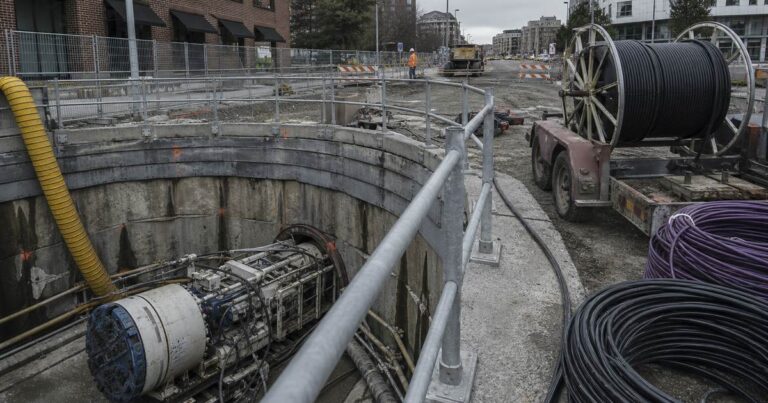
Microtunneling for fiber optic cable, power ducts and other conduit crossings installs a small-diameter casing below a road, railway or watercourse under remote, laser-guided control, with almost no surface disruption. This article explains when that method is the right choice for cable, fiber and electrical duct work, and when it is not. It sets out the two ways to build a utility corridor, the tolerance a conduit line actually needs, how cable pulling tension and bend radius constrain the casing, and how microtunneling, horizontal directional drilling and open cut divide the work.
When is microtunneling the right tool for a conduit crossing?
A cable crossing is a short, small-diameter installation with a specific job: get power or communications cable from one side of an obstacle to the other without cutting the surface. The casing protects the cable, and the cable is pulled or blown through it after the drive is complete.
Microtunneling for fiber optic routes and power feeders becomes attractive when the surface above cannot be opened, when the crossing passes under a railway or a busy road, or when the water table rules out an open trench. It installs a straight, guided casing at a controlled line and grade, which is what a conduit casing usually needs.
Not every conduit job suits the method. A short crossing in open ground, or a route that has to curve around existing services, may be cheaper and faster by another trenchless technique or by open cut. The decision is a question of fit, not a ranking.
- The surface cannot be surrendered: rail, road or waterway crossings where traffic must keep moving.
- The route is short and fairly straight: a guided casing lines up with the vaults and handholes at each end.
- Ground or groundwater blocks an open trench: deep cover or a high water table makes excavation costly.
- The owner wants a durable sleeve: a casing that future cables can be pulled through without a new excavation.
Should a cable crossing use a duct bank or a single casing for a utility corridor?
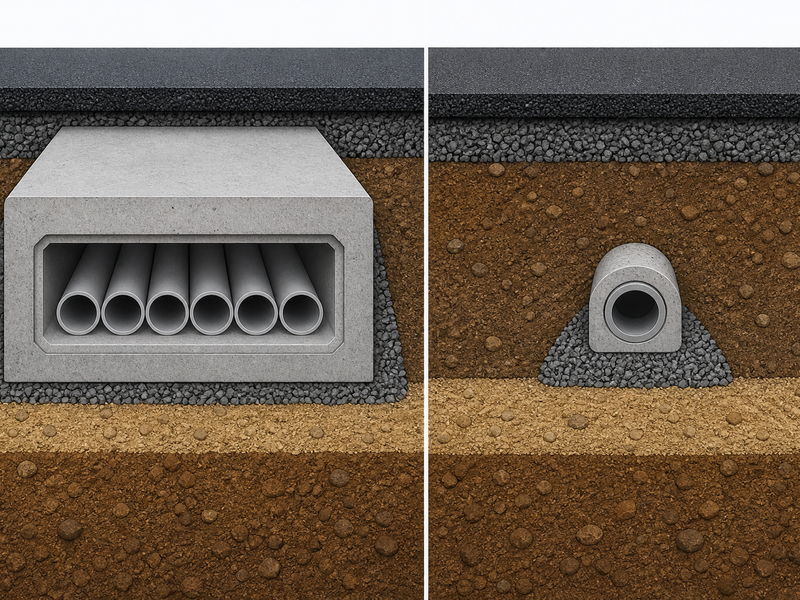
A duct bank is an underground assembly of several conduits, usually encased in reinforced concrete or set in a grouped metal or plastic arrangement, that carries power and telecommunications cables together. It is the grouped, multi-duct way to build a utility corridor.
A single casing is the other option: one sleeve, sized for one electrical conduit or a small number of lines, installed on its own.
The choice changes the bore. Microtunneling for fiber optic duct banks tends to need a larger casing that holds several inner ducts, while a single cable crossing can use a much smaller sleeve. Grouping cables lowers the cost per cable but concentrates heat and fault risk, so spacing and encasement matter.
- Duct bank: more cables per drive, one shared excavation and one shared surface footprint.
- Duct bank: grouped cables need a derating check for mutual heating.
- Single casing: lower first cost and simpler joints, with less capacity for future cable.
- Single casing: easier to add in stages as the network grows.
Why does microtunneling for fiber optic cable need less grade accuracy than a sewer?
A gravity sewer has to fall at a continuous slope, so its tolerance is about line and grade over a long distance. A conduit casing has a different job: it has to sit at a safe depth and hold a clear separation from other services. That is a cover-and-clearance problem rather than a fall problem.
That does not make conduit work loose. A duct installed too shallow, or too close to a gas main or a water main, is a design fault even if the line and grade are perfect. Cover and separation are set by the electrical code, the utility owner’s specification and local ordinance, and they change with voltage class and surface type.
How tight is the tolerance in practice?
The accuracy the drive achieves is still worth stating. Pipe jacking in stable ground is commonly held to about ±50 mm on line and level at any point, laser guidance can reach roughly ±25 mm, and pilot-tube microtunneling is quoted at ±1 in. on slope and ±3 in. on line.
In our conduit work the settlement check comes before the casing size. Under a city road the permitted surface movement is the binding limit, not the line and grade, because the city, not the cable, owns the surface. The annular overcut is normally 13 to 38 mm; under a road it is deliberately reduced so that movement stays below about 10 mm, and that figure is what fixes the casing scheme.
- Minimum cover: fixed by the governing document and the surface above, not by the machine.
- Separation: a clearance rule, checked against the utility survey record.
- Line and grade: most critical where the casing must line up with a vault or handhole.
- Bore quality: a straight, smooth casing keeps cable pulling loads inside the cable’s rating.
How do you pull cable through a microtunnel casing without damaging it?
A casing that is accurate to the millimetre can still damage a cable if it is rough inside or bends too sharply. For microtunneling for fiber optic cable, the bore is only useful if the cable can be pulled through it without harm. The cable manufacturer sets a minimum bend radius, and the installed route must never fall below it.
Pulling tension is the second limit. The load at the pulling eye rises with cable weight, friction against the duct wall and any curvature, and it must stay below the cable’s maximum allowable tension. Long pulls are eased with lubrication and by pulling from the far end or in stages.
Joint alignment is where a jacked casing helps. On a cable crossing, pipe joints that stay square and flush give a smooth bore, so the cable does not catch or scrape on a step. On the conduit drives we have supported, the joint detail and the inner duct arrangement are agreed before the first pipe is jacked.
For fiber, bending loss and tension both accumulate. A route with several gentle curves can load a cable more than one long straight run, so the pull plan and the alignment are designed together.
How many inner ducts should a conduit casing hold for future capacity?
How many spare ducts should be built in?
The cheapest duct is the one already in the ground when the next cable arrives. Sizing a corridor for spare ducts is a judgement about growth, and the cost of extra ducts inside one casing is usually small next to the cost of a second drive.
Inner duct count drives the casing size. A casing has to hold the inner ducts, their spacers and enough room for the pull, so the required internal diameter grows with the number of ducts and the cable they carry.
Microtunneling for fiber optic corridors is often chosen because the network is expected to grow. Adding ducts to a completed drive later is not possible; adding them now, inside the same casing, is. That is why owners who expect growth usually accept a larger casing at the outset.
How far can a small-diameter casing be driven before accuracy suffers?
Drive length shapes the plan too. A small casing reaches roughly 150 to 250 m depending on its internal size, and the full envelope is set out in Table 2 later in this article.

How close may a conduit run to other utilities and energized cables?
How much separation does an energized cable need in a shared corridor?
A utility corridor built by microtunneling for fiber optic and power cables is a shared space below a street, and separation is how conflicts are avoided. Cables have to keep a working clearance from gas, water and drainage mains, and from each other, and the survey record is where those clearances are proved.
Energized cables add a second requirement. Power cables grouped in a duct bank produce heat and an energized field, so spacing, grouping and sometimes concrete encasement are set by the electrical code and the utility owner. The same principle applies to an electrical conduit run as to a fiber duct, but the numbers differ.
These rules are local. Minimum cover, separation, conduit material and wall thickness are decided by the local electrical code, NEMA conduit standards, the owner or utility specification and local ordinance. They vary with voltage class, surface type and ground conditions, so the project must be designed to its own governing documents.
Where we have pulled cable into a jacked casing, the two documents that most often disagree are the separation schedule and the survey record. Resolving them before the drive is far cheaper than resolving a clash after it.
When does microtunneling beat HDD or open cut for conduit work?
When should a 12-duct fiber corridor go in by microtunneling?
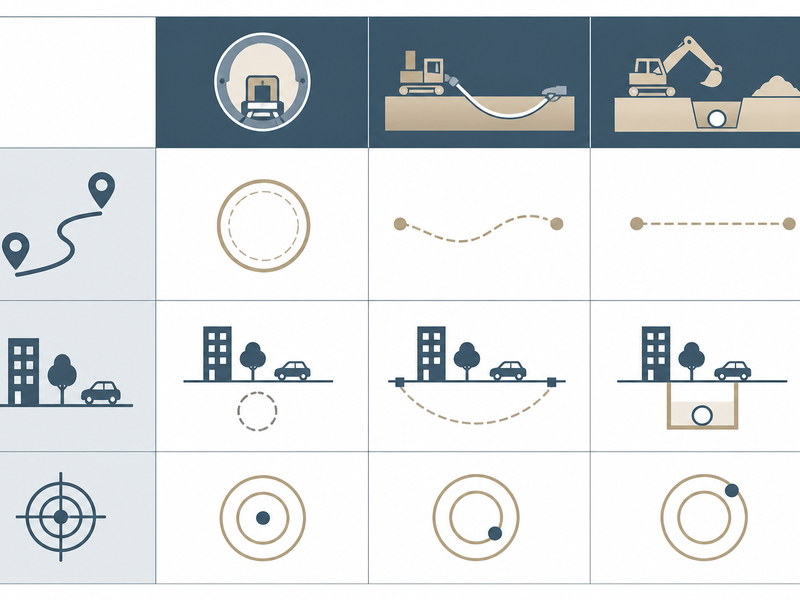
For small-diameter conduit and microtunneling for fiber optic schemes, three methods divide the work: microtunneling, horizontal directional drilling and open cut. The choice follows the route shape, the surface above, the clearance rules and the accuracy the casing needs.
| Метод | Where it fits | Constraint to accept |
|---|---|---|
| Microtunneling (pipe jacking) | Straight, laser-guided casing under a busy surface with tight line and grade | Higher setup cost and a shaft at each end of the drive |
| Horizontal directional drilling | Long, curved routes where a steerable bore and pullback suit the duct | Less precise line and grade, and pullback loads on the product |
| Open cut | Shallow, short crossings with room to work and easy reinstatement | Surface disruption, traffic management and reinstatement cost |
The table is a starting point. A microtunneling drive under a railway points to the guided-casing option; a long, curved route in open ground often points to directional drilling; and a shallow crossing with room to work can still be open cut. More than one method can be defensible on the same alignment.
What drive length and shaft size does a conduit crossing need?
Microtunneling for fiber optic and power conduit runs within a small-diameter range, and the reach it can manage rises with the casing size. The figures below are indicative industry values, and the real limit on any project is the ground and the jacking force it allows.
| Casing internal size (m) | Indicative drive length (m) | Typical conduit use |
|---|---|---|
| Below 0.9 | 150 | Single or few ducts under a road |
| 0.9 | 200 | Duct bank section under a city street |
| 1.0 | 250 | Multi-duct utility corridor |
Pilot-tube microtunneling, the small-product variant, is the exception to that size table: it is typically limited to about 120 m (400 ft) per drive and suits a single fiber or power duct where high accuracy matters, with working shafts around 8 to 16 ft.
Jacking force closes the envelope. A small-bore drive still pays a friction bill: expect 0.5 to 2.5 t/m² over the external circumferential area, and lubrication can take that towards 0.1 t/m² or lower. That is why a long small-diameter drive is planned around lubrication and, where needed, intermediate jacking stations.
Shafts set part of the footprint. A precast caisson of 2.4 to 4 m suits microtunneling, and the smallest workable layout for a multi-duct casing is about 11,000 sq ft, sized around the pulling rig and the pipe string as much as the machine. In our shaft layouts, the jointing area is usually what will not fit.
Who grants the right to cross, and who can hold up the drive?
A conduit crossing almost always crosses land that someone else controls. A road authority, a railway, a waterway agency or a private owner grants the right to cross, and each has its own drawing requirements and inspection regime.
Which utility owners have to be consulted before a conduit crossing is designed?
Utility corridors add the utility owners themselves. If the drive passes near a gas main or a power duct bank, those owners may require a watching brief, a clearance check or protective measures during the works.
The practical message is to start the approvals early and to keep one record of every condition. A single missed condition on a cable crossing can stop a drive that is otherwise ready to launch.
Frequently asked questions (FAQ)
When should a conduit crossing use microtunneling instead of HDD?
Use microtunneling when the casing must hold a straight line and grade under a surface that cannot be opened. Horizontal directional drilling suits long, curved routes where a steerable bore and pullback are an advantage, while microtunneling is the guided, remote option when accuracy and surface protection come first.
Does microtunneling for fiber optic work need the same accuracy as a sewer?
Not in the same way, but the casing still has to be right. A conduit does not need a continuous fall like a gravity sewer, yet it must hold its cover and its clearance from other services, so the binding constraints are depth and separation rather than slope.
How far can a cable be pulled through a microtunnel casing?
It depends on the cable, the duct and the alignment, not on the tunnel length alone. Pulling tension rises with cable weight, wall friction and curvature and must stay under the cable’s rated maximum, so long pulls are eased with lubrication and by pulling in stages. The manufacturer’s bend radius and tension limits set the practical limit.
Should a fiber or power crossing use a duct bank or a single casing?
Use a duct bank when several cables must share one crossing, and a single casing when only one or a few lines are needed. Choose on capacity for growth and on fault isolation, not on first cost alone. A duct bank amortises the crossing over more cables and isolates a fault to one group of conduits; a single casing is the cheaper first move when only one or two lines are planned and the route can be revisited later.
How many spare ducts should a utility corridor include?
Add spare ducts now, because they cannot be added to a completed drive. Extra ducts inside the same casing cost far less than a second drive later, so the count should follow the owner’s expected network growth.
What sets the cover and separation for a power conduit crossing?
It is set by the governing electrical code, the utility owner’s specification and local ordinance. Where the owner issues no separation schedule, the code minimum governs, so the design should record that assumption rather than borrow a figure from another project.
Основные выводы
- Conduit crossings are a cover-and-clearance problem, not a slope problem, which is what separates them from a sewer drive.
- A duct bank shares one casing across many cables; a single casing serves one or a few lines with less future capacity.
- Cable bend radius and pulling tension, not the bore alone, usually set the smallest casing that will work.
- Small casings are quoted at about 150 m below 0.9 m, 200 m at 0.9 m and 250 m at 1.0 m, with pilot-tube drives near 120 m.
- Microtunneling for fiber optic and power corridors pays back when the surface cannot be opened and spare ducts are built in from the start.
- Separation and cover rules are local, so the governing code and the utility specification decide them.
How JSW supports cable, fiber and conduit crossings
JSW is a pipeline engineering and construction company that delivers trenchless crossings with its own crews and equipment. Our scope covers строительство методом микротуннелирования, бестраншейные технологии, horizontal directional drilling services, услуги по прокладке трубопроводов и pipeline inspection. For microtunneling for fiber optic and power conduit crossings, our range covers DN300 to DN1500 (12 to 60 in.), with single drives up to 600 m and laser guidance around ±25 mm.
Our teams treat the conduit, the cable pull and the surface above as one problem. That means agreeing the cover and separation schedule before tender, sizing each shaft so the pulling equipment has room, and reporting process data a reviewer can audit after the fact.
- Комплексная доставка: microtunneling, cable duct installation and inspection under one scope.
- Auditable process data: guidance, jacking force and grout records available for review.
- Ценообразование с учетом риска: geotechnical, utility and access risks named in the bid, not hidden in a rate.
- Safety and compliance: ISO 9001:2015, ISO 14001:2015 and ISO 45001:2018 certified systems.
Planning a fiber, power or duct bank crossing below a live surface? Send your alignment, cable schedule and target casing size for a free technical review. Our engineers respond with a scoped recommendation and a budget range.





































 English
  Arabic
  Russian
  Spanish
  French
  Vietnamese
  Polish
  Thai
Thai  Indonesian
  Turkish
  Portuguese