

Microtunneling for stormwater sets the pipe diameter that a storm event demands and installs it below a city with minimal surface disruption, which is why the method often carries a capacity-led drainage trunk. This article follows the chain from rainfall to flow to diameter, then examines what a large-diameter microtunnel requires in pipe, machine and shaft. It uses the record 3.4 m stormwater drive in Calgary as the reference point and sets out where manned entry and lining type, not diameter alone, decide the switch to a segmental TBM.
Which input decides the diameter of a stormwater tunnel?
A stormwater tunnel is sized from the water it must carry, not from the machine that will bore it. The diameter falls out of a chain that begins with a chosen design event and ends with a pipe capacity check, and every link can add or remove millimetres of bore.
Microtunneling for stormwater enters only after that hydraulic decision is close to final, because the method installs a fixed diameter at final line and grade. What the method then constrains is the drive length, the shaft locations and the pipe that can be jacked, which this article works through in turn.
How do design storm and roughness feed the diameter calculation?
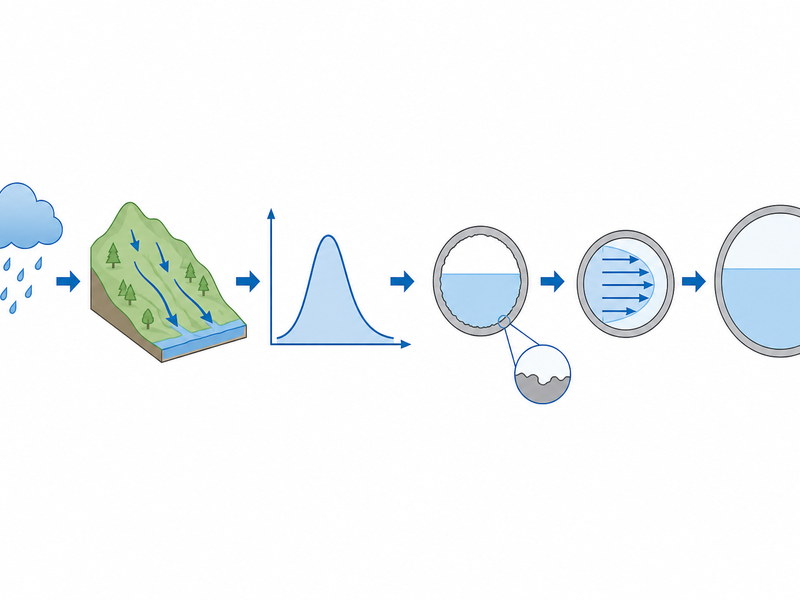
The design storm is a statement of risk. A return period, an intensity-duration-frequency curve and a storm duration are selected together, and they define the rainfall the system must pass without unacceptable flooding in the streets above.
That rainfall becomes a flow through hydrology. Catchment area, imperviousness and time of concentration convert intensity into a peak discharge, and the trunk is sized for that discharge plus any future development the owner allows for.
The flow becomes a diameter through open-channel hydraulics. Capacity depends on roughness, slope, cross-sectional area and the velocity the section develops, and the designer tests trial diameters until one carries the peak flow at a velocity that scours sediment but does not erode the pipe.
- Return period and duration: the risk statement that fixes rainfall intensity for the event.
- Runoff model: catchment area, imperviousness and time of concentration give peak flow.
- Roughness and slope: the coefficient and gradient that set how much the pipe can carry.
- Velocity check: a minimum to keep sediment moving, a maximum to protect the lining.
- Freeboard: the margin left above the design water surface inside the tunnel.
Roughness is the link most often taken for granted. A smooth precast bore and an older, rougher channel do not pass the same flow at the same gradient, so the coefficient assumed at design must match the pipe installed. In our reviews of drainage designs, the roughness assumption and the specified pipe are sometimes written by different people and never reconciled.
Why does microtunneling for stormwater win on a deep capacity-led urban trunk?
Capacity-led trunks are usually deep, and depth is where trenchless methods separate from open cut. A large trunk may sit well below the utilities and basements that fill a city’s upper metres, so an open trench would mean deep shoring, long road closures and a volume of exported material a dense district cannot absorb.
Published figures for a comparable drive put excavation at 0.5 versus 6.1 m³ per metre against an open-cut trench, and spoil transport at 8 versus 136 truck trips per 100 m.
For microtunneling for stormwater, the surface argument is stronger still. These alignments run under established built-up areas where the surface cannot be surrendered for a season, and the shafts become the only surface footprint the project needs to occupy.
The 3.4 m record: what a large-diameter microtunnel actually requires
Can a microtunneling drive actually reach 3.4 m in diameter?
The largest-diameter microtunnel completed in North America was finished in December 2022 as part of Calgary’s Northwest Inner City Upper Plateau Separation project. It is a 3.4 m (11.2 ft) internal diameter stormwater trunk built to a design flow of 20 m³/s (706 ft³/s), with a single drive of 765 m (2,510 ft).
The figure shows the whole envelope at once. A large-diameter jacking pipe at this size is a heavy segment-handling problem, a large closed-face machine, and a shaft that places more than 30 t at a time.
The construction window was short. The drive ran from September to December 2022, twelve weeks in total, which put a premium on pipe supply, handling and jointing speed.
How is a large-diameter jacking pipe designed and tested?
The pipe was the governing structural item. This large-diameter jacking pipe is 328 mm thick precast reinforced concrete designed to ASTM C76 and ASCE 27, furnished as 230 sections, each 3.3 m (10.9 ft) long and weighing more than 32 t.
A jacking pipe in a bore of this size carries load in two ways at once. It must resist the crushing load of the ground, expressed through the D-load concept in ASTM C76, and it must survive the axial jacking force that pushes the whole string forward.
The joints are where those duties meet. Every joint must stay square under load, seal against groundwater and transfer thrust without spalling the pipe ends, so the joint detail and the pipe end preparation are specified together.
On the large-diameter drives we have supported, the pipe handling plan is written before the machine is chosen. Lifting, storage and setting rates, not cutterhead advance, set the daily production on a pipe this heavy.
What changes in a mixed face below the water table?
The Calgary drive ran below the water table for its whole length, and its ground ranged from Paskapoo Formation bedrock, including mudstone, siltstone and sandstone, into unconsolidated coarse-grained channel-fill deposits.
That combination is a mixed face, and a mixed face below the water table is the hardest routine condition a machine faces. The contract documents responded by setting a minimum performance requirement: the machine had to be closed-face, to maintain full face support and control groundwater inflow.
The machine was a closed-face slurry AVN2500 with a mixed-face cutterhead and an up-skin kit, letting it bore a 4.0 m (13 ft) outer envelope and jack the smaller product pipe behind it.
Microtunneling for stormwater in such ground is as much a pressure-control exercise as a cutting exercise. Face pressure, slurry properties and the balance against the water table decide whether the surface above stays still.
How do stormwater, CSO control and flood relief differ in duty?
These three terms are often used as if they described one thing. They do not, and the difference changes what the tunnel is asked to do and how success is measured.
Stormwater conveyance is the routine job: collect runoff and move it to a watercourse or a treatment point, sized for the design event the authority adopts. A combined sewer overflow is a different problem: the overflow happens where sanitary flow and storm flow share one pipe, and the mixture spills when that pipe fills.
When is a relief tunnel the right answer instead of a larger pipe?
A flood relief tunnel is the largest frame. It may be sized to intercept, store or divert a flood peak, so its diameter is often set by a rare event or by a required storage volume rather than by a simple pipe-full check.
- Stormwater conveyance: move the design runoff; capacity and velocity govern.
- Combined sewer overflow: capture the spill from a shared pipe; water quality governs.
- Flood relief tunnel: divert or store a peak; volume and the rarity of the event govern.
A public example is a Columbus, Ohio drive of 90 in. diameter used to relieve an existing combined sewer overflow, alongside a new 36 in. relief sewer. Larger schemes such as the Dallas Mill Creek, Peaks Branch and State-Thomas relief tunnels, and the large stormwater conveyance tunnel studies by the Harris County Flood Control District, sit in different diameter and method ranges. These are public-record projects rather than JSW work.
Why should a stormwater shaft stay in service after the drive is finished?
A stormwater shaft is not only construction access. On many projects it becomes the permanent drop structure, the flow-control point and the maintenance access, and designing it that way turns a temporary cost into an asset the owner keeps.
- Drop structure: dissipates energy where flow enters the trunk.
- Flow control: regulates the network from the same shaft.
- Maintenance access: the only way to reach the trunk in service.
A shaft of 2.4 to 4 m diameter is usually a precast caisson, and the Pipe Jacking Association’s guidance covers about 15 m in dry ground with steel sheet piles and around 20 m with secant piles. The depth the hydraulics demand usually decides which of those the ground will allow.
A drop into a deep trunk is a design in its own right: energy must be dissipated so the structure does not scour itself, and shaft and tunnel are detailed as one hydraulic element.
In the shaft layouts our teams have reviewed, the constraint is almost always the same: fitting the launch geometry, the pipe string and the permanent flow control into one footprint that the city will let the project occupy.
Microtunneling or segmental TBM? the real boundary
ASCE/CI 36-15 does not put a diameter limit on microtunneling; it treats the term as a description of the method. The line that practice actually draws is the need for manned entry.
When a tunnel must be entered for work, when a segmental lining is required, or when the diameter reaches municipal deep storage scale, a rock or soft-ground TBM with segmental lining is the better tool. The Calgary 3.4 m stormwater drive sits inside microtunneling reach, while deep storage tunnels of the kind built for very large cities are segmental TBM work.
The boundary is not a single number, so it is worth stating as a set of conditions. Table 1 sets the two options side by side.
| Критерий | Microtunneling (pipe jacking) | Segmental TBM |
|---|---|---|
| Final lining | Precast jacking pipe installed in one pass | Bolted segmental lining, often with a final lining |
| Manned entry | Generally remote from the surface, without manned entry | Entry possible; needed for some inspection and work |
| Диаметр | About 0.35 to 4 m; ASCE/CI 36-15 sets no limit | Set by manned-entry and segmental-lining requirements, not by a diameter ceiling |
| Joint duty | Joints transfer jacking thrust and seal | Ring joints bolt and compress under ground load |
| Ground | Closed-face slurry or EPB, with mixed-face conditioning | Rock or soft ground with continuous segmental support |
| Reference point | Calgary 3.4 m stormwater trunk | Very large deep storage tunnel programmes |
What drive length can a stormwater trunk reach?
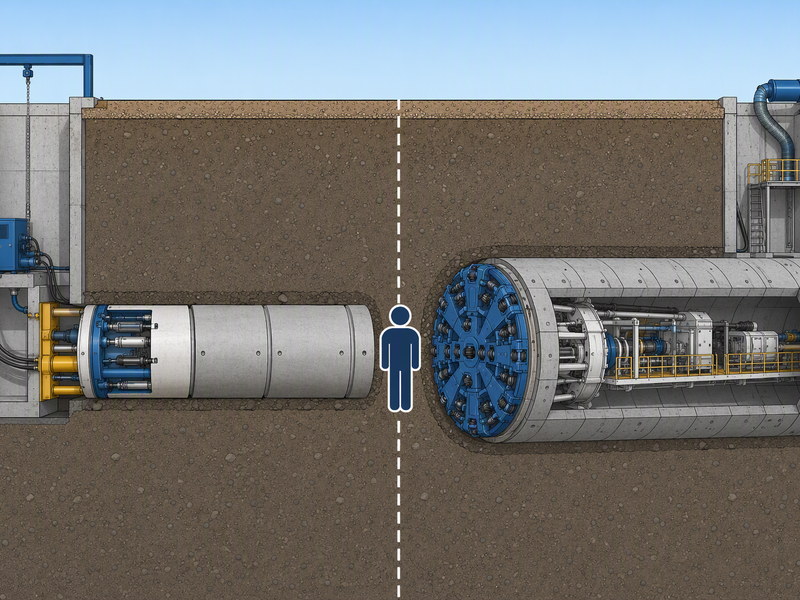
Microtunneling is quoted across a wide diameter band, and the drive length a project can attempt rises with it. The method covers roughly 0.35 to 4 m, and standard pipe jacking is generally described as spanning 150 to 2,400 mm, with larger bores achieved when the need justifies the machine.
The Pipe Jacking Association’s indicative lengths show how diameter and reach move together: 1.8 m to 900 m, 1.9 or 2.1 m to 1,000 m, and 2.4 m to 2,000 m, with drives able to greatly exceed 1 km when a project-specific risk analysis supports them.
Jacking force is why the envelope closes. Friction over the external circumferential area runs about 0.5 to 2.5 t/m² dry, dropping towards 0.1 t/m² once bentonite lubrication is applied, and large-diameter long drives almost always need intermediate jacking stations to keep thrust inside the pipe’s capacity.
Table 2 gives the working guide we use when a drainage trunk’s diameter is fixed by hydraulics and the drive length by the shaft locations the city permits.
| Internal diameter (m) | Indicative drive length (m) | Typical stormwater use |
|---|---|---|
| 1.0 | 250 | Local stormwater trunk |
| 1.2 | 450 | Urban stormwater conveyance |
| 1.5 | 700 | Trunk-scale stormwater drive |
| 1.8 | 900 | Large trunk and combined sewer overflow relief |
| 1.9 to 2.1 | 1,000 | Interjack stations normally required |
| 2.4 | 2,000 | Longest range; project-specific risk analysis |
A length table is a starting point, not a promise. The reach that matters is the one the geology, the shaft sites and the jacking force together allow.

What ground movement can a deep stormwater trunk be allowed under a road?
A drainage trunk runs under the busiest parts of a city, so ground movement is a contractual matter before a technical one. Settlement is a ground-loss effect, driven by the annular gap behind the machine and how quickly it is filled.
The annular overcut is typically 13 to 38 mm, and an overcut of about 35 mm can move the surface. Under a roadway or a railway, the annulus is tightened so settlement stays within about 10 mm, which is a specification item rather than a field choice.
- Settlement: ground loss into the annular gap; limit the overcut and grout promptly.
- Heave: face pressure above what the overburden carries; match pressure to cover.
- Utility conflicts: concentrate at shafts and connections, not along the deep trunk.
In the monitoring regimes we run, movement triggers are written into the contract with the asset owner before the drive starts. That owner’s limit governs instead of the contractor’s convenience, and the drive stops once a trigger is reached; compensation grouting is the usual remedy as it is approached.
Frequently asked questions (FAQ)
What determines the diameter of a stormwater microtunnel?
The diameter is set by the peak flow that the chosen design event produces, not by preference. Rainfall intensity for the return period feeds a runoff model, the resulting discharge is checked against pipe capacity using roughness and slope, and the trial diameter is enlarged until velocity and freeboard both pass.
Can microtunneling for stormwater handle a design storm peak flow?
Yes, within the diameter range the method can install. Microtunneling covers roughly 0.35 to 4 m, and ASCE/CI 36-15 treats it as a method description rather than a diameter limit, so a stormwater trunk can be sized hydraulically first and matched to the machine second.
How large can a large-diameter jacking pipe be?
The record for North America is a 3.4 m internal diameter stormwater trunk completed in Calgary in December 2022. Its pipe is 328 mm thick precast reinforced concrete designed to ASTM C76 and ASCE 27, supplied as 230 sections each 3.3 m long and heavier than 32 t.
When should a flood relief tunnel switch to a segmental TBM?
The practical divider is whether people must enter the tunnel to work. When manned entry, a segmental lining or a very large storage-tunnel diameter is required, a rock or soft-ground TBM with segmental lining is the better tool, while the Calgary 3.4 m drive stayed inside microtunneling range.
Can a microtunnel relieve a combined sewer overflow in a live system?
Yes, and that is a common driver. A new parallel trunk intercepts and stores or conveys the excess that would otherwise spill, and the connection is made at structures that already receive flow, so the existing system keeps operating during the drive.
How much settlement should a stormwater drive be allowed under a road?
Movement is governed by the annular overcut and how promptly it is grouted. Overcut is typically 13 to 38 mm, about 35 mm can move the surface, and under a roadway or a railway the annulus is tightened so settlement stays within about 10 mm.
Основные выводы
- Diameter follows from the design storm through runoff, roughness, slope and velocity, not from the machine.
- Microtunneling for stormwater suits deep, capacity-led urban trunks where open cut would hold the surface for a season.
- North America’s largest-diameter microtunnel is the Calgary 3.4 m stormwater trunk.
- A pipe of this size is a handling, joint and jacking-force problem as much as a boring problem.
- The boundary with a segmental TBM is manned entry, a segmental lining or deep storage scale.
- Shafts that double as permanent drops and flow-control structures carry part of their own cost.
How JSW supports stormwater and drainage projects
JSW is a pipeline engineering and construction company that delivers trenchless crossings with its own crews and equipment. Our scope covers строительство методом микротуннелирования, бестраншейные технологии, услуги по прокладке трубопроводов и услуги по ремонту трубопроводов, with pipeline inspection for connection and acceptance. For microtunneling for stormwater and drainage trunks, our range covers DN300 to DN1500 (12 to 60 in.), with single drives up to 600 m and laser guidance around ±25 mm.
Our teams treat the hydraulic design and the surface above it as one problem. That means confirming the diameter against the design event before tender, sizing each shaft for a permanent flow-control role where possible, and reporting process data that a reviewer can audit after the fact.
- Комплексная доставка: microtunneling, pipe installation and inspection under one scope.
- Auditable process data: guidance, jacking force and grout records available for review.
- Ценообразование с учетом риска: geotechnical, utility and access risks named in the bid, not hidden in a rate.
- Safety and compliance: ISO 9001:2015, ISO 14001:2015 and ISO 45001:2018 certified systems.
Planning a stormwater trunk or flood relief tunnel below a city? Send your design rainfall, target diameter and alignment for a free technical review. Our engineers respond with a scoped recommendation and a budget range.





































 English
  Arabic
  Russian
  Spanish
  French
  Vietnamese
  Polish
  Thai
Thai  Indonesian
  Turkish
  Portuguese