
Microtunneling vs Jack and Bore
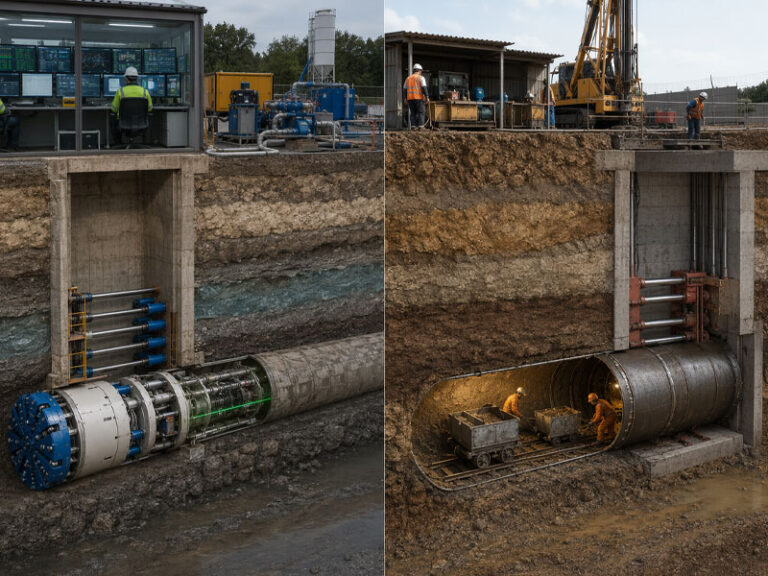
Microtunneling is a remote-controlled trenchless pipe installation method that uses a microtunnel boring machine (MTBM), laser guidance, and closed-face excavation to install pipelines without worker entry into the pipe. Jack and bore is a traditional trenchless method where workers enter the pipe to excavate soil and remove spoil manually or mechanically.
The main difference is that microtunneling provides higher safety, precision, and ground control, while jack and bore offers a lower-cost solution for short crossings in stable soil conditions. Microtunneling is a specialized form of pipe jacking that uses remote-controlled equipment instead of manual excavation inside the pipe.
| Характеристика | Микротоннелирование | Jack and Bore |
|---|---|---|
| Operation | Remote controlled from surface | Worker entry required inside pipe |
| Guidance | Laser-guided with millimetre precision | Manual/mechanical alignment |
| Точность | ±25–50 mm (continuous laser guidance) | ±50–100 mm (depending on conditions) |
| Ground Conditions | Soft soil, groundwater, unstable ground | Stable dry soil, above water table |
| Personnel Safety | Higher – no entry required | Lower – personnel inside active excavation |
| Initial Cost | Higher equipment and setup cost | Lower equipment and mobilisation cost |
| Диапазон диаметров | 10 to 136 inches | 42 inches and larger |
| Cost per Foot | $150–$500+ | $80–$250+ |
What Is Microtunneling?
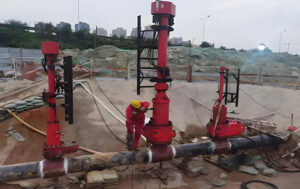
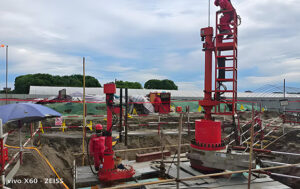
Микротоннелирование is a trenchless construction method that uses a remotely controlled microtunnel boring machine (MTBM) to excavate soil while hydraulic jacks simultaneously install prefabricated pipes from a launch shaft to a reception shaft. The entire operation is monitored and controlled from a surface control room using laser guidance systems and real-time data feeds.
Key characteristics:
- No personnel entry required during routine operations
- Closed-face excavation with continuous ground support
- Slurry or earth pressure balance systems manage groundwater and unstable soils
- Millimetre-level accuracy for gravity sewer and sensitive installations
Typical applications:
- Gravity sewer systems requiring precise slope control
- Water transmission pipelines
- Crossings beneath railways, highways, and rivers
- Urban utility installations with strict settlement limits
- Oil and gas pipeline crossings in complex terrain
What Is Jack and Bore?
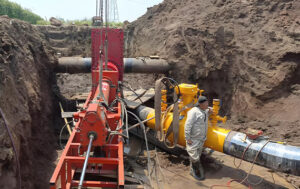
Jack and bore is a traditional trenchless installation method where a casing pipe is hydraulically pushed from a launch shaft while excavation occurs manually or mechanically inside the pipe. Workers enter the pipe to operate excavation equipment, remove spoil, and monitor alignment.
Key characteristics:
- Personnel required inside the pipe for excavation and spoil removal
- Open-face construction with limited ground support
- Suitable for larger diameter pipes (42 inches and above)
- Established method with extensive industry experience
Typical applications:
- Trunk sewer lines with larger diameters
- Water and utility crossings
- Road and railway crossings in stable ground
- Pressure pipelines where precise grade is less critical
- Utility corridors with large diameter requirements
Microtunneling vs Pipe Jacking
Microtunneling is a specialized pipe jacking technique. Traditional pipe jacking may involve manual excavation inside the pipe, while microtunneling uses a remotely controlled MTBM with laser guidance and no personnel entry.
Key distinction:
- Прокладка труб методом протаскивания = the broader family of hydraulic pipe installation methods
- Микротоннелирование = a remote-controlled, laser-guided subset of pipe jacking with higher precision and safety
The term “pipe jacking” encompasses both traditional methods (where workers may be inside the pipe) and microtunneling (where operation is fully remote). When specifying a project, it is important to distinguish between these approaches based on safety, accuracy, and ground condition requirements.
Key Differences Between Microtunneling and Jack and Bore
1. Operating Method and Control
| Аспект | Микротоннелирование | Jack and Bore |
|---|---|---|
| Управление | Remote from surface control room | Manual/mechanical inside pipe |
| Guidance System | Laser or gyro-based with real-time monitoring | Visual alignment or basic surveying |
| Excavation | Mechanical cutting head with face support | Manual or mechanical excavation |
| Spoil Removal | Slurry or auger system, continuous | Buggies, carts, or vacuum extraction |
The remote-control capability of microtunneling eliminates the need for personnel inside the pipe, significantly enhancing safety and enabling smaller diameter installations.
2. Worker Safety
Microtunneling:
- No personnel entry during routine operations
- Surface-based control eliminates confined space risks
- Continuous face support reduces collapse hazards
- CCTV and sensor monitoring provide full visibility
Jack and Bore:
- Personnel required inside the pipe during excavation
- Confined space entry protocols required
- Open-face construction increases collapse risk in unstable ground
- Air quality monitoring and ventilation systems required
The safety advantage of microtunneling is particularly significant in high-groundwater conditions or unstable soils where personnel entry would present unacceptable risks.
3. Accuracy and Precision
| Параметр | Микротоннелирование | Jack and Bore |
|---|---|---|
| Typical Accuracy | ±25–50 mm (line and grade) | ±50–100 mm (manual alignment) |
| Guidance Method | Laser or gyro-based with continuous monitoring | Visual/mechanical with limited adjustment |
| Real-time Monitoring | Yes – continuous position tracking | Ограниченный |
| Grade Control | Highly precise – ideal for gravity sewers | Умеренный |
Microtunneling’s laser guidance system provides continuous millimetre-level control over line and grade, making it the preferred choice for gravity sewer installations where precise slope is critical for hydraulic performance. Jack and bore relies on manual alignment methods that typically produce less precise results, though accuracy can vary based on operator experience and ground conditions.
4. Ground Conditions
| Ground Condition | Микротоннелирование | Jack and Bore |
|---|---|---|
| High Groundwater | Suitable – closed-face systems balance pressure | Not suitable (requires dewatering) |
| Unstable Soils | Suitable – continuous face support | Risky – open-face construction |
| Soft Soils/Peat | Suitable – slurry systems manage excavation | Limited – face stability issues |
| Rock/Mixed Ground | Suitable with specialized cutting heads | Ограниченный |
| Stable Dry Soils | Suitable | Лучшее применение |
Microtunneling is preferred over jack and bore in areas of high water table unless pumping systems can effectively draw down water levels during construction.
5. Diameter Range and Drive Length
| Параметр | Микротоннелирование | Jack and Bore |
|---|---|---|
| Диапазон диаметров | 10 to 136 inches | 42 inches and larger |
| Typical Drive Length | 500 to 1,500 feet | Up to 1,500 feet |
| Maximum Record Length | Up to 2,000 metres (with advanced systems) | Varies by ground conditions |
| Minimum Diameter | 10 inches (no personnel entry required) | 42 inches (to allow worker access) |
The minimum diameter limitation is critical: jack and bore requires personnel access, so pipes must be at least 42 inches in diameter. Microtunneling can install pipes as small as 10 inches because no personnel entry is required.
6. Cost Comparison and Factors
Microtunneling involves higher initial costs due to sophisticated equipment and greater setup complexity. Jack and bore is generally more cost-effective for shorter, simpler installations.
| Фактор стоимости | Микротоннелирование | Jack and Bore |
|---|---|---|
| Equipment Cost | Higher (MTBM, slurry plant, guidance) | Lower (jacking frame, basic equipment) |
| Mobilisation | More complex and time-consuming | Simpler and faster |
| Labour Requirement | Lower (remote operation) | Higher (personnel inside pipe) |
| Risk and Contingency | Lower (reduced ground risk) | Higher (ground instability risks) |
| Project Complexity | Suitable for complex/large projects | Suitable for short/simple projects |
Factors Affecting Microtunneling and Jack Bore Cost
| Фактор | Impact on Cost |
|---|---|
| Диаметр трубы | Larger diameter increases equipment and jacking requirements |
| Drive length | Longer drives require higher capacity systems and more planning |
| Soil conditions | Rock, boulders, and groundwater increase complexity and cost |
| Shaft depth | Deeper shafts increase construction and safety costs |
| Материал трубы | Different pipes require different jacking force capabilities |
| Site access | Limited access increases mobilisation and logistics cost |
| Groundwater management | Dewatering or slurry systems add significant cost |
| Accuracy requirements | Higher precision requires more sophisticated guidance systems |
Microtunneling vs Jack and Bore Cost per Foot
Typical cost range (indicative industry estimates):
- Microtunneling: Approximately $150–$500+ per linear foot
- Jack and Bore: Approximately $80–$250+ per linear foot
Actual project costs depend significantly on diameter, depth, soil conditions, groundwater levels, pipe material specifications, access shaft requirements, and site location. Always obtain project-specific quotations from qualified contractors for accurate cost estimates.
Microtunneling vs Jack and Bore: Which Method Is Better?
Neither method is universally better. The correct choice depends on project-specific requirements.
Microtunneling is generally preferred for:
- Gravity sewer systems requiring precise grade control
- Urban areas with strict settlement limits
- Difficult ground conditions (high groundwater, unstable soils)
- Small diameter pipelines (10–42 inches)
- Long drive lengths with complex alignment
- Projects where personnel safety is a primary concern
- Water transmission pipelines requiring accurate grade
Jack and Bore is usually preferred for:
- Large diameter casing pipes (42 inches and above)
- Short road or railway crossings
- Stable soil conditions above the water table
- Lower-budget projects with straightforward requirements
- Pressure pipelines where grade accuracy is less critical
- Rapid mobilisation and shorter project timelines
- Water and utility crossings in stable ground
Advantages and Disadvantages
Микротоннелирование
| Преимущества | Disadvantages |
|---|---|
| Remote operation – no personnel entry | Higher equipment and setup cost |
| Superior accuracy for gravity systems | More complex mobilisation |
| Suitable for unstable ground and high water table | Requires skilled operators and engineers |
| Continuous face support reduces ground settlement | Slurry treatment plant required |
| Can install small diameter pipes (10″+) | Not economical for very short drives |
| Lower risk of safety incidents | Longer lead times for equipment |
Jack and Bore
| Преимущества | Disadvantages |
|---|---|
| Lower equipment and mobilisation costs | Personnel entry required (safety concerns) |
| Simple and well-understood method | Limited to larger diameters (42″+) |
| Faster mobilisation for short drives | Not suitable for high groundwater |
| Extensive industry experience | Open-face construction – higher collapse risk |
| Suitable for large diameter installations | Limited accuracy for gravity systems |
| Widely available equipment and labour | Ground settlement risks in unstable soils |
Applications by Method
Microtunneling Applications
| Приложение | Why Microtunneling is Preferred |
|---|---|
| Gravity sewer systems | Laser-guided accuracy maintains required slopes |
| Stormwater pipelines | Precise alignment for hydraulic efficiency |
| Water transmission pipelines | Accurate grade control for gravity flow systems |
| Railway crossings | Controlled settlement prevents track deformation |
| Highway crossings | Minimal surface disruption and settlement |
| River crossings | Can install bundled pipelines in one casing |
| Urban utility corridors | Tight settlement limits protect adjacent structures |
| Oil and gas crossings | Handles complex terrain and precise alignment |
Jack and Bore Applications
| Приложение | Why Jack and Bore is Suitable |
|---|---|
| Trunk sewer lines | Large diameter pipes accommodate personnel access |
| Pressure pipelines | Less critical grade requirements |
| Water and utility crossings | Cost-effective for short crossings in stable ground |
| Road crossings (stable ground) | Simple method for short crossings |
| Utility corridors | Cost-effective for large diameter installations |
| Temporary lines | Lower cost for non-critical installations |
Часто задаваемые вопросы
Q: What is the main advantage of microtunneling?
A: Microtunneling provides superior accuracy, safety, and performance in difficult ground conditions because excavation is remotely controlled and continuously supported. The laser guidance system achieves millimetre-level precision, making it ideal for gravity sewer installations where slope control is critical.
Q: Why is microtunneling better for sewer installation?
A: Gravity sewer systems require precise slope control to maintain hydraulic performance. Microtunneling’s laser-guided system provides the accuracy required to install pipes at the correct grade, preventing flow issues and blockages.
Q: Can microtunneling replace jack and bore?
A: Yes. In many projects, microtunneling can replace traditional jack and bore when higher accuracy or difficult ground conditions are required. However, for short crossings in stable ground with large diameter pipes, jack and bore remains a cost-effective option.
Q: Is jack and bore cheaper than microtunneling?
A: Usually yes, especially for short crossings in stable soil. However, microtunneling may reduce risks and delays in complex projects, potentially making it more cost-effective over the project lifecycle when considering risk and contingency costs.
Q: What diameter pipes can each method install?
A: Microtunneling can install pipes from 10 to 136 inches. Jack and bore typically requires pipes of 42 inches or larger to allow personnel access for excavation and spoil removal.
Q: Which method is more accurate?
A: Microtunneling provides higher accuracy (±25–50 mm) compared to jack and bore (±50–100 mm). The laser guidance system enables continuous real-time monitoring and adjustment, while jack and bore relies on manual alignment methods.
Q: Does microtunneling work in rocky ground?
A: Yes. Microtunneling is effective for rocky terrain due to its closed-face systems and ability to handle boulders up to approximately 30% of face size with appropriate cutting heads.
Q: How long can microtunneling drives be?
A: Microtunneling can achieve 500–1,500 feet typically, with advanced systems reaching up to 2,000 metres (approximately 6,500 feet) depending on ground conditions and equipment specifications.
Q: What safety risks are associated with each method?
A: Microtunneling eliminates confined space entry risks by operating from the surface. Jack and bore requires personnel inside the pipe, exposing workers to collapse hazards, air quality issues, and other confined space risks.
Q: Is microtunneling suitable for all ground conditions?
A: Microtunneling is suitable for most ground conditions including soft soils, groundwater, unstable soils, and rock. However, very hard rock or heavily bouldered ground may require specialized cutting heads or pre-treatment.
Q: What is the cost per foot for microtunneling vs jack and bore?
A: Microtunneling typically costs approximately $150–$500+ per linear foot, while jack and bore typically costs approximately $80–$250+ per linear foot. Actual costs vary based on diameter, depth, soil conditions, and project location.
Q: Is microtunneling the same as pipe jacking?
A: No. Microtunneling is a specialized form of pipe jacking that uses remote-controlled equipment and laser guidance. Traditional pipe jacking may involve manual excavation inside the pipe.
Microtunneling vs Jack and Bore: Summary Comparison
| Характеристика | Микротоннелирование | Jack and Bore |
|---|---|---|
| Operation | Remote controlled | Worker entry required |
| Guidance | Laser/gyro with real-time monitoring | Manual/mechanical alignment |
| Точность | ±25–50 mm | ±50–100 mm |
| Диапазон диаметров | 10–136 inches | 42+ inches |
| Ground Conditions | All conditions (including groundwater) | Stable dry soil |
| Безопасность | No personnel entry | Personnel inside pipe |
| Face Support | Closed-face (continuous) | Open-face (limited) |
| Spoil Removal | Slurry or auger | Buggies/carts |
| Equipment Cost | Высокий | Low–Moderate |
| Mobilisation Complexity | Высокий | Low–Moderate |
| Labour Requirement | Низкий | Высокий |
| Risk Level | Низкий | Moderate–High |
| Лучшее для | Complex, long, accurate, urban | Simple, short, large diameter |
| Cost per Foot | $150–$500+ | $80–$250+ |
JSW Trenchless Engineering Capabilities
JSW provides comprehensive technical support for trenchless pipeline projects, including:
- Method selection based on ground conditions and project requirements
- Ground condition evaluation and geotechnical analysis
- MTBM and jacking system selection for optimal performance
- Pipe specification and material recommendations
- Construction planning and risk assessment
- Field engineering support during installation
- Обеспечение качества and project management
Equipment and Systems
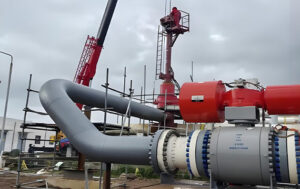
- Microtunnel Boring Machines (MTBM): Slurry and earth pressure balance systems for challenging ground conditions, handling diameters from 10 to 136 inches
- Jacking Systems: High-capacity hydraulic jacking frames and intermediate jacking stations with thrust capacities up to 2,000 tonnes
- Guidance Technology: Laser and gyro-based alignment systems achieving millimetre-level precision
- Pipe Supply: Reinforced concrete, GRP, steel, and vitrified clay pipes rated for jacking forces
- Slurry Treatment: Separation plants for efficient spoil management and fluid recycling
Why Choose JSW
- Proven track record across diverse ground conditions and project scales
- Comprehensive equipment fleet available for project mobilisation
- Experienced engineering team supporting project planning and execution
- Commitment to safety, quality, and environmental responsibility
- Global project experience with local technical support
Contact JSW trenchless specialists for project-specific engineering recommendations and method selection guidance.






 English
  Arabic
  Russian
  Spanish
  French
  Vietnamese
  Polish
  Thai
Thai  Indonesian
  Turkish
  Portuguese