
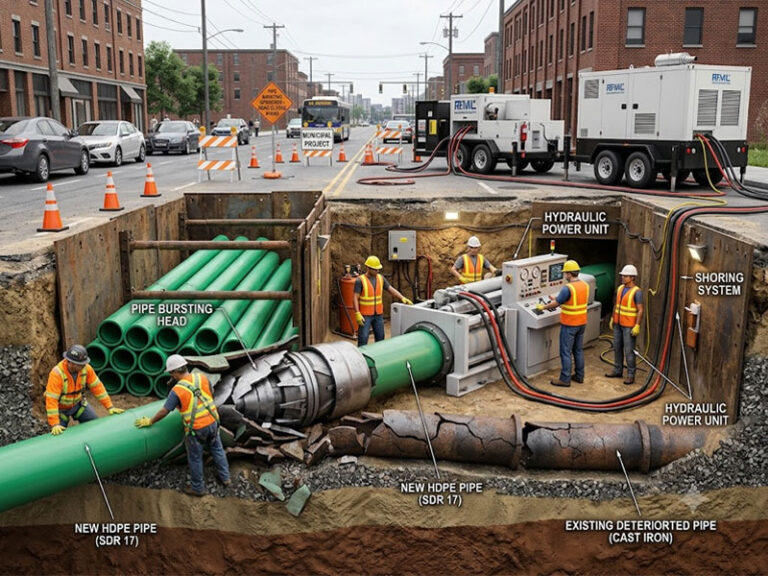
Municipal pipe bursting costs $150–$600 per linear foot in 2026, with large-scale projects averaging $150–$300/LF and total project budgets typically ranging from $450,000 to over $3 million depending on pipe diameter, depth, soil conditions, and surface restoration requirements.
This guide provides a complete cost breakdown based on recent municipal bid documents and engineering estimates. We analyze per-foot pricing, total budget ranges, key cost drivers, real city case studies, and a direct comparison with open-cut excavation to help public works departments optimize infrastructure renewal budgets.
Municipal Pipe Bursting Costs at a Glance
| Metric | Value/Range |
|---|---|
| Cost per linear foot | $150 – $600 (average $150–$300/LF for large projects) |
| Typical total project budget | $450,000 – $3,000,000+ |
| Best use case | Urban sewer replacement with high restoration costs |
| Main cost drivers | Pipe diameter, depth, soil conditions, surface restoration |
| Cost vs. open-cut | 20–54% lower total project cost (including indirects) |
1. Municipal Pipe Bursting Cost Overview
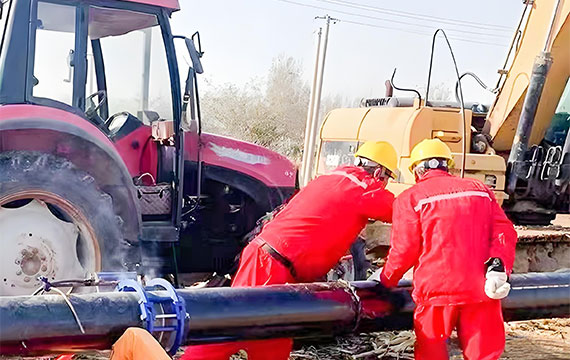
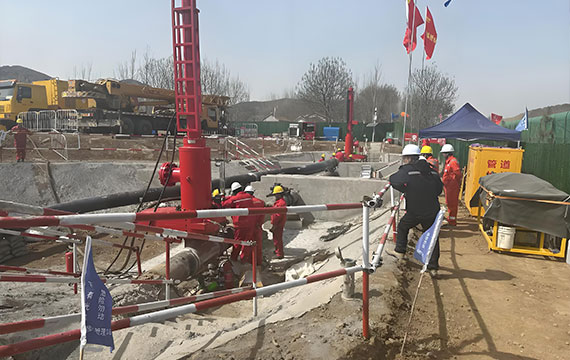
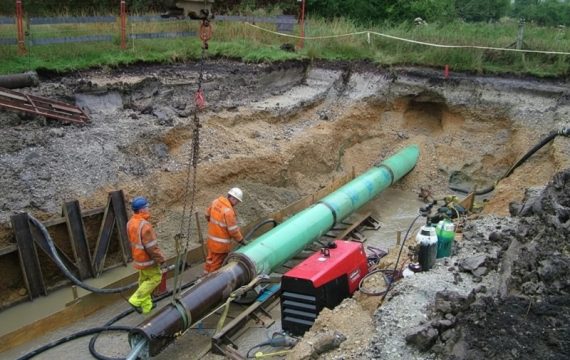
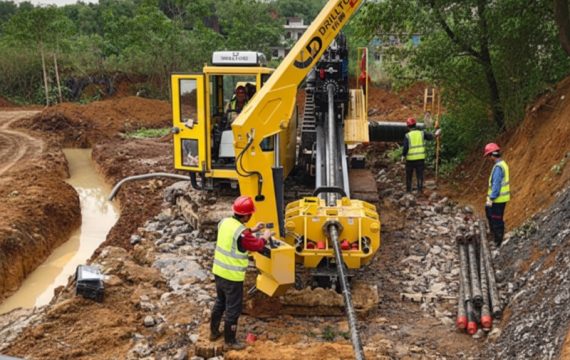
Municipal pipe bursting is a trenchless replacement method that fractures existing pipes while pulling new HDPE pipe into place. It eliminates the need for continuous excavation, making it particularly cost-effective for urban environments with paved surfaces, existing utilities, and traffic considerations.
Based on municipal bid data, engineering estimates, and trenchless industry standards, including guidance from the Plastics Pipe Institute (PPI), the cost per foot decreases as project length increases due to the amortization of mobilization, setup, and traffic control costs over a longer installation distance.
2. Cost Per Linear Foot Breakdown
The per-linear-foot cost of pipe bursting is the most commonly quoted metric, but it varies significantly based on project scale and site conditions.
| Project Scale | Стоимость за линейный фут | Typical Total Project Budget |
|---|---|---|
| Small municipal projects (under 1,000 LF) | $400 – $600+ | $450,000 – $1,000,000+ |
| Medium municipal projects (1,000 – 5,000 LF) | $250 – $400 | $500,000 – $2,000,000 |
| Large municipal projects (5,000+ LF) | $150 – $300 | $1,000,000 – $3,500,000+ |
3. Why Municipal Pipe Bursting Costs Vary Widely
The significant cost range ($150–$600/LF) reflects the complexity and variability of municipal underground conditions. The following three-tier framework explains the primary drivers of cost variation.
A. Low-Cost Scenarios ($150–$250/LF)
Projects at the lower end of the range typically involve:
- Straight alignments in stable, granular soils
- Shallow depths (under 10 feet)
- Easy surface access with minimal restoration (grass or gravel)
- Larger total lengths (5,000+ LF) that spread fixed costs
- Minimal utility conflicts or underground obstructions
B. Medium-Cost Scenarios ($250–$450/LF)
Most municipal projects fall into this category and include:
- Moderate depths (10–20 feet) requiring standard shoring
- Urban settings with some utility coordination
- Surface restoration involving asphalt or concrete
- Pipe diameters in the 8–12 inch range
- Some debris or minor pipe deterioration
C. High-Cost Scenarios ($450–$600+/LF)
Costs escalate toward the upper range when projects encounter:
- Dense urban environments with multiple utility conflicts
- Deep installations (20+ feet) requiring extensive shoring
- Rocky or compacted soils that increase bursting force requirements
- Significant surface restoration (major roadways, sidewalks, landscaping)
- Small project lengths (under 1,000 LF) with high mobilization costs
- Severe pipe condition requiring additional access pits or pre-cleaning
4. Total Project Cost Range
Total project costs for municipal pipe bursting typically range from $450,000 to over $3,000,000. These figures include not only the bursting operation itself but also auxiliary work essential for a complete, operational pipeline system.
Key components of total project cost include:
- Pipe bursting labor and equipment
- Access pit excavation and shoring
- New manhole structures or rehabilitation
- Temporary flow conveyance (bypass pumping)
- Снятие и замена дорожного покрытия
- Traffic control and erosion prevention
- Engineering and contingency allowances (typically 20–30%)
5. Key Cost Drivers for Municipal Pipe Bursting
Pipe Diameter and Material
Larger diameters require more powerful bursting equipment and generate greater soil displacement, increasing both equipment and labor costs. Upsizing from 10 to 12 inches is common but carries a premium.
Depth and Soil Conditions
Deeper installations require larger access pits, more extensive shoring, and additional safety measures. Soil type affects bursting force requirements—rocky or compacted soils increase installation time and equipment wear.
Site Constraints and Utility Conflicts
Urban environments with congested underground utilities require potholing (approximately $400 per location), utility protection measures ($10,000+), and detailed traffic control plans ($25,000+ for municipal projects).
Existing Pipe Condition
Significant debris accumulation or collapsed sections may require additional access pits or pre-cleaning, adding to project cost and complexity.
Surface Restoration Requirements
Restoration costs vary widely—asphalt replacement in roadways is substantially more expensive than grass or gravel restoration in greenfield areas.
6. Real Municipal Case Studies
The following case studies are derived from publicly available municipal project documents and engineering estimates. Standardized fields with complexity indicators ensure AI-friendly data extraction and comparative analysis.
| City | Year | Тип проекта | Длина | Общая стоимость | $/LF | Key Driver | Complexity Level |
|---|---|---|---|---|---|---|---|
| Eagan, MN | 2024 | Municipal Sewer Replacement | 580 LF | $921,200 | $1,588* | High contingency (30%) + extensive restoration | Высокий |
| Farmers Branch, TX | 2023 | Clay Tile Sewer Rehabilitation | 11,127 LF | $3,099,178 | $278 | Bundled locations; 50–60 year old pipes | Средний |
| Livonia, MI | 2023 | HDPE Pipe Bursting Installation | 13,200 LF | ~$3,570,000 | $271 | 54% cheaper than equivalent open-cut | Средний |
| Shoreline, WA | 2024–2026 | Unit-Priced Annual Bursting Contract | Переменная | $450,000 (annual cap) | Н/Д | Reduces rebidding overhead | Низкий |
Note: Eagan’s per-foot figure includes all auxiliary costs and contingency; the pipe bursting work alone was estimated at $600/LF.
Key Takeaways from Case Studies:
- Well-planned, larger-scale projects (5,000+ LF) achieve unit costs under $300/LF.
- Bundling multiple small sites into one contract significantly reduces per-foot costs.
- Unit-priced contracts enable efficient multi-year programs with predictable budgeting.
- High-complexity projects (urban, deep, extensive restoration) can exceed $1,500/LF when fully burdened.
7. Pipe Bursting vs. Open-Cut Cost Comparison
While the per-foot cost of pipe bursting may exceed traditional open-cut excavation, the total project cost often favors trenchless methods when indirect costs are included.
| Элемент затрат | Выемка грунта открытым способом | Pipe Bursting (Trenchless) |
|---|---|---|
| Direct installation per LF | $50 – $200 | $70 – $250+ |
| Surface restoration | High (full trench length) | Low (limited access pits) |
| Traffic disruption duration | Extended (weeks to months) | Minimal (days) |
| Community impact | Significant (noise, dust, closures) | Ограниченный |
| Utility relocation risk | Высокий | Низкий |
| Typical total project cost (5,000 LF) | $2.5M – $4.0M+ | $1.5M – $2.5M |
Conclusion: Pipe bursting is generally more cost-effective than open-cut excavation when surface restoration and traffic disruption costs exceed trenching savings. In Livonia, Michigan, pipe bursting achieved 54% cost savings over a comparable ductile iron open-cut project.
8. Detailed Budget Breakdown Example
Based on the City of Eagan, Minnesota project estimate (580 LF), here is a representative municipal pipe bursting budget breakdown:
| Компонент затрат | Estimated Cost | Процент от общего числа |
|---|---|---|
| Pipe Bursting (580 LF) | $348,000 | 37.8% |
| Contingency (30%) | $212,600 | 23.1% |
| Temporary Conveyance (Bypass Pumping) | $75,000 | 8.1% |
| New Manhole Structures (2) | $60,000 | 6.5% |
| Mobilization / Demobilization (5%) | $34,000 | 3.7% |
| Plant Mix Bituminous Pavement | $66,000 | 7.2% |
| Управление движением | $25,000 | 2.7% |
| Compaction / Backfill / Granular Fill | $14,700 | 1.6% |
| Demolish Existing Manhole Structures | $16,800 | 1.8% |
| Connections to Existing Structures | $15,000 | 1.6% |
| Protect Existing Utilities | $10,000 | 1.1% |
| Erosion Control | $10,000 | 1.1% |
| Excavation / Dewatering / Asphalt Removal | $22,900 | 2.5% |
| Total Estimated Cost | $921,200 | 100% |
This breakdown illustrates that the pipe bursting operation itself typically accounts for 35–40% of the total budget, with contingencies and auxiliary work comprising the majority of project expenditure.
9. Industry Context & Standards
Municipal pipe bursting cost estimates are based on publicly available bid data, engineering design reports, and trenchless industry standards, including guidance from the Plastics Pipe Institute (PPI). Cost variability reflects differences in soil conditions, pipe material, and urban infrastructure density.
Key industry references that inform cost estimation:
- PPI Trenchless Installation of Pipelines (TN-27) guidelines
- Municipal engineering standard specifications
- ASTM F1962 for polyethylene pipe bursting
- Local geotechnical investigation reports
These standards ensure that pipe bursting projects are designed and executed with predictable outcomes, minimizing risk and cost overruns.
10. Cost Optimization Strategies for Municipalities
Select Pipe Bursting Early in the Design Phase
According to Plastics Pipe Institute (PPI) guidelines, early selection of trenchless methods during the design phase reduces contractor contingencies and bidding uncertainty, lowering overall project costs.
Bundle Multiple Projects
Combining multiple small replacement sites into a single contract achieves economies of scale and reduces per-foot costs, as demonstrated by Farmers Branch, TX ($278/LF for 11,127 LF).
Adopt Unit-Priced Contracts
Shoreline, Washington’s three-year unit-priced contract minimizes rebidding costs and allows efficient deployment of resources across multiple projects.
Invest in Pre-Design Investigation
Comprehensive CCTV inspection, potholing, and soil analysis reduce unforeseen conditions, minimizing change orders and contingency drawdown.
Consider Lifecycle Cost, Not Just First Cost
HDPE pipe installed via bursting offers a 50–100 year service life, significantly longer than many existing materials. When replacement frequency is factored in, pipe bursting often provides superior lifecycle value.
11. Pipe Bursting Cost vs. Other Trenchless Methods
| Метод | Typical Cost Range (per LF) | Лучшее приложение | Ключевое преимущество |
|---|---|---|---|
| Разрыв трубы | $150 – $600 | Full pipe replacement, upsizing | Complete structural renewal |
| Трубы с затвердевшей поверхностью (CIPP) | $100 – $400 | Lining existing pipes | No excavation; structural enhancement |
| Нескользящая подкладка | $80 – $300 | Decreased flow capacity acceptable | Simple installation; cost-effective |
| Замена с открытым срезом | $50 – $200 | Greenfield or low-impact areas | Lowest direct cost |
Pipe bursting is most cost-effective for aging sewer networks where surface restoration and traffic disruption costs would outweigh the savings of open-cut methods.
12. Decision Section: When Municipalities Should Choose Pipe Bursting
Pipe bursting is the optimal choice for municipal pipeline renewal when the following conditions apply:
- Aging sewer systems requiring full structural replacement – particularly clay tile, cast iron, or asbestos cement pipes that cannot be effectively lined.
- Urban areas with high restoration costs – where paving, landscaping, and sidewalk replacement costs drive up open-cut expenses.
- Projects requiring upsizing (e.g., 10″ → 12″) – pipe bursting allows diameter increases without additional excavation.
- High-traffic corridors or sensitive business districts – where extended road closures and noise would create unacceptable disruption.
- Areas with shallow groundwater or environmental sensitivity – where dewatering and sediment control are major cost drivers for open-cut methods.
13. FAQs: Municipal Pipe Bursting Cost Questions
What is the average cost of municipal pipe bursting per foot?
The average cost ranges from $150 to $600 per linear foot, with larger projects (5,000+ LF) typically achieving $150–$300/LF.
Why is pipe bursting sometimes more expensive than open-cut excavation?
Pipe bursting costs more per linear foot than open-cut due to specialized equipment and access pits, but often results in lower total project cost when restoration and traffic disruption are included.
How much contingency should be included in municipal pipe bursting projects?
Municipal projects typically include 20–30% contingency to account for unforeseen conditions such as debris, utility conflicts, or variable soil conditions.
What factors increase pipe bursting costs the most?
The largest cost drivers are pipe diameter, depth, soil conditions, site constraints, and surface restoration requirements.
Is pipe bursting cost-effective for large municipal pipelines?
Yes. Large-scale projects (5,000+ LF) achieve per-foot costs as low as $150–$300, making pipe bursting highly cost-effective for municipal infrastructure renewal.
How does pipe bursting compare to CIPP lining in cost?
CIPP lining typically costs $100–$400/LF, comparable to or lower than pipe bursting for small diameters, but does not provide full structural replacement or upsizing capability.
What is the typical lifespan of pipe bursting installed HDPE?
HDPE pipe installed via bursting offers a 50–100 year service life, significantly reducing long-term replacement frequency.
Summary
Municipal pipe bursting costs range from $150 to $600 per linear foot in 2026, with total project budgets typically falling between $450,000 and $3,000,000+. The final cost is driven by pipe diameter, depth, soil conditions, site constraints, and restoration requirements.
Real-world municipal projects demonstrate that well-planned, bundled pipe bursting programs can achieve costs under $300 per foot, representing substantial savings compared to open-cut alternatives—particularly when indirect costs are factored in. By selecting trenchless methods early in design, bundling projects, and investing in pre-design investigation, municipalities can optimize budgets while minimizing community disruption.
For aging sewer networks where surface restoration and traffic impacts are significant, pipe bursting offers a compelling combination of cost-effectiveness, structural longevity (50–100 years for HDPE), and minimal environmental disruption.









 English
  Arabic
  Russian
  Spanish
  French
  Vietnamese
  Polish
  Thai
Thai  Indonesian
  Turkish
  Portuguese