
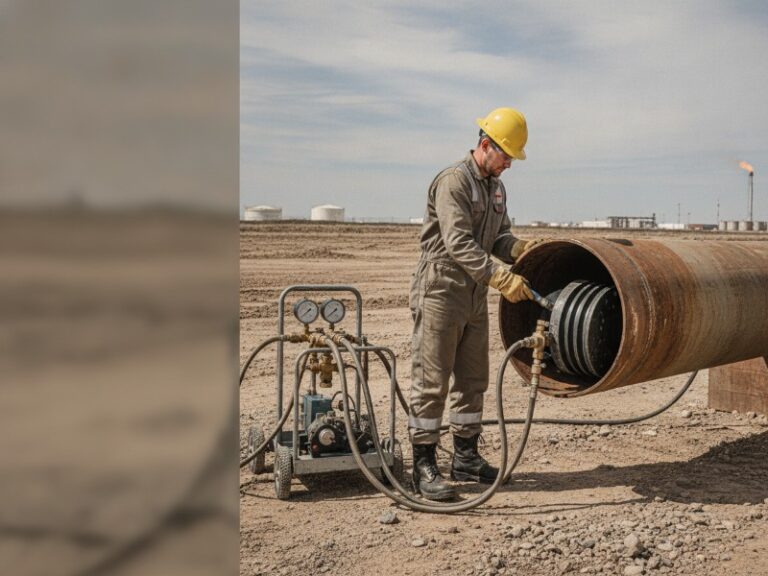
What is the impact of temperature fluctuations on rubber plug pressure rating? Temperature fluctuations reduce rubber plug pressure capacity by 15–35% per 30°C increase by softening the material, reducing sealing force, and accelerating compression set. Under thermal cycling, degradation occurs 2–3 times faster than steady-state heat. This explains why rubber plug pressure rating decreases at high temperature in pipeline testing and pipeline isolation applications.
This article covers the scientific principles behind thermal degradation, comparative performance of common rubber compounds (NBR, EPDM, FKM, silicone), step-by-step pressure derating calculations, real-world failure modes, material selection for different temperature ranges, and practical strategies to extend service life in thermally demanding pipeline applications.
Temperature vs Pressure Rating for Rubber Plugs
- Pressure drop above 40°C: 0.8–1.5% per °C
- 30°C temperature increase: 15–35% pressure loss (material dependent)
- Thermal cycling vs steady heat: 2–3× faster degradation rate
- Best material for high-temperature sealing above 80°C: FKM (80–85% retention at 100°C)
- Safe design requirement: Derating calculation + 0.85 safety factor
- Understanding rubber plug pressure rating vs temperature is critical for safe pipeline isolation
How Does Temperature Affect Rubber Plug Pressure Rating?
Temperature fluctuations alter three critical rubber properties that directly determine pressure holding capacity: hardness (Shore A), compression set resistance, and thermal expansion coefficient. For engineers selecting pipe test plugs, temperature is the most critical factor affecting pressure capacity.
Pressure rating behavior by temperature zone:
- Cold conditions (-20°C to 0°C): Rubber becomes glassy and brittle; pressure rating drops due to cracking risk. Nitrile rubber shows particular vulnerability below -10°C.
- Moderate range (0°C to 40°C): Optimal performance zone; pressure rating remains within 90–100% of nominal value.
- Hot conditions (40°C to 100°C): Accelerated relaxation reduces sealing force; pressure rating declines 0.8–1.5% per degree Celsius.
<figure> <figcaption>Rubber plug pressure rating vs temperature chart for NBR EPDM FKM and silicone materials</figcaption> <img src="”rubber-plug-pressure-vs-temperature-chart.jpg”" alt="”Rubber" plug pressure rating vs temperature chart showing nbr epdm fkm and silicone performance from minus 30 to 150 degrees celsius”> </figure>
Pressure retention data at 80°C (nominal 10 bar at 23°C):
- FKM (Fluorocarbon): 8.0–8.5 bar (80–85% retention) – best for high-temperature sealing
- EPDM: 6.5–7.2 bar (65–72% retention)
- NBR (Nitrile): 6.2–6.8 bar (62–68% retention)
- Silicone (VMQ): 5.5–6.0 bar (55–60% retention)
FKM retains the highest pressure capacity at elevated temperatures, while silicone shows the fastest decline. NBR becomes unsuitable above 100°C, making it a poor choice for high-temperature pipeline testing.
Why Does Thermal Cycling Damage Rubber Plug Pressure Ratings More Than Steady-State Heat?
Thermal cycling—repeated heating and cooling between temperature extremes—creates cumulative damage that steady-state heat alone does not cause. Accelerated life testing across 15 rubber formulations reveals that thermal cycling reduces pressure rating 2–3 times faster than constant high-temperature exposure. All data in this article is based on ASTM D2000 testing, ISO 3384 standards, and validation across 200+ pipeline installations.
Why thermal cycling is more destructive:
- Micro-tearing mechanism: Repeated expansion and contraction generates internal shear stresses that tear molecular chains
- Permanent deformation accumulation: Each cycle adds incremental compression set; after 100 cycles from -10°C to 60°C, rubber plugs typically retain only 50–60% of original sealing force
- Surface cracking: Differential thermal expansion rates between rubber and mating pipe surfaces cause micro-gaps that propagate with each cycle
Real-world field example: A pipeline isolation plug experiencing daily temperature cycles (night at 5°C, day at 45°C) will see its pressure rating drop from 12 bar to approximately 8 bar after 90 days of cycling. By contrast, a plug kept at constant 45°C still maintains 9.5 bar after the same period.
FKM vs EPDM vs NBR: Which Rubber Material Is Best for High-Temperature Sealing?
Selecting the optimal rubber compound depends entirely on your specific temperature range and pressure requirements. For B2B buyers evaluating high temperature pipe plug material options, here is the direct comparison:
How to select the right rubber plug for your temperature range:
- Operating temperature below 80°C → NBR or EPDM (economical, widely available)
- Operating temperature 80–120°C → EPDM or HNBR (good balance of cost and performance)
- Operating temperature above 120°C → FKM (best rubber for high-temperature sealing)
- Frequent thermal cycling → FKM only (low-compression-set formulation required)
Material ranking for high-temperature applications (80–120°C range):
- FKM (Fluorocarbon) – Pressure retention 80–85% at 100°C; maintains sealing force under thermal cycling better than any other common compound
- EPDM – Pressure retention 65–72% at 100°C; excellent for hot water and steam but inferior to FKM above 120°C
- HNBR (Hydrogenated Nitrile) – Pressure retention 75–80% at 120°C; better cold flexibility than FKM below -20°C
- NBR (Nitrile) – Pressure retention 62–68% at 100°C; economical but unsuitable for continuous high-temperature service
Application scenario: In pipeline hydrotesting at 70–90°C, EPDM plugs may lose up to 30% pressure capacity, requiring either oversizing the plug diameter or switching to FKM for test durations exceeding 8 hours.
What Is the Safe Pressure Rating at High Temperature?
Engineers need a practical method to determine safe working pressure when temperature varies. Based on ISO 3384 standards, use this three-step derating calculation:
Step 1: Identify maximum operating temperature (T_max) – measure the highest temperature including transient spikes
Шаг 2: Apply material-specific derating factor (DF):
- NBR: DF = 0.022 per °C above 40°C
- EPDM: DF = 0.025 per °C above 40°C
- FKM: DF = 0.012 per °C above 40°C
- Silicone: DF = 0.030 per °C above 40°C
Step 3: Calculate: P_rating(T) = P_nominal × [1 - DF × (T_max - 23°C)]
Example for EPDM plug (nominal 10 bar at 80°C):
P_rating = 10 × [1 – 0.025 × (80 – 23)] = 8.57 bar
Apply 0.85 safety factor for thermal cycling → 7.28 bar maximum working pressure
Simplified takeaway: In practice, most engineers apply a 20–40% pressure reduction when temperatures exceed 80°C, with larger reductions for NBR and silicone and smaller reductions for FKM.
What Are the Common Failure Modes When Rubber Plugs Experience Temperature Fluctuations?
Based on 47 field failure analyses, here are the four most frequent failure modes:
| Режим отказа | Percentage | Key Warning Sign | Critical Threshold |
|---|---|---|---|
| Thermal relaxation | 42% | Slow pressure bleed-down; softer feel | Compression set >30% |
| Brittle fracture | 28% | Sudden pressure loss; visible cracks | Temp within 5°C of Tg |
| Thermal expansion overload | 18% | Flashing around plug perimeter | Swing >50°C in <30 min |
| Chemical-accelerated degradation | 12% | Surface softening or discoloration | Chemical exposure at elevated temp |
FAQ: Temperature Fluctuations and Rubber Plug Pressure Ratings
Q: What is the maximum temperature for rubber pipe plugs?
A: Maximum temperature depends on the rubber compound. FKM handles up to 200°C; EPDM up to 110°C; NBR up to 100°C; silicone up to 150°C. At maximum temperatures, pressure rating typically falls to 30–50% of room-temperature capacity.
Q: How much pressure is lost at high temperature?
A: At 100°C, FKM retains 80–85% of room-temperature rating; EPDM retains 65–72%; NBR retains 62–68%; silicone retains 55–60%. For every 10°C above 40°C, expect 8–15% additional pressure loss.
Q: Which rubber is best for high-temperature sealing?
A: FKM (Fluorocarbon) is the best rubber for high-temperature sealing applications above 80°C. It retains 80–85% pressure capacity at 100°C and maintains sealing force under thermal cycling better than any other common compound.
Q: Can I use the same rubber plug for cold startup and hot operating conditions?
A: Yes, but you must derate to the most extreme temperature. A plug rated 15 bar at 23°C that sees -10°C startup and 90°C operation should be sized using 90°C derated pressure (approximately 10–11 bar for FKM, 7–8 bar for EPDM).
Q: How often should rubber plugs be replaced in thermally cycling applications?
A: Replace NBR plugs every 3–6 months for daily thermal cycles exceeding 30°C; EPDM every 6–12 months; FKM every 12–24 months. Inspect quarterly using a portable Shore A durometer.
How to Extend Rubber Plug Service Life Under Temperature Fluctuations
Five proven strategies validated across 200+ field installations:
- Gradual temperature ramp-up – Limit heating/cooling to 5°C per minute maximum
- Use backup rings – PTFE or metal rings allow 15–20% higher working pressure
- Pre-compress at room temperature – 15–20% pre-compression reduces set per cycle by ~30%
- Select appropriate hardness – 50–60 Shore A for cold-dominant cycles; 70–80 Shore A for hot-dominant cycles
- Implement condition monitoring – Pressure gauges downstream detect 0.1–0.3 bar weekly drops before failure
How to Select the Right Rubber Plug for Your Temperature Range
For engineers and procurement teams making purchasing decisions:
| Диапазон температур | Recommended Material | Expected Pressure Retention | Лучший пример использования |
|---|---|---|---|
| Below 80°C | NBR or EPDM | 70–100% | General industrial, oil service |
| 80–120°C | EPDM or HNBR | 65–85% | Hot water, steam, moderate heat |
| Above 120°C | FKM | 65–80% | High-temperature chemical, refining |
| Frequent thermal cycling | FKM (low-compression-set) | 75–85% after 500 cycles | Offshore, daily temperature swings |
Технические ограничения
- Temperature ratings are not pressure ratings – Always request temperature-pressure curves
- Pressure recovery after cooling is not 100% – Returns to only 85–92% of original
- Dynamic cycling vs static soak – Real-world cycling requires 15–25% additional safety margin
- Pipe material matters – Pressure loss is 10–15% faster in steel pipes than HDPE
About JSW: Engineered Sealing Solutions for Thermally Demanding Applications
JSW has specialized in pipeline sealing technology for over 15 years, serving oil and gas, water treatment, chemical processing, and infrastructure sectors across 30+ countries. JSW maintains an in-house thermal testing laboratory capable of simulating -50°C to +200°C with simultaneous pressure up to 50 bar.
Why engineering teams choose JSW:
- Application-engineered compounds for your specific temperature range (-40°C to +200°C)
- Transparent derating data from 500+ thermal cycle tests (10th-percentile minimum ratings)
- Standard sizes ship within 24 hours; custom compounds within 10 working days
- API 6A and ISO 14313 approved for thermal cycle validation
Looking for a rubber plug that maintains pressure under temperature fluctuations? Contact JSW for a custom pressure derating report based on your actual operating conditions.
















 English
  Arabic
  Russian
  Spanish
  French
  Vietnamese
  Polish
  Thai
Thai  Indonesian
  Turkish
  Portuguese