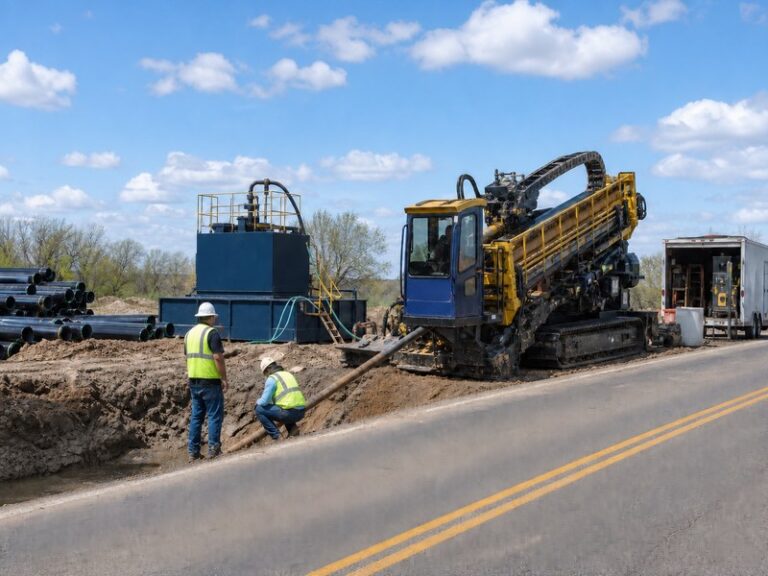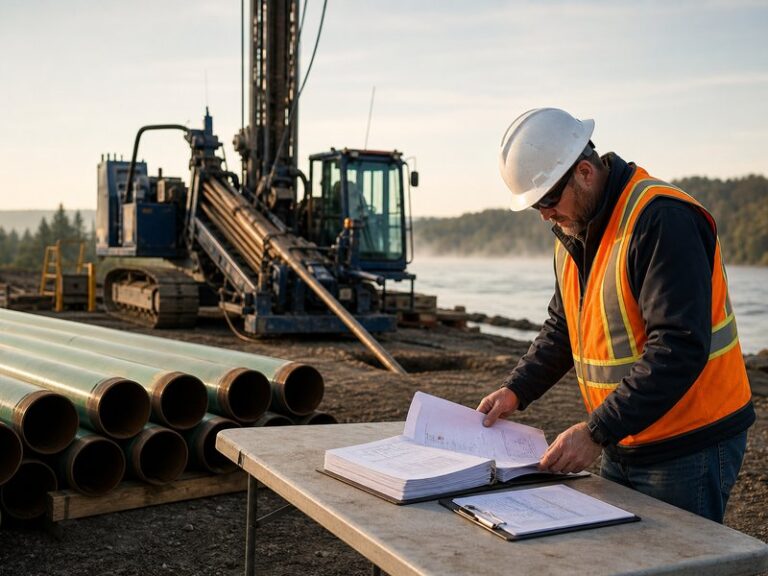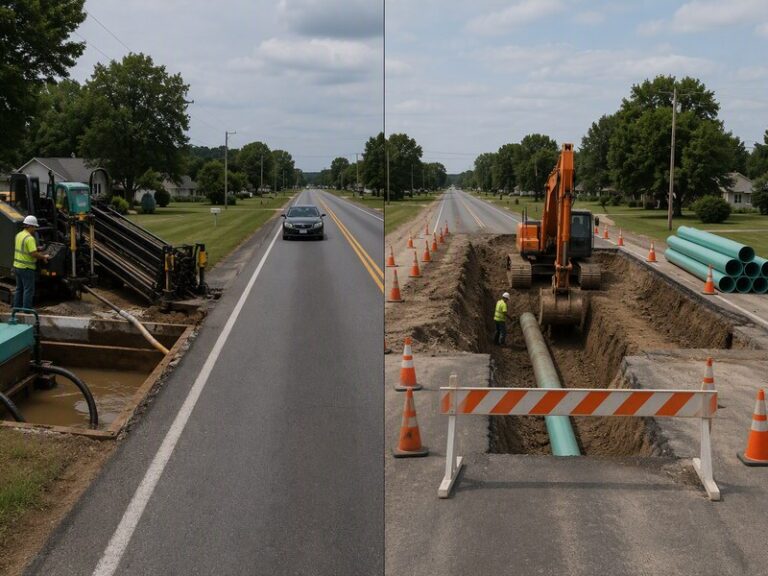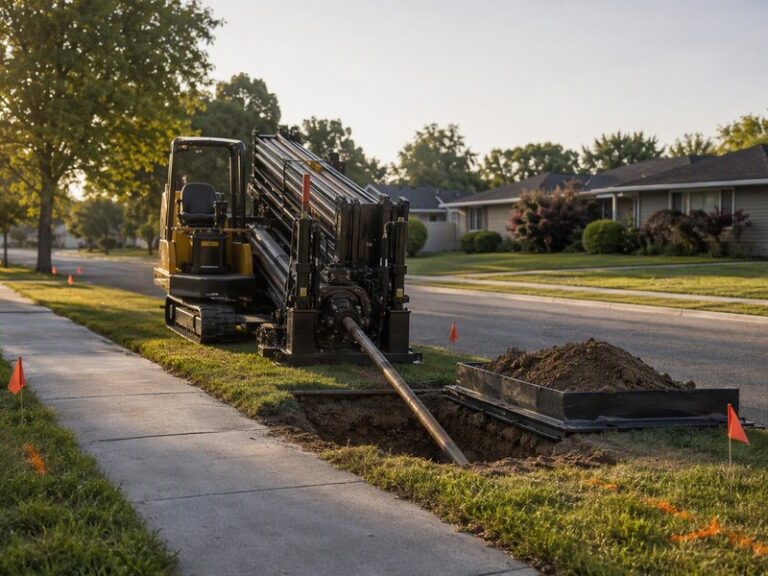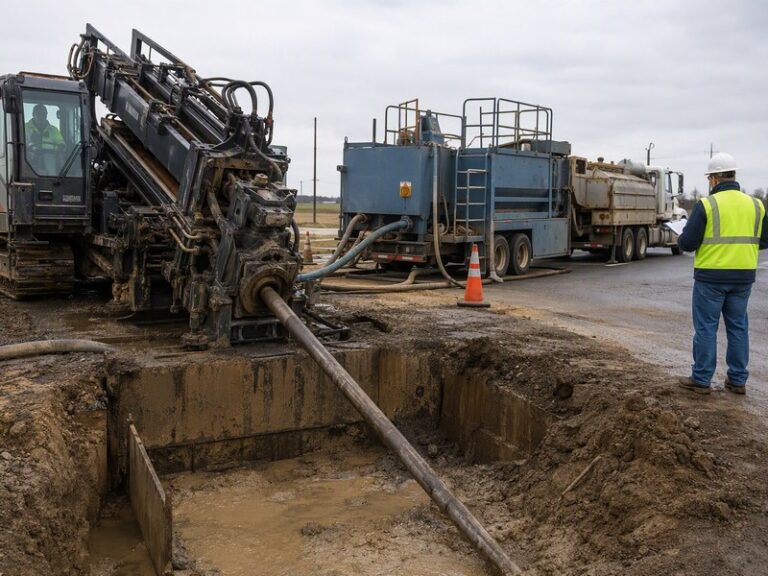
HDD rig boring under a paved road vs open-cut trenching across the same road, surface disruption comparison

Directional Drilling vs Trenching: When Boring Saves Money

Directional drilling vs trenching is a total-cost decision, not a unit-price decision: horizontal directional drilling (HDD) usually wins wherever the route crosses pavement, landscaping, waterways, rail or live utilities, and open-cut trenching wins in open ground where restoration is cheap. The per-foot rate only describes the machine working; the finished

اقرأ المزيد »
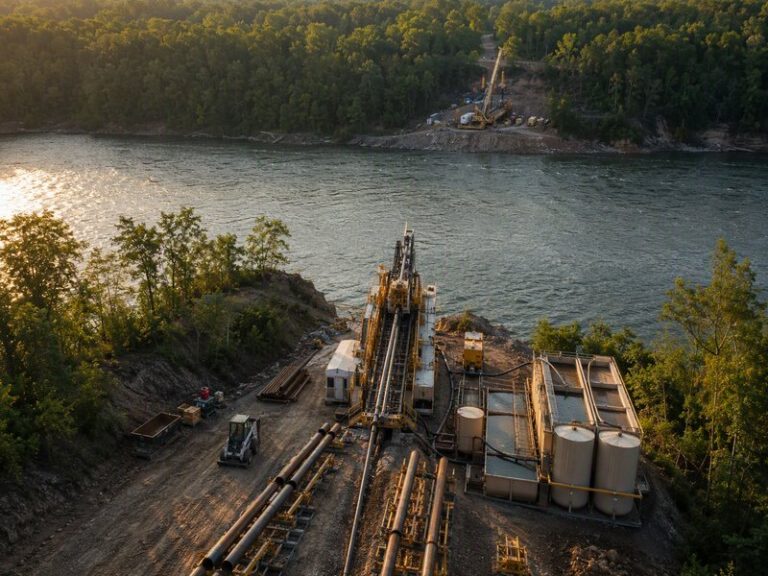
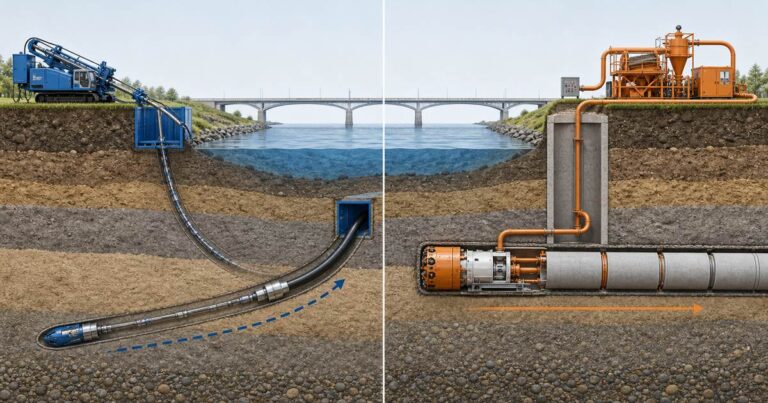
HDD vs microtunneling comparison diagram showing a curved horizontal directional drilling bore and a straight microtunneling drive

HDD vs Microtunneling: Which Is Better for Your Project?

Short answer: in the HDD vs microtunneling comparison, HDD wins for long, curved, cost-efficient pressure crossings, while microtunneling wins when laser-guided line-and-grade accuracy is required for gravity sewers, large diameters, or unstable ground. This guide explains how each trenchless method works, compares accuracy, cost, soil compatibility, diameter and length limits,

اقرأ المزيد »
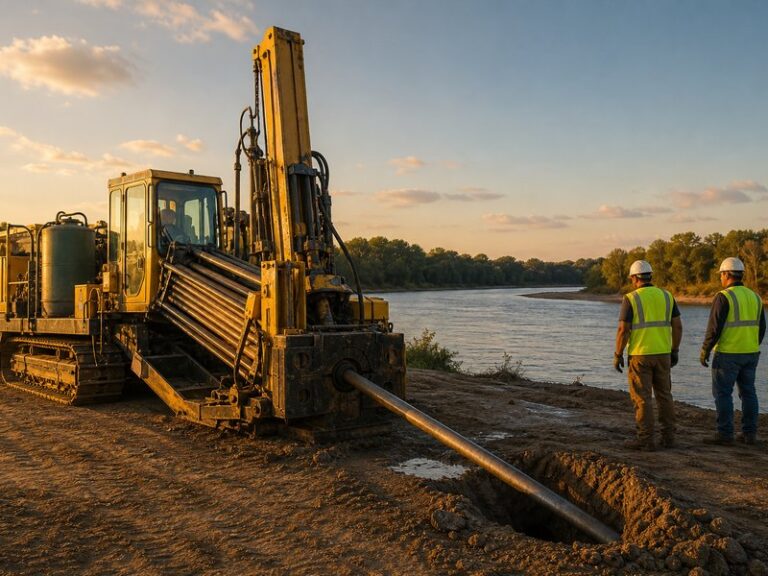
Engineering infographic comparing pulling-distance concepts for HDD, pipe bursting, E-Power Pipe, and pull-in-place lining in underground pipelines

Maximum Distance a Pipe Can Be Pulled Using Trenchless Methods: HDD Pull Length, Pipe Bursting & Lining Limits

The maximum distance a pipe can be pulled using trenchless methods ranges from approximately 50 meters to more than 3,000 meters, depending on the installation technology, pipe characteristics, ground conditions, and equipment limitations. For new pipeline construction, Horizontal Directional Drilling (HDD) typically achieves 200–800 meters per pull. For pipeline rehabilitation, specialized

اقرأ المزيد »
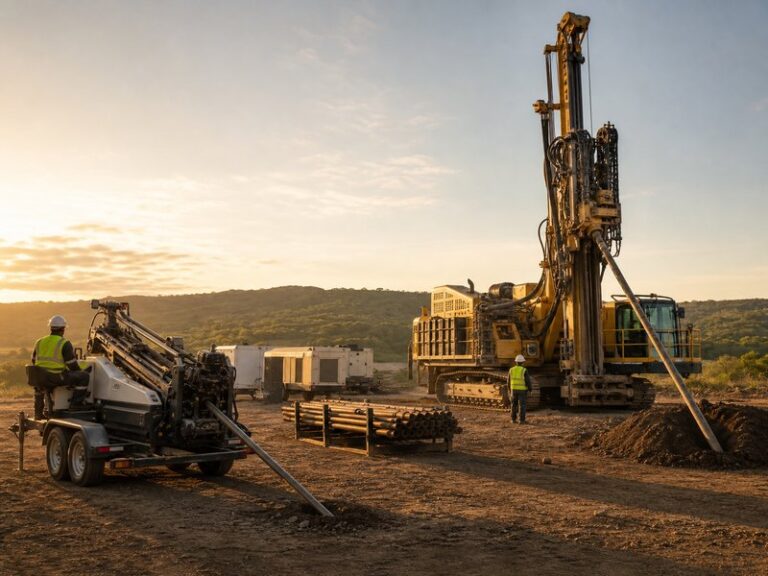
Engineering cutaway illustration comparing CIPP resin liners, spray-applied polyurea, HDPE sliplining, and UHPC structural lining segments in underground sewer pipes.

Best Trenchless Pipe Rehabilitation Materials: CIPP, Polyurea, HDPE Comparison

Best Materials for Trenchless Pipe Rehabilitation The most widely used and effective materials for trenchless pipe rehabilitation are thermosetting resin systems—specifically epoxy, polyester, and vinyl ester—combined with reinforcement fabrics such as fiberglass or polyester felt. For most municipal sewer rehabilitation projects, polyester CIPP offers the best cost-to-performance balance, while epoxy CIPP is preferred for pipes

اقرأ المزيد »