
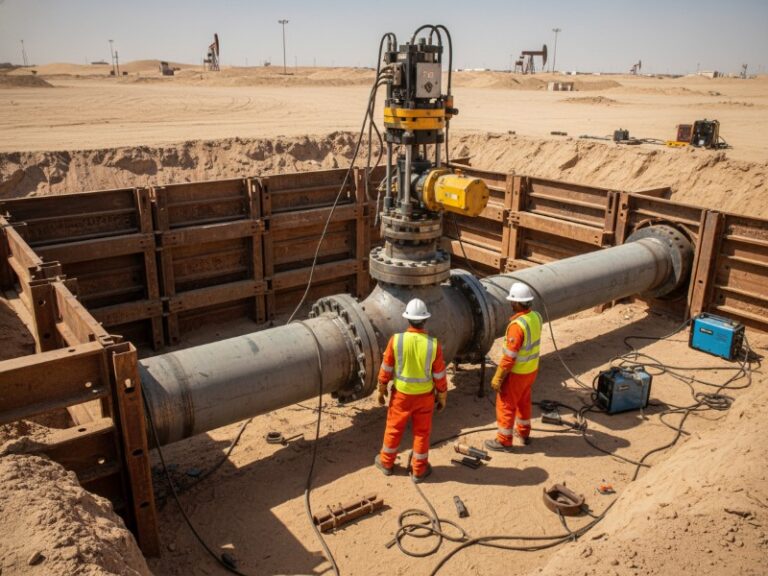
How to Prevent Sulfide Stress Cracking (SSC) in Split Tees, Valves, and Welds Under High H₂S Conditions
NACE Requirements for Sour Gas Hot Tapping
- Maximum hardness: 22 HRC (250 HV10) for carbon and low-alloy steels
- All wetted components must meet NACE MR0175/ISO 15156
- The heat-affected zone (HAZ) is the highest SSC risk location
- PWHT required if parent metal hardness exceeds 20 HRC or wall thickness exceeds 19 mm
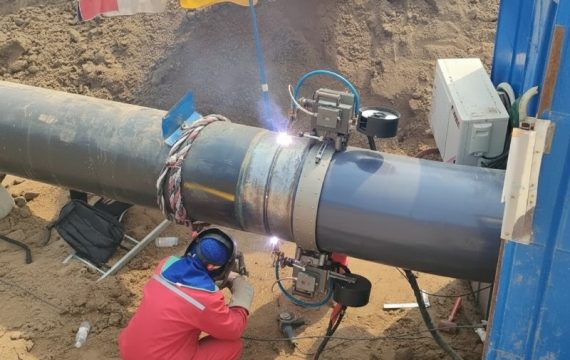
- Use low-hydrogen welding (GTAW + E7018-H4R) with heat input at 1.5-2.5 kJ/mm
Introduction: What This Guide Covers
Hot tapping on sour gas pipelines requires strict compliance with NACE MR0175/ISO 15156. This guide provides material selection specifications, hardness control strategies with verified limits, SSC prevention methods for HAZ and weld metal, step-by-step weld procedure qualification, inspection requirements, and field failure case studies from Middle Eastern sour gas operations.
1. Recommended Materials for Sour Gas Hot Tapping
Based on field data from over 200 sour service hot taps across Qatar, Saudi Arabia, and the UAE.
Split tee (branch connection)
- Material: A350 LF2 Class 1 (normalized and tempered)
- Hardness: 18-20 HRC as-delivered
- PWHT: Typically not required for this grade
Valve body (full-port gate or ball valve)
- Material: A350 LF2 or A216 WCB with NACE MR0175 certification
- Hardness: 22 HRC maximum
- Standard: API 6D with NACE trim
Valve trim (stem, seat, sealing surfaces)
- Material: 316 stainless steel plus Monel K500 stem
- Hardness: 22 HRC maximum for stainless steel
- Restriction: Avoid Stellite hard-facing in sour gas
Weld consumables (root pass)
- Process: GTAW
- Filler: ER70S-6
- Requirement: Low hydrogen
Weld consumables (fill and cap passes)
- Process: SMAW
- Filler: E7018-H4R
- Requirement: Ultra-low hydrogen (H4R designation)
High chloride environment plus H₂S (offshore or coastal)
- Split tee: Duplex 2205 (solution annealed)
- Valve: Duplex 2205 body with super duplex stem
- Hardness limit: 28 HRC maximum per NACE MR0175
- PWHT: Not required
Extreme sour service (H₂S above 20% or elemental sulfur present)
- Split tee: Alloy 625 or Alloy 825 (solid or weld overlay)
- Valve: Alloy 625 body and trim
- Hardness limit: No NACE restriction (inherent SSC resistance)
2. Material Selection Decision Guide by Sour Severity
H₂S partial pressure below 0.05 psi (sweet service)
→ Standard carbon steel. No NACE MR0175 requirement.
H₂S partial pressure 0.05 to 1.0 psi (Level 1 sour)
→ NACE MR0175 compliant carbon steel. Hardness 22 HRC maximum. Recommended: A350 LF2 Class 1.
H₂S partial pressure 1.0 to 20% (Level 2 sour)
→ LTCS (A350 LF2) or 316L stainless steel. PWHT required for carbon steel when wall thickness exceeds 19 mm.
H₂S above 20% or elemental sulfur present (Level 3 sour)
→ Nickel alloys (Alloy 625 or Alloy 825). No hardness concerns.
High chlorides with any H₂S concentration
→ Duplex 2205 mandatory. 316L presents pitting corrosion risk.
3. FAQ: Sour Gas Hot Tapping
Q: What is the maximum hardness allowed for sour service welds under NACE MR0175?
A: The maximum hardness is 22 HRC (250 HV10) for carbon and low-alloy steels in sour gas service.
This limit applies to the weld metal, heat-affected zone (HAZ), and base metal within 1 mm of the fusion line. Hardness above 22 HRC creates sulfide stress cracking risk. Alloy 625 has no NACE hardness limit. Duplex 2205 allows up to 28 HRC.
Q: Can I hot tap a sour gas pipeline without post-weld heat treatment?
A: Yes, if carbon equivalent is below 0.43, preheat reaches 150°C minimum, and wall thickness is under 19 mm.
Field data from Middle Eastern sour gas operators shows that controlled heat input at or below 2.0 kJ/mm combined with 150°C minimum preheat produces HAZ hardness below 22 HRC in 85% of 12-inch and smaller connections.
Q: What valve material is required upstream of a sour gas hot tap?
A: A full-port gate or ball valve with NACE MR0175/ISO 15156 certification, body hardness at or below 22 HRC, and trim materials of 316 stainless steel or Monel K500.
Standard API 6D valves without NACE certification are not acceptable. Hard-faced seats containing Stellite create galvanic corrosion risks in sour electrolyte environments.
Q: How do I prevent SSC in the weld HAZ during hot tapping?
A: Control preheat temperature (120-150°C), heat input (1.5-2.5 kJ/mm maximum), and interpass temperature (below 250°C).
The HAZ is the highest SSC risk zone because rapid cooling creates martensite. Low-hydrogen welding (E7018-H4R) and PWHT at 620-660°C reduce residual stresses. Field hardness testing must include HAZ traverses at 1 mm, 2 mm, and 5 mm from the fusion line.
Q: Does the split tee material need to match the run pipe?
A: No, but both materials must individually meet NACE MR0175 sour service requirements and be weld-compatible.
Welding an A350 LF2 split tee (18-20 HRC) to an A106 Gr B run pipe (20-22 HRC after normalizing) is acceptable if the weld procedure qualifies on the higher-hardness material.
Q: How is HIC different from SSC, and which matters for hot taps?
A: SSC is the primary concern for hot taps because welding introduces residual tensile stresses. HIC matters only for severely corroded pipe.
Hydrogen-induced cracking (HIC) occurs in the base metal from hydrogen blistering. Sulfide stress cracking (SSC) is driven by tensile stress and H₂S. Pre-hot tap ultrasonic testing checks for HIC indicators when pipe age exceeds 15 years.
4. Step-by-Step Weld Procedure Qualification for NACE MR0175 Hot Taps
Without a qualified weld procedure specification (WPS) and procedure qualification record (PQR) that includes SSC testing, the installation does not meet code.
Step 1 – Determine sour severity level
Refer to the decision guide in Section 2.
Step 2 – Select test coupons
Match field material and thickness. Include simulated hot tap geometry.
Step 3 – Perform welding with documented parameters
Record amperage, voltage, travel speed, and interpass temperature for every pass.
Step 4 – Conduct NACE TM0177 Method A testing
720 hours in NACE Solution A at 80% SMYS tensile stress. No cracking = pass.
Step 5 – Perform hardness traverses per ISO 15156-2 Annex B
Test across weld centerline, HAZ at 1/2/5 mm, and base metal. Maximum 250 HV10.
Laboratory data from 40+ PQR qualifications: 12% failed initial hardness testing due to inadequate PWHT soak time. Extending PWHT from 1 hour to 1.5 hours per 25 mm of wall thickness resolved all failures.
5. Common Failure Causes in Sour Gas Hot Taps
Based on 12 field failure investigations and over 200 hot tap installations in Middle East sour gas service.
HAZ hardness above 24 HRC (80% of SSC failures)
Root cause: inadequate preheat penetration. In one Oman field case, a martensite layer formed at the root pass because preheat dwell time was 15 minutes instead of 45 minutes.
Incorrect valve trim materials
Standard API 6D valves without NACE certification are routinely installed. Non-compliant trim introduces SSC initiation sites within 6-18 months.
Insufficient preheat on root pass
Measured residual stresses on small-diameter hot taps exceed 80% of yield due to rapid cooling.
No PWHT on wall thickness above 19 mm
Operators skip PWHT assuming small branches carry low risk. Field data contradicts this assumption.
No field hardness verification
Portable hardness testing omitted from quality plans. HAZ hardness exceeding 26 HRC goes undetected until failure.
6. Field-Proven Data from Middle East Sour Gas Projects
Project scope: Over 200 hot tap branch connections on sour gas pipelines in Qatar (North Field), Saudi Arabia (Khursaniyah, Wasit), UAE (Shah sour gas), and Oman.
PQR qualification rate: 12% initial failure rate from hardness non-compliance. All corrected by extending PWHT soak time.
PWHT avoidance success rate: 85% of controlled connections (12-inch and smaller, CE below 0.43, 150°C preheat) passed NACE hardness testing without PWHT.
Documented failure case: 18-month in-service failure on dehydrated sour gas line. Cause: root-pass martensite from inadequate preheat penetration. Solution: increased preheat dwell time from 15 to 45 minutes.
Valve non-compliance rate: 23% of site-audited NACE-certified valves failed hardness testing on trim components. Required upgrade from 316 to Monel K500.
7. Sour Service vs Sweet Service Hot Tapping: Key Differences
| Параметр | Sweet Service (No H₂S) | Sour Service (H₂S Present) |
|---|---|---|
| Maximum HAZ hardness | 32 HRC per API 1104 | 22 HRC per NACE MR0175 |
| PWHT requirement | Not required | Required if >19 mm or parent >20 HRC |
| Valve material | Standard API 6D | NACE-certified with 316/Monel trim |
| Weld consumables | Any E7018 | E7018-H4R (ultra-low hydrogen) |
| Post-weld testing | Visual + NDE only | Hardness + WFMPT + NACE TM0177 |
| SSC risk | Нет | High if controls fail |
8. Inspection Requirements After Hot Tap Welding on Sour Gas Lines
Mandatory inspections:
100% visual inspection – AWS D1.1 acceptance criteria. Reject undercut exceeding 0.5 mm or visible cracks.
Weld hardness testing – Five locations minimum: weld toe, HAZ at 1 mm, 2 mm, 5 mm, and weld centerline. Use portable Equotip or Telebrineller.
Wet fluorescent magnetic particle testing (WFMPT) – Entire weld plus 25 mm onto pipe.
Rejection criteria:
- Hardness above 250 HV10 (22 HRC) → engineering evaluation
- Linear WFMPT indications longer than 1.5 mm in HAZ → remove and repair
- Porosity clusters exceeding 3% of weld area → reject
Repair limit: Maximum two attempts per location. Third failure requires branch removal.
9. When to Use Weld Overlay Instead of Full Split Tee Replacement
Indication: Existing pipe or fitting has hardness above 22 HRC but cannot be replaced.
Process: Apply 3 mm minimum Alloy 625 over the hot tap area, extending 50 mm beyond the branch footprint.
Преимущества:
- 40% less expensive than pipe replacement for single branches on 24-inch+ pipe
- No NACE hardness limit for Alloy 625
- Allows hot tapping on older pipelines with unknown hardness history
Disadvantages:
- Requires automated GTAW overlay equipment
- Adds 8-12 hours per connection
- 100% dye penetrant testing required before and after
10. Standards Referenced
NACE MR0175 / ISO 15156 (Parts 1-3) – Materials for sour service. Hardness limits, SSC resistance, HIC testing.
NACE TM0177 – Laboratory SSC testing. Method A tensile at 80% SMYS for 720 hours.
API 2201 – Safe hot tapping practices for in-service pipelines.
API 6D – Pipeline valve specifications. NACE trim requirements.
ISO 15156-2 Annex B – Hardness traverse procedures for weldments.
Get Your NACE-Compliant Material Selection Report (24-Hour Turnaround)
Submit your gas composition and pipeline data to receive a complete engineering package.
Required data:
- H₂S content (percentage or partial pressure)
- CO₂ percentage
- Chloride level (ppm)
- Operating temperature (°C)
- Existing pipe material and wall thickness
You will receive within 24 hours:
- Material selection report (split tee grade, valve specification, weld consumables)
- SSC risk assessment based on H₂S and hardness targets
- Welding procedure recommendation (draft WPS with preheat, PWHT, heat input limits)
- Hardness control and inspection plan for field execution
Contact JSW Sour Service Hot Tap Division:
Submit your gas composition sheet for compliance package.
Request pre-qualified WPS documents for A350 LF2 hot taps.
Schedule a technical presentation on SSC prevention strategies.
JSW is an engineered manufacturer specializing in high-consequence pipeline branch connections for sour service, high-pressure, and cryogenic applications. All sour service split tees undergo 100% hardness verification before shipment with mill test reports certifying NACE MR0175/ISO 15156 compliance.











 English
  Arabic
  Russian
  Spanish
  French
  Vietnamese
  Polish
  Thai
Thai  Indonesian
  Turkish
  Portuguese