
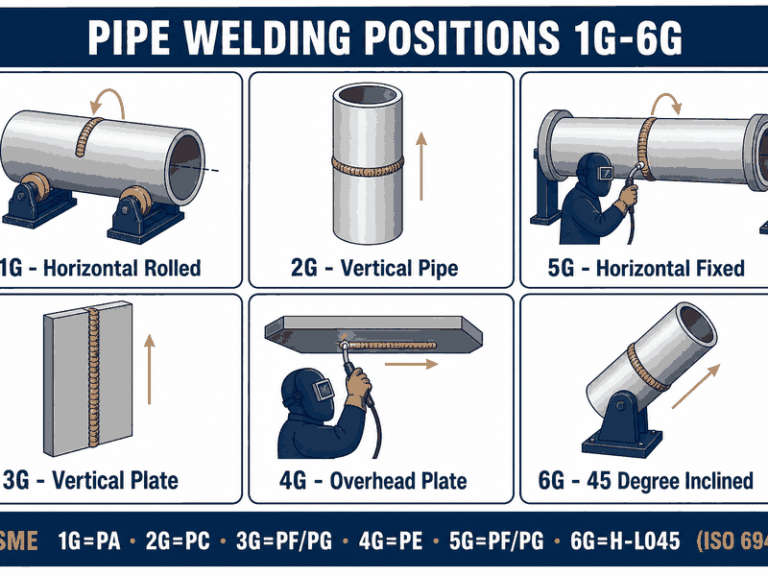
Pipeline welding positions from 1G to 6G are the standardized orientations used to classify, test, and qualify pipe welds, with 1G (horizontal rolled), 2G (vertical pipe), 5G (horizontal fixed), and 6G (45-degree fixed) applying to pipe and 3G and 4G applying to plate. This guide explains what every pipeline welding position means, how the codes map across ASME Section IX, API 1104, and ISO 6947, how qualification coverage grows from 1G to 6G, and why the 6G certification is the industry benchmark for all-position pipe welders. You will also learn how 5G vs 6G welding differ, when to use uphill or downhill progression, how positions affect welding procedure qualification, and which position to specify for your pipeline project.
Key Takeaways
- Only four positions apply to pipe: 1G, 2G, 5G, and 6G under ASME Section IX; 3G and 4G are plate positions.
- 6G is the broadest qualification: passing the 45-degree fixed pipe test qualifies a welder for every pipe position, which makes the 6G certification the standard hiring filter for pipeline work.
- Position is an essential variable: every change in position or progression (uphill vs downhill) requires its own qualified welding procedure.
- 5G vs 6G: 5G is a horizontal fixed pipe, while 6G tilts the pipe to 45 degrees and combines flat, vertical, horizontal, and overhead welding in one joint.
What Are Pipeline Welding Positions?
Pipeline welding positions are the standardized orientations of the pipe and the weld joint used by codes to describe where a weld is made. Every code that governs pipe welding, including ASME BPVC Section IX (2023 Edition), API 1104 (22nd Edition), and AWS D1.1, defines positions with the same letter-and-number system so that qualification tests, procedures, and inspection records mean the same thing everywhere.
The system works on two axes: the orientation of the pipe axis and the orientation of the weld. When the pipe axis is horizontal and rotates, the weld stays flat and the position is 1G. When the pipe axis is vertical, the weld is a horizontal ring and the position is 2G. When the pipe axis is horizontal but fixed, the welder works around the whole circumference and the position is 5G. When the pipe is fixed at a 45-degree incline, every orientation appears in one joint and the position is 6G.
Positions exist for a practical reason: gravity changes how the molten weld pool behaves. In flat welding the pool stays where it is placed, but in vertical and overhead welding it wants to run out of the joint. A welder who controls the pool in every orientation has all-position skill, which is exactly what the 6G test measures.
Pipeline Welding Positions 1G to 6G: The Complete Breakdown
Each position code describes a specific combination of pipe axis, weld orientation, and rotation. The welding position chart below is the fastest way to compare all six, and the sections after it explain each one in the order welders usually train in.
| Позиция | Pipe or plate | Orientation | Difficulty | Typical use |
|---|---|---|---|---|
| 1G | Pipe (rolled) | Horizontal axis, rotating; weld flat | Lowest | Shop fabrication on positioners and rollers |
| 2G | Pipe (fixed) | Vertical axis; weld horizontal | Умеренный | Vertical risers, stacks, downcomers |
| 3G | Plate (fixed) | Weld vertical, up or down | Умеренный | Structural plate and tank shell welds |
| 4G | Plate (fixed) | Weld overhead | Высокий | Structural plate and tank roof welds |
| 5G | Pipe (fixed) | Horizontal axis; weld around circumference | Высокий | Field girth welds on fixed horizontal lines |
| 6G | Pipe (fixed) | Axis inclined 45 degrees; all orientations in one joint | Highest | All-position qualification test; inclined and offshore lines |
1G: Horizontal Rolled Position
In the 1G position the pipe axis is horizontal and the pipe rotates on rollers or a positioner, so the weld is always made at the top in the flat orientation. Gravity works with the welder, the weld pool stays in place, and the weld is the easiest of all pipe positions to control.
1G is the standard for shop prefabrication of pipe spools because it maximizes travel speed and deposition rate. In our fabrication shop we run 1G welds on positioners for most spool work and hold rejection rates well below field fixed-position work; the position alone explains most of the difference.
2G: Vertical Pipe, Horizontal Weld
In the 2G position the pipe axis is vertical and the weld is a horizontal ring around the pipe. The welder works around the joint, and the weld face is horizontal, so the pool behaves like a horizontal fillet on both sides of the groove.
2G is common on vertical risers, stacks, and downcomers in process plants and stations. It is more demanding than 1G because the root opening and the fill passes must be managed on both the upper and the lower bevel faces, but it is still easier than any fixed horizontal or inclined pipe weld.
3G: Vertical Position
The 3G position is a plate position, not a pipe position. The plate is vertical and the weld runs vertically, either uphill (3F up) or downhill (3F down), depending on the procedure. It appears in this 1G to 6G sequence because the same numbering system covers plate and pipe, but it is defined for structural plate and tank work, not for pipe welding positions.
Uphill vertical welds deposit from bottom to top with higher heat input and better mechanical properties, while downhill vertical welds are faster and use fast-freezing electrodes. Structural codes such as AWS D1.1 treat 3G as a separate qualification from 3F, and both are plate-specific.
4G: Overhead Position
The 4G position is also a plate position. The plate is horizontal and the welder welds from underneath with the weld pool suspended against gravity. It is one of the hardest positions to control because any hesitation allows the pool to sag or drop out of the joint.
4G appears in plate qualification tests and structural work such as tank roofs and skid frames. For pipe welders it matters mainly as training: mastering overhead control on plate builds the pool control needed for the lower half of a 6G weld, where the weld is effectively overhead.
5G: Horizontal Fixed Pipe
In the 5G position the pipe axis is horizontal and the pipe is fixed, so the welder must weld around the entire circumference. The weld passes through flat, vertical, and overhead orientations as the welder works from the top over the sides and under the bottom, which is why 5G demands continuous adjustment of the torch angle and travel speed.
5G is the workhorse position of field pipeline construction. Most mainline girth welds on horizontal lines are 5G welds made with downhill progression using cellulosic electrodes such as E6010, the method commonly called stovepipe welding because the weld is built in short segments around the pipe.
6G: The 45-Degree Fixed Position
In the 6G position the pipe is fixed at a 45-degree incline. The weld path is inclined, which means the molten pool is never in a stable flat, vertical, or overhead relationship for long, and the welder must blend all of those orientations into one continuous joint.
6G is the most difficult pipe welding position and the most valuable qualification a pipe welder can hold. It is also the test that hiring managers use first: a welder who passes 6G has proven all-position skill, and under the qualification rules of Section IX and API 1104, the 6G test qualifies the welder for every pipe position.
Which Welding Positions Apply to Pipe vs Plate?
A common source of confusion is the meaning of 3G and 4G in a pipeline context. The numbering system spans both product forms: positions 1G, 2G, 3G, and 4G are defined for plate, while pipe uses 1G, 2G, 5G, and 6G.
When people say “pipe welding positions from 1G to 6G”, they are usually listing the whole code family, but only 1G, 2G, 5G, and 6G actually apply to pipe.
International projects add a second code language. ISO 6947:2019, Welding and allied processes – Welding positions, uses letter codes: PA for the horizontal rolled pipe position (1G), PC for the horizontal weld on a vertical pipe (2G), PF for vertical uphill, PG for vertical downhill, PE for overhead, and H-L045 for the 45-degree inclined pipe position (6G). Knowing both systems matters when your welder qualification records must satisfy a client who works to ISO 6947.
| ASME Section IX code | Product form | Описание | ISO 6947 code |
|---|---|---|---|
| 1G (pipe, rolled) | Pipe, rolled | Horizontal axis, rotating, weld flat | PA |
| 2G (pipe, fixed) | Pipe, fixed | Vertical axis, horizontal weld | PC |
| 5G (uphill) | Pipe, fixed | Horizontal axis, weld around circumference, vertical up | PF |
| 5G (downhill) | Pipe, fixed | Horizontal axis, weld around circumference, vertical down | PG |
| 6G | Pipe, fixed | Axis inclined 45 degrees | H-L045 |
| 1G (plate) | Plate | Flat | PA |
| 2G (plate) | Plate | Horizontal | PC |
| 3G (plate) | Plate | Vertical | PF / PG |
| 4G (plate) | Plate | Overhead | PE |
5G vs 6G: What Is the Difference?
The 5G vs 6G comparison is the question welders and project managers ask most often. Both positions fix the pipe, but the pipe axis differs: 5G holds the pipe horizontal, while 6G inclines it to 45 degrees. That single change turns a weld that passes through flat, vertical, and overhead zones into a weld where every zone is blended continuously on an incline.
In 5G, the welder can still use gravity predictably: uphill and downhill segments are distinct, and the weld pool behaves conventionally at each point. In 6G, the inclined axis means the pool runs sideways at every point of the circumference, so the welder must constantly reposition the body, the torch, and the travel angle. This is why training schools and employers treat 6G as the definitive all-position test.
There is also a practical difference in what each qualification proves. Under ASME Section IX, a welder who passes 5G is qualified for 1G, 2G, and 5G. A welder who passes 6G is qualified for 1G, 2G, 5G, and 6G, which in practice covers every pipe position a project will specify.
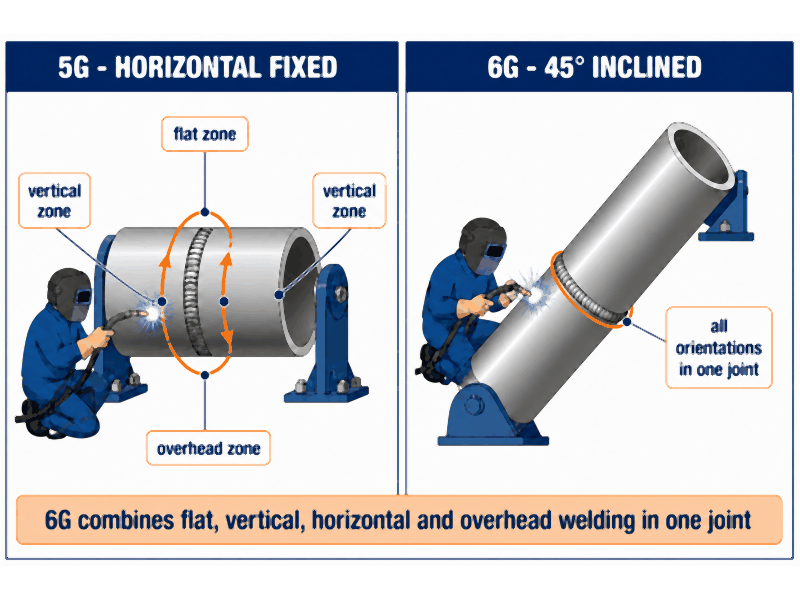
Figure 1. The 5G position fixes the pipe horizontally; the 6G position inclines the pipe to 45 degrees and combines every orientation in one weld.
Uphill vs Downhill Welding in Fixed Positions
Within 5G and 6G work, progression is a separate variable. Downhill welding (vertical down) starts at the top of the pipe and works downward in short segments, using fast-freezing cellulosic electrodes such as E6010. It is the standard for mainline girth welds on large-diameter transmission pipelines because it is fast and matches the “stovepipe” rhythm of field crews.
Uphill welding (vertical up) works from the bottom upward with higher heat input and slower travel, producing finer grain structure and better impact properties. It is preferred for critical root and hot passes, for thicker walls, and for low-hydrogen electrodes such as E7018. On our crude transfer projects we use downhill E6010 for the mainline and switch to uphill E7018 for tie-ins and repairs where toughness requirements are tighter.
| Characteristic | Downhill (vertical down) | Uphill (vertical up) |
|---|---|---|
| Travel direction | Top of pipe toward bottom | Bottom of pipe toward top |
| Typical electrodes | E6010, cellulosic | E7018, low hydrogen |
| Heat input | Ниже | Выше |
| Speed | Faster | Slower |
| Typical use | Mainline girth welds, large diameters | Tie-ins, repairs, thick walls, critical services |
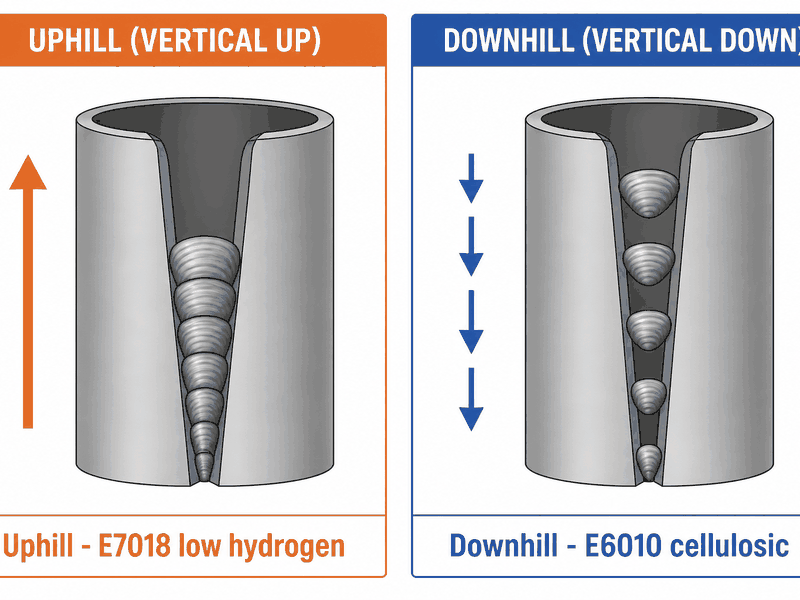
Figure 2. Uphill welding progresses from the bottom of the pipe; downhill welding starts at the top and works downward in short segments.
What Does a 6G Welding Certification Cover?
A 6G certification is the result of the 6G pipe welding test, a formal qualification issued to a documented standard that proves a welder can produce an acceptable groove weld on pipe fixed at a 45-degree incline. The test coupon is typically a 6-inch schedule 80 pipe with a 60-degree bevel and an open root, welded with the process the welder will use in production, commonly SMAW with an E6010 root and E7018 fill, or GTAW root with SMAW fill on alloy and stainless lines.
The value of the certification is its scope. Because the 6G position contains every orientation, codes extend the qualification to all pipe positions. The table below shows how coverage grows with each test position under Section IX rules; API 1104 applies the same logic to its welder qualification tables for pipeline work.
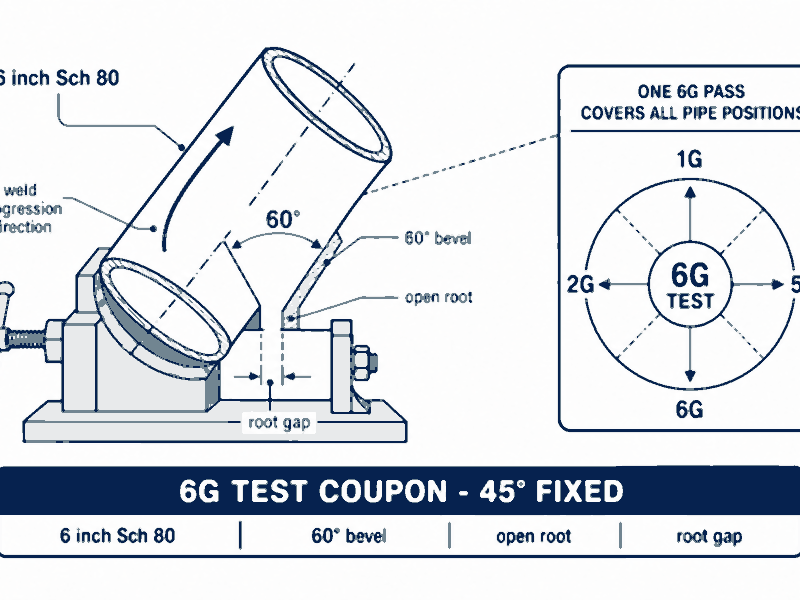
Figure 3. The 6G pipe welding test uses a coupon fixed at 45 degrees; one acceptable coupon qualifies every pipe position.
| Test position | Positions qualified | Комментарий |
|---|---|---|
| 1G (rolled) | 1G only | Shop rolled welds only; no fixed-position credit |
| 2G (vertical pipe) | 1G, 2G | Adds horizontal weld on vertical pipe |
| 5G (horizontal fixed) | 1G, 2G, 5G | Adds full circumferential fixed weld |
| 6G (45-degree fixed) | 1G, 2G, 5G, 6G | All pipe positions; the industry benchmark |
The labor market rewards the benchmark. U.S. Bureau of Labor Statistics data (Occupational Outlook Handbook, May 2024) show a median annual wage of $51,000 for welders, cutters, solderers, and brazers, with the highest-paid 10 percent earning more than $75,850, and the median in specialty trade contracting at $57,310.
Pipeline employers in particular use the 6G certification as a screening requirement because it demonstrates the all-position skill that fixed-position field work demands. The 6G welder certification is also the most widely recognized single credential a pipe welder can hold, making it a direct factor in both hiring and pay.
Keep two limitations in mind. A 6G certification is valid only for the process, material group, thickness range, and pipe diameter range stated on the card, and its continuity rules differ by code. Under API 1104, a welder must re-qualify after a 6-month interruption in welding with that process; under Section IX, the same continuity rule applies, and the employer is responsible for monitoring it under QW-322. It is also not a license to weld every standard: ASME Section IX, API 1104, and AWS D1.1 qualifications are separate systems, and a 6G card earned under one does not automatically transfer to the others.
If your project requires 6G-qualified welders or position-matched procedures, send your pipe size, wall thickness, fluid, pressure, and governing standard to our engineering team at sales@jsw.com, or use the quote request form below.
How Do Welding Positions Affect Procedure Qualification?
Welding position is an essential variable in every procedure qualification. Under Section IX, a change in position, or in progression for pipe (uphill versus downhill), requires a new welding procedure specification (WPS) with its own procedure qualification record (PQR). The same principle applies under API 1104, where the position and direction of welding are recorded in the qualified procedure and in the welder qualification.
This is why a project cannot borrow a procedure from another line. In our welding department we maintain separate qualified procedures for 1G roll welding, 5G downhill mainline welding, 5G uphill tie-in welding, and 6G inclined welding, each with its own essential variables for process, electrode class, amperage range, travel speed, and heat input. Matching the welder’s card and the WPS to the actual position on site is the first check our QC team performs before any joint is welded.
The practical rule for contractors is simple: qualify the exact positions you plan to weld, and qualify them in the direction you will use. A 5G downhill procedure does not cover 5G uphill work, and a 1G shop procedure does not cover any fixed-position field weld. Budgeting for the correct qualification scope early avoids costly re-qualification and rejected welds after mobilization.
How to Choose the Right Welding Position for Your Pipeline Project
The right position is decided by the pipe arrangement and the governing standard, not by welder preference. Work through these four steps before you finalize the welding specification:
- Identify the pipe orientation. Horizontal runs on rollers become 1G roll welds. Vertical risers become 2G. Fixed horizontal field lines become 5G. Inclined, offshore, and restricted sections become 6G or a combination of positions.
- Check the governing code. Section IX governs facility piping welds, API 1104 governs cross-country pipeline welding, and the owner specification may add position or progression requirements on top of either.
- Match qualifications to work. Confirm every welder’s card covers every position and progression assigned to them. A single 6G-certified welder can cover all pipe positions; a crew of 1G-only welders cannot legally weld a fixed field joint.
- Decide shop versus field. Wherever pipe can be rolled on a positioner, 1G welding raises productivity and quality. In our fabrication facility we roll most spools in 1G, then assign 5G or 6G welders only to the fixed tie-ins, which keeps field rework low and schedule risk manageable.
For large-diameter mainlines, automatic pipeline welding removes much of the human-position problem: mechanized systems hold the torch angle constant around the circumference and are qualified as a position-capable process. On one 36-inch gas line project, we used automatic welding for the 5G mainline joints and manual 6G-qualified crews for the tie-ins, and the combined approach held the first-pass acceptance rate above 97 percent.
If your project involves bending, cutting, or joining pipe in fixed positions, the same position logic applies to every weld in the system. Our pipeline construction services cover position planning, procedure qualification, and crew deployment from spool fabrication through final tie-in.
Position-Related Weld Defects and How to Avoid Them
Each position creates its own defect pattern, and knowing the pattern is the fastest way to prevent it. The table below maps the defects our inspectors see most often on fixed-position pipeline welds to their causes and controls.
| Defect | Position where common | Primary cause | Prevention |
|---|---|---|---|
| Lack of fusion | 5G and 6G side walls | Torch angle not adjusted to the inclined wall | Maintain the travel angle; slow down at the 3 and 9 o’clock zones |
| Incomplete penetration | 6G root | Root gap closing on the lower side of the incline | Set the root gap to the procedure and check fit-up before the root pass; machine-cut bevels from pipeline cutting machines hold the gap within tolerance |
| Slag inclusions | Downhill 5G | Slag running ahead of the fast-freezing pool | Use the electrode angle and amperage from the qualified procedure |
| Porosity | Overhead zones of 5G and 6G | Trapped gas in a sagging pool | Control heat input; keep the arc tight; dry the electrodes |
| Undercut | 2G upper bevel | Arc held too long on the top edge | Short arc, steady travel, correct amperage |
Two habits prevent most of these defects regardless of position. First, weld to the qualified procedure parameters instead of adjusting by feel. Second, inspect the root and hot pass before completing the fill, because defects found at the root cost minutes while defects found at final inspection cost days. When defects do appear, planned pipeline repair services and, for buried lines, trenchless pipeline repair return the line to service under the same qualification discipline. In our experience, crews that follow both habits hold their rejection rate below 2 percent even on 6G tie-ins.
Часто задаваемые вопросы
What are the pipeline welding positions from 1G to 6G?
The pipe welding positions are 1G (horizontal rolled), 2G (vertical pipe with a horizontal weld), 5G (horizontal fixed pipe), and 6G (pipe fixed at a 45-degree incline). The codes 3G (vertical) and 4G (overhead) are plate positions under ASME Section IX, not pipe positions. A welder qualified in the 6G position is qualified for all pipe positions, which is why 6G is the most demanding and most valued welding test.
How many welding positions are there?
There are four basic welding positions: flat, horizontal, vertical, and overhead. In the code system, plate uses 1G (flat), 2G (horizontal), 3G (vertical), and 4G (overhead); pipe uses 1G (rolled), 2G (vertical pipe), 5G (horizontal fixed), and 6G (45-degree inclined), which is where the 1G to 6G sequence comes from.
What is the difference between 5G and 6G welding?
In 5G welding, the pipe axis is horizontal and the pipe is fixed, so the welder must weld around the full circumference, changing the work angle continuously. In 6G welding, the pipe is fixed at a 45-degree incline, which combines flat, horizontal, vertical, and overhead welding into a single inclined weld. The 6G position is harder than 5G and qualifies the welder for every pipe position, while a 5G test qualifies 1G, 2G, and 5G only.
What does a 6G welding certification cover?
A 6G welding certification proves that a welder can produce a sound groove weld on pipe fixed at 45 degrees, a test that combines flat, vertical, horizontal, and overhead welding in one joint. Under ASME Section IX and API 1104, passing the 6G test qualifies the welder for all pipe welding positions: 1G, 2G, 5G, and 6G. Employers commonly use the 6G welder certification as a hiring filter for pipeline work because it demonstrates all-position welding skill.
Does a 6G certification qualify a welder for plate positions like 3G and 4G?
No. A 6G pipe qualification covers only the pipe positions 1G, 2G, 5G, and 6G. Plate positions such as 3G (vertical) and 4G (overhead) are separate qualifications under ASME Section IX, and a pipe qualification card does not transfer to plate work.
Is 1G or 6G welding easier?
1G is the easiest pipe welding position because the pipe rotates while the weld stays flat and gravity works with the welder. 6G is the hardest pipe position because the pipe is fixed at 45 degrees, forcing the welder to control the weld pool in every orientation within a single joint. Most welders train from 1G up through 2G and 5G before attempting a 6G qualification.
What is the difference between uphill and downhill pipe welding?
Downhill welding (vertical down) moves the electrode from the top of the pipe toward the bottom and is the standard method for field mainline girth welds on large-diameter pipelines, using fast-freezing cellulosic electrodes such as E6010. Uphill welding (vertical up) deposits the weld from bottom to top with higher heat input and is used for fixed-position root and fill passes where better mechanical properties are required, typically with E7018 low-hydrogen electrodes. Both methods are governed by separate qualified procedures because position and progression are essential variables.
Which pipe welding position should I use for a new pipeline project?
The position is decided by the pipe arrangement and the standard, not by preference. Shop prefabrication uses 1G roll welding on positioners for speed and quality. Fixed field welds on horizontal pipe require 5G, and inclined or vertical runs require 6G or 2G. The governing code, such as ASME Section IX for facility piping or API 1104 for cross-country lines, defines which positions the welder qualification must cover, so match the qualified positions to the positions actually welded on site.
How long does a 6G welding certification stay valid?
Validity rules differ by code. Under API 1104, a welder must re-qualify after a 6-month interruption in welding with that process. Under ASME Section IX, the same continuity rule applies, and the employer is responsible for monitoring it under QW-322. In both systems, the certification covers only the process, material group, thickness range, and pipe diameter range stated on the card, and a 6G card earned under one code does not transfer to another.
Welding positions from 1G to 6G are the language every code, procedure, and inspection record uses to describe pipe welds. The practical summary is short: 1G rolls the pipe and keeps the weld flat, 2G welds a horizontal ring on a vertical pipe, 5G welds a fixed horizontal pipe around the full circumference, and 6G welds a pipe fixed at 45 degrees, the position that qualifies a welder for everything else. The 3G and 4G codes belong to plate, not to pipeline work.
Two decisions drive cost and quality on any project. The first is qualification scope: position and progression are essential variables, so procedures and welder cards must match the positions you actually weld, and a 6G certification is the widest single credential a welder can hold. The second is shop versus field: rolling pipe in the 1G position where possible, and reserving 5G and 6G welders for fixed tie-ins, keeps quality high and schedules predictable.
If you are planning pipeline construction, repair, or maintenance work, send our engineering team your pipe size, wall thickness, fluid, pressure, and governing standard. We will confirm the pipeline welding positions required for your project, qualify the procedures, and deploy the right welders and equipment for the job.
For related work, see our pipeline maintenance services and hot tapping and plugging services, both of which follow the same position qualification discipline. For more pipeline welding guides, see our pipeline welding knowledge hub.
For tie-ins on live lines, our hot tapping equipment and line stopping and plugging equipment support fixed-position in-service welding. Where joints must be prepared in fixed positions, our pipeline cold bending capability keeps fit-up within tolerance.







 English
  Arabic
  Russian
  Spanish
  French
  Vietnamese
  Polish
  Thai
Thai  Indonesian
  Turkish
  Portuguese