
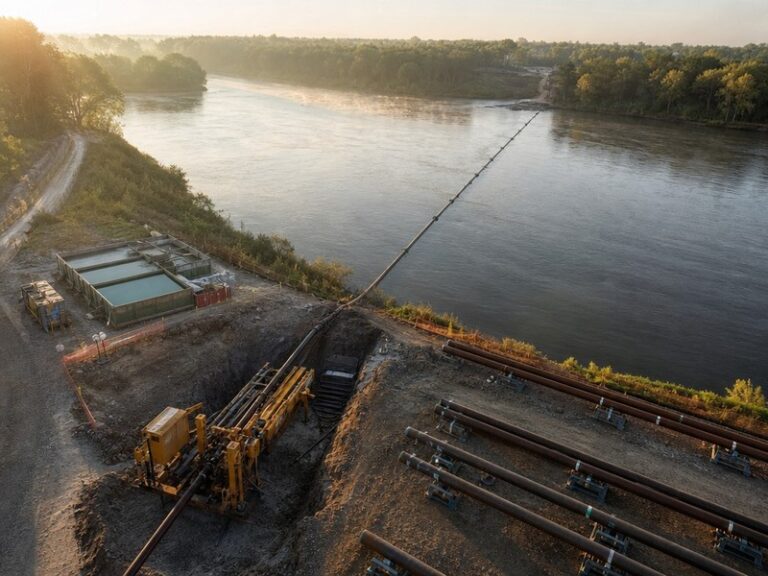
There is no single fixed horizontal directional drilling maximum length or diameter: the longest HDD crossing completed to date is about 13,213 ft (4,027 m), and the largest steel product pipes routinely installed by HDD reach about 48 in. (1,219 mm) in diameter, with the practical limits set by rig capacity, geology and bore design rather than by any universal rule. This guide explains the verified record crossings that define today’s limits, the five factors that decide how far and how large a bore can go, the trade-off between horizontal directional drilling maximum length and pipe diameter, and when long or large crossings should move to intersect drilling, microtunneling or other trenchless methods. The figures come from documented project records and from our engineering work supporting pipeline construction, HDD projects and trenchless repair across utility, oil and gas, and infrastructure sectors. If you are scoping a crossing now, jump to the rig class table or contact our engineering team to check your numbers before you mobilize.
| Fact | Значение |
|---|---|
| Longest completed HDD crossing | 13,213 ft (4,027 m), Ganges River, India, 2024, intersect method |
| Largest steel product pipe installed by HDD | About 48 in. (1,219 mm), reamed to a 60-in. final hole |
| Reamed-hole rule of thumb | Final hole about 1.5 times the product pipe OD, 48 to 60 in. and 42 to 54 in. |
| When intersect method is standard | Crossings beyond 7,000 ft (2,100 m) |
On this page:
- What Is the Maximum Length for Horizontal Directional Drilling?
- What Is the Maximum Diameter for Horizontal Directional Drilling?
- What Limits HDD Length and Diameter?
- How Do Length and Diameter Trade Off Against Each Other?
- What Length and Diameter Ranges Fit Each Rig Class?
- Microtunneling vs HDD
- HDD Length and Diameter FAQ
- How JSW Supports HDD and Pipeline Projects
What Is the Maximum Length for Horizontal Directional Drilling?
The horizontal directional drilling maximum length is not a fixed number; it is the longest bore that a given rig, geology and bore plan can execute reliably. The current world record, as of August 2026, is 13,213 ft (4,027 m): the horizontal directional drilling maximum length achieved by a 26-in. steel gas pipeline crossing the Ganges River in India, completed in 2024 with the intersect method.
- Short crossings: up to 1,000 ft (300 m), normally drilled with a single mini or midi rig.
- Medium crossings: 1,000 to 3,000 ft (300 to 900 m), typical for midi or maxi rigs.
- Long crossings: 3,000 to 7,000 ft (900 to 2,100 m), normally maxi rig territory.
- Ultra-long crossings: beyond 7,000 ft (2,100 m), where the intersect method is standard practice.
There is no fixed horizontal directional drilling maximum length because every record is set by equipment that did not exist a decade earlier. Industry engineers estimated as early as 2015 that the technology could already support crossings of 15,000 ft (4,570 m); the 2024 Ganges crossing brought the proven distance to 13,213 ft. The intersect method, which drills two pilot holes from both banks and meets in the middle, removes the single-rig distance ceiling almost entirely, which is why it has become the default for crossings beyond 7,000 ft. Length and diameter figures in this guide are drawn from documented project records and verified against the framework of the NASTT HDD Good Practices Guidelines and DCA industry practice; they reflect projects completed as of August 2026.
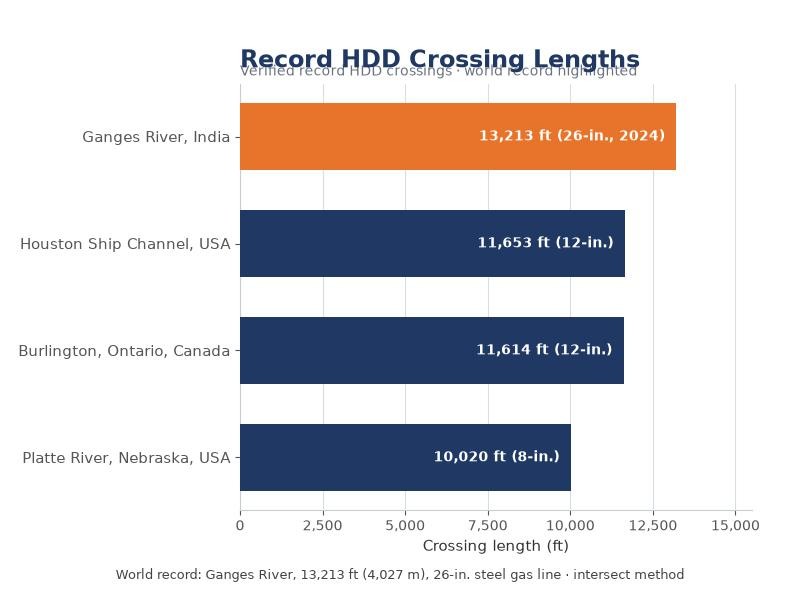
Figure 1. Verified record HDD crossing lengths, from the 10,020-ft Platte River gas line to the 13,213-ft Ganges River world record.
The table below lists the record-length crossings that define the practical horizontal directional drilling maximum length today.
| Crossing | Длина | Product pipe | Метод | Maximum depth |
|---|---|---|---|---|
| Ganges River, India | 13,213 ft (4,027 m) | 26-in. steel gas line plus 6-in. fiber conduit | Intersect | 164 ft (50 m) |
| Houston Ship Channel, USA | 11,653 ft (3,552 m) | 12-in. steel propane line | Intersect | 160 ft (49 m) |
| Burlington, Ontario, Canada | 11,614 ft (3,540 m) | 12-in. steel | Intersect | 230 ft (70 m) |
| Platte River, Nebraska, USA | 10,020 ft (3,054 m) | 8-in. steel gas line | Intersect | 175 ft (53 m) |
Two patterns stand out in these records. First, every crossing longer than 7,000 ft used the intersect method, because a single rig pushing drill pipe for several miles accumulates steering error and friction that the two-ended approach avoids. Second, the product pipes in the longest crossings are small, 26 in. or less, because length and diameter compete for the same rig capacity.
What Is the Maximum Diameter for Horizontal Directional Drilling?
The practical HDD pipe diameter limit for steel product pipe in verified project work through 2026 is about 48 in. (1,219 mm), with final reamed holes reaching about 60 in. (1,524 mm). Larger product pipe is theoretically possible, but 48-in. steel is the practical ceiling for completed installations documented in industry records, and that remains the realistic HDD maximum diameter for planning purposes.
One of the largest HDD pipe installations on record is the Murray River crossing in British Columbia, Canada, which placed a 48-in. NPS steel pipe over 1,347 m (4,420 ft). The bore was reamed to a 60-in. final hole, protected by telescoping steel casing up to 96 in. at the entry, and pulled back with a maximum pullback force of 886,000 lb (402 t), assisted by a 24-in. pneumatic hammer. The Coosa River crossing in the United States placed a 42-in. steel pipe over 3,407 ft (1,039 m), reamed in three passes at 30, 42 and 54 in., with maxi rigs working from both sides in an intersect configuration.
| Crossing | Product pipe | Длина | Final reamed hole | Peak pullback |
|---|---|---|---|---|
| Murray River, Canada | 48-in. NPS steel | 4,420 ft (1,347 m) | 60 in. | 886,000 lb (402 t) |
| Coosa River, USA | 42-in. steel | 3,407 ft (1,039 m) | 54 in. (three passes) | Maxi rigs, intersect |
For steel pipe, contractors normally plan the final reamed hole at about 1.5 times the product pipe outside diameter. A 48-in. pipe therefore needs a 60-in. final hole, and a 42-in. pipe needs a 54-in. hole, exactly the schedule the Coosa River project used. Reaming is done in multiple passes rather than a single cut, which protects the bore wall and keeps drilling fluid circulating.
It is important to state the limits honestly. HDD bores larger than 60 in. are almost always casing or conduit applications, not product pipe installations, and documented projects that installed steel product pipe larger than 48 in. by HDD are not part of the public record we work from. When a design calls for product pipe of 54 in. or larger, the engineering team should compare HDD against microtunneling and open-cut options before committing to a method.
What Limits HDD Length and Diameter? Five Practical Constraints
There is no universal HDD length limit or diameter limit; both the horizontal directional drilling maximum length and the maximum diameter are governed by the same five constraints, and any one of them can stop a bore regardless of the others.
1. Rig Pullback and Torque Capacity
The machine’s rated pullback force and torque define the brute-force ceiling of any crossing. The largest maxi rigs are rated above 1,000,000 lb (454 t) of push-pull; the Ganges record used two American Augers DD1100 machines at that scale, with torque deliberately held below 60,000 ft-lb to protect the drill string. Once the pullback demand of the product pipe approaches the rig rating, the only options are a larger rig, an intersect setup or a smaller pipe. A practical guardrail: once computed pullback demand exceeds about 80% of the rig’s rated capacity, upsize the rig, switch to intersect, or reduce the pipe size.
2. Geology and Ground Conditions
Ground conditions decide how fast and how safely a bore advances, and they become more punishing as length and diameter grow. Hard rock slows penetration and wears bits and reamers; gravel and cobble beds cause fluid loss and bore collapse; solution voids can swallow circulation. A crossing that is straightforward in stiff clay can become a multi-week effort in fractured rock, which is why a geotechnical report is the first document a competent bore plan starts from. If the geotechnical report shows fractured rock, gravel beds or karst voids in the crossing zone, budget for slower reaming and higher mud loss before committing to a length.
3. Borehole Stability and Reaming
Reaming is the process of enlarging the pilot hole in successive passes before pullback; each pass uses a slightly larger reamer to protect the bore wall and keep drilling fluid circulating. A stable annulus is what makes long pullback possible, and stability depends on the ratio between the hole and the pipe. The 1.5-times reamed-hole convention for steel pipe exists for this reason: too tight a hole jams the pipe, too loose a hole lets the bore wall collapse under its own weight. Multiple reaming passes, each only slightly larger than the last, keep the bore open while the drilling fluid builds a filter cake on the wall. Verify the 1.5-times reamed-hole ratio against soil type; softer ground may require a larger annulus or casing to prevent collapse during pullback.
4. Drilling Fluid Delivery
Drilling fluid carries cuttings out of the bore, supports the hole wall and lubricates the pipe, and its delivery rate is a hard constraint. The Ganges project combined two 600 GPM mud pumps for roughly 800 GPM of effective flow, an indicator of what ultra-long bores consume. Undersized pumps force slower reaming, raise stuck-pipe risk and can terminate a crossing well before the rig’s rated distance is reached. Size mud pumps for peak reaming demand, not average flow; a project that cannot hold circulation below 600 GPM equivalent is at high stuck-pipe risk.
5. Pipe Strength and Buckling Resistance
The product pipe itself sets a limit that no rig can bypass. Steel pipe is pulled by its full cross-section and can absorb very high loads, but HDPE and other plastic pipes are governed by allowable tensile stress, commonly limited to about 1,000 psi for PE installations, and by buckling resistance in the oversized annulus. In our project reviews, pipe material and wall thickness, not the rig, are the limiting factors in roughly half of the long-bore feasibility checks we run. For plastic pipe, stop the design once allowable tensile stress exceeds the computed pullback load; no rig upgrade can fix an overstressed pipe.
How Do Length and Diameter Trade Off Against Each Other?
Length and diameter compete for the same capacity, so the practical horizontal directional drilling maximum length falls as the pipe diameter rises. A larger pipe consumes more pullback force per foot, needs a larger final reamed hole and demands more reaming passes, all of which shorten the distance a given rig can deliver.

Figure 2. Record crossings show the length-diameter trade-off: large-diameter bores are shorter, ultra-long bores carry smaller pipes.
| Product pipe | Crossing | Длина | Final reamed hole |
|---|---|---|---|
| 48-in. steel | Murray River, Canada | 4,420 ft (1,347 m) | 60 in. |
| 42-in. steel | Coosa River, USA | 3,407 ft (1,039 m) | 54 in. |
| 26-in. steel | Ganges River, India | 13,213 ft (4,027 m) | 38 in. |
| 12-in. steel | Burlington, Canada | 11,614 ft (3,540 m) | 24 in. |
Use this pattern when scoping a crossing, and confirm the numbers against your geotechnical data before locking the design. If the design fixes the diameter at 48 in., plan the bore as a mid-length river or obstacle crossing and budget for a 60-in. final hole, the practical HDD maximum diameter; if the design fixes the length at 10,000 ft, plan for a small-diameter pipe and an intersect operation. Designs that demand both maximum length and maximum diameter in one bore are the ones that fail or end in a method change.
Not sure whether your crossing fits inside proven limits? Send our engineering team your pipe size, crossing length and geotechnical report, and we will confirm whether the numbers are realistic before you mobilize, with a technical feasibility review and scoped proposal within five working days. Contact JSW engineering.
What Length and Diameter Ranges Fit Each Rig Class?
Match the rig class to the bore plan: mini rigs (5,000-100,000 lb) handle crossings up to 1,000 ft, midi rigs (100,000-200,000 lb) reach 1,000-2,500 ft, and maxi rigs (200,000 lb and up) cover 2,500 ft to several miles with pipe from 24 to 48 in. Rig classes exist precisely because length and diameter needs differ by project, and matching the machine class to the bore plan is the fastest way to stay inside practical limits.
| Rig class | Pullback rating | Typical length | Typical product pipe | Typical use |
|---|---|---|---|---|
| Mini | 5,000 to 100,000 lb | Up to 1,000 ft | 2 to 12 in. | Utility lines, road and driveway crossings |
| Midi | 100,000 to 200,000 lb | 1,000 to 2,500 ft | 12 to 24 in. | Municipal water, sewer and gas mains |
| Maxi | 200,000 to 1,000,000+ lb | 2,500 ft to several miles | 24 to 48 in. | River, canal and highway crossings, large pipelines |
The classes overlap by design, and a project near a class boundary should be verified by calculation rather than by rule of thumb. In our experience, the most common sizing error is a midi rig quoted for a crossing that the bore plan clearly places in maxi rig territory, which surfaces during pullback as a rig at full throttle and a pipe that will not move.
Microtunneling vs HDD: When Should a Long, Large Crossing Change Methods?
Choosing between microtunneling vs HDD comes down to three factors: finished diameter, grade control and ground support. HDD is not always the right answer at the upper end of the envelope. Microtunneling, another trenchless method, competes directly with HDD for long, large and precise crossings, and it wins in three specific situations: very large diameters, exact grade control and soft ground where a straight, supported line is required.
| Фактор | HDD | Микротоннелирование |
|---|---|---|
| Proven length | Up to 13,213 ft (4,027 m) | Multi-kilometer drives with intermediate shafts |
| Product pipe | Steel, HDPE, ductile iron | Concrete, steel, fiberglass, jacked pipe |
| Диапазон диаметров | Product pipe up to about 48 in. | Up to 144 in. (3.6 m) in large-diameter work |
| Alignment and grade | Controlled arc, tolerances in inches | Exact line and grade, tolerances in millimeters |
| Ground support | Open bore held by drilling fluid | Pipe jacked behind a shielded machine head |
| Typical cost profile | Lower for mid-size crossings | Higher setup, but viable for very large diameters |
Use HDD when the bore can follow a curved profile, the pipe is steel or HDPE, and the diameter stays within practical reaming range. Use microtunneling when the design demands a straight, precision-grade gravity sewer, a finished diameter beyond 48 in., or stable support in soft soils where an open bore would collapse. The two methods also combine in one project: a microtunneled casing with an HDD-installed product line inside it is a proven arrangement for congested crossings.
HDD Length and Diameter FAQ
How long can horizontal directional drilling go?
In practice, HDD crossings run from under 1,000 ft for utility lines to more than 13,000 ft for record river crossings. Short crossings stay below 1,000 ft, medium runs reach 3,000 ft, long crossings extend to 7,000 ft, and anything beyond that normally uses the intersect method with two rigs.
What is the longest horizontal directional drilling crossing ever completed?
The longest HDD crossing completed to date is the 13,213 ft (4,027 m) Ganges River crossing in India, finished in 2024 with the intersect method. It placed a 26-in. steel gas line and a 6-in. fiber conduit, was drilled by two American Augers DD1100 maxi rigs, and took 76 days from the pilot hole start to the completed pullback, which makes it the current horizontal directional drilling maximum length for a single continuous installation.
Can horizontal directional drilling install 60-inch pipe?
A 60-in. bore is at the proven upper end of HDD, but it is the reamed hole size, not the product pipe. The largest steel product pipes installed by HDD on record are about 48 in., such as the Murray River crossing, which was reamed to a 60-in. final hole, so the practical HDD maximum diameter for product pipe is 48 in. If a design truly requires 60-in. product pipe, the team should evaluate microtunneling before committing.
What is the maximum depth for horizontal directional drilling?
Depth is rarely the limiting factor in HDD, and it does not interact with the length and diameter limits the way ground conditions do. The record crossings in this guide were drilled 160 to 230 ft (49 to 70 m) below the surface, and the constraint at depth is usually steering accuracy and drilling fluid return, not the machine.
How deep can horizontal directional drilling go?
HDD routinely reaches 100 ft below the surface, and record river crossings have been drilled as deep as 230 ft (70 m). Beyond that range, the practical constraints shift to steering accuracy and drilling fluid return rather than the rig’s depth rating.
Does a larger pipe diameter reduce the horizontal directional drilling maximum length?
Yes, and the trade-off is steep. A larger pipe needs a larger final reamed hole, more reaming passes and more pullback force per foot, so the same rig can push a small pipe much farther than a large one, and the horizontal directional drilling maximum length is always project-specific. The record data shows it clearly: 48-in. pipe at 4,420 ft, 42-in. pipe at 3,407 ft, and 12-in. pipe beyond 11,000 ft.
How do contractors drill crossings longer than one rig can reach?
They use the intersect method. Two rigs drill toward each other from opposite sides of the crossing, a magnetic guidance system brings the two pilot holes together, and one rig pulls the product pipe through the full length. Intersect drilling is standard practice for HDD projects beyond 7,000 ft and is the method behind nearly every record length in this guide.
What is the maximum HDD length for HDPE pipe?
HDPE crossings routinely reach several thousand feet, but the practical ceiling is set by allowable tensile stress, commonly about 1,000 psi for PE installations, not by the rig. Long HDPE bores are planned by calculating the pullback force against that stress limit, then confirming the rig can deliver the required force without overloading the pipe; our pipeline construction services team runs this exact check on every HDPE bore it reviews.
Have a different question about your bore parameters? Our engineering team reviews HDD feasibility questions daily; send us your crossing details and get a technical feasibility review with a scoped proposal within five working days.
How JSW Supports HDD and Pipeline Projects
JSW is a pipeline engineering and construction partner supporting owners and contractors across the full lifecycle of directional drilling and trenchless work, including:
- Construction and repair: pipeline construction services, trenchless pipeline repair technology and pipeline maintenance services.
- Welding and fabrication: pipeline automatic welding technology, pipeline cold bending and pipeline hot tapping and plugging services.
- Equipment and tooling: pipeline hot tapping equipment, pipeline plugging pigs and pipeline cutting machines for the entry spread.
We support microtunneling projects with the same engineering discipline.
What distinguishes our support is feasibility engineering at the start. Before a single joint is welded, we review the bore parameters against the limits described in this guide, checking pipe material and wall thickness, expected pullback force, reaming schedule and rig class, and we state plainly when a design is pushing beyond proven practice and which alternative method should be evaluated. There is no universal horizontal directional drilling maximum length, only the limit your equipment, geology and bore plan allow, and we help you find that limit before you mobilize. Get a technical feasibility review of your crossing: send our engineering team your bore plan, pipe size, geotechnical report and crossing type, and we will confirm whether your length and diameter are realistic, with a scoped proposal within five working days. Start your feasibility review.





































 English
  Arabic
  Russian
  Spanish
  French
  Vietnamese
  Polish
  Thai
Thai  Indonesian
  Turkish
  Portuguese