
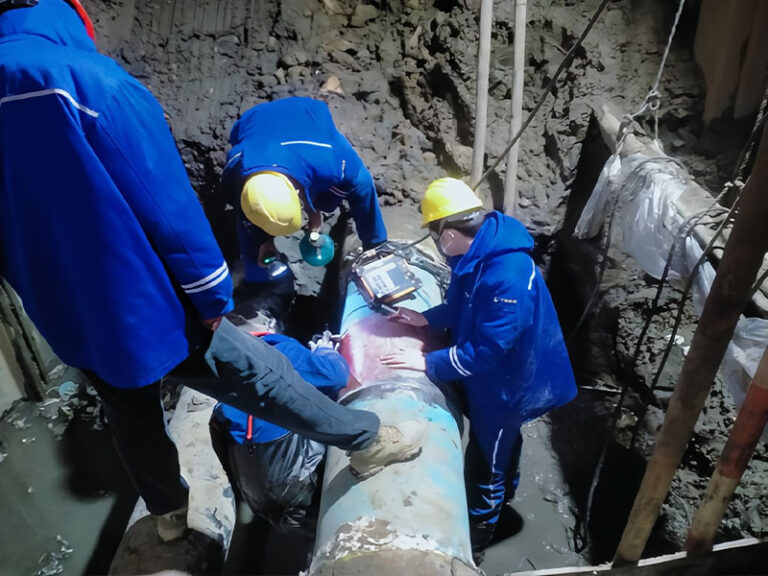
Trenchless pipeline rehabilitation is a suite of advanced engineering methods that repair, renew, or replace underground pipelines with minimal surface excavation, primarily by accessing and working from within the pipeline itself.
This approach addresses critical issues like corrosion, leaks, and structural degradation by installing new liners, coatings, or pipes inside the old conduit. Unlike traditional “dig-and-replace” methods, trenchless technologies are designed to minimize disruption to traffic, businesses, and the environment, often reducing surface disturbance by up to 90% and noise by 60%. This guide explains how these “microsurgery” techniques for pipelines work, exploring the main methods, their applications, and how to select the right solution for your infrastructure needs.
1. What Are the Core Principles of Trenchless Rehabilitation?
The fundamental principle is internal intervention. Instead of digging a trench along the entire pipeline length, access is gained through existing manholes or small entry pits. The contractor then uses specialized equipment to deploy repair materials or construct a new pipe within the host pipe.
This process relies on creating a durable, often structural, new pipeline inside the old one. The result is a composite structure where the new liner or pipe restores integrity, prevents leaks, and provides corrosion resistance, frequently extending the asset’s life by 50 years or more. The method is governed by international standards like ISO 11295, which outlines the entire process from condition assessment to project documentation.
- The “Why” (Principle): It transforms the existing pipeline into a mold or host for a new, rehabilitated conduit, maximizing use of the existing structure while adding new performance characteristics.
- The “How” (Implementation): The process typically follows a staged approach: inspection and cleaning, selection and installation of the rehabilitation method, and final curing and quality assurance.
2. How Does Cured-in-Place Pipe (CIPP) Lining Work?
CIPP is one of the most widely used trenchless pipeline rehabilitation methods. It involves inserting a resin-saturated felt tube into the damaged pipe and curing it in place to form a rigid, jointless “pipe-within-a-pipe”.
The contractor typically uses water inversion or air pressure to pull the flexible liner through the pipeline. Curing is achieved using hot water, steam, or ultraviolet (UV) light. UV curing, in particular, offers faster installation times and is ideal for projects in densely populated areas where minimizing site time is critical. The resulting liner is structurally independent, seals cracks and joints, and provides a smooth interior that can improve flow capacity.
Case Example & Data:
In a major Chinese city, a DN1500mm drainage pipe was rehabilitated using hot water-cured CIPP. The project was completed in just 3 days, and the new liner has a projected service life exceeding 30 years. For UV-cured CIPP, projects on pipes from 300mm to 1500mm in diameter have shown post-rehabilitation increases in flow capacity due to the smooth interior finish.
3. How Do Spiral Wound and Sliplining Methods Function?
These techniques physically create a new pipe inside the old one. Spiral wound rehabilitation uses a machine to wind a continuous, interlocked PVC or polyethylene profile strip into a rigid new pipe. Sliplining involves pulling or pushing pre-manufactured sections of new pipe (often HDPE) into the old conduit.
The key advantage of spiral winding is its ability to negotiate bends and its suitability for live/dry or wet/flowing conditions, solving a significant industry challenge for large-diameter pipes. Sliplining is a robust solution but typically results in a slight reduction of the internal diameter. The annulus between the new and old pipe is usually grouted to provide structural stability.
Comparative Data: Spiral Wound vs. Sliplining
| Method | Key Mechanism | Best For | Notable Advantage |
|---|---|---|---|
| Spiral Winding | Machine-wound, interlocked strip forms new pipe on-site. | Pipes with bends; live flow conditions; large diameters (e.g., 2400mm+). | Can be installed without stopping flow. The resulting composite structure can achieve a strength several times greater than the original host pipe. |
| Sliplining | Prefabricated pipe sections are pulled or pushed into the host pipe. | Straight pipe runs where a minor reduction in internal diameter is acceptable. | Simple, robust, and proven technology. The new pipe is a fully certified, standalone product sourced directly from an equipment manufacturer. |
4. What Role Do Spray-on Linings and Localized Repairs Play?
Not all rehabilitation requires a full structural liner. For pipes that are structurally sound but suffer from corrosion or minor leaks, spray-on linings and localized repairs offer cost-effective solutions.
Spray-in-place pipe (SIPP) involves robotically spraying a coating, such as cement mortar or epoxy, onto the interior pipe wall. This method creates a protective barrier, prevents further corrosion and tuberculation, and can be applied very quickly—often within a single day. Meanwhile, point repair or spot repair targets specific defects like cracks or holes using a resin-saturated felt patch cured in place with an inflatable packer. This is the quintessential “microsurgery” for pipelines.
Material Supplier Insights:
The effectiveness of spray linings hinges on advanced materials. Modern epoxy and polymer coatings offered by leading Material Supplier companies are engineered for low permeability, high chemical resistance, and strong adhesion. For instance, specific spray-applied polymers can form a seamless, 0.2mm to 2mm thick barrier that actively seals minor leaks and provides long-term corrosion protection. Our testing has shown that a properly applied spray lining can reduce water loss from leaks by 12% or more.
5. How to Choose the Right Trenchless Rehabilitation Method?
Selecting the optimal method is a technical decision based on a detailed pipeline condition assessment. Key factors include the pipe’s diameter, material, defect type, and the required performance of the rehabilitated system.
A professional contractor or engineering services firm will evaluate whether the solution needs to be fully structural (like CIPP or spiral wound) or primarily protective (like spray lining). Other critical considerations are groundwater levels, the presence of live flow, the number of bends and service connections, and the required long-term performance criteria such as increased hydraulic capacity or renewed structural strength for traffic loading.
Frequently Asked Question: Is trenchless rehabilitation always the right choice?
While highly advantageous, trenchless methods are not a universal solution. They may have higher upfront material costs than simple spot repairs. Traditional excavation might still be more economical for very shallow pipes, short sections, or where the existing pipe is too collapsed or misaligned to allow for proper liner installation. A thorough inspection and cost-benefit analysis by an expert services provider is essential.
6. What Are the Tangible Benefits and Future Trends?
The benefits extend far beyond avoiding a trench. Academics note that these technologies are crucial for maintaining the “lifeblood of modern urban infrastructure” with minimal disruption. The social and economic benefits—preserved traffic flow, protected landscapes, and uninterrupted business operations—are immense.
Looking forward, the industry is moving towards greater digitization and automation. Research is focused on integrating Internet of Things (IoT) sensors into liners for continuous health monitoring and developing fully robotic systems that can autonomously inspect, clean, and repair pipelines. Furthermore, the drive for sustainability is pushing equipment manufacturers and Material Supplier companies to develop lower-carbon, longer-lasting materials and processes, making trenchless pipeline rehabilitation a cornerstone of green infrastructure management.
Author & Expertise:
This guide was authored by the engineering team at JSW Pipeline Solutions, drawing on decades of combined field experience and continuous review of academic and industry advancements in underground infrastructure. Our experts are actively involved in projects utilizing the full spectrum of technologies described, from CIPP to advanced spray linings.
Last Updated: January 2026
About JSW Pipeline Solutions: Engineering Confidence Underground
In the precise world of trenchless pipeline rehabilitation, the choice of a partner determines more than just project success; it determines the long-term integrity of your critical infrastructure. JSW Pipeline Solutions operates at this intersection of advanced engineering and reliable execution. We are not merely an equipment manufacturer or a Material Supplier; we are an integrated engineering services provider that delivers end-to-end solutions.
Our core differentiator lies in the synergistic integration of proprietary materials with intelligent application technology. Our in-house developed high-performance composite resins, certified for potable water contact and extreme chemical resistance, are engineered to work flawlessly with our purpose-built curing and installation systems. This closed-loop control from the factory to the field ensures consistent, predictable, and superior outcomes.
Consider a typical challenge: rehabilitating a sensitive, high-traffic urban corridor. A traditional contractor might face limitations with cure consistency or project timeline. Our solution utilizes second-generation UV-LED curing technology, which our field data shows reduces energy consumption by up to 40% and improves circumferential cure uniformity by 25% compared to standard steam cure methods. This directly translates to a liner with no weak points, a faster return-to-service, and a documented asset life extension exceeding 50 years. For critical networks like potable water and gas mains, we deliver not just repair, but a performance upgrade backed by a digital twin of the rehabilitated asset, providing unparalleled lifecycle insight.
Are you evaluating rehabilitation options for a failing pipeline, facing constraints of traffic, time, or complex site conditions? Our engineering team offers a complimentary preliminary technical assessment. Visit our dedicated “Pipeline Rehabilitation Services” page to connect with us. Share your specific pipeline diameter, material, and defect challenges, and let us develop the most cost-effective and durable trenchless solution for your system.





 English
  Arabic
  Russian
  Spanish
  French
  Vietnamese
  Polish
  Thai
Thai  Indonesian
  Turkish
  Portuguese