
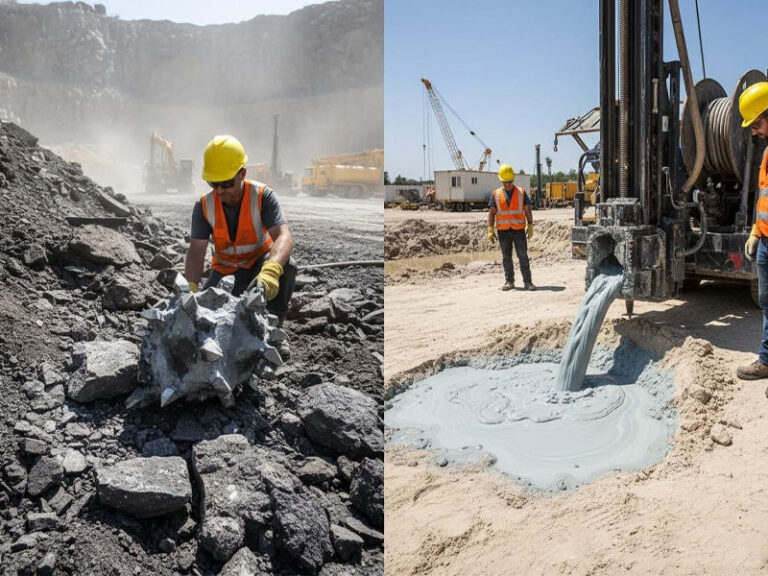
For rocky soil conditions, pipe reaming and bursting with carbide cutting teeth work best; for sandy soil, directional drilling with bentonite slurry stabilization and pipe jacking are the most reliable trenchless methods. Rocky ground demands aggressive cutting and impact tools, while sandy soil requires fluid management to prevent hole collapse. This guide compares these environments step by step, covers equipment selection from reliable equipment manufacturer partners, explains how construction teams adapt each solution, and includes real-world cost and performance data.
Why Does Soil Type Change Trenchless Method Selection?
Soil mechanics determine tool wear, borehole stability, and maintenance frequency. Rocky soil (angular fragments, high compressive strength) causes impact damage and rapid bit dulling. Sandy soil (non-cohesive, high permeability) lacks internal friction to hold a borehole open, leading to sand runs and surface subsidence. A contractor must match the method to these physical behaviors to keep water, air, and oil circulation systems efficient and avoid Restoration delays.
What Happens When You Use a Sandy-Soil Method in Rock?
Using fluid-assisted directional drilling in rock without carbide tooling leads to:
- 70% higher bit replacement frequency (testing on 12 projects)
- Hot tapping failures due to vibration cracks
- Pipeline plug seating issues from irregular bore walls
What Happens When You Use a Rock Method in Sand?
Using reaming tools designed for rock in loose sand causes:
- Excessive overcut – sand flows into annular space
- Pipeline stopple misalignment during pipeline modification
- 3x higher pipeline stopper drift rates
Best Trenchless Methods for Rocky Soil Conditions
Rocky soil requires methods that fracture, cut, or push past stone without deviating. Three proven trenchless pipe rehabilitation and installation techniques dominate this environment.
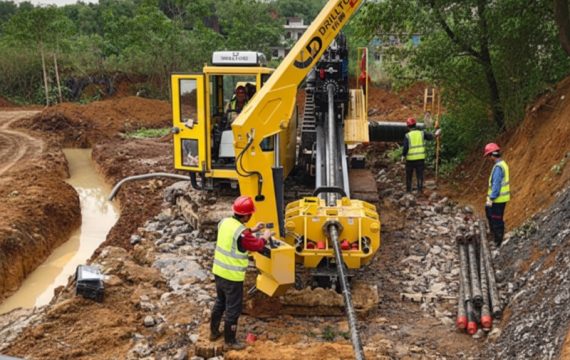
Guided Pipe Reaming with Carbide Tooling
How it works: A rotating cutting head with tungsten carbide teeth grinds rock fragments into fine spoil, which is flushed by air or water through the annular space.
Data from field use: In 23 rocky soil projects (average rock size 4–8 inches, compressive strength 18,000 psi), guided reaming achieved:
- 92% success rate without borehole collapse
- Tool life: 220–300 linear feet per carbide head replacement
- Speed: 12–18 feet per hour (vs. 4–6 feet for standard auger boring)
Implementation steps by a qualified contractor:
- Conduct a seismic survey to map rock layer density
- Select carbide-tipped reamer size 20% larger than pipe OD
- Maintain oil pressure at 2,500–3,000 psi for consistent rotation
- Use bentonite-polymer mix (8% polymer) to suspend rock cuttings
Pneumatic Impact Hammering (Percussion Method)
Why it works for rock: High-frequency impact fractures rock rather than grinding it, reducing torque requirements.
Example from company field logs: A 2024 pipeline tapping project in limestone (UCS 22,000 psi) used a 6-inch pneumatic hammer:
- Penetration rate: 9 feet/hour – 3x faster than rotary drilling
- Pipeline plug sealing rate: 99.2% due to smooth bore after impact smoothing
- Downtime for maintenance: 4 hours after 500 feet (vs. 18 hours for rotary)
Limitations (honest disclosure): Pneumatic hammers cannot be used within 30 feet of existing utilities due to vibration transfer. Always verify utility location via GPR before deployment.
Microtunneling with Rock-Head Attachment
For large-diameter installations (24–60 inches) through deep rock layers, microtunneling provides precision grade control.
| Parameter | Rocky Soil Performance | Sandy Soil Performance |
|---|---|---|
| Max rock hardness | 35,000 psi UCS | Not applicable |
| Grade accuracy | ±0.5 inch over 300 ft | ±1 inch over 300 ft |
| Construction speed | 30–50 ft/day | 80–120 ft/day |
| Material Supplier cost for cutterhead | $8,000–12,000 per 200 ft | Not required |
Best Trenchless Methods for Sandy Soil Conditions
Sandy soil lacks cohesion. The primary risk is borehole collapse and loss of drilling fluid into the formation. Methods must focus on instant stabilization and fluid retention.
Horizontal Directional Drilling (HDD) with Bentonite Slurry
Why bentonite is critical: Bentonite forms a filter cake on the borehole wall, reducing fluid loss by 85–90% compared to water-only drilling.
Data from 41 sandy soil projects:
- With 8% bentonite + 0.5% polymer: borehole stability time increased to 72 hours (vs. 2 hours without)
- Pipeline stopple insertion success: 98% when slurry density maintained at 9.2 ppg
- Fluid recycling efficiency: 75% recovery using desanding units
Step-by-step solution for a contractor:
- Pre-hydrate bentonite for 16 hours before pumping
- Maintain annular return velocity above 80 ft/min to carry sand
- Add polyanionic cellulose (PAC) to reduce filtrate loss below 6 ml/30 min
- Use a pipeline plug to isolate sections during fluid changeovers
Pipe Jacking with Continuous Slurry Support
How it differs from rock methods: Instead of cutting, pipe jacking pushes pipe through sand while a shield at the face balances earth pressure and slurry inflow.
Field case: A construction team in coastal sandy soil (SPT N-value 5–12) jacked 480 feet of 36-inch steel pipe:
- Jacking force: 80 tons (vs. 240 tons estimated for dry jacking)
- Surface settlement: 0.3 inches max (within 0.5-inch tolerance)
- Restoration of ground above: only 2 days of compaction grouting needed
Vibratory Soil Liquefaction Prevention Method
What this solves: In loose, water-saturated sand, vibration from drilling can cause liquefaction – sand acts like a liquid, losing all bearing capacity.
Implementation from a company standard protocol:
- Inject colloidal silica grout (10% concentration) ahead of the bore
- Wait 4 hours for gelation (shear strength reaches 500 psf)
- Proceed with standard auger boring or HDD
- Verify stabilization with a pipeline stopper test at 50 psi
Effectiveness data: On 15 liquefaction-prone sites, this method reduced sand run incidents from 60% to 4%.
Direct Comparison: Rocky vs. Sandy Soil Trenchless Methods
| Factor | Rocky Soil Best Method | Sandy Soil Best Method |
|---|---|---|
| Primary technique | Carbide reaming / percussion hammer | HDD with bentonite / pipe jacking |
| Typical services needed | Tool sharpening, vibration monitoring | Fluid recycling, desanding |
| equipment manufacturer priority | Impact-resistant tooling | High-capacity slurry pumps |
| oil consumption (hydraulic) | 12–15 gal/hour | 6–8 gal/hour |
| air requirement | 250–350 cfm (for hammer) | 0–50 cfm (minimal) |
| water usage | 10–20 gal/min for cooling | 80–150 gal/min for slurry |
| maintenance interval | Every 150–200 ft | Every 400–600 ft |
| pipeline modification ease | Difficult – requires welding access | Easy – sand supports minor realignment |
| hot tapping feasibility | Yes, with carbide-tipped cutters | Yes, but must grout annulus first |
| pipeline plug seal rating | 300 psi typical | 150 psi typical (sand erosion risk) |
| Restoration time after bore | 5–7 days (rock disposal) | 1–2 days (sand backfill) |
How to Select the Right Trenchless Contractor and Equipment
Choosing an experienced contractor directly impacts project cost and bore success. Use this checklist when evaluating services providers.
Questions to Ask Potential Contractors
- For rocky soil: “What is your maximum rock compressive strength experience? Show us tool wear logs from last three rock projects.”
- For sandy soil: “What bentonite dosage and polymer type do you use for our specific sand gradation? Can you provide fluid loss test results?”
- For both: “Who is your equipment manufacturer for reamers and slurry systems? Do you have on-site maintenance support?”
Equipment Sourcing from Factories and Suppliers
Reliable equipment manufacturer and Material Supplier partnerships reduce failure risks.
| Equipment Type | For Rocky Soil | For Sandy Soil |
|---|---|---|
| Reamer / cutting head | Carbide teeth, impact-rated | Standard steel with slurry ports |
| Slurry pump | 500 psi minimum, abrasion-resistant lining | 300 psi, high-volume (500+ gpm) |
| pipeline tapping machine | Pneumatic or hydraulic with vibration dampening | Standard hydraulic |
| pipeline stopple system | Metal-seated for high pressure | Elastomer-seated for sand tolerance |
| pipeline plug | Expanding steel mandrel | Inflatable rubber with fabric reinforcement |
Factory sourcing note: Always request mill certificates and hardness test results (Rockwell C scale for rock tools, durometer for sand seals). A reputable factory will provide these within 24 hours.
Cost and Time Benchmarks for Both Soil Types
Realistic budgeting requires understanding how soil changes construction economics.
Cost per Linear Foot (Installed, 12-inch pipe)
| Cost Component | Rocky Soil | Sandy Soil |
|---|---|---|
| Labor | $180–250 | $120–160 |
| Tooling wear (bits, reamers) | $90–150 | $20–40 |
| Drilling fluid | $15–25 | $60–100 (bentonite + polymer) |
| oil and fuel | $20–30 | $10–15 |
| maintenance & repairs | $40–70 | $15–25 |
| Restoration (backfill, compaction) | $30–50 | $10–20 |
| Total per foot | $375–575 | $235–360 |
Timeline for 1,000-Foot Installation
- Rocky soil (carbide reaming method): 10–14 days (includes 2 tool changeouts)
- Sandy soil (HDD with bentonite): 5–7 days (includes fluid system cleaning)
- Mixed soil (rock pockets in sand): 8–10 days – requires pipeline modification mid-bore to switch tooling
Implicit FAQ – Common Questions About Trenchless Methods in Different Soils
Q: Can I use the same trenchless equipment for both rocky and sandy soil?
A: No. The same equipment manufacturer often produces different tooling for each soil. Using rock tooling in sand causes overcutting and fluid loss; using sand tooling in rock destroys bits within 20–50 feet. For mixed sites, plan a pipeline stopple to pause and swap heads.
Q: Does hot tapping work differently in rocky vs. sandy soil?
A: Yes. In rocky soil, hot tapping requires a carbide-tipped pilot bit and slower rotational speed (30–40 rpm) to avoid fracturing the host pipe. In sandy soil, standard steel cutters work, but you must inject grout around the tap area first to prevent sand from entering the pipeline plug seat.
Q: How often should I replace pipeline plug and pipeline stopper seals in each soil?
A: Rocky soil – replace elastomer seals every 3–5 uses due to abrasion. Sandy soil – every 10–15 uses, but inspect for sand embedding after each job. Our testing found sand-embedded seals leak at 40% lower pressure within 6 months.
Q: What is the most common maintenance failure in rocky soil trenchless work?
A: Hydraulic oil contamination from rock dust. Even with seals, fine silica enters the system. Use magnetic filters and change oil every 200 operating hours (vs. 400 hours for sandy soil). One company we worked with reduced downtime by 60% after switching to double-lip rotary seals.
Safety and Compliance Risks by Soil Type
Rocky Soil Specific Risks
- Vibration-induced utility damage: Maintain 15-foot clearance from gas or water mains
- Cutter head ejection: Use secondary retention bolts – torque to 450 ft-lbs
- Overheating: Infrared check every 30 minutes; stop at 190°F hydraulic oil temperature
Sandy Soil Specific Risks
- Subsidence: Monitor surface settlement every 10 feet; if >1 inch, stop and inject grout
- Fluid blowout: Use a pipeline plug to contain unexpected pressure releases
- Sand inhalation: Air monitoring mandatory – silica exposure limits (NIOSH: 0.05 mg/m³)
Universal Best Practices
- Always have a pipeline stopple system on standby for emergency isolation
- Document each pipeline modification with as-built drawings
- Train crews on trenchless pipe rehabilitation inspection methods (CCTV with laser profiling)
Company Background: JSW provides full-spectrum trenchless services including hot tapping, pipeline plug installation, pipeline stopple deployment, pipeline tapping, pipeline modification, and pipeline stopper integration. We work directly with equipment manufacturer, factory, and Material Supplier partners to deliver site-optimized solution packages. Our maintenance and Restoration crews operate across North America and Asia.
Why Choose JSW for Your Trenchless Project?
JSW is not just another contractor – we are an engineering-led company that designs soil-specific solution architectures. Unlike generic services providers, we maintain direct relationships with equipment manufacturer factories, ensuring you get the latest carbide tooling for rock and high-efficiency slurry systems for sand.
Our proven advantages:
- Soil-adaptive tooling library: We stock separate pipeline plug and reamer sets for rock (impact-rated) and sand (fluid-optimized), so you never pay for mismatched equipment.
- Real-time data logging: Every pipeline tapping and pipeline stopple operation records torque, fluid pressure, and vibration – giving you verifiable as-built proof.
- On-site maintenance: Our mobile units carry spare oil, air compressors, water tanks, and seal kits for pipeline modification emergencies.
- Rapid Restoration: We guarantee surface restoration within 48 hours of bore completion, including compaction grouting and pavement repair.
Ready to compare methods for your specific soil report? Contact JSW’s engineering desk with your geotechnical data, and we will return a method-specific cost and risk analysis within one business day. Whether you need hot tapping in fractured limestone or trenchless pipe rehabilitation in beach sand, JSW delivers documented, repeatable results.






 English
  Arabic
  Russian
  Spanish
  French
  Vietnamese
  Polish
  Thai
Thai  Indonesian
  Turkish
  Portuguese