
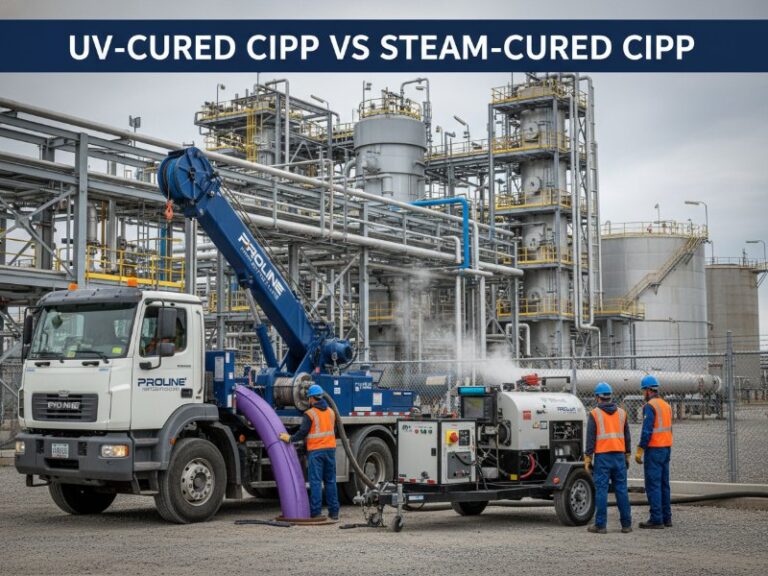
- Choose UV-cured CIPP when: Project speed (cure in <1 hour), verifiable QA documentation, and minimal business disruption are top priorities. Best for long, straight runs >300m in commercial or industrial zones.
- Choose steam-cured CIPP when: Upfront equipment budget is limited (<USD 65,000), reliable 3-phase power is unavailable, or pipe geometry includes multiple bends >45 degrees.
- Conditions that change the conclusion: Pipe diameter >800mm favors steam; potable water applications favor UV; remote sites without 480V power favor steam.
Key Takeaways (3 Main Conclusions)
- Performance: Both methods meet 50-year design life per ASTM F1216. Based on typical field data, UV offers 8–15% higher mechanical properties; steam offers 18–22% lower material costs.
- Speed & Disruption: UV curing typically completes in 4–7 hours total (cure time 15–45 minutes, no cooldown). Steam curing usually takes 8–14 hours (cure time 2–6 hours, plus 2–4 hours cooldown).
- Environmental Impact: Based on estimated typical conditions, UV produces 50–68% lower carbon emissions (2.8–4.2 vs 5.6–8.9 kg CO2e/m) and uses 80–90% less water than steam curing.
Assumptions for All Cost and Performance Data
The comparisons below assume the following typical conditions unless otherwise noted:
- Pipe diameter range: DN300–DN600 (12–24 inches)
- Single run length: 300–500 meters
- Geographic region: North America (U.S. labor and energy costs)
- Energy prices: Electricity at USD 0.12/kWh; diesel at USD 3.80/gallon
- Crew rates: USD 95–120 per hour per person
- No unusual access constraints (e.g., deep burial, contaminated groundwater)
Data sources include manufacturer technical specifications (JSW 2024, RADIUS 2023), ASTM standards, and published municipal project records.
What Is the Difference Between UV-Cured and Steam-Cured CIPP?
UV-cured CIPP uses ultraviolet light to harden resin in 15–45 minutes at ambient temperature, while steam-cured CIPP uses high-temperature steam (120–150°C) to activate curing over 2–6 hours.
Mechanism comparison:
- UV curing: A light train with mercury vapor or LED lamps (365–400 nm wavelength) travels through the liner. Photoinitiators in the resin absorb UV energy, triggering polymerization. Curing happens immediately as the light passes.
- Steam curing: A boiler generates pressurized steam that circulates inside the inflated liner. Heat transfers through the liner wall, activating thermal initiators. The entire liner reaches cure temperature simultaneously.
Performance verdict (revised, more authoritative tone):
Both methods can meet 50-year design-life expectations when installed to specification. UV-CIPP generally offers faster cure times, stronger QA traceability, and lower site disruption, while steam-cured CIPP usually has lower upfront equipment cost and can be more practical for budget-limited or power-constrained projects.
Cost Comparison: Which Method Costs Less by Project Size?
Steam curing requires 60–75% lower initial capital investment (USD 33,000–65,000 vs USD 99,000–250,000 for UV), but UV achieves 12–15% lower total project costs on jobs exceeding 1,500 linear meters due to faster production rates.
Initial Equipment Investment (USD)
| Cost Component | UV-Cured CIPP | Steam-Cured CIPP |
|---|---|---|
| Primary energy unit | 45,000–120,000 (generator) | 8,000–15,000 (boiler) |
| Curing train / hose system | 35,000–90,000 (light train) | 1,500–3,000 (steam hoses) |
| Winch & handling gear | 12,000–25,000 | 12,000–25,000 |
| Temp/energy monitoring | 3,000–7,000 | 5,000–10,000 |
| Safety & PPE | 4,000–8,000 | 8,000–15,000 |
| Total entry cost | USD 99,000–250,000 | USD 33,000–65,000 |
Per-Meter Operating Costs (USD per linear meter, DN300–DN600)
| Cost Factor | UV-Cured CIPP | Steam-Cured CIPP |
|---|---|---|
| Liner + resin materials | 45–65 | 38–55 |
| Energy (electricity/fuel) | 3–5 | 8–14 |
| Crew size & labor | 3 people, 4–6 hrs | 5 people, 8–12 hrs |
| Water treatment / disposal | 1–2 | 5–8 |
| Traffic control & disruption | Lower (faster cure) | Higher (longer occupation) |
| Total per meter | USD 78–112 | USD 64–95 |
Total Project Cost Scenarios (USD)
| Project Size | UV-Cured Total | Steam-Cured Total | Cost Winner |
|---|---|---|---|
| Small (<300m, residential) | 23,400–33,600 | 19,200–28,500 | Steam (approx. 18% lower) |
| Medium (300–1,500m, commercial) | 78,000–168,000 | 76,800–142,500 | Near equal |
| Large (>1,500m, industrial) | 117,000–168,000 | 134,400–171,000 | UV (approx. 12–15% lower) |
Installation Workflow: Step-by-Step Comparison
UV curing typically completes in 4–7 hours total versus 8–14 hours for steam curing, primarily due to UV’s 15–45 minute cure time and no cooldown requirement.
UV-Cured CIPP Workflow
| Step | Duration | Key Activities |
|---|---|---|
| 1. Pre-liner cleaning & CCTV | 2–4 hrs | High-pressure jetting (3,000–5,000 psi), obstacle mapping |
| 2. Liner insertion | 1–3 hrs | Winch-pull UV-sensitive liner into position |
| 3. Inflation & positioning | 30–60 min | Compressed air to 0.5–1.0 psi, visual confirmation |
| 4. UV light train curing | 15–45 min | Programmed pullback at 0.5–2 m/min, energy dosage recording |
| 5. Quality verification | 1–2 hrs | CCTV inspection, robotic cutting of service connections |
| Total | 4–7 hrs | No cooldown period |
Steam-Cured CIPP Workflow
| Step | Duration | Key Activities |
|---|---|---|
| 1. Pre-liner cleaning & bypass | 2–5 hrs | Cleaning plus temporary bypass pumping |
| 2. Liner insertion & inflation | 1–4 hrs | Pull thermal-resin liner, inflate to 0.5–1.0 psi |
| 3. Steam circulation & curing | 2–6 hrs | Boiler at 120–150°C, temperature probes at multiple points |
| 4. Cooldown & cure verification | 2–4 hrs | Cool below 40°C, Barcol or Shore D hardness testing |
| 5. Reconnection | 1–3 hrs | Remove bladder/calibration tube, cut service connections |
| Total | 8–14 hrs | Cooldown required |
Durability and Quality Assurance: What Testing Shows
Based on ASTM testing, UV-cured liners typically achieve 8–15% higher mechanical properties than steam-cured liners, but both methods comfortably exceed 50-year design life requirements.
Mechanical Properties Comparison (ASTM D790, D638, D2583)
| Property | Test Method | UV-Cured Range | Steam-Cured Range | ASTM Minimum |
|---|---|---|---|---|
| Flexural modulus (MPa) | ASTM D790 | 2,850–3,200 | 2,600–2,950 | ≥1,724 |
| Flexural strength (MPa) | ASTM D790 | 52–68 | 48–62 | ≥31 |
| Tensile strength (MPa) | ASTM D638 | 35–45 | 32–42 | ≥20 |
| Barcol hardness | ASTM D2583 | 45–55 | 40–50 | ≥35 |
Quality Assurance Capabilities
| QA Feature | UV-Cured | Steam-Cured |
|---|---|---|
| Real-time cure monitoring | Yes (light train sensors record energy dosage/meter) | Partial (temperature probes at access points only) |
| Electronic cure records | Yes (exportable data log) | Typically no (manual temperature logs) |
| Post-cure hardness testing | Optional | Required (every 100m) |
| Suitability for nuclear/pharma QA | Yes (full traceability) | Limited |
Best Applications: When to Choose Each Method
UV curing is generally preferred for long, straight pipelines with strong QA requirements (airports, industrial, potable water). Steam curing is typically more practical for small-diameter laterals, remote sites without 3-phase power, and pipes with complex geometry.
Decision Matrix
| Project Characteristic | UV-Cured CIPP | Steam-Cured CIPP |
|---|---|---|
| Pipe diameter | Typically 150–800 mm | 100–1,200+ mm |
| Single run length | 300–500 m (up to 800 m with boosters) | 100–150 m (vent points needed) |
| Bends >45 degrees | Not recommended | Generally acceptable |
| Emergency/high-traffic corridor | Strongly preferred | Not ideal |
| Potable water (NSF/ANSI 61) | Yes (ambient cure) | Not recommended (heat can damage cement linings) |
| Remote site without 480V power | Requires generator truck | Can use diesel/propane boiler |
| Upfront capital <USD 70,000 | Difficult | Practical |
Environmental and Safety Impact Comparison
Based on estimated typical conditions, UV curing produces 50–68% lower carbon emissions and uses 80–90% less water than steam curing, but steam curing avoids the need for high-voltage electrical equipment at remote sites.
Environmental Impact per Linear Meter (Estimated Typical Values, DN400 pipe)
| Impact Category | UV-Cured CIPP | Steam-Cured CIPP |
|---|---|---|
| Carbon footprint (kg CO2e) | 2.8–4.2 (estimated) | 5.6–8.9 (estimated) |
| Water consumption (liters) | 5–10 | 40–80 |
| Wastewater requiring treatment | Minimal (mostly rinse water) | Yes (acidic condensate, pH 3–5) |
| VOC emissions during cure | None (light-activated) | Low (heat accelerates residual monomer release) |
| Noise levels at site (dB @ 15m) | 65–75 | 80–95 (boiler burner cycling) |
Safety Hazard Comparison
| Hazard Type | UV-Cured CIPP | Steam-Cured CIPP |
|---|---|---|
| Burn risk | None from curing process | High (140°C hoses, fittings, condensate) |
| High-pressure release | Low (compressed air only, <2 psi) | High (steam up to 125 psi) |
| Eye/skin UV exposure | High (365–400 nm light) | None |
| Ozone generation | Low (requires ventilation) | None |
| Confined space entry | Required for both | Required for both |
Frequently Asked Questions (FAQ)
Q1: Is UV-CIPP cheaper than steam for small projects?
For small projects under 300 meters, steam is typically 15–20% cheaper (approx. USD 19,000–28,500 vs UV at USD 23,000–33,600) due to lower material costs and simpler equipment. However, if the pipe is under a busy intersection requiring night work and traffic control, UV may be cost-competitive due to faster completion.
Q2: Can the same resin work for both UV and steam curing?
No. UV resins contain photoinitiators that respond to 365–400nm light. Steam resins contain thermal initiators that activate at 80–150°C. Using the wrong resin results in incomplete cure (soft spots, uncured monomer bleed) or no cure at all.
Q3: Which method is safer for drinking water pipes?
UV curing is preferred for potable water. It operates at ambient temperature (25–40°C) and uses resin systems certified to NSF/ANSI Standard 61. Steam’s 120–150°C temperature can damage cement mortar linings commonly found in older water mains.
Q4: How does pipe diameter affect method selection?
For standard UV systems, maximum practical curing diameter is approximately 800mm due to light intensity falloff. Above 800mm, steam curing is typically required. Below 200mm, steam is often preferred because small-diameter UV light trains (under 150mm) may lack sufficient intensity for standard liner thicknesses.
Q5: Which method provides better quality documentation?
UV curing generally provides superior QA documentation. The light train’s sensors record energy dosage at regular intervals, creating an electronic cure record. Steam curing typically relies on manual temperature probe readings at access points and post-cure hardness testing.
Q6: Does cold weather affect either method differently?
Yes. UV curing typically operates effectively from -20°C to 50°C, though resin viscosity increases below 5°C requiring pre-heating (adds 1–2 hours). Steam curing often struggles below freezing because condensate freezes in hoses and exposed fittings, and steam creates fog in manholes reducing visibility.
Q7: Which method handles existing service connections better?
Steam curing generally handles active service connections better. Heat transfers through the liner regardless of light path obstructions. UV requires robotic cutters to remove calibration tube sections that block light transmission at each service connection—adding 15–30 minutes per connection.
Q8: What is the typical lifespan of UV vs steam-cured liners?
Both methods typically provide 50+ year design life for gravity sewer applications when installed per ASTM F1216. The liner’s lifespan depends more on resin quality, installation quality, and host pipe condition than on curing method.






 English
  Arabic
  Russian
  Spanish
  French
  Vietnamese
  Polish
  Thai
Thai  Indonesian
  Turkish
  Portuguese