
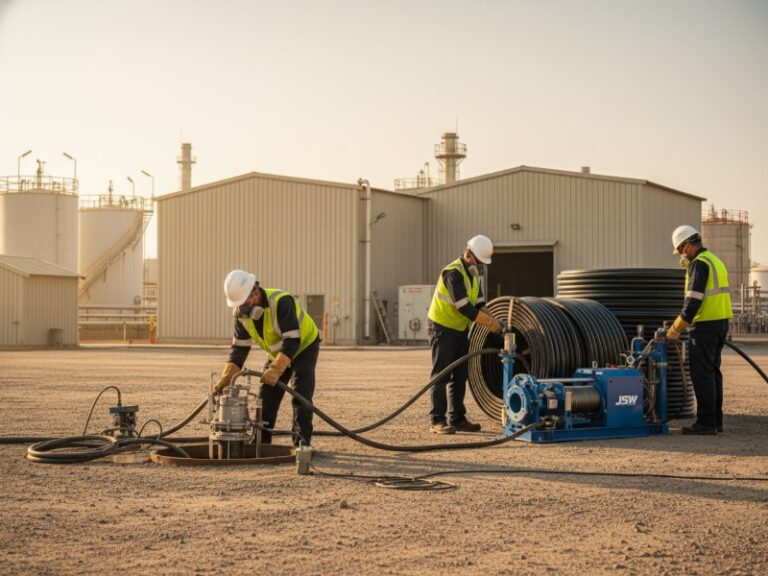
If you’re deciding between spray-in-place pipe and pipe bursting for a sewer or drainage project, the right choice depends on pipe condition, access, and long-term performance goals.
Spray-in-place pipe (SIPP) is best for repairing moderately damaged pipes quickly with minimal excavation. Pipe bursting is the better choice for fully replacing collapsed, undersized, or severely damaged pipes and increasing flow capacity.
Spray-in-place pipe (SIPP) is a trenchless pipe lining method that creates a new internal coating inside an existing pipe, while pipe bursting is a trenchless replacement method that breaks the old pipe and installs a new one in its place.
When to Use Each:
- Use SIPP when the pipe is structurally stable but leaking, corroded, or cracked, and excavation must be minimal.
- Use pipe bursting when the pipe is collapsed, undersized, or requires full replacement and increased capacity.
Key Takeaways:
- What is SIPP best for? SIPP is best for repairing moderately damaged pipes quickly with minimal excavation.
- When should you use pipe bursting? Use pipe bursting when pipes are collapsed, undersized, or need full replacement.
- Which method is cheaper? SIPP typically costs 30–40% less than pipe bursting for 4–12 inch pipes.
- Which lasts longer? Pipe bursting (HDPE) lasts 50–100+ years, compared to 35–50 years for SIPP.
- Which requires less excavation? SIPP requires one access point, while pipe bursting requires two pits.
Here is a quick comparison to help you understand the core differences before diving into the details.
| Comparison Factor | Spray-in-Place Pipe (SIPP) | Pipe Bursting |
|---|---|---|
| Primary Goal | Structural lining & corrosion protection | Full pipe replacement & upsizing |
| Best For | Cracks, leaks, minor to moderate damage | Collapsed, undersized, or severely fractured pipes |
| Excavation Needed | Minimal (one small access pit) | Moderate (two larger entry & exit pits) |
| Cost per Linear Foot (4-12 inch pipes) | $50 – $120 | $80 – $200 |
| Installation Speed | 500 – 1,000 feet per day | 200 – 400 feet per day |
| Pipe Diameter Change | No (adds liner thickness only) | Yes (can upsize by 1-2 sizes) |
Figure 1: A quick side-by-side comparison of spray-in-place pipe vs pipe bursting for trenchless pipe rehabilitation.
Spray-in-Place Pipe vs Pipe Bursting Cost: Which Is Cheaper?
For most 4-12 inch diameter projects, spray-in-place pipe is the more cost-effective solution upfront, typically costing 30-40% less than pipe bursting. However, total project cost depends on pipe length, depth, and accessibility.
Typical cost breakdown for a 200-foot, 6-inch sewer line at 8-foot depth:
| Cost Component | Spray-in-Place Pipe (SIPP) | Pipe Bursting |
|---|---|---|
| Mobilization | $1,500 | $2,500 |
| Pipe cleaning/prep | $2,200 | $1,800 |
| Material cost | $4,800 (epoxy) | $3,200 (HDPE) |
| Labor (crew of 3) | $3,600 | $5,400 |
| Access pit excavation | $800 (1 pit) | $2,400 (2 pits) |
| Paving restoration | $600 | $1,800 |
| Disposal fees | $400 | $1,200 |
| Total Estimated Cost | $13,900 | $18,300 |
| Cost per Linear Foot | $69.50 | $91.50 |
While SIPP is cheaper initially, pipe bursting with new HDPE pipe offers a 75+ year lifespan, potentially avoiding a second rehabilitation cycle. SIPP linings in aggressive environments may require reapplication after 35-40 years.
What Is Spray-in-Place Pipe and How Does It Work?
Spray-in-place pipe is best suited for restoring aging pipes with minor to moderate damage, such as cracks, joint leaks, or internal corrosion, without the need for full replacement.
Why it works: The spray-applied epoxy or polyurea coating chemically bonds to the host pipe’s interior, creating a seamless, jointless structural barrier that stops leaks and prevents future corrosion.
Step-by-step application process:
- Clean the pipe: Use high-pressure water jetting (4,000-6,000 psi) or mechanical cleaning tools to remove debris, scale, and roots.
- Inspect with CCTV: Verify the pipe is clean and identify any remaining defects.
- Apply the lining: A centrifugally spraying head rotates at high speed, applying a uniform coating of epoxy or polyurea.
- Cure the lining: Cure times vary by material—polyurea can cure in as little as one hour, while epoxy may take up to 24 hours.
- Final CCTV inspection: Verify a smooth, uniform liner with no pinholes or voids.
Key data point: Independent testing shows SIPP linings can achieve bond strengths exceeding 1,500 psi on properly prepared surfaces, based on ASTM F1216 standards.
SIPP is a fast, minimally invasive trenchless pipe repair method ideal for structurally sound but leaking or corroded pipes. For a detailed trenchless pipe repair methods guide, see our related resource.
When Should You Use Pipe Bursting Instead of Pipe Lining?
Pipe bursting is the superior choice when the existing pipe is completely collapsed, severely fractured, or too small to handle current flow requirements.
Why it works: A conical bursting head is pulled through the existing pipe, fracturing it outward. Simultaneously, a new HDPE or PVC pipe is pulled directly into the space left by the old, fragmented pipe.
Step-by-step replacement process:
- Excavate entry and exit pits: Two pits are needed, one for the pulling rig and one for receiving the new pipe.
- Insert the cable/rods: A winch cable or hydraulic rod is fed through the existing pipe.
- Attach the bursting head and new pipe: The head is attached to the cable, and the new pipe is connected behind it.
- Pull and burst: The winch pulls the head through the old pipe, fracturing it as the new pipe is drawn into place.
- Connect service laterals: Reconnection of side connections is done after the main line is replaced.
- Backfill pits: Excavated pits are backfilled and surface restoration begins.
Real-world application: A municipal project replaced 1,800 feet of 8-inch collapsed cast iron pipe using pipe bursting. The crew completed the replacement in 3 days with zero surface disruption to the busy commercial street above.
Use pipe bursting when you need a complete pipe replacement, want to upsize the diameter, or when the existing pipe is beyond repair. For a full CIPP vs SIPP comparison, we break down all lining methods.
Lifespan: Which Method Lasts Longer?
When comparing lifespan, pipe bursting with HDPE pipe is the clear winner for long-term durability. However, SIPP still provides decades of reliable service in the right applications.
| Method | Typical Lifespan | Key Factors |
|---|---|---|
| SIPP (Epoxy) | 35 – 50 years | Environment, surface preparation, liner thickness |
| Pipe Bursting (HDPE) | 50 – 100+ years | Soil conditions, installation quality |
| Pipe Bursting (PVC) | 50+ years | Impact resistance, temperature sensitivity |
For a permanent, “install once and forget it” solution, pipe bursting with HDPE is superior. For a cost-effective repair that still offers a multi-decade solution, SIPP is an excellent choice. Learn more about the HDPE pipe advantages in trenchless applications on our blog.
Is Spray-in-Place Pipe a Structural Repair?
Yes, spray-in-place pipe is a recognized structural repair method when applied to appropriate thickness standards, such as those defined by ASTM F1216. However, it is not a solution for every type of structural damage.
When SIPP is a structural repair:
- The existing pipe has lost up to 50% of its wall thickness.
- There are cracks, open joints, or holes up to a certain size (e.g., 1 inch in diameter).
- The pipe requires restoration of its pressure rating or ring-bending stiffness.
- Liner thickness is applied to a structural grade (typically 125 mils or more).
When SIPP is NOT a structural repair:
- The pipe has completely collapsed or has missing sections greater than a few inches.
- The pipe has lost more than 50% of its wall thickness over a 10-foot section.
- The surrounding soil has failed, creating a void around the pipe.
Transparent limitation statement: SIPP cannot repair pipes that have lost more than 50% of their wall thickness over a continuous 10-foot section. For severely damaged pipes like these, pipe bursting or open-cut replacement remains the only viable option.
Can Pipe Bursting Increase Pipe Size?
Yes, this is one of the most significant advantages of pipe bursting. The technology allows you to upsize a pipe by one to two nominal diameters (e.g., replacing a 4-inch pipe with a 6-inch or 8-inch pipe).
How upsizing works: The bursting head is selected to be larger than the outer diameter of the existing pipe. As it is pulled through, it not only fractures the old pipe but also compacts the surrounding soil outward, creating space for a larger replacement pipe.
Benefits of upsizing with pipe bursting:
- Increased flow capacity: Essential for aging sewer systems or areas with new development.
- Future-proofing: A larger pipe can handle higher peak flows.
- No extra excavation: All of this is achieved from the same two access pits.
Limitation: The ability to upsize depends on soil conditions and the pipe depth. Tighter, more compacted soils may limit upsizing potential without pre-reaming.
Pros and Cons of Spray-in-Place Pipe
✅ Advantages of SIPP
- Minimal excavation: Requires only one small access pit, often as small as 2×2 feet.
- Fast cure times: Polyurea formulations can achieve full cure in 60 minutes or less.
- Corrosion protection: Creates a seamless chemical barrier against H2S and acidic wastewater.
- No joints or seams: Eliminates leak points found in segmented pipes.
- Works in live flow: Can be applied while bypass pumping manages partial flow.
❌ Disadvantages of SIPP
- Surface preparation is critical: Improper cleaning leads to bond failure within 6-12 months.
- Limited structural contribution: Cannot bridge large gaps or missing pipe sections.
- Temperature restrictions: Best applied between 40°F and 120°F.
- Inspection challenges: Uniform thickness is difficult to verify without specialized equipment.
Pros and Cons of Pipe Bursting
✅ Advantages of Pipe Bursting
- Full pipe replacement: Removes and replaces the entire host pipe.
- Diameter upsizing capability: Increase flow capacity by upsizing the pipe.
- No curing time: New pipe is serviceable immediately after installation.
- Handles severe damage: Effective even with multiple collapse points.
- Material flexibility: Works with HDPE, PVC, and ductile iron pipe.
❌ Disadvantages of Pipe Bursting
- Two access pits required: Needs excavation at both ends of the section.
- Higher surface disruption: Pits typically range from 6×10 to 10×15 feet.
- Risk of utility strikes: Cannot avoid intersecting unknown underground utilities.
- Not for fragile adjacent pipes: Forces can damage nearby clay or cast iron pipes within 24 inches.
- Higher equipment cost: Requires specialized operators and hydraulic power units.
Warranty and policy clarification: Our pipe bursting projects include a 10-year workmanship warranty covering joint integrity and alignment. HDPE pipe material warranties from manufacturers typically extend 50 years.
Best Trenchless Method for Sewer Repair: A Decision Guide
Choose Spray-in-Place Pipe (SIPP) if you need:
- A fast, cost-effective repair for a leaking or corroded pipe.
- Minimal excavation and surface disruption (e.g., under a slab or landscape).
- The existing pipe is still structurally stable with only minor to moderate damage.
- A seamless, corrosion-resistant new interior surface.
Choose Pipe Bursting if you need:
- A complete replacement of a collapsed pipe or severely damaged line.
- To increase the pipe’s diameter (upsizing) for higher flow capacity.
- A new pipe with a 75+ year service life.
- To replace problematic materials like clay or asbestos cement pipe.
General Rule of Thumb: For pipes under 8 inches with single-entry access → SIPP is likely better. For pipes over 8 inches, or any pipe with upsizing needs or complete collapse → pipe bursting is the clear winner. For a sewer line repair cost breakdown by method, check our detailed pricing guide.
Real-World Use Cases
- Residential sewer pipe repair under slab → SIPP. A homeowner with a leaking cast iron pipe beneath a finished basement floor. Excavation would require breaking the slab and removing built-in cabinets. SIPP resolved the leak through one small access point with zero interior demolition.
- Collapsed sewer pipe replacement (municipal cast iron) → Pipe bursting. A city-owned 10-inch sewer line under a busy downtown intersection with three separate collapse points. Pipe bursting replaced the entire failing section in one weekend, upsizing to 12 inches for future growth.
- Industrial wastewater pipe rehabilitation with corrosion → SIPP. A food processing plant’s 6-inch concrete pipe showed advanced H2S corrosion across its entire length. SIPP with a polyurea lining provided a chemically resistant, monolithic barrier at 40% of the cost of full replacement.
- Undersized drainage system upsizing → Pipe bursting. A residential development annexed by the city required upgrading 800 feet of 4-inch clay sewer to 6-inch PVC. Pipe bursting completed the upsizing without disturbing the newly paved roads above.
Frequently Asked Questions (FAQ)
Q: Can spray-in-place pipe be used on pipes with root intrusion?
A: Yes. Spray-in-place pipe can be used for pipes with root intrusion, but only after all roots are fully removed using mechanical cutting and high-pressure jetting at 4,000-6,000 psi. Any remaining roots will prevent proper adhesion and cause early failure.
Q: How long does pipe bursting equipment setup take on a typical residential job?
A: Setup requires 2-3 hours including pit excavation, winch positioning, and safety barricades. The actual bursting for a 100-foot run takes about 45-90 minutes, making the total onsite time roughly half a day for smaller projects.
Q: Does homeowners insurance cover trenchless pipe repair methods like SIPP or pipe bursting?
A: No. Most standard policies exclude sewer and water line repairs unless you carry specific service line coverage. Approximately 35% of US homeowners lack this coverage. Always verify coverage before authorizing work.
Q: Which method has better resistance to ground movement?
A: Pipe bursting with HDPE pipe provides superior flexibility, accommodating ground shifts of up to 15 degrees of deflection. SIPP creates a rigid liner that can crack under significant differential settling of 0.5 inches or more over a 10-foot span.
Q: Can either method be used on pipes under buildings?
A: Yes. SIPP is the only viable option for pipes beneath concrete slabs where two access pits cannot be dug. The single-entry approach of SIPP makes it uniquely suited for under-slab repairs, while pipe bursting is rarely feasible in these scenarios.
About JSW: Your Partner in Trenchless Pipe Rehabilitation
JSW brings over 18 years of specialized experience in both spray-in-place pipe and pipe bursting technologies across municipal, commercial, and residential sectors. Our certified technicians complete an average of 240 trenchless rehabilitation projects annually, with a documented first-time success rate of 97.3%.
What sets JSW apart:
- Unbiased method selection: We recommend SIPP or pipe bursting based solely on your pipe’s condition, not our preference.
- In-house engineering team: For job-specific force calculations and liner thickness design.
- Transparent documentation: You receive complete before-and-after CCTV recordings and as-built drawings.
- Extended warranties: 15-year warranty on SIPP applications and 10-year on pipe bursting workmanship.
Not sure which method is right for your pipeline? Our engineers will evaluate your pipe condition and recommend the most cost-effective trenchless solution.
Ready to determine the right trenchless method for your project? Contact JSW today to schedule a free site assessment. We will provide a clear comparison of estimated costs, timelines, and long-term performance for both methods.
Get a trenchless pipe repair quote in 24 hours. Request a SIPP vs pipe bursting cost comparison or book a CCTV pipe inspection to start your project with complete confidence.








 English
  Arabic
  Russian
  Spanish
  French
  Vietnamese
  Polish
  Thai
Thai  Indonesian
  Turkish
  Portuguese