
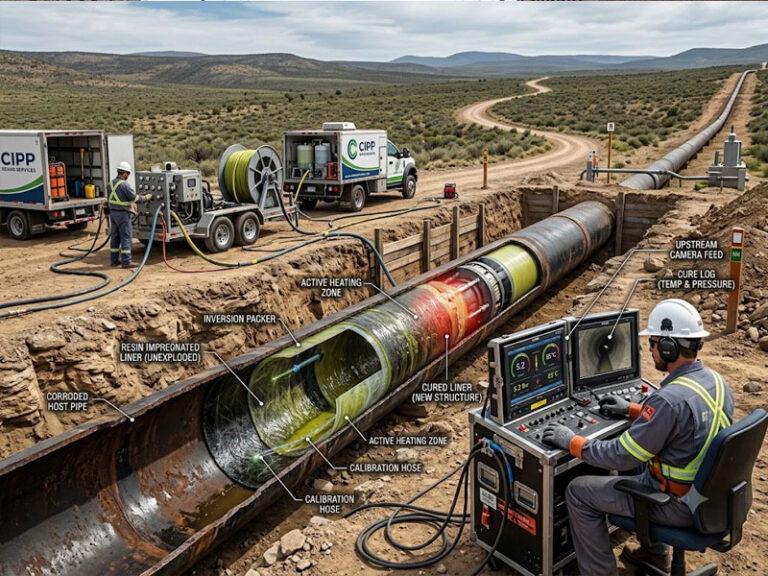
A pipeline rehabilitation proposal is a structured engineering document used to evaluate pipeline condition, compare trenchless rehabilitation methods, estimate project costs, and define execution and risk management strategies. It is used by asset owners, engineers, and contractors to support data-driven decision-making for pipeline rehabilitation planning and capital investment.
This document serves as a critical decision-making tool for extending the service life of aging pipelines. It translates complex inspection data into actionable strategies, covering everything from initial defect assessment to final QA/QC documentation. The following guide provides a comprehensive breakdown of each critical component of a pipeline rehabilitation proposal, helping asset owners, engineers, and contractors navigate the process with confidence.
What Is a Pipeline Rehabilitation Proposal?
A pipeline rehabilitation proposal is a formal, technical document prepared by engineering or contracting firms to present a recommended strategy for renewing a deteriorated pipeline. Unlike a simple repair estimate, this proposal integrates engineering analysis, cost-benefit justification, and risk management.
Core Purpose: To provide asset owners with the necessary information to make an informed, risk-based capital investment decision. It answers not just “how much will it cost?” but also “why is this the best approach, and what are the long-term benefits?”
A comprehensive pipeline rehabilitation plan typically includes five core components: condition assessment, rehabilitation method selection, detailed cost estimation, project schedule, and risk mitigation planning.
Pipeline Rehabilitation Proposal Components (Standard Engineering Format)
A professionally structured pipeline rehabilitation proposal follows a logical, standardized engineering format to ensure clarity and completeness. This standard structure is critical for securing approvals, funding, and ensuring all stakeholders are aligned.
Standard Components:
- 1. Executive Summary: A high-level overview of the project, solution, and benefits for decision-makers.
- 2. Condition Assessment Report: Verifiable data from pipeline inspection, including CCTV footage and structural analysis.
- 3. Rehabilitation Method Selection: Justification for the chosen trenchless rehabilitation technology.
- 4. Cost Estimation & Budgeting: An itemized cost estimate with clear contingency allowances.
- 5. Project Execution Schedule: A detailed timeline from mobilization to project closeout.
- 6. Risk & Compliance Analysis: Identification of potential issues and clear mitigation measures.
- 7. QA/QC Plan: Protocols for ensuring quality and compliance with industry standards.
- 8. Final Deliverables: Documentation to be provided upon project completion.
Pipeline Condition Assessment Requirements
A credible pipeline rehabilitation proposal begins with a thorough condition assessment. This section provides the objective evidence that justifies the need for rehabilitation and informs the selection of the most appropriate method.
Key Assessment Data:
- CCTV Inspection: High-resolution video footage and still images identifying specific defects such as cracks, fractures, joint displacements, corrosion, and root intrusion.
- Structural Integrity Testing: Data on remaining wall thickness and load-bearing capacity, often collected via ultrasonic testing or pipe penetrating radar.
- Leak Detection: Results from pressure tests or acoustic sensors, quantifying infiltration or exfiltration rates.
- Geotechnical Data: Soil composition, groundwater levels, and external load assessments to determine the pipeline’s operating environment.
- Remaining Service Life: An engineering estimate of how long the pipeline can continue to function in its current state.
The data compiled in the pipeline condition assessment report is the foundational element that drives all subsequent decisions in the rehabilitation plan.
Trenchless Rehabilitation Method Selection
Choosing the right rehabilitation method is a critical decision point. The pipeline rehabilitation proposal must justify its recommendation based on a detailed analysis of the pipeline’s condition, operational constraints, and project objectives. This section provides a clear methodology for making that decision.
Key Factors in Selecting a Pipeline Rehabilitation Method
The selection process is driven by a multi-faceted evaluation of the following decision factors:
- Structural Condition: Is the pipe partially deteriorated (requiring a protective coating) or fully deteriorated (requiring a stand-alone structural liner)?
- Hydraulic Capacity Requirements: Can the chosen method maintain or increase the pipeline’s flow capacity?
- Excavation and Access Limitations: Are there insertion pits available, or is excavation severely restricted by surface conditions?
- Budget Constraints: What is the optimal balance between upfront cost and long-term asset life?
- Service Interruption Tolerance: How much downtime can the community or industrial process withstand during the rehabilitation?
Trenchless Pipeline Rehabilitation Methods Comparison
| Method | Typical Pipe Type | Best Use Case | Approx. Cost Level | Disruption Level | Lifespan Impact |
|---|---|---|---|---|---|
| Cured-in-Place Pipe (CIPP) | Sanitary/Storm Sewers | Structural repair of deteriorated pipes | Medium | Low | 50+ years |
| Pipe Bursting | Cast Iron, Concrete, Clay | Replacing severely damaged mains & increasing diameter | High | Medium | 50+ years |
| Sliplining (Fusible PVC) | Gravity Pipelines | Quick, cost-effective rehabilitation with low flow | Low | Very Low | 30-50 years |
| Spray-on Lining | Manholes, Large-Diameter Pipes | Cost-effective structural enhancement and protection | Low | Low | 20-30 years |
| Hybrid Lining Systems | Large Trunk Mains | Combining multiple technologies for complex geometries | High | Low | 50+ years |
Key Insight: Method Selection Depends on Structural Condition and Service Constraints
- CIPP is ideal for full structural rehabilitation of sanitary and storm sewers, providing a jointless, corrosion-resistant new pipe within the old one.
- Sliplining is best for low-cost gravity systems where flow capacity and budget are the primary constraints.
- Pipe Bursting is preferred for capacity upgrade projects or where the existing pipe is severely damaged and requires replacement rather than lining.
Cost Estimation & Budget Breakdown
Cost estimation is a critical component of any pipeline rehabilitation proposal. Transparent, itemized cost estimation is the most scrutinized part of any proposal. A robust estimate builds trust and helps secure funding by demonstrating fiscal responsibility.
Typical Cost Components:
- Mobilization/Demobilization: Costs for transporting equipment and setting up/removing the site.
- Materials and Installation: The largest cost component, covering the liner, resin, and labor.
- Traffic Control & Restoration: Replacing asphalt pavement, landscaping, and maintaining public safety.
- Bypass Pumping: Ensuring continuous service during installation.
- Project Contingency (40%): To cover unforeseen conditions (e.g., groundwater infiltration, unknown obstacles).
- Engineering Contingency (20%): For potential design modifications during the project.
- Permitting & Inspection: Regulatory fees and third-party QA/QC costs.
Project Schedule & Execution Planning
The pipeline rehabilitation plan must present a realistic schedule, highlighting key milestones. This is particularly important for securing government funding or coordinating with other infrastructure projects.
Standard Milestones:
- Preliminary Design & Engineering
- Final Design & Plan Approval
- Permitting (Environmental, Right-of-Way)
- Procurement & Contractor Selection
- Mobilization & Site Preparation
- Rehabilitation Installation
- Quality Testing & Post-Installation Inspection
- Site Restoration & Project Closeout
A well-defined schedule helps manage stakeholder expectations and demonstrates the proponent’s ability to deliver the project efficiently.
Risk Management Strategy
A pipeline rehabilitation proposal must identify and mitigate project risks across all phases. This section addresses potential risks and outlines clear mitigation measures, demonstrating professional competence and building confidence with asset owners.
| Risk Category | Potential Issue | Mitigation Strategy |
|---|---|---|
| Geotechnical | Unknown soil conditions, groundwater infiltration | Conduct potholing and geotechnical investigations pre-construction. |
| Technical | Liner installation failure, improper curing | Implement a robust QA/QC plan with third-party inspection. |
| Operational | Service disruption, bypass pumping failure | Use redundant pumping systems and schedule work during low-demand periods. |
| Regulatory | Permit delays, non-compliance | Engage with regulatory agencies early in the process. |
QA/QC and Industry Standards
Industry-leading pipeline rehabilitation proposals include a robust Quality Assurance and Quality Control plan to ensure work meets specified standards and complies with relevant regulations. Adherence to recognized standards is a key indicator of professionalism and project quality.
QA/QC Components:
- Materials Testing: Verification of liner thickness, material strength, and resin cure.
- Inspection Protocols: CCTV surveys pre- and post-installation, and pressure testing for all new installations.
- Documentation: As-built drawings, material certifications, and test results.
Standards Used in Pipeline Rehabilitation Planning
- ASTM F1216: A standard practice for the design of CIPP lining systems.
- NASSCO PACP: The industry standard for pipeline inspection and condition assessment protocols.
- ISO 11295:2026: An international framework for the classification and planning of pipeline rehabilitation systems.
- EPA Pipeline Integrity Guidelines: Adherence to environmental and safety regulations.
- Demonstration of compliance with local environmental regulations and safety codes.
Why Pipeline Rehabilitation Proposals Are Important
Investing in a well-prepared pipeline rehabilitation proposal provides significant long-term value, helping organizations avoid reactive and often more costly emergency repairs.
Key Benefits:
- Reduce Infrastructure Failure Risk: Proactive planning prevents catastrophic and expensive pipeline failures.
- Extend Asset Life (30–50 Years): Strategic rehabilitation can add decades of service life to existing assets.
- Optimize Capital Investment: A clear proposal allows for informed budgeting and funding allocation.
- Reduce Excavation Costs: Trenchless methods, as defined in the proposal, minimize costly and disruptive open-cut excavation.
- Minimize Environmental & Community Impact: Planned work reduces disruption to the public and the environment.
Pipeline Rehabilitation Proposal – Key Takeaways
- Defines pipeline condition and identifies potential failure risks
- Compares trenchless rehabilitation methods to select the optimal approach
- Provides engineering-based cost estimation with contingency planning
- Establishes a realistic project schedule with clear milestones
- Identifies risks and outlines robust mitigation strategies
- Ensures QA/QC compliance with industry standards like ASTM F1216, NASSCO, and ISO 11295:2026
Frequently Asked Questions
Q: What is included in a pipeline rehabilitation proposal?
A: A pipeline rehabilitation proposal includes condition assessment data, rehabilitation method selection, cost estimation, project scheduling, risk analysis, and QA/QC documentation used for engineering decision-making.
Q: What information is needed to prepare a rehabilitation proposal?
A: Key inputs include existing pipeline records, CCTV inspection data, operational requirements, environmental constraints, and stakeholder objectives, as per the ISO 11295:2026 framework.
Q: How long does it take to prepare a pipeline rehabilitation proposal?
A: A proposal typically takes 4-12 weeks to prepare, depending on project complexity and the availability of existing pipeline data.
Q: Can a proposal include multiple rehabilitation methods?
A: Yes. Proposals often include multiple alternatives (e.g., CIPP vs. sliplining) to allow asset owners to compare options based on cost, risk, and long-term performance.
Q: What design life do rehabilitation proposals typically guarantee?
A: Most proposals target a 50-year design life for structural rehabilitation systems, validated by research and industry testing.
A pipeline rehabilitation proposal provides a structured framework for pipeline rehabilitation planning and execution. It is much more than a cost estimate. It is a comprehensive, data-driven document that integrates pipeline condition assessment, engineering analysis, risk management, and project planning. By following a structured format and adhering to industry standards like ISO 11295:2026 and ASTM F1216, proponents can build a compelling case for investment, secure necessary funding, and ultimately deliver successful infrastructure renewal projects. The future of sustainable infrastructure lies in effective rehabilitation strategies, and the pipeline rehabilitation plan is where that future begins.
About the Author
This guide was prepared by the JSW Engineering Team, a leader in pipeline construction and rehabilitation services. With over 15 years of experience in trenchless technology and infrastructure renewal, JSW specializes in helping municipalities, utilities, and industrial clients develop cost-effective, sustainable solutions for aging pipeline networks.
Interested in a pipeline rehabilitation proposal for your project? Our team provides comprehensive assessment, engineering, and proposal development services tailored to your specific needs. Contact our experts at JSW for a consultation.









 English
  Arabic
  Russian
  Spanish
  French