
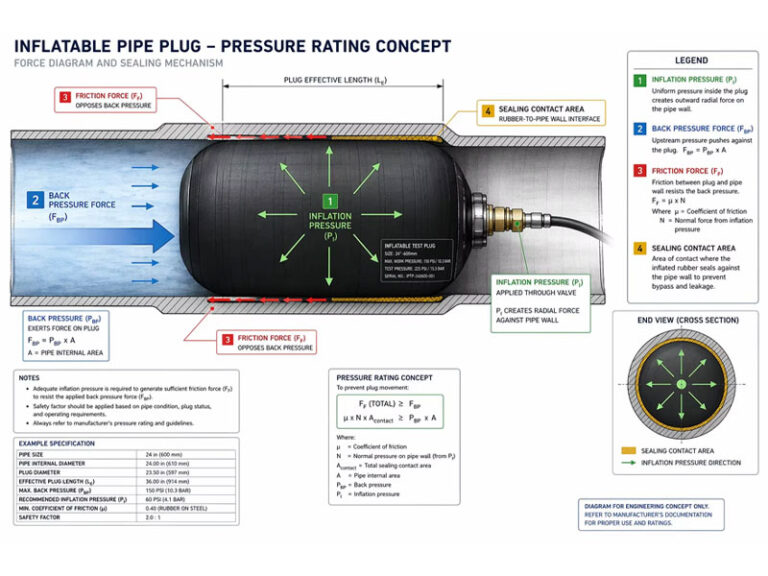
There is no universal pressure limit for inflatable pipe plugs. The maximum back pressure depends on the plug design, size, pipe diameter, pipe material, and installation conditions. Most inflatable pipe plugs are rated from 1 bar (14.5 psi) to more than 13 bar (188 psi). Always follow the manufacturer’s specific pressure rating for your pipe size and application.
This guide covers how pressure limits are determined, critical safety factors, testing methods, and best practices for selecting an inflatable pipe plug or pipe isolation plug for pipeline testing, repairs, bypass operations, or isolation work.
1. Inflatable Pipe Plug Back Pressure Rating: What Is the Maximum Pressure Limit?
The maximum back pressure rating of an inflatable pipe plug is the highest hydraulic or pneumatic pressure that can be applied from the downstream side without causing seal failure, plug movement, or blowout. This rating is the most critical specification for selecting a plug for pipeline testing, repairs, or isolation work.
For standard inflatable pipe plugs, typical maximum back pressure ratings range from 1 bar (14.5 psi) for large-diameter sewer plugs to over 13 bar (188 psi) for small-diameter, reinforced high-pressure testing plugs. The specific value is always pipe-size dependent because the hydraulic force acting on the plug increases with the cross-sectional area of the pipe.
Field experience has shown that exceeding the manufacturer’s rated back-pressure limit can significantly increase the risk of plug movement, seal failure, or uncontrolled pressure release. For critical applications, many operators apply additional safety margins such as 2:1 or higher depending on project requirements and applicable safety procedures.
2. Is Deflection the Same as Pipe Plug Back Pressure?
Although the term “deflection limit” is sometimes used in pipeline engineering, inflatable pipe plug manufacturers typically specify performance using maximum allowable back pressure or pressure rating. For pipe plugs, failure is generally caused by plug movement, seal loss, or blowout rather than a measurable deflection value in millimeters.
In structural pipeline engineering, “deflection” refers to pipe wall bending or joint angular displacement under load. This is a different concept from the pressure-holding capacity of a temporary isolation plug. When searching for product specifications, using “pipe plug back pressure rating” or “inflatable pipe plug pressure limit” will yield more accurate and relevant results.
3. How Do Manufacturers Calculate Pipe Plug Pressure Limits?
Manufacturers determine pipe plug pressure limits through a combination of engineering calculation and controlled physical testing. The fundamental relationship is based on the balance between the hydraulic force from back pressure and the friction force generated by the inflated rubber bladder against the pipe wall.
3.1 The Force Balance Principle
The hydraulic force pushing the plug out of the pipe is calculated as:
Force = Pressure × Area
When pressure is expressed in psi and area in square inches:
Force (lb) = Pressure (psi) × Area (in²)
Where:
- Pressure is the back pressure applied to the plug face
- Area is the internal cross-sectional area of the pipe (π × r²)
As pipe diameter increases, the force acting on the plug increases significantly because the pressure acts over a larger surface area.
3.2 Friction and Seal Holding Capacity
The plug’s resistance to this force comes from:
- Friction between the inflated rubber bladder and the pipe inner wall
- Compression seal created by the inflation pressure expanding the bladder
The relationship is:
Friction Force = Coefficient of Friction × Normal Force
The normal force is created by the inflation pressure inside the plug. However, the coefficient of friction varies significantly based on pipe material, surface roughness, and whether the pipe is wet or dry.
3.3 Example: Calculating Back Pressure Force on a Pipe Plug
To understand the forces involved, consider a 12-inch pipe under 10 psi back pressure:
Step 1: Calculate pipe area
- Radius = 6 inches
- Area = π × (6²) = π × 36 ≈ 113 square inches
Step 2: Calculate total force
- Force = Pressure × Area
- Force = 10 psi × 113 sq in = 1,130 pounds
Therefore, a pipe plug in a 12-inch pipe must resist more than 1,000 pounds of pushing force at only 10 psi back pressure. This is why a plug rated for a small diameter pipe cannot automatically be used at the same pressure in a larger diameter pipeline.
3.4 Manufacturer Testing Protocols
Reputable manufacturers perform hydrostatic and pneumatic pressure tests to verify ratings. Testing typically includes:
- Pressure verification testing at elevated pressures according to manufacturer procedures and applicable industry standards
- Leakage inspection at the seal interface
- Material compatibility testing with common pipeline fluids
- Dimensional verification before and after pressurization
The published back-pressure rating is typically the maximum safe working pressure, with a built-in safety margin. We recommend requesting test certificates for critical applications.
4. Factors That Affect Pipe Plug Back Pressure Capacity
The actual back pressure capacity of a pipe plug in the field can differ from the manufacturer’s published rating due to several site-specific factors.
4.1 Pipe Diameter
Larger pipe diameters have lower back-pressure ratings for the same plug design because the hydraulic force increases with the square of the radius.
4.2 Pipe Material and Surface Condition
The coefficient of friction between the rubber bladder and the pipe wall is the primary variable affecting holding capacity:
- Clean, dry concrete or ductile iron pipe: Highest friction, best holding capacity
- Smooth plastic pipe (PVC, HDPE): Lower friction, reduced holding capacity
- Corroded or scaled pipe: Variable friction, often unpredictable
- Wet or active pipelines: Significantly reduced friction, requiring derating
Field experience indicates that back-pressure capacity may be significantly reduced in wet, smooth-walled plastic pipes compared with clean, dry concrete pipes. Always apply appropriate safety margins based on site-specific conditions.
4.3 Installation Depth
The plug must be inserted into the pipe far enough to ensure full bladder contact with the pipe wall. Industry best practice requires insertion to a minimum depth of at least the pipe radius.
4.4 Inflation Pressure
Inflation pressure must be maintained within the manufacturer’s specified range. Under-inflation reduces the normal force and friction, lowering back-pressure capacity. Over-inflation can damage the bladder and create a rupture hazard.
4.5 Plug Condition and Age
Rubber bladders degrade over time due to UV exposure, chemical contact, and repeated inflation cycles. Aged or damaged plugs have reduced friction coefficients and lower effective back-pressure ratings.
5. Inflation Pressure vs Back Pressure: What’s the Difference?
This is a common point of confusion in pipeline testing. The table below clarifies the distinction.
| Feature | Inflation Pressure | Back Pressure |
|---|---|---|
| Location | Inside the plug bladder | Outside, against the plug face |
| Purpose | Creates the sealing force against the pipe wall | The load pushing the plug outward |
| Controlled By | Operator during installation | The pipeline test condition or system pressure |
| Typical Value | Usually higher (e.g., 30-200 psi) | Usually lower (e.g., 1-150 psi) |
| Main Risk if Incorrect | Bladder damage or rupture | Plug movement, seal loss, or blowout |
| Adjustability | Adjustable via inflation pump | Determined by the test or system pressure |
Understanding this difference is essential for safe plug selection and operation. Always verify both the required inflation pressure and the expected back pressure for your application.
6. Inflatable Pipe Plug Maximum Back Pressure Rating Reference Chart
The following table provides representative maximum back pressure ratings for common inflatable pipe plug series. These values are for reference only; actual ratings vary by manufacturer and product revision.Table 1: Representative Maximum Back Pressure Ratings for Inflatable Pipe Plugs by Application
| Plug Series / Type | Typical Application | Typical Use Condition | Nominal Pipe Size | Inflation Pressure | Max Back Pressure |
|---|---|---|---|---|---|
| Stack Test Plug | Air stack testing | Low-pressure air | 4″ – 6″ (100–150mm) | 25 – 35 psi | 13 psi (0.9 bar) |
| Standard Bypass Plug | Pipeline bypass & monitoring | Flow control, water | 8″ – 36″ (200–900mm) | 20 – 30 psi | 15 – 25 psi (1.0–1.7 bar) |
| High-Pressure Reinforced Plug | Hydrostatic pressure testing | High-pressure water | 2″ – 12″ (50–300mm) | 100 – 200 psi | 100 – 150 psi (6.9–10.3 bar) |
| Heavy-Duty Aramid Reinforced Plug | Chemical resistance & high durability | Chemicals, high temp | 4″ – 24″ (100–600mm) | 35 – 80 psi | Varies by chart; up to 13 bar (188 psi) |
| Multi-Size (Oval) Plug | Elliptical or corrugated pipe | Irregular pipe surfaces | 6″ – 24″ (150–600mm) | 30 – 50 psi | Typically reduced rating |
7. What Happens When a Pipe Plug Exceeds Its Pressure Limit?
Exceeding the rated back pressure of a pipe plug can result in several failure modes, all of which are dangerous.
7.1 Plug Slippage and Seal Loss
The most common failure is the plug sliding backward under pressure, breaking the seal and allowing flow to bypass. While less catastrophic than blowout, this still causes uncontrolled pressure release and flooding in the work area.
7.2 Plug Ejection (Blowout)
When back pressure exceeds the friction force significantly, the plug can be violently ejected from pipeline openings with significant force, creating a serious injury hazard. The sudden decompression can also create a blast wave that causes hearing damage and concussive injuries.
7.3 Bladder Rupture
Excessive pressure can cause the rubber bladder to rupture internally. This may occur if inflation pressure is too high, or if back pressure causes the bladder to deform beyond its elastic limit.
7.4 Pipe Damage
In rare cases, excessive back pressure can transmit force to the pipe wall, causing structural damage, cracking, or joint separation.
8. How to Safely Use Inflatable Pipe Plugs During Pipeline Testing
Following a structured safety protocol is essential for any pipeline testing or isolation operation.
8.1 Pre-Installation Checklist
- Verify the plug model and size match the pipe diameter
- Inspect the rubber bladder for cuts, abrasions, or signs of aging
- Check the inflation valve and pressure gauge for proper operation
- Confirm the manufacturer’s back-pressure rating for your specific pipe size
- Review the site-specific risk assessment and permit-to-work
8.2 Installation Best Practices
- Insert the plug to a depth of at least one pipe radius
- Inflate gradually to the recommended inflation pressure
- Lock off the inflation valve and remove the inflation hose
- Install a secondary restraint system (safety chain or strap) for high-risk applications
8.3 During Testing
- Monitor pressure gauges continuously
- Never leave pressurized plugs unattended
- Keep all personnel clear of the pipe opening
- Establish a safe exclusion zone around the work area
8.4 Pressure Relief and Removal
- Depressurize slowly and in controlled steps
- Verify pressure has returned to zero before removing the plug
- Inspect the plug for damage after removal
- Record the test results and any observations
9. Frequently Asked Questions
Q1: How much pressure can an inflatable pipe plug hold?
An inflatable pipe plug can hold anywhere from approximately 1 bar (14.5 psi) to more than 13 bar (188 psi) , depending on the plug type, size, reinforcement design, and pipe conditions. Always follow the manufacturer’s rated maximum back pressure for your specific pipe size and application.
Q2: Can a pipe plug fail under back pressure?
Yes. If back pressure exceeds the rated holding capacity, the plug may slip, lose its seal, or eject from the pipeline. Excessive pressure can create a dangerous release of stored energy. For critical applications, many operators apply additional safety margins such as 2:1 or higher depending on project requirements and applicable safety procedures.
Q3: Does pipe diameter affect the pipe plug pressure rating?
Yes. Larger pipe diameters usually have lower back-pressure ratings because the hydraulic force acting on the plug increases with the pipe cross-sectional area. A plug that holds 2 bar in a 4-inch pipe may only hold 0.5 bar in a 12-inch pipe of the same series.
Q4: What is the difference between inflation pressure and back pressure?
Inflation pressure is the pressure inside the plug’s rubber bladder, used to expand the plug against the pipe wall to create the seal. Back pressure is the external pressure from the fluid or air downstream of the plug, pushing against the installed plug’s face. These are separate specifications; inflation pressure is typically higher than back pressure for most plug designs. Refer to the comparison table in Section 5 for a detailed breakdown.
Q5: What safety precautions are recommended for high-pressure pipe plug use?
Always verify the manufacturer’s back-pressure rating, inspect the plug before each use, install the plug to the proper depth, maintain correct inflation pressure, use secondary restraints for high-risk applications, and establish a safe exclusion zone. Never exceed the rated pressure and always depressurize slowly.
Q6: Can the same pipe plug pressure rating be used for different pipe materials?
No. The same pipe plug may have different allowable back-pressure ratings depending on whether it is installed in concrete, ductile iron, PVC, HDPE, or irregular pipe conditions. Pipe surface condition directly affects friction and holding capacity. Always check the manufacturer’s guidance for the specific pipe material in your project.
10. People Also Ask: Can a Pipe Plug Hold Water Pressure?
Yes, some inflatable pipe plugs are specifically designed for hydrostatic testing and water pressure applications. However, the allowable pressure depends on the specific plug model, pipe diameter, and manufacturer’s rating. Plugs used for water pressure testing typically require higher inflation pressures and reinforced bladder construction to maintain a seal under wet conditions. Always confirm that your selected plug is rated for hydrostatic (water) testing if that is your application.
The safe and effective use of an inflatable pipe plug depends entirely on understanding and respecting its back-pressure rating. This rating is determined by the plug design, pipe diameter, pipe material, and installation conditions. While the term “deflection limit” is sometimes used in pipeline engineering, pipe plug manufacturers specify performance using maximum allowable back pressure. Ratings typically range from 1 bar to over 13 bar, with the specific value provided on the product datasheet.
By following manufacturer specifications, applying appropriate safety factors, and adhering to best installation practices, pipeline testing and isolation work can be completed safely and efficiently. Always prioritize verification of the back-pressure rating for your specific application.
About JSW Pipeline Testing Solutions
JSW provides inflatable pipe plugs and pipeline testing equipment designed for municipal, industrial, and rehabilitation applications. Our engineering team supports customers with plug selection, pressure rating verification, installation guidance, and custom pipeline testing solutions.
Every plug is pressure-tested before shipment, and we provide detailed technical documentation including back-pressure rating charts, installation guides, and safety data sheets. Contact JSW engineering specialists for inflatable pipe plug selection, pressure rating verification, and custom pipeline testing solutions.










 English
  Arabic
  Russian
  Spanish
  French
  Vietnamese
  Polish
  Thai
Thai  Indonesian
  Turkish
  Portuguese