
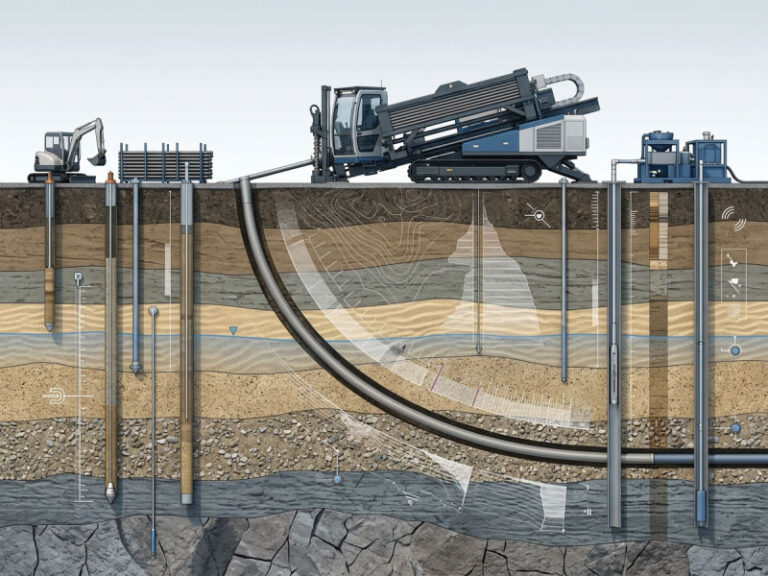
Soil stability before a trenchless project is measured through five main steps:
- Geological Review & Surface Survey: Assessing existing maps and visible site conditions.
- Field Investigation: Performing soil borings with Standard Penetration Tests (SPT) and Cone Penetration Tests (CPT) .
- Laboratory Analysis: Testing soil samples for strength, permeability, and classification.
- Geotechnical Baseline Report (GBR) Preparation: Synthesizing data into a contractual document for design and bidding.
- Construction Monitoring: Using surface settlement points and piezometers to control ground movement in real-time.
These tests determine soil strength, density, groundwater conditions, and the risk of collapse or hydraulic fracture (frac-out) before drilling begins.
Soil Stability Testing Process at a Glance
Investigation Stage Primary Test / Method Core Purpose Site Review Geological Survey, Desk Study Identify potential ground risks and surface constraints. Field Investigation SPT, CPT, Soil Borings Measure in-situ soil strength, density, and stratigraphy. Laboratory Testing Classification, Shear Strength Tests Determine precise engineering parameters for design. Design Analysis Geotechnical Baseline Report (GBR), FEM Modeling Predict borehole stability and settlement risk. Construction Monitoring Surface Monitoring Points (SMP), Piezometers Control ground movement and prevent hydraulic fracture.
Definition Block:
Soil stability testing for trenchless construction, especially for HDD and microtunneling projects, refers to the process of evaluating whether surrounding soil can withstand drilling, excavation, and pipe installation without excessive deformation, settlement, borehole collapse, or hydraulic fracture. It is the foundational step that dictates method selection, equipment needs, and overall project risk management.
Why Is Geotechnical Investigation Important Before Trenchless Construction?
Unlike open-cut excavation, trenchless construction occurs underground, where operators cannot directly observe soil behavior. Incorrect assumptions about soil conditions can lead to catastrophic outcomes, including borehole collapse, excessive surface settlement, steering failure, or an uncontrolled hydraulic fracture (frac-out) . A thorough geotechnical investigation for HDD and other methods transforms unknown ground conditions into manageable, predictable engineering parameters, providing the data necessary for safe and efficient project execution.
1. What Are the Three Phases of Geotechnical Investigation for Trenchless Projects?
A successful trenchless construction ground investigation follows a structured, phased approach to reduce geological uncertainty and manage construction risk.
1.1 Planning Stage: The Desk Study and Surface Survey
Every project begins above ground. This initial phase involves gathering existing data to infer subsurface conditions without disturbing the site.
- Data Collection: Review existing geological maps, soil survey reports, and case histories from nearby projects. This can reveal depositional history, such as whether the area was shaped by glaciation, which may indicate the presence of cobbles and boulders.
- Surface Mapping: Walk the site to identify visible features like water bodies, existing utilities, and the condition of adjacent structures. This helps in planning access routes and assessing environmental constraints.
- Inferred Risks: Analyze topographical maps to understand drainage patterns and the likely depth of the water table, a critical factor for subsequent groundwater level monitoring.
1.2 Preliminary Subsurface Investigation: The Field Program
This is the core of the investigation, where physical samples are collected, and in-situ tests are performed to provide data for the detailed design.
- Soil Borings: Vertical test borings are the primary method for obtaining both disturbed and undisturbed soil samples. The number and depth of boring test holes are determined by the project’s scale, the diameter of the proposed bore, and the site’s variability.
- In-Situ Field Tests: The most common and critical tests performed during this phase are the Standard Penetration Test (SPT) , one of the most widely used soil testing methods for HDD projects, and the Cone Penetration Test (CPT) for fine-grained soils.
- Groundwater Assessment: Installing standpipe piezometers in select boreholes allows for the monitoring of the water table’s depth, fluctuations, and the soil’s permeability. This data is essential for calculating hydrostatic pressure on the borehole wall.
1.3 Final Geotechnical Baseline Report (GBR)
The investigation culminates in the creation of a Geotechnical Baseline Report (GBR) . This document is a contractual statement of the anticipated ground conditions and forms the basis for the contractor’s bid and the engineer’s design.
- Data Synthesis: The GBR compiles all field and laboratory test results, presenting a clear profile of the subsurface strata.
- Risk Evaluation: It defines the geotechnical risks and establishes a common understanding between the owner, engineer, and contractor.
- Design Parameters: The GBR provides the final, agreed-upon parameters for design, such as the undrained shear strength of clays, the internal friction angle of sands, and the estimated modulus of elasticity, which are used in finite element models to predict settlement.
Figure 1: HDD Soil Investigation Workflow
A typical workflow for geotechnical investigation in a trenchless project progresses logically from planning to execution.Site Review → Geotechnical Investigation → SPT/CPT Testing → Laboratory Analysis → GBR Preparation → HDD Design → Real-time Monitoring
2. Why Are SPT & CPT Tests Critical for HDD Soil Analysis?
SPT and CPT are the two workhorses of geotechnical investigation, providing the essential, quantifiable data needed for HDD soil analysis.
2.1 The Standard Penetration Test (SPT): A Core Method for HDD Soil Analysis
The SPT is a robust, widely understood test that is fundamental for HDD soil analysis. Its long history has resulted in a vast library of empirical correlations.
How It Works: A split-barrel sampler is driven into the soil at the bottom of a borehole using a 140-pound hammer dropped from 30 inches. The number of blows required for the final 12 inches is the SPT N-value, a direct measure of the soil’s resistance to penetration.
Linking N-Values to Design Parameters:
- For Sands: The N-value correlates with relative density and internal friction angle, vital for predicting borehole wall stability.
- For Clays: The N-value is used to estimate the undrained shear strength (Su) , critical for calculating the maximum allowable annular pressure to prevent a hydraulic fracture risk (frac-out) .
- Modulus of Elasticity: The N-value can also be correlated to the soil’s modulus of elasticity (E), an essential input for finite element models (FEM).
- Test Application: For long HDD crossings, many engineers use boring spacing in the range of approximately 60–90 meters as a planning reference; however, the final investigation density depends on geological variability, project risk, and local standards.
2.2 Cone Penetration Test (CPT): Continuous Soil Profiling for HDD Design
While the SPT is a staple, CPT testing for trenchless projects offers a more continuous and detailed profile of subsurface conditions, especially in fine-grained soils.
How It Works: A conical probe is pushed hydraulically into the ground at a constant rate. Sensors measure the tip resistance (qc) and sleeve friction (fs) in real-time, providing a near-continuous log of soil behavior.
Advantages for Trenchless Design:
- Continuous Data: Unlike SPT, the CPT provides a continuous record, allowing for the identification of thin, problematic layers.
- Pore Pressure Measurement: Piezocone probes measure in-situ pore water pressure, invaluable for assessing drainage conditions and predicting consolidation settlement.
- Cost-Effectiveness: The test is faster than SPT borings, making it a more economical option for large-scale projects.
Table 1: Comparison of SPT and CPT Testing Methods
Feature Standard Penetration Test (SPT) Cone Penetration Test (CPT) Data Type Discrete, point-specific measurements (N-value). Continuous, real-time profile of resistance. Best For Coarse-grained soils (sands, gravels) and obtaining physical samples. Fine-grained soils (clays, silts) and soft ground. Output N-value (blows/foot), correlates to density, strength. qc (tip resistance), fs (sleeve friction), pore pressure. Key Advantage Provides physical soil samples for laboratory testing. Provides a high-resolution, continuous stratigraphic log.
3. Common Soil Stability Problems During HDD Construction
Understanding potential ground behavior is key to mitigating risks. The following are common issues encountered during trenchless operations, along with their detection methods.
Table 2: Common Soil Stability Problems During HDD Construction
Problem Primary Cause Associated Risk Detection Method Borehole Collapse Loose sand or gravel with insufficient cohesion. Lost circulation, pipe entrapment. SPT N-values, CPT profiles, monitoring drilling fluid returns. Hydraulic Fracture (Frac-out) Excess annular pressure exceeding in-situ soil strength. Uncontrolled fluid release to surface, environmental damage. Real-time pressure monitoring, piezometer data. Surface Settlement Inadequate soil support due to overcut or poor fluid management. Damage to pavements, utilities, structures. Surface settlement points (SMPs), inclinometers. Steering Deviation Encountering boulders, cobbles, or variable rock layers. Incorrect alignment, potential project failure. Continuous steering data, geological mapping from borings. Drilling Fluid Loss High permeability soil (e.g., gravel, fractured rock). Reduced bore stability, increased fluid costs. Monitoring drilling fluid return volumes.
4. How Is Soil Stability Monitored During HDD Construction?
Even with thorough pre-construction investigation, real-time ground settlement monitoring is non-negotiable for ensuring safety.
1. Instrumentation and Monitoring Points
- Surface Monitoring Points (SMP): Hardened steel markers are installed to track vertical settlement or heave using precise optical surveying.
- Subsurface Monitoring: Inclinometers measure horizontal displacements, while extensometers track vertical deformation at depth.
- Piezometers: Continuously monitor pore water pressure changes to provide an early warning of a potential hydraulic fracture risk (frac-out) .
2. Establishing Baseline Readings
All monitoring points are surveyed at least seven days before construction begins to establish a “zero reading” baseline.
3. Actionable Thresholds
Specific movement limits are set, often based on allowable movements for nearby utilities (sometimes as strict as 0.5 inches).
- Threshold Value (50% of limit): Construction team discusses and adjusts methods.
- Contractor Response Value (90% of limit): Active measures are taken to prevent exceeding the limit.
- Shutdown Value (100% of limit): All work stops except for stabilization, resuming only after a plan is developed.
5. Practical Engineering Experience in Trenchless Soil Assessment
Successful trenchless construction requires integrating rigorous geotechnical data with extensive field experience. Experienced contractors combine laboratory data with field observations during drilling. Parameters such as torque, penetration rate, drilling fluid returns, and annular pressure provide real-time feedback about actual ground behavior. This empirical data is then cross-referenced with predictive models to maintain borehole integrity and minimize ground disturbance.
JSW applies this data-driven engineering approach in HDD planning and trenchless construction support, helping clients reduce geological uncertainty and improve project safety. By integrating the Geotechnical Baseline Report with on-site operational experience, our teams anticipate risks and adjust drilling parameters proactively.
6. Frequently Asked Questions (FAQ) About Soil Stability Testing
Q1: What soil tests are required before HDD drilling?
A: A standard investigation includes soil borings, Standard Penetration Tests (SPT), Cone Penetration Tests (CPT), groundwater level measurements, and laboratory tests for soil classification, strength, and permeability.
Q2: What is the most important soil parameter for HDD design?
A: The most critical parameters include the undrained shear strength for clays, the internal friction angle for sands, the SPT N-value for empirical correlations, and the groundwater pressure. These define borehole stability and the risk of collapse or hydraulic fracture.
Q3: How is the risk of ground collapse or settlement estimated for HDD?
A: The risk is estimated using finite element models (FEM) that predict settlement based on soil parameters like cohesion and modulus of elasticity. These predictions are verified during construction through a comprehensive ground settlement monitoring program.
Q4: What is a Geotechnical Baseline Report (GBR) and why is it important?
A: A Geotechnical Baseline Report (GBR) is a formal document that establishes the anticipated ground conditions. It is crucial because it defines the geotechnical risks, provides the design parameters, and serves as a contractual baseline for the contractor’s work plan.
Q5: What is a “frac-out” in HDD?
A: A frac-out, or hydraulic fracture, is an uncontrolled release of drilling fluid from the borehole. It occurs when annular pressure exceeds the in-situ soil strength. It is a major environmental and safety risk mitigated by proper soil stability measurement and pressure monitoring.
Q6: How often should soil borings be done for a long HDD project?
A: While boring spacing of 60–90 meters is a common planning reference, the final density depends on geological variability and project risk. A more variable site requires a higher density of borings.
Q7: What is the difference between disturbed and undisturbed soil samples?
A: A disturbed sample has its structure altered and is used for classification. An undisturbed sample is carefully extracted to preserve its structure and is required for accurate measurement of engineering properties like shear strength.
Q8: How does groundwater affect trenchless construction?
A: High groundwater levels reduce effective stress, making soil weaker and less stable. It also increases pressure on the borehole wall, raising the risk of collapse or a hydraulic fracture.
Q9: What is the role of laboratory testing in a geotechnical investigation?
A: Laboratory testing complements field tests by providing precise measurements of soil properties like classification, grain size distribution, and undrained shear strength, all essential for design.
Q10: How long does a typical geotechnical investigation take?
A: The duration varies, but a typical investigation, including planning, field work, lab analysis, and report writing, usually takes between 4 to 8 weeks. Inaccurate data can lead to significant cost overruns, making this a critical phase that should not be rushed.
References and Technical Standards
- ASTM D1586: Standard Test Method for Standard Penetration Test (SPT) and Split-Barrel Sampling of Soils.
- ASTM D5778: Standard Test Method for Performing Electronic Friction Cone and Piezocone Penetration Testing of Soils.
- ASCE Standard Guidelines for Trenchless Installation of Pipelines.
- Horizontal Directional Drilling Good Practices Guidelines, North American Society for Trenchless Technology (NASTT).










 English
  Arabic
  Russian
  Spanish
  French