
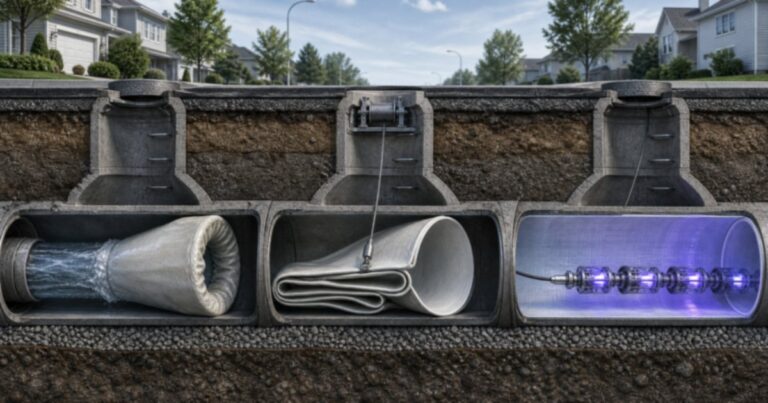
Choose the route by host conditions and cure control, not by habit. The everted route suits long, tight-bore runs; the pulled route, runs needing tighter on-site thickness control; the light route, fast, low-emission schedules. All three share a typical 150-300 m single-run band, so diameter and access decide first.
Choosing among CIPP installation methods is a specification decision, not a contractor preference. Cured-in-place pipe (CIPP) is the lining family covered here. All three routes install a resin-saturated tube and cure it in place to form a new pipe inside the host; what separates them is how the tube reaches the wall and how the resin is set. In short, inversion suits long, round, manhole-to-manhole drives, pull-in-place suits drives needing tighter on-site control of the finished wall, and UV light curing suits short closures and odor-sensitive sites. The comparison below runs on diameter, run length, cure window and footprint.
Which Installation Route Should You Specify?
Route selection among CIPP installation methods starts with four inputs, and the first that fails removes an option: host-pipe diameter, single-run length, the wall-thickness tolerance the design assumes, and how fast the line must return to service.
The everted route remains the default and is named in ASTM F1216. The pulled route, named in ASTM F1743, trades some of that familiarity for tighter on-site thickness control. A light route addressed in ASTM F2019 suits schedules that need lower styrene exposure.
Bottom line: match the route to the drive and the cure window first, then confirm it against the equipment and the named standards.
What Separates the Three Installation Routes?
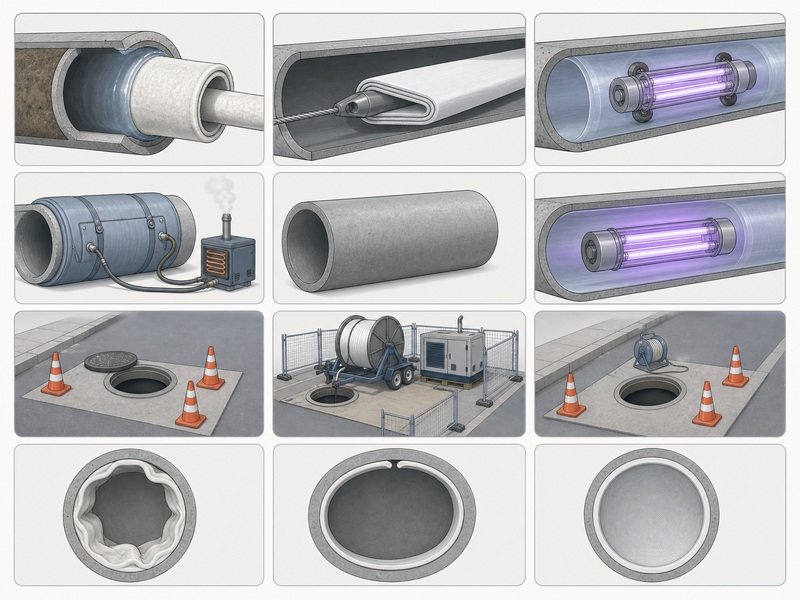
The three CIPP installation methods share a material and a goal, so the differences sit in placement and cure: how the tube reaches the wall, and how the resin sets.
- Placement: an everted tube is turned inside out against the wall under pressure; a pulled tube is dragged in and inflated; a light-cured liner is a pre-shaped glass tube drawn into position.
- Cure: hot water, steam, ambient or ultraviolet light, each with its own time, temperature control and emissions profile.
- Consequence: diameter ceiling, run length, thickness control and site emissions all follow.
Resin impregnation comes first: the tube is wet out to a defined weight per unit length, and that weight fixes the finished wall.
Inversion: How Does the Tube Reach the Wall and Cure?
Inversion places the liner by turning it inside out. A resin-impregnated tube is fastened at the manhole, and water or air pressure pushes the leading face down the pipe until the tube has everted along the whole run and lies against the wall.
The tube is then cured in place. This is the older of the three routes and the one described by ASTM F1216.
Cure is normally by circulated hot water, steam, or ambient for slower schedules; hot water and steam dominate because their temperature history is easy to log. Resin impregnation weight is logged so the finished wall can be checked against the design.
Where it fits. Long, roughly circular runs reached through existing manholes.
Where it struggles. It needs a controlled eversion pressure and a bore that passes the tube, so large diameters and tight bends cost more.
Watch-out. The wall is fixed once the tube is wetted out.

Pull-in-Place: How Is the Tube Positioned and Cured?
The pulled route drags the tube into the host pipe with a winch, then inflates it against the wall and holds it while it cures, avoiding the eversion step entirely. ASTM F1743 covers this practice.
Cure follows the same options as the everted route – hot water, steam or ambient. Inflation pressure holds the unrounded tube against the host while the resin sets, so the degree of rounding is an installation control rather than a by-product of eversion.
Resin impregnation weight fixes the nominal wall before the tube leaves the surface.
Where it fits. Runs needing a thinner, controlled wall and access for a winch set-up.
Where it struggles. Pulling friction rises with length and diameter, so very long large-diameter drives can exceed the safe pulling load.
Watch-out. The liner must be fully rounded before cure.

UV Light Curing: How Fast Can the Liner Set?
The light route pulls a glass-reinforced liner into the host pipe and cures it with an ultraviolet light train drawn through the tube. The liner reacts to ultraviolet light rather than heat; ASTM F2019 addresses UV-cured glass-reinforced liners, and the tube and resin are supplied as a matched system.
The headline effect is speed. Published descriptions put a light train curing at roughly one metre of liner per minute, against the one-to-four-hour window typical of steam and hot water.
The second effect is emissions. UV curing draws no cure water through the line, so it avoids much of the styrene that a hot-water cure can carry to the surface, and published commentary notes lower odor. Resin impregnation and cure are logged together.
Where it fits. Programme-critical drives, odor-sensitive sites and runs where a fast, repeatable cure window matters.
Where it struggles. A light train needs a clean, well-rounded tube and the right liner-arc configuration, and the method is most established in small-to-medium diameters.
Watch-out. An unrounded liner can be shadowed and left under-cured.
How Do Water, Steam and Light Cure Methods Compare?
Cure method decides how long the line is out of service and how much heat or light the liner sees. Water and steam apply heat soak and have the deeper track record; UV curing applies light and is the faster route.
The three CIPP installation methods differ most here in schedule, so the table below compares the cure options a specification must fix. All figures are typical public ranges.
| Cure method | Typical cure time | Control basis | Emissions profile |
|---|---|---|---|
| Hot water | About one to four hours | Temperature and soak time | Styrene carried in cure water |
| Steam | About one to four hours | Temperature and pressure | Vapor released at the manhole |
| Ambient | Longest of the three; set by site temperature | Temperature and duration | No cure water |
| Ultraviolet light | About one metre per minute of liner | Winch speed and light output | No cure water; lower emissions |
Bottom line: thermal cure is easier to measure, but light cure is easier to schedule into a short closure and carries less styrene to the surface.
What Diameter, Length and Thickness Can Each Route Handle?
Diameter, run length and wall thickness separate the three CIPP installation methods more than any other input, and each route’s practical ceiling comes from its equipment. The bands below are typical public ranges, not guaranteed limits.
| Route | Typical host diameter | Typical single run | How wall thickness is controlled |
|---|---|---|---|
| Everted tube | 50-2,750 mm (2-108 in.) | 150-300 m (500-1,000 ft) | Fixed at wet-out, not adjustable on site |
| Pulled tube | 100-2,440 mm (4-96 in.) | 150-300 m (500-1,000 ft), limited by pulling load | Set at wet-out, adjustable before inflation |
| Light-cured glass liner | 150-1,830 mm (6-72 in.), per equipment supply ranges | 150-300 m (500-1,000 ft), set by the light train | Set by the liner design and the light dose |
Thickness uniformity is the quality-control point that separates the routes most clearly. In an everted tube the wall is fixed once the tube is wet out.
A wrinkle forms where an everted tube bridges an ovality or an offset joint, and behind that wrinkle the liner is not against the host.
A pulled tube can be tensioned and inflated to work a wrinkle out before cure. A light-cured liner is pre-shaped and resists wrinkling, but a wrinkle that remains shadows the light and leaves that strip under-cured.
Bottom line: confirm the diameter band and the single-run length first, then choose the route whose thickness control matches the design tolerance.
The typical band for CIPP as a whole, 50 mm to 2,750 mm (2 in. to 108 in.), is wider than any single route covers. Where the wall reduces the bore, the trade-off is covered in the comparison of diameter loss and structural strength.
How Do Footprint and Traffic Impact Differ?
The CIPP installation methods differ in what they park at the access point. Eversion needs pressure equipment, a water or steam supply and a cure-water set-up. A pull needs a winch at the far end and an inflation supply. The light route needs only a train and a power source.
In our experience, the cure method, not the placement method, sets the clock. Our field crews plan bypass around the cure window rather than the placement step, using the same occupancy logic that decides a trenchless route against open-cut excavation.
How Do the Three Routes Compare Head to Head?
Seen together, the three CIPP installation methods differ on five criteria that matter to a specification. The table below sets them side by side; every figure is a typical public range.
| Criterion | Inversion | Pull-in-place | UV curing |
|---|---|---|---|
| Placement | Tube everted by water or air pressure | Tube winched in, then inflated | Light-cured liner pulled in, light train drawn through |
| Governing practice | ASTM F1216 | ASTM F1743 | ASTM F2019 |
| Cure options | Hot water, steam, ambient | Hot water, steam, ambient | Ultraviolet light |
| Main quality risk | A wrinkle where an everted tube bridges a joint | A wrinkle worked out before cure | A shadowed strip left under-cured |
| Site impact | Larger cure-water set-up | Winch set-up at both ends | Compact, fast turnaround |
A fourth option sits outside these routes: whether to line a whole run or only a defect is a question of scope, and the choice between sectional and full-length CIPP repair should be settled before a route is nominated.
Which Five Rules Should Guide Route Selection?
Five rules cover most route decisions for the CIPP installation methods covered here, checked in order so a route that fails early is removed before later rules apply.
- Check the diameter and the longest single drive against Table 2. A drive outside the route’s diameter band, or beyond a typical 150-300 m single run, removes that route before cost is discussed.
- Fix the thickness tolerance the design assumes. If the wall must be tightly controlled on site, a pre-inflation adjustment is easier to defend.
- Set the cure window from the traffic and bypass plan. Where the closure is shorter than the typical one-to-four-hour thermal cure, price the light route first.
- Confirm the styrene and odor constraints. On a sensitive surface, the emissions profile can decide the route before the schedule does.
- Match the route to the named standards. ASTM F1216, ASTM F1743 and ASTM F2019 each map to a route, so name that standard in the specification; an unnamed route invites a substitution.
The line is surveyed first: a trenchless assessment records the defects that pipeline rehabilitation must address.
Want a second opinion on the route before you tender? Share your pipe diameter, run length and survey, and a JSW engineer will confirm which of the three CIPP installation methods fits the drive.
Which Route Fits Your Project?
Across the three CIPP installation methods, the deciding difference is usually which route the drive can accept: the everted route fits long, round drives, the pulled route a tighter wall, and UV curing short closures where emissions matter.
In our relining work, the route is settled once the survey, the diameter and the cure window sit on one page.
JSW plans and delivers CIPP lining and the wider trenchless pipe rehabilitation scope with its own crews and equipment, so placement and cure are specified as one system. The comparison of trenchless rehabilitation methods sets the three routes against pipe bursting and slip lining.
Ready to fix the route for your drive? Send your diameter, run length and CCTV survey for a free method review. A JSW engineer replies with a recommended route, the matching cure method and a budget range.
Frequently Asked Questions About CIPP Installation Methods
Is the lowest-priced route always the cheapest over the programme?
Not always. The everted route avoids a winch set-up and a light train, so its equipment cost can look lower, but cure time and bypass duration carry their own cost.
When is pull-in-place the better route?
When the wall thickness has to be controlled on site. The pulled route lets the crew position the tube before inflation, so a folded liner can be rounded to the intended bore; the limit is pulling friction.
Does UV curing always cut the cure time?
For most drives, yes. A light train cures a glass-reinforced liner faster than heat soak and more repeatably, because the winch speed sets the light dose.
What does resin impregnation control?
It controls the finished wall. Wetting the tube evenly, with the right resin weight per unit length, fixes the wall thickness and the structural capacity of the liner.
What happens when a drive is too long to pull?
The route changes with the drive. Where pulling friction rules out a pull, an everted route or a shorter sub-run is considered; route selection starts from the drive geometry.
How is wrinkle and thickness acceptance checked?
By measurement, before acceptance. A wrinkle that survives cure leaves the liner off the host; on a light-cured liner it shadows the light and leaves that strip under-cured. Thickness is checked against the wet-out weight and the design wall.
Sources
- ASTM International – publisher of ASTM F1216, ASTM F1743 and ASTM F2019.
- NASSCO – Pipeline Assessment and Certification Program (PACP) and site emission guidance.
- WRc – UK water-sector research and trenchless rehabilitation guidance.







 English
 Arabic
 Russian
 Spanish
 French
 Vietnamese
 Polish
 Thai
 Indonesian
 Turkish
 Portuguese